Introduction
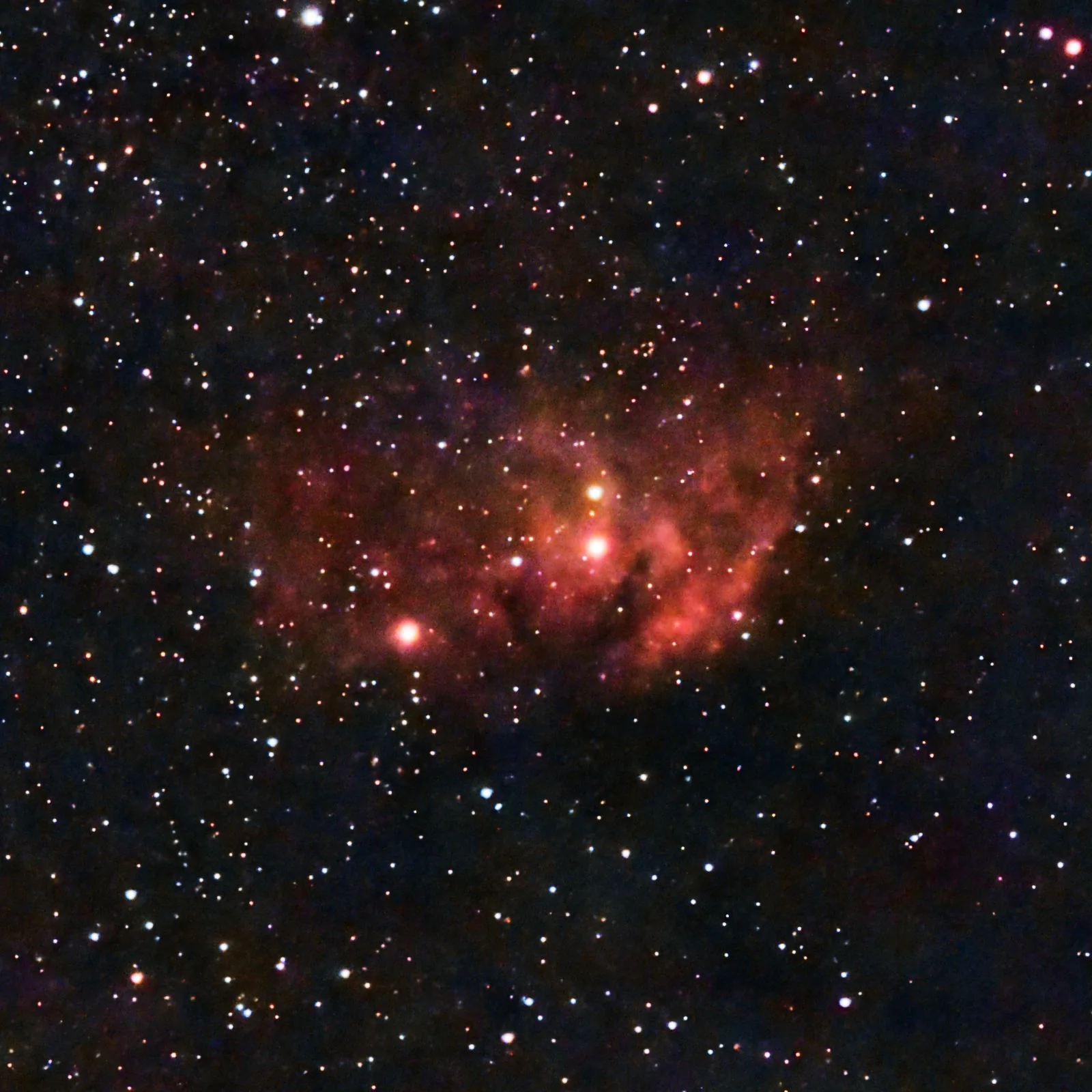
Sh2-101 — the Tulip Nebula — is a bright, irregular cloud of ionized hydrogen in Cygnus, popular with astrophotographers for the same reason it got its nickname: in a wide-field, narrowband image it genuinely looks like a bloom, with reddish “petals” wrapped around a bright center. That’s a fun coincidence of shape, not a hidden design, but it’s not the most interesting thing about this patch of sky.
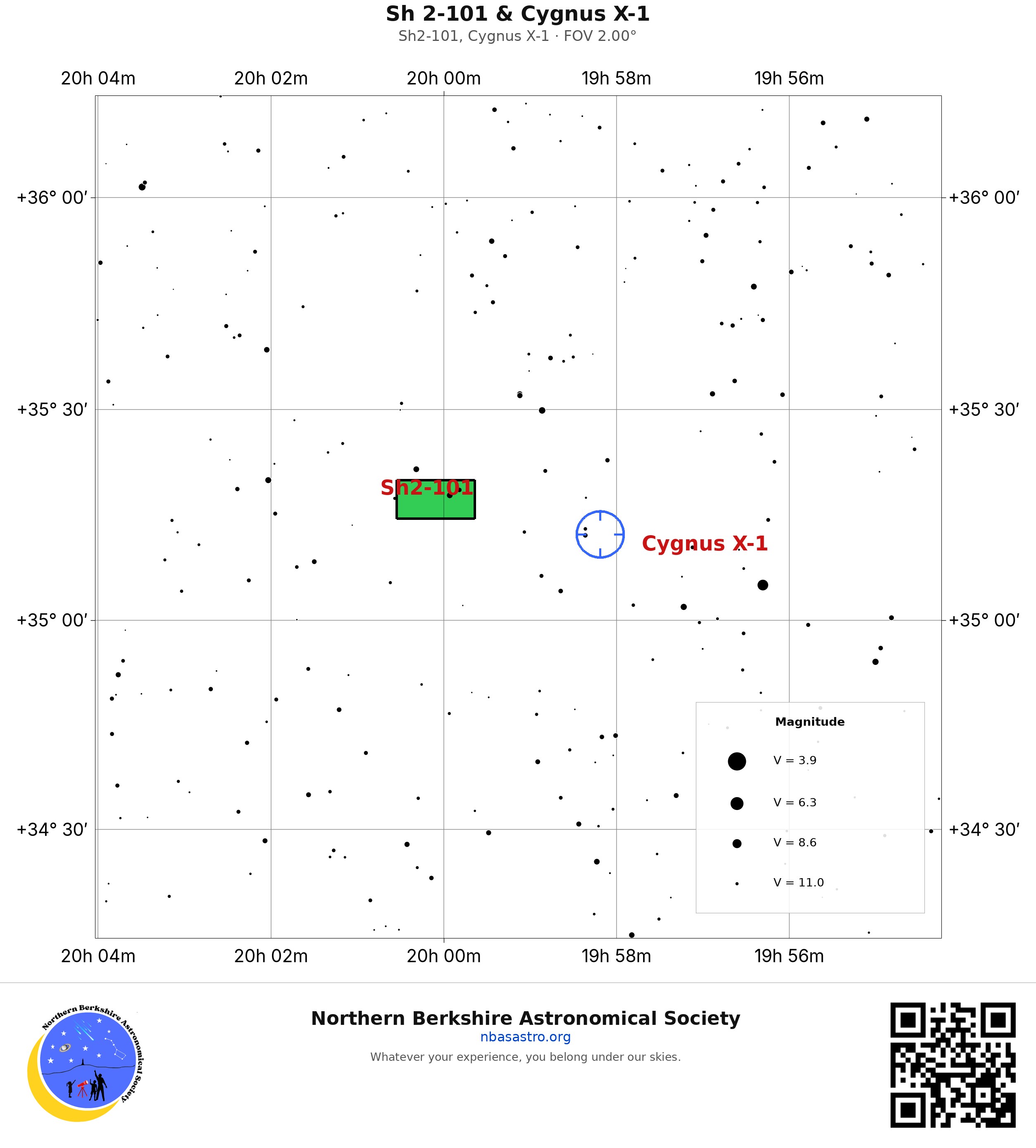
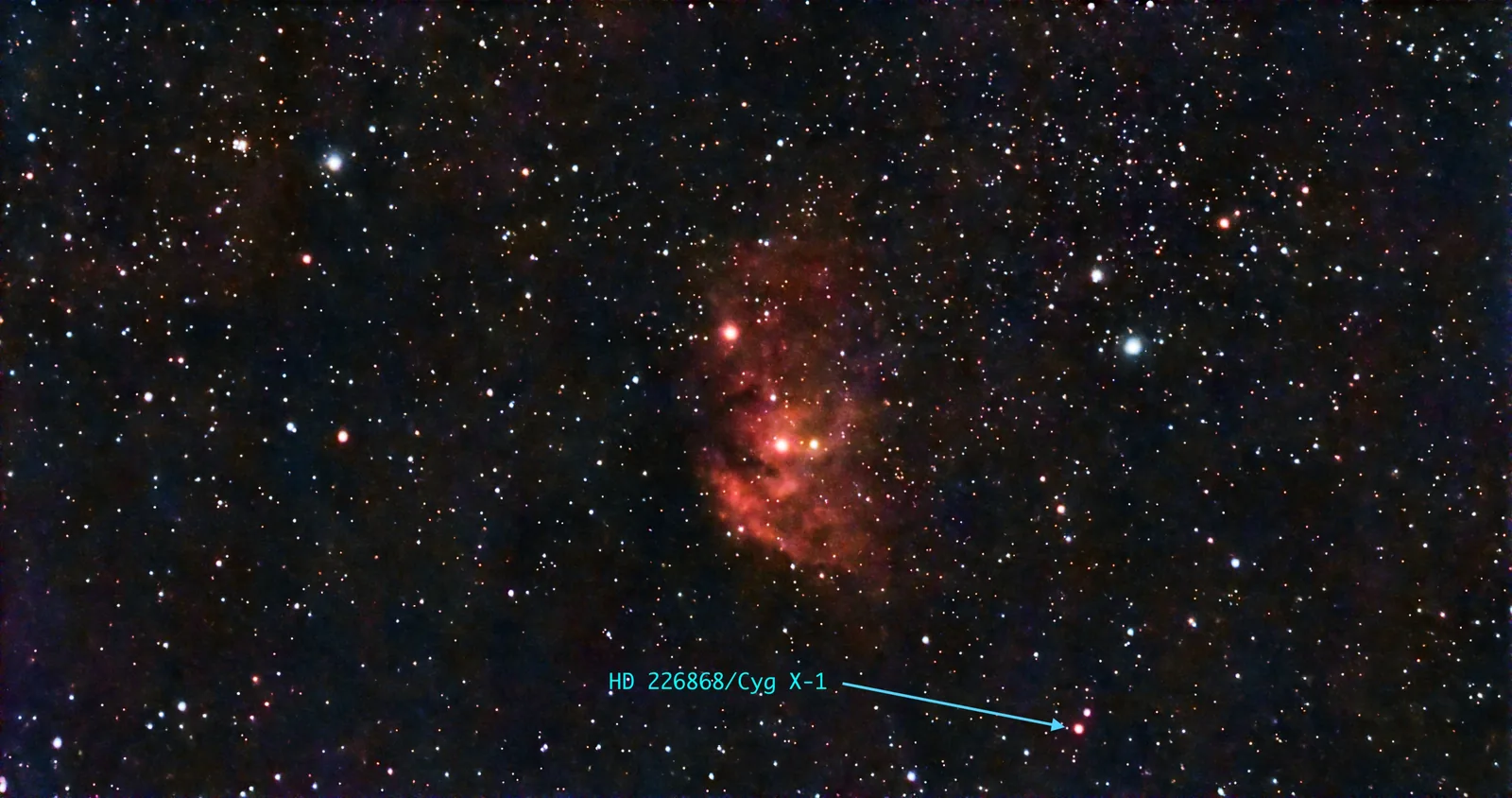
About 27 arcminutes — a little under half a degree — west-southwest of the nebula sits Cygnus X-1, one of the first objects ever proposed to be a black hole and still one of the best-studied. It has no visible glow of its own. But the ordinary-looking star that betrays its presence is bright enough to find with a small telescope, sitting in the very same frame as the nebula. If you’ve photographed the Tulip, there’s a decent chance you’ve already got Cygnus X-1’s companion star sitting quietly in a corner of your image without knowing it.
Discovery
Sh2-101 doesn’t have a discovery story in the way William Herschel’s catalog objects do — Herschel found those visually, at the eyepiece, and logged each one the night he saw it. This nebula never had that moment. It’s too faint and too spread out (magnitude 9 smeared across 16 by 9 arcminutes is a very low surface brightness) to announce itself to a human eye at a telescope. It only became visible once photography caught up to it.
Its earliest photographic record is Swedish astronomer Sven Cederblad’s 1946 catalog of bright diffuse galactic nebulae, where it’s listed as Cederblad 173 (Ced 173) — a designation still in use today. It surfaces again in 1959 in Stewart Sharpless’s catalog of H II regions, compiled from National Geographic–Palomar Sky Survey plates, as entry 101 of 313 — hence Sh2-101. Sharpless wasn’t finding anything new here; he was independently working through the same kind of photographic survey material Cederblad had already used thirteen years earlier, systematically cataloging emission nebulae that still hadn’t been formally listed. Neither catalog gave it a name, just a number. The “Tulip” nickname came later still, from people looking at processed astrophotographs and recognizing a shape in the glow. It’s a good reminder that a lot of what we now think of as “iconic” deep-sky objects only became iconic once imaging technology, and the community built around it, caught up to them — decades after they’d first been flagged on a photographic plate.
Cygnus X-1
The nebula’s neighbor has the opposite kind of history — dramatic almost from the start.
Cygnus X-1 was found in 1964, not by a telescope but by Geiger counters riding an Aerobee sounding rocket launched from White Sands, New Mexico, as part of an early survey of the X-ray sky. The position that survey returned was crude — good to a few degrees — and there was nothing unusual at that location in visible light. For years it was just a source on an X-ray map with no obvious identity.
That changed in 1971, when two independent radio astronomy teams (one in the Netherlands, one at the National Radio Astronomy Observatory in the U.S.) picked up a variable radio source at the X-ray position, precise enough to pin it to a single ninth-magnitude star: HDE 226868, a hot supergiant about half a degree from the more familiar 4th-magnitude star Eta Cygni. A supergiant alone can’t produce X-rays like this — something unseen had to be pulling material off it and heating that material to millions of degrees. In 1972, two independent groups (Louise Webster and Paul Murdin at the Royal Greenwich Observatory, and Tom Bolton at the University of Toronto) worked out the orbital motion from the star’s Doppler-shifted spectrum and found the hidden companion had to be several times more massive than the theoretical limit for a neutron star. That left one candidate: a black hole. By the end of 1973, most astronomers agreed.
Cygnus X-1 is famous enough to have its own footnote in pop-physics history — Stephen Hawking bet Kip Thorne in 1975 that it was not a black hole, explicitly as an insurance policy against a lifetime of his own research being wrong. He conceded in 1990 as the evidence became overwhelming.
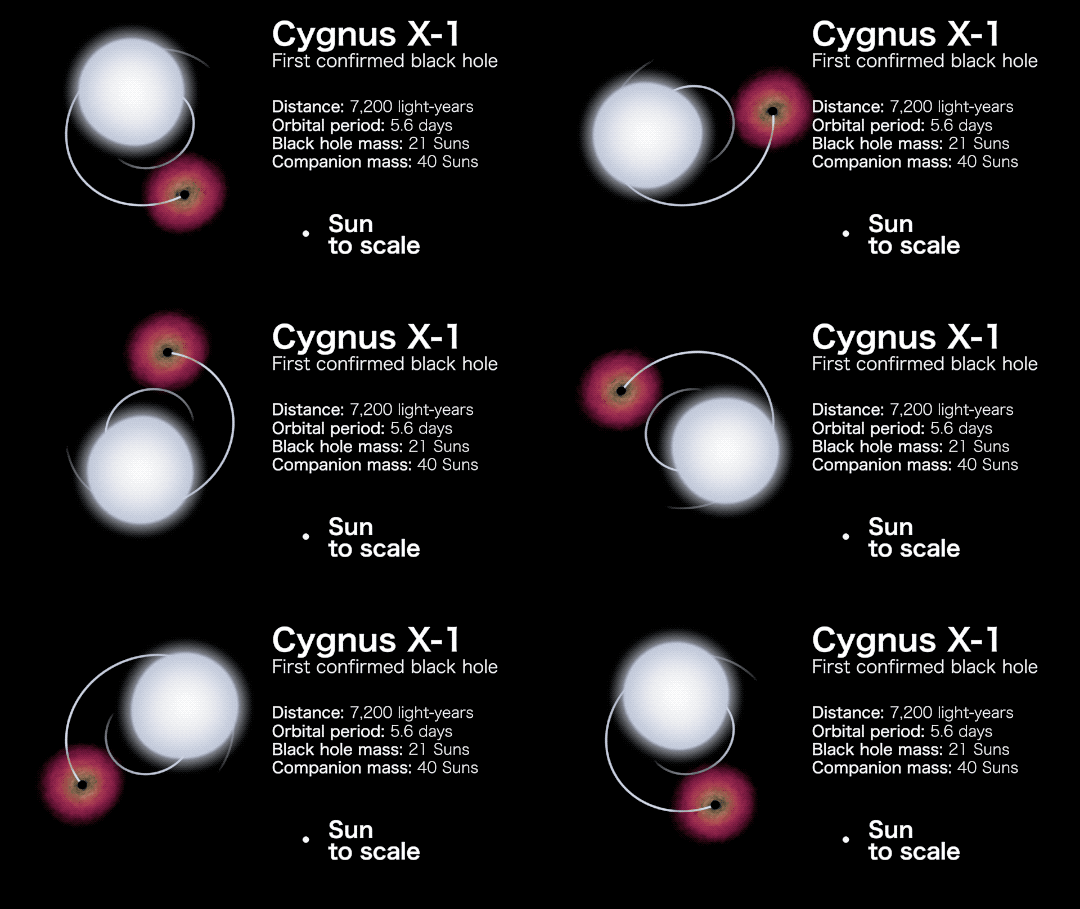
What’s actually there: a supergiant star and a compact object orbiting each other every 5.6 days, separated by only about a fifth of the Earth-Sun distance. The supergiant’s stellar wind feeds an accretion disk around the compact object; infalling gas is heated to the point that it radiates strongly in X-rays, making Cygnus X-1 one of the brightest persistent X-ray sources in the sky (though invisible to your eyes — you’d need an X-ray telescope in orbit to see any of this directly). A jet from the system slams into surrounding interstellar gas, lighting up a faint radio- and optically-visible bow shock — asymmetric, because the jet going the other direction runs into thinner gas and never gets to.
That bow shock is worth being precise about, since it’s easy to see it sitting near the Tulip in an image and assume the two are connected. They’re not confirmed to be. The shock is the black hole’s own jet plowing into whatever ordinary interstellar gas happens to lie in its path near the Cygnus X-1 system — it isn’t identified as material belonging to Sh2-101’s own ionized cloud. Photographs often show the shock front sitting just beyond the nebula’s outer glow, but that’s a projection: two objects appearing close together on the sky says nothing about whether they’re actually touching in three-dimensional space, and published distances to the two don’t fully agree (Sh2-101 is quoted anywhere from 6,000 to 8,000 light-years depending on the source; Cygnus X-1 at 7,000–7,300). The honest state of things is that no source establishes the bow shock as physically interacting with the Tulip Nebula’s gas — it’s its own structure, coincidentally framed next to the nebula.
The mass of the black hole itself is still being refined rather than settled. Estimates from different methods and different years have ranged from roughly 15 to 21 solar masses; a 2025 study put it as low as 13.8–17.5. That range isn’t a sign anything is wrong — it’s what active research on a real object looks like. The companion star, HDE 226868, is separately estimated at around 20–30 solar masses.
Sh2-101 and Cygnus X-1 are not physically connected — they’re unrelated objects that happen to share a sightline, and interestingly sit at broadly comparable distances in the general direction of the Cygnus spiral-arm structure. But there’s no evidence they formed together or interact in any way. It’s a coincidence of geometry, not physics — which is itself worth knowing, since it’s easy to assume two objects photographed together are related.
What You’re Looking At
The red glow is a classic H II region: hydrogen gas ionized by ultraviolet radiation from young, hot stars embedded in and around it, re-emitting that energy mostly as H-alpha light — the reason narrowband and modified-DSLR images pick it up so much more readily than the naked eye ever could. The main ionizing source is HDE 227018, an O6.5 giant near the nebula’s core and a member of the Cygnus OB3 association, which sits at the edge of this same complex. The dark intrusions cutting into the glow, visible especially in the tighter crop below, are not empty space; they’re foreground dust, cold and opaque, silhouetted against the brighter gas behind it — the same basic physics that makes Barnard’s dark nebulae dark.
The “tulip” shape itself is worth being honest about: it’s pareidolia, the same instinct that finds faces in clouds, applied to an irregular ionization front carved by stellar winds and radiation pressure. There’s no petal-like structure driving the gas — the resemblance is real and it’s a fine way to remember the object, but it isn’t a physical feature of the nebula any more than the Horsehead Nebula is an actual horse.
Finding and Observing It
Sh2-101 sits at RA 20h 00m 29s, Dec +35° 19′, in central Cygnus. Despite a catalog magnitude near 9, that light is spread thin across a 16 × 9 arcminute patch of sky, so it is a difficult visual target even in a fairly large amateur scope — it responds best to a narrowband filter (H-alpha or a UHC/OIII-type combination) or to a camera, where it comes up readily in exposures of a few minutes.
Once you’ve got the nebula framed, look about half a degree away for HDE 226868 (also catalogued as V1357 Cygni or SAO 69181), a ninth-magnitude blue-white supergiant sitting roughly half a degree from 4th-magnitude Eta Cygni. On its own it looks like an unremarkable star — because to your eyes, that’s exactly what it is. What makes it worth finding is what you can’t see: it’s locked in a five-and-a-half day orbit with a black hole roughly fifteen to twenty times the Sun’s mass, close enough that the black hole is stripping material directly off it. Locating that star with your own telescope is about as close as an amateur observer can get to putting a finger on a black hole.
You don’t need a narrowband rig to start on this one. A smart telescope, or a plain DSLR/mirrorless camera with a basic light-pollution filter, will pull real color and structure out of the Tulip after a few minutes of stacked exposure — low surface brightness like this is exactly the problem stacking is good at solving. It won’t look like the deep narrowband portraits most people associate with this object, but it’s the same real nebula, and it’s a legitimate place to start rather than a consolation prize.
One color note if you’re imaging this in narrowband: a dual-band light-pollution filter passing only H-alpha and OIII (the kind commonly used for exactly this target) doesn’t record true stellar color at all. Every star’s hue in that kind of image just reflects however much continuum light leaked through those two narrow lines, remapped by whatever color palette you processed with afterward — and Ha transmission usually wins out, which is why most stars in an Ha/OIII frame trend orange-red regardless of their real spectral type. So if HDE 226868 looks reddish in your image, that’s the filter, not the star. That said, the star does have a real, independently measured color problem of its own: its catalogued B−V index is +0.81, far redder than the roughly −0.3 expected for an O9.7 supergiant. That gap — about 1.1 magnitudes — is genuine interstellar reddening, dust along the ~7,000-light-year line of sight through the Cygnus star-forming region scattering away much of the star’s blue light before it reaches any telescope. The star itself is still a blazing-hot, intrinsically blue-white supergiant; both your filter and the actual dust between here and there are conspiring to hide that from any picture.