
Introduction
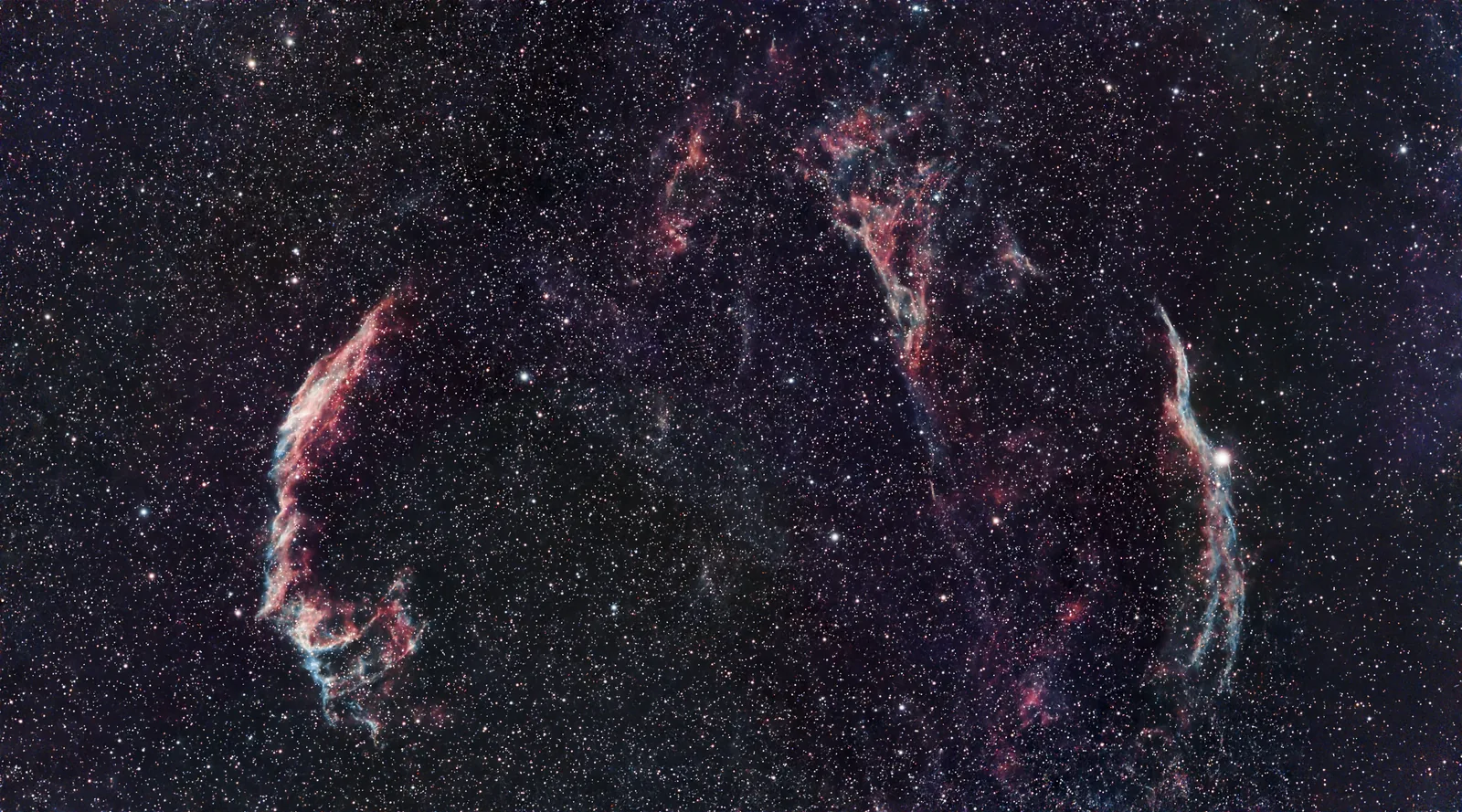
Most of the deep-sky objects worth chasing in summer are star clusters, or the soft glow of a nebula where stars are being born or quietly shedding their outer layers late in an ordinary life. The Veil Nebula is neither. It’s the wreckage of a single violent event – a massive star’s core-collapse supernova – with the blast wave still crashing through the surrounding gas more than twenty thousand years later. Sitting on the eastern “wing” of the Swan, it’s also enormous: roughly 3° across, six times the width of the full Moon, easily the largest target of the summer season.
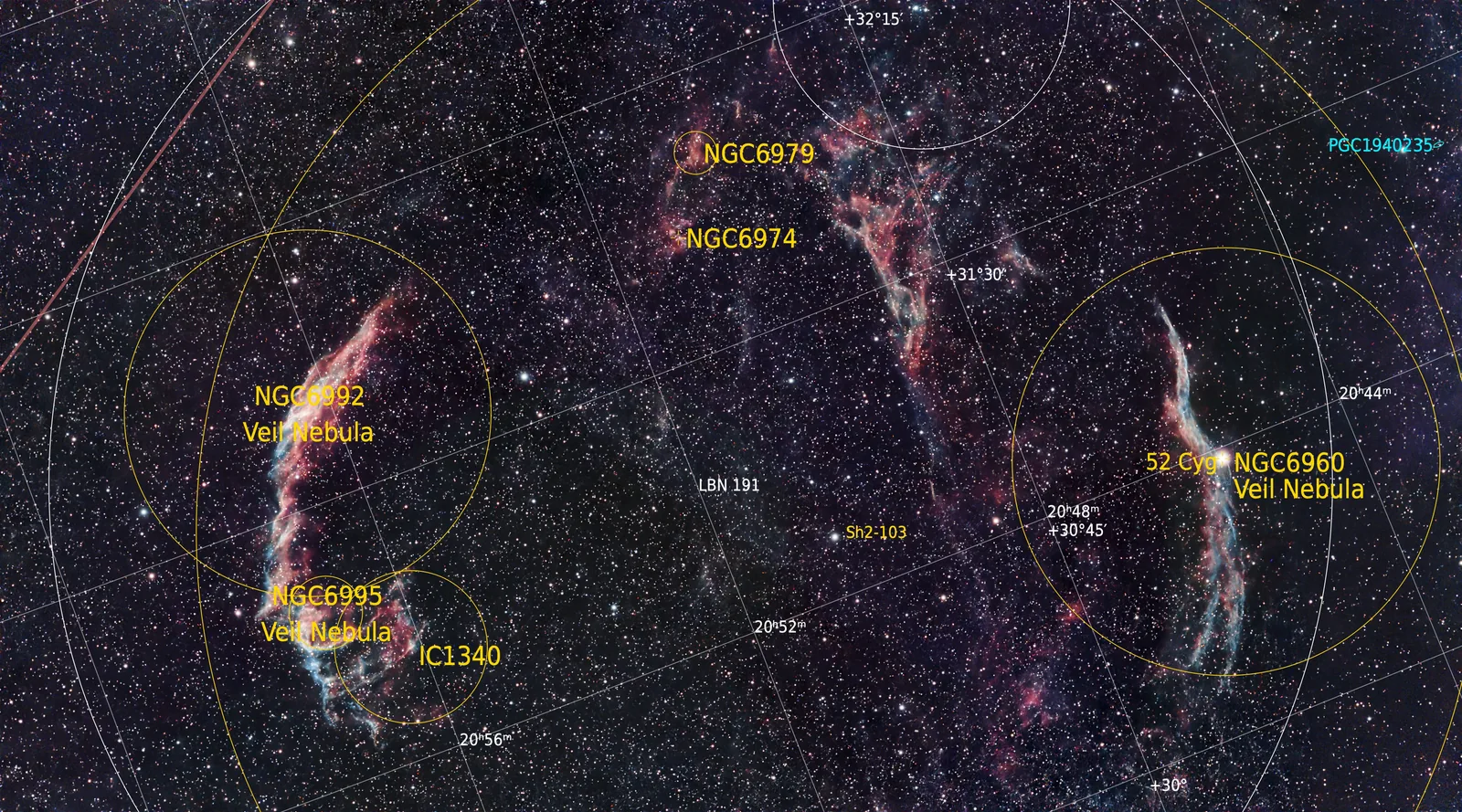
Everything you can see of it is a single object, or more precisely a single event, even though it carries half a dozen different catalog numbers. On one side, the naked-eye star 52 Cygni marks the Western Veil (NGC 6960, Caldwell 34); almost directly across the loop, the Eastern Veil (NGC 6992, NGC 6995, and IC 1340, together Caldwell 33) forms the brightest, most photographed arc. Between them, fainter and harder to see, the northern arc (NGC 6974 and NGC 6979) and Pickering’s Triangle bridge the gap. All of it is the same expanding shell, seen in pieces only because of how – and when – each piece happened to get its name.
Discovery

William Herschel found the complex in early September 1784, sweeping it up with his 18-inch reflector from England. He logged the separate arcs as separate objects each time he crossed one, with no way to know at the time that they were fragments of the same shell. It wasn’t until Johann Dreyer folded Herschel’s observations into the 1888 New General Catalogue that the pieces got their now-familiar individual numbers: NGC 6960 (the Western Veil), NGC 6992 and NGC 6995 with IC 1340 (together, the Eastern Veil), and the fainter northern clumps NGC 6974 and NGC 6979. None of those numbers describe a discovery in the sense of “someone found this” – they describe a cataloguer sorting one continuous shell into several drawers.

The one genuinely separate discovery inside the complex is Pickering’s Triangle: a faint, roughly wedge-shaped patch of nebulosity in the middle of the loop, found photographically in 1904 by Williamina Fleming at Harvard College Observatory. Fleming was one of the “Harvard Computers,” the group of women employed to analyze photographic plates at a fraction of what male astronomers were paid; per the convention of the era, the discovery was credited to the observatory’s director, Edward Pickering, and the name stuck. Pickering’s Triangle still has no NGC number of its own – NGC 6979 is occasionally used for it, but that number actually belongs to a separate knot Herschel logged eighty years earlier. The reason is simple chronology, not any flaw in how the Triangle was found: Dreyer’s catalogue went to print in 1888, and Fleming’s plate wasn’t exposed until 1904. The Triangle was discovered sixteen years too late to have ever been eligible for a number in the first place.
One Explosion, Two Colors
Here’s the part worth being precise about, because “supernova remnant” undersells how strange this object actually is. Somewhere around 21,000 years ago, a star roughly 20 times the Sun’s mass exploded. At its peak, it would have blazed to around apparent magnitude -9 – brighter than Venus, plainly visible in broad daylight – before fading over the following months. Nobody recorded it; the nearest datable human activity from that era is cave art, not sky charts. What we’re looking at now isn’t the star, and it isn’t even the material the star threw off. It’s ionized gas and dust from the surrounding interstellar medium, swept up and lit by the blast wave, still expanding outward at hundreds of kilometers per second, colliding with whatever gas happens to be in its way, and heating that gas hot enough to glow. The nebula is the collision, not the corpse.
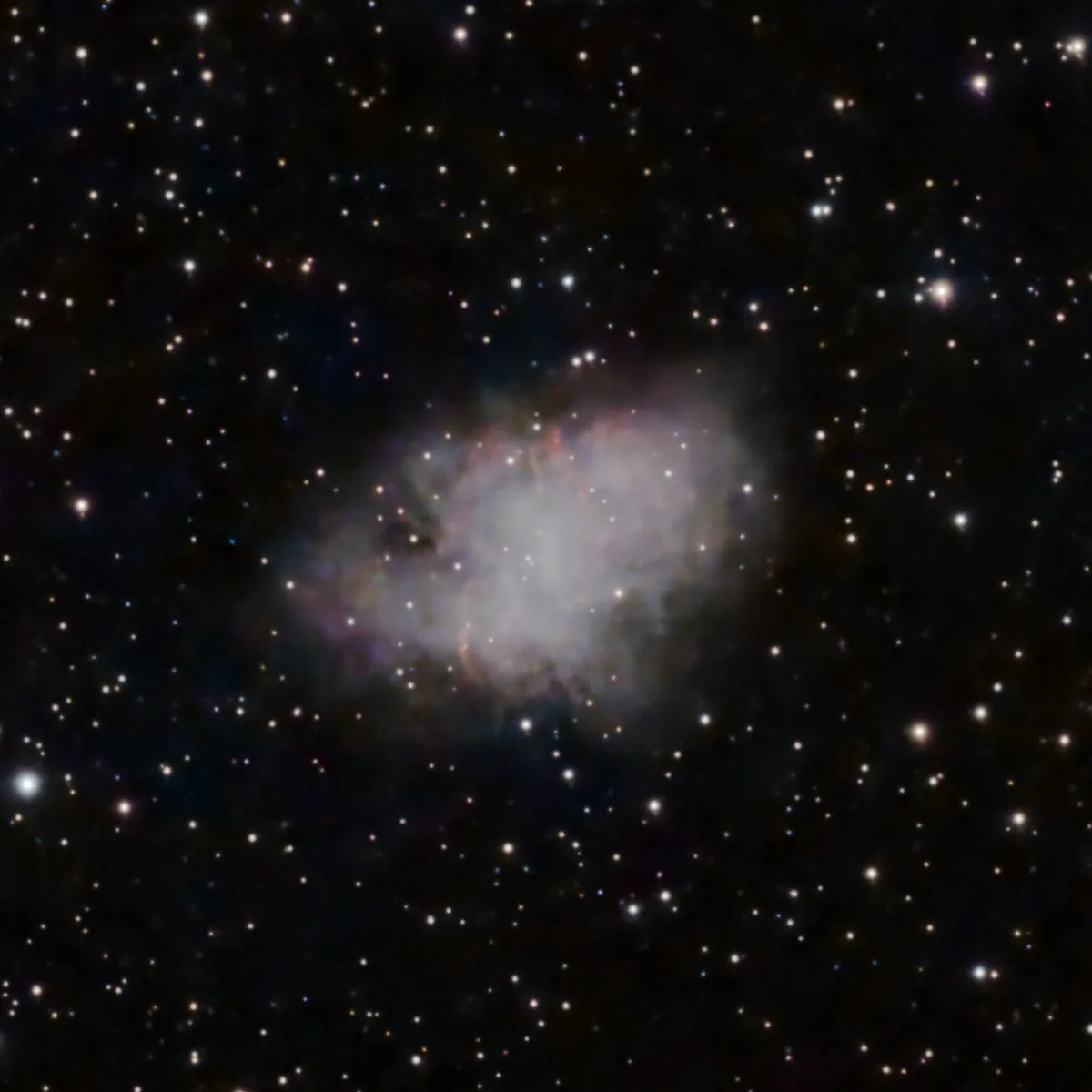
That’s a genuinely different thing from what’s glowing in some other famous supernova remnants. The Crab Nebula (M1) is a plerion: it’s still lit from the inside by an actively spinning neutron star, a pulsar, that keeps flinging out particles and powering the glow directly. The Veil has no such engine. Despite real searching, no neutron star has ever been conclusively identified at its center. Whatever compact remnant the original star left behind – if it survived at all – isn’t contributing to what you see. Every photon reaching your eyepiece or your sensor is shock-heated interstellar gas, radiating because a 21,000-year-old blast wave hit it, not because anything is still actively powering it from within.
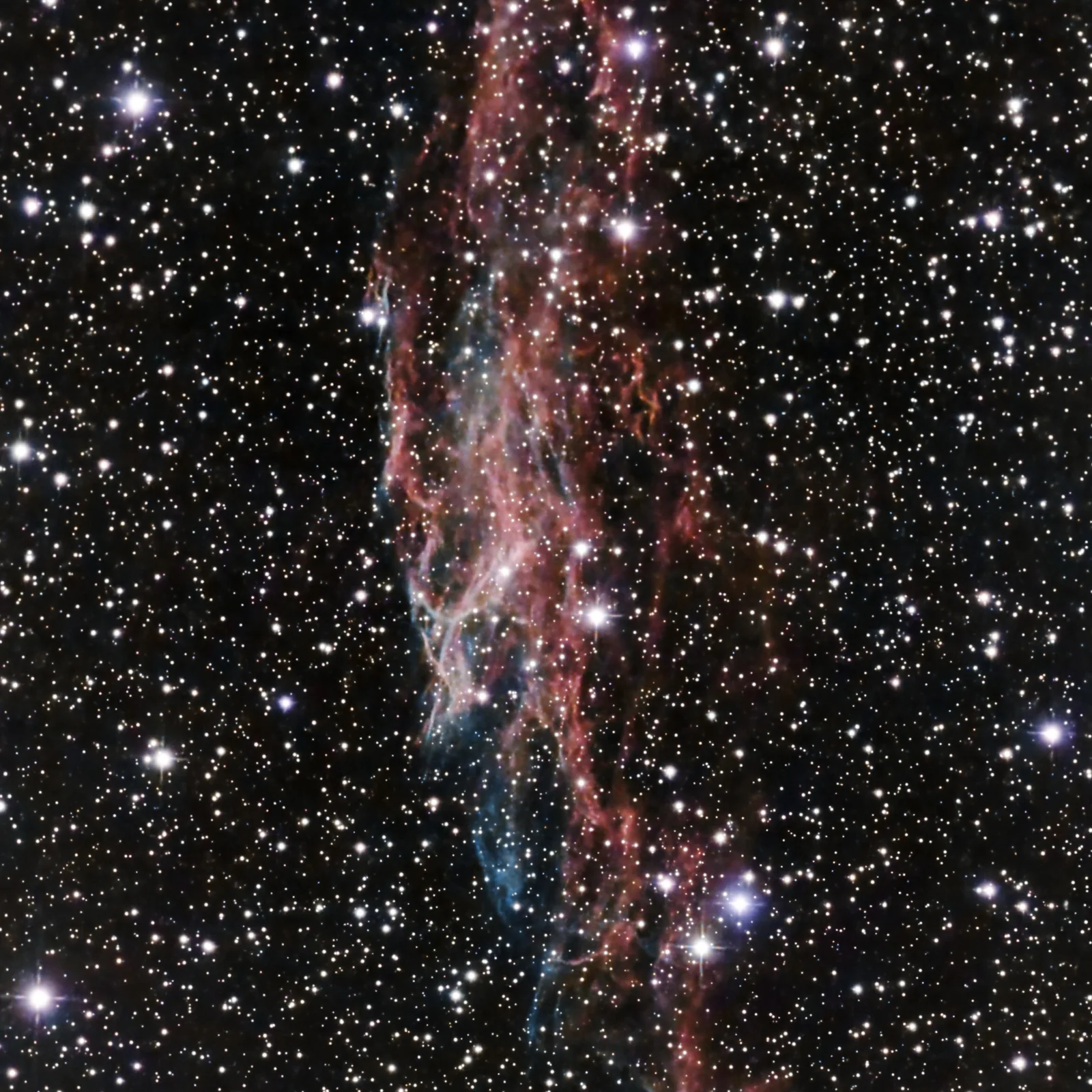
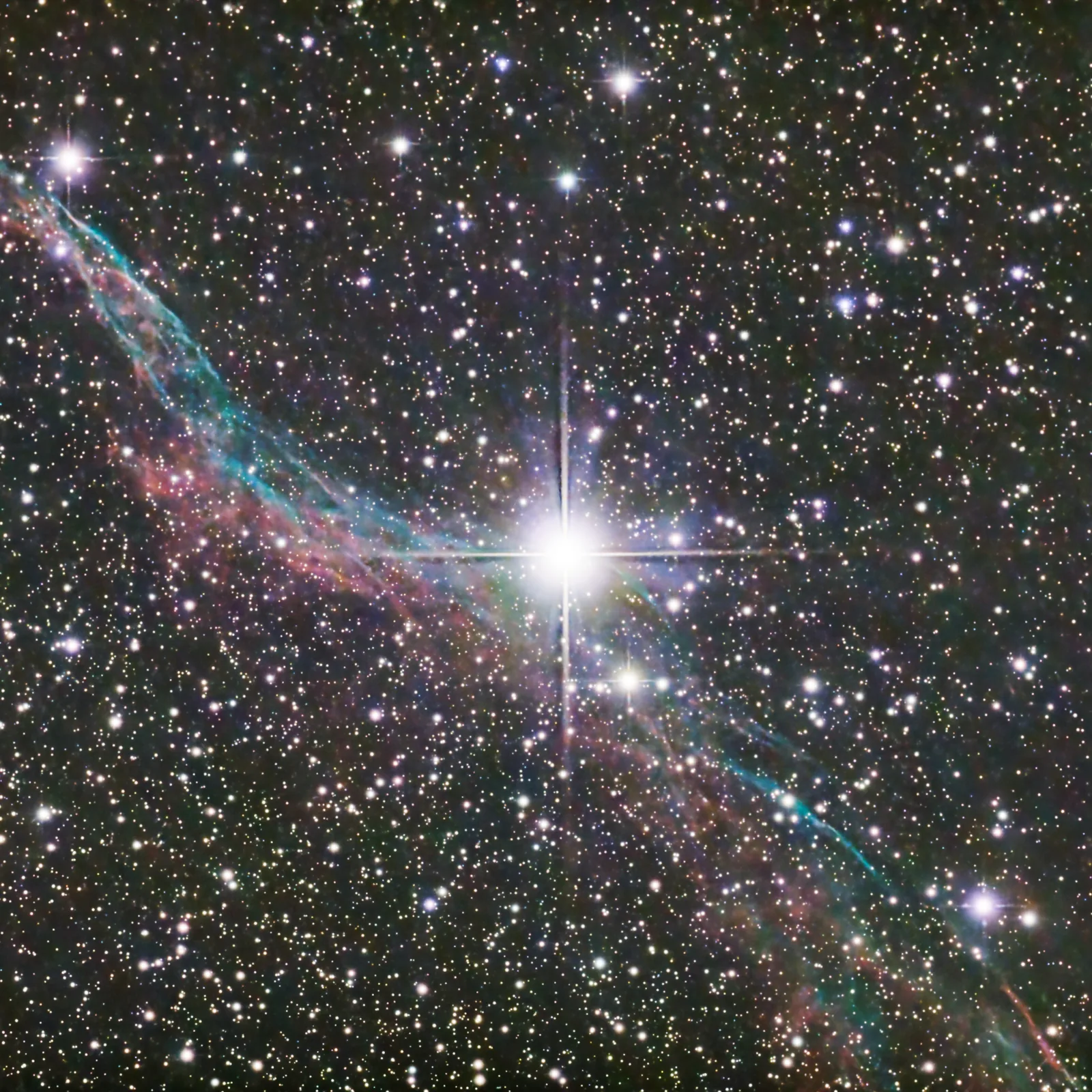
That mechanism is also the answer to why parts of the Veil are red and parts are blue-green. It isn’t decoration – it’s a temperature map of the shock front, frozen mid-collision. The leading edge of the blast wave, where the shock is freshest and hottest, strips electrons hard enough to doubly ionize oxygen, which glows blue-green. Hydrogen swept up slightly earlier has had time to cool and recombine, and glows red. Where narrowband imagers add sulfur to the palette, that’s a third, slower stage of the same cooling process. Sharp, crisp, blue-white filaments are the shock happening right now, edge-on to your view; the softer red wisps are the same shock’s afterglow.
The threadlike look is real structure, not a photographic effect. Each filament is a genuinely thin sheet – current measurements put the shock layer at only about 40 AU thick, roughly the distance from the Sun out to Pluto – and it only reads as a bright line because we’re seeing that thin sheet edge-on, like looking along the edge of a piece of paper. Turn the same shock to face us instead, and it spreads its light across a much wider patch of sky and fades into the kind of soft haze you see in Pickering’s Triangle.
That same physics explains why the complex doesn’t look uniform – and it’s worth seeing what that looks like modeled directly. The image below simulates one isolated cloud of interstellar gas caught in the path of a supernova blast wave: color shows density, red lines trace the flow of shocked plasma through and around the cloud. That’s the Veil’s non-uniformity in miniature. Multiply this single encounter across a shell 130 light-years wide, meeting clouds of wildly different density and being struck at every possible angle, and you get exactly the patchwork the Veil actually shows: Pickering’s Triangle fainter and hazier than the two main arcs, for two compounding reasons – it’s a patch of shock front we’re viewing more face-on than edge-on, which spreads its light across more sky instead of concentrating it along a thin, bright edge, and it’s likely pushing through somewhat less dense interstellar gas, which produces a broader, dimmer glow instead of a crisp collision front. The whole Veil is one shockwave meeting an uneven bath of gas – dense in some places, sparse in others, closer to face-on here and edge-on there – and the varied structure you see across the complex is that unevenness, made visible.
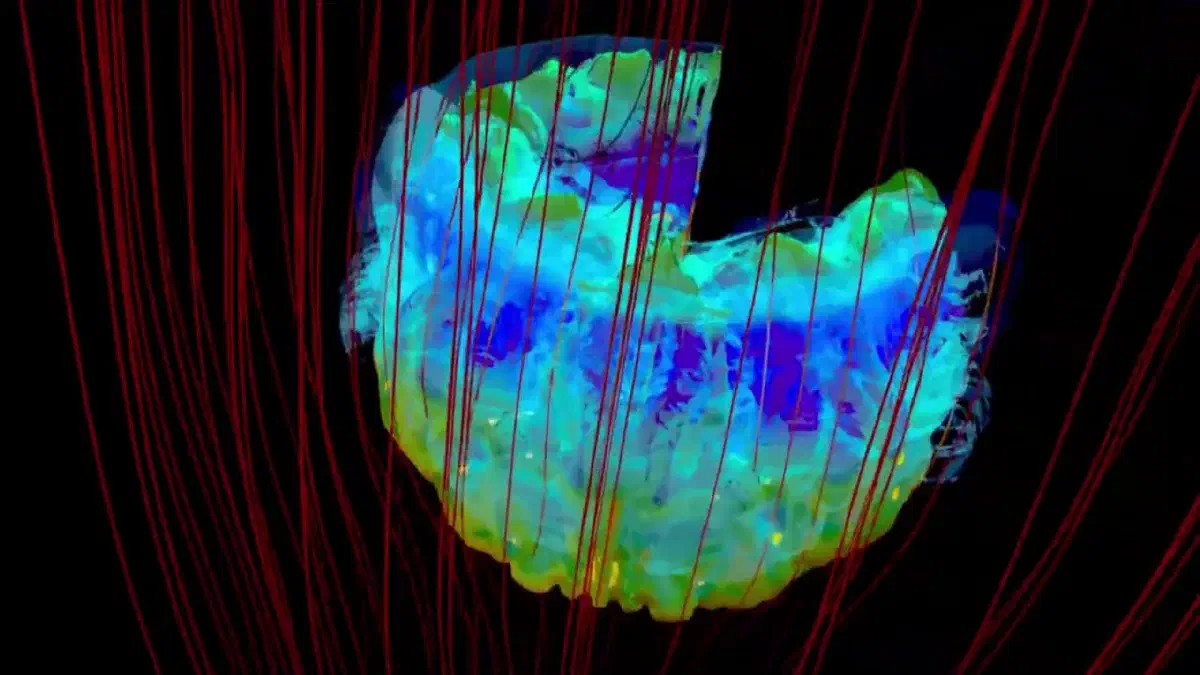
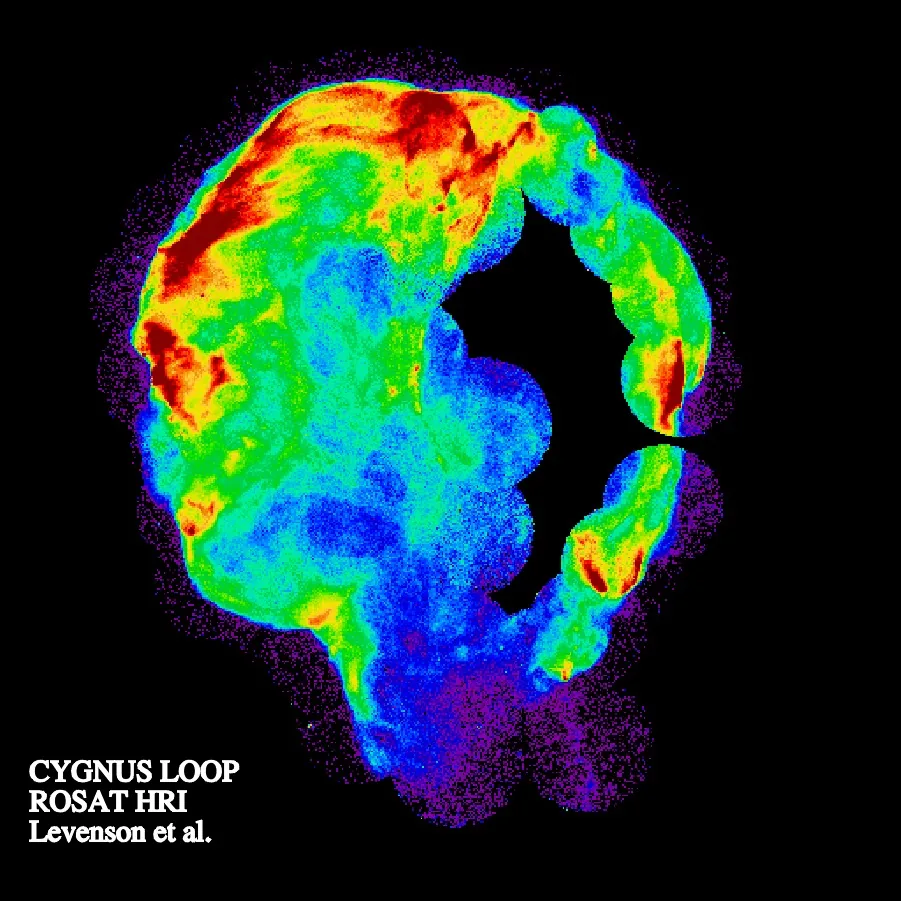
It also explains something the annotated image above doesn’t show: there’s no bright southern arc to match the Western and Eastern Veil. X-ray images of the full Cygnus Loop reveal why – the shell is close to a complete sphere, except for a wide “blowout” toward the south, where the blast wave ran into a stretch of space with almost nothing in it. No interstellar gas to strike means no compression, no heating, and no glow. The explosion didn’t skip that side. It just isn’t hitting anything bright enough to see.
How Old, How Far
Age and distance for the Veil have both moved around in the literature, and it’s worth presenting honestly as a range rather than a single overconfident number. Ages as young as 10,000 years and as old as 20,000 have both been published; the most careful recent work, a 2018 study (Fesen et al.) measuring the proper motion and expansion of the shell directly, puts it at roughly 21,000 years, with the remnant now about 18 parsecs across. Distance settled more recently and more precisely: Gaia’s EDR3 parallax data, published in 2021, pins it at 725 ± 15 parsecs – about 2,360 light-years, tighter than the 1,400-2,400 light-year range earlier estimates had scattered across.
Follow-up work since then has measured the shock itself directly, comparing images of individual filaments taken decades apart to clock their outward motion: speeds across the surveyed filaments range from about 240 to 650 kilometers per second, depending on which part of the shell and which patch of interstellar gas it’s currently plowing through – the same unevenness that shapes the nebula’s structure also shows up directly in how fast different parts of it are still moving.
Finding and Observing the Veil
None of that changes the observing reality, though: I expected the Veil to be hard. Everything about its reputation – a famous, oft-photographed supernova remnant, spread across nearly six full Moons of sky, individually faint enough that most of it was found photographically rather than by eye – suggested a target that would take a big scope, a dark site, and a fair amount of patience to actually see. Instead, from a Bortle 4.5 site with a 12-inch reflector, it was obvious. Unmistakable, even. The gap between that reputation and that experience turns out to be the whole story: what you need to see the Veil well isn’t really aperture. It’s a filter, or a stacked exposure – either one cuts straight through the faintness that makes this object sound harder than it is.
52 Cygni is the easiest way in: a naked-eye star, magnitude 4.2, that Herschel himself used to log the position of the Western Veil (“passes thro’ 52 Cygni… near 2 degrees in length,” in his own words), and it still works as a signpost today – NGC 6960 runs right through it. You’ve already seen it, in fact: it’s the bright star a few images back, in the shot showing the blue-to-red color transition.
Whether the Veil is easy or hard depends almost entirely on how you’re looking at it, and it’s worth being honest about that split rather than promising one experience that only applies to some of your readers. Visually, without a filter, it’s genuinely faint and easy to overlook, especially under any real light pollution – this is where the “difficult” reputation comes from, and it’s not wrong for that specific case. Add an OIII or UHC narrowband filter, though, and it transforms: those filters isolate almost exactly the wavelengths the shock front is emitting, cutting out most of the sky background while passing the nebula nearly untouched. An 8-inch scope with a filter, under a reasonably dark sky, shows it clearly; that’s the setup behind most “surprisingly easy” reports, including this one.
Smart scopes get there by a completely different route – not a filter cutting out unwanted light in real time, but a stacked exposure building up faint signal over many minutes, the same principle that let Fleming find Pickering’s Triangle on a photographic plate in 1904. Either path – narrowband-filtered eyepiece or stacked sensor – cuts through the faintness that trips up casual, unfiltered, naked-eyepiece viewing.
It’s worth knowing how rare an object like this is. Supernova remnants are one of the toughest classes of deep-sky object for a visual observer, and realistically only one other is in the same league as the Veil: M1, the Crab Nebula, over in Taurus. It’s smaller and doesn’t need a filter – its light is concentrated instead of spread across three degrees of sky – so it shows up in scopes as small as 4-6 inches. Past those two, the difficulty jumps sharply: IC 443, the Jellyfish Nebula in Gemini, wants a 12-inch scope, a dark sky, and a filter, and even then it’s a real challenge; Simeis 147, the Spaghetti Nebula, is close to a photograph-only object, with plenty of experienced observers who’ve never managed to see it visually at all.
Other Supernova Remnants
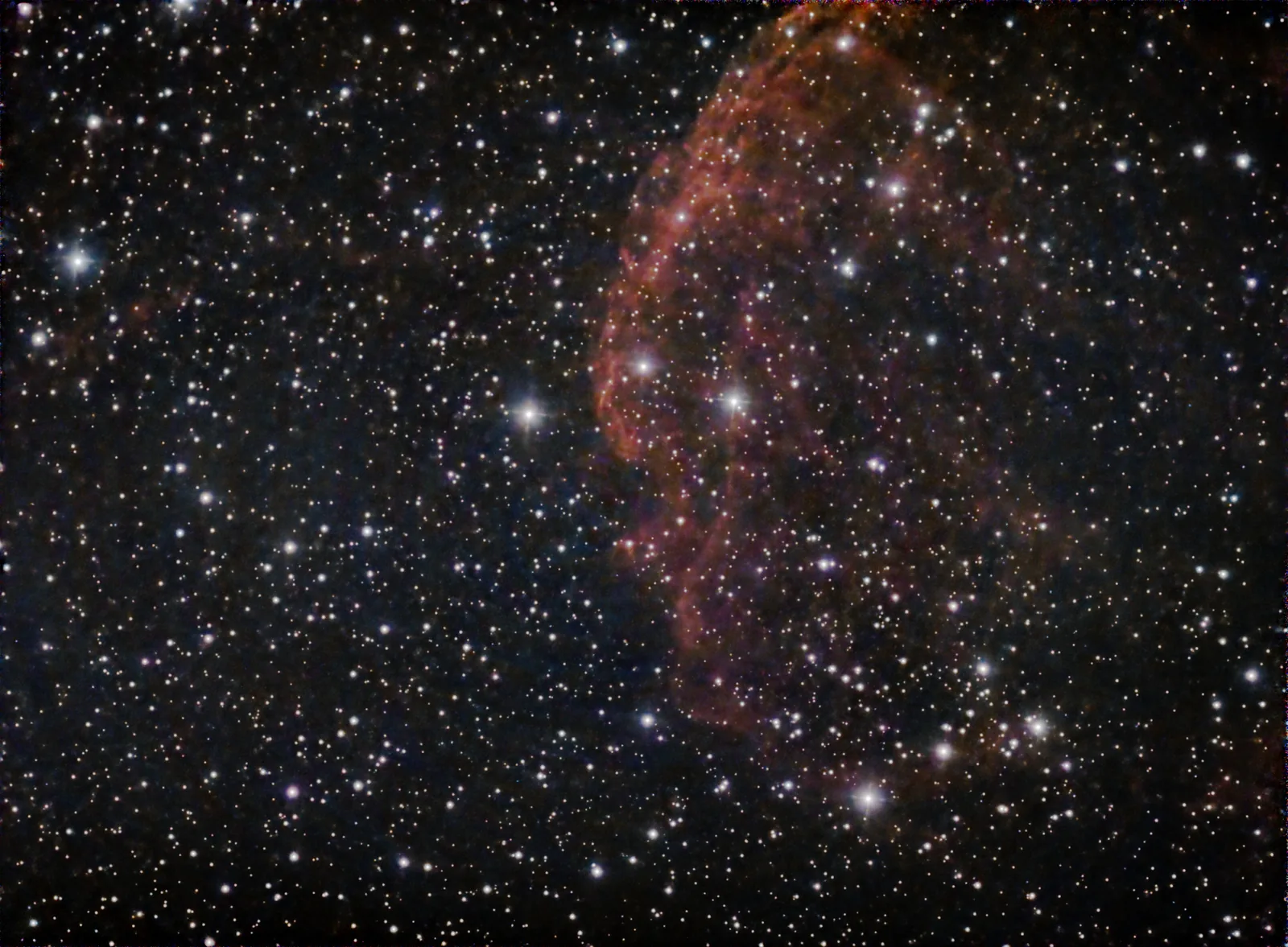
One more honest note, since the color story above is worth pairing with what you’ll actually see: visually, even through a filter, the Veil reads as ghostly gray-white wisps. The human eye doesn’t collect enough light at these brightness levels to perceive color, no matter how vivid the red and blue-green structure looks in a photograph. The color is real – it’s not processing trickery – but it’s a photographic reality, not a visual one. What the eyepiece gives you is structure and motion of the eye across faint filaments in real time; what a camera gives you, after enough stacked exposures, is the actual temperature map of a 21,000-year-old collision, painted in color the eye was never built to catch. Both are worth having.