Introduction
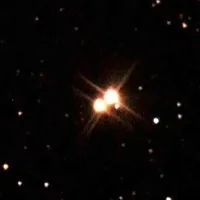
None of that is visible at the eyepiece. What you’ll see tonight is a faint orange dot with a fainter companion nearby. Everything interesting about 61 Cygni is in what we know about it, not in what it looks like — so that’s where this article spends its time.
The First Stellar Distance Ever Measured
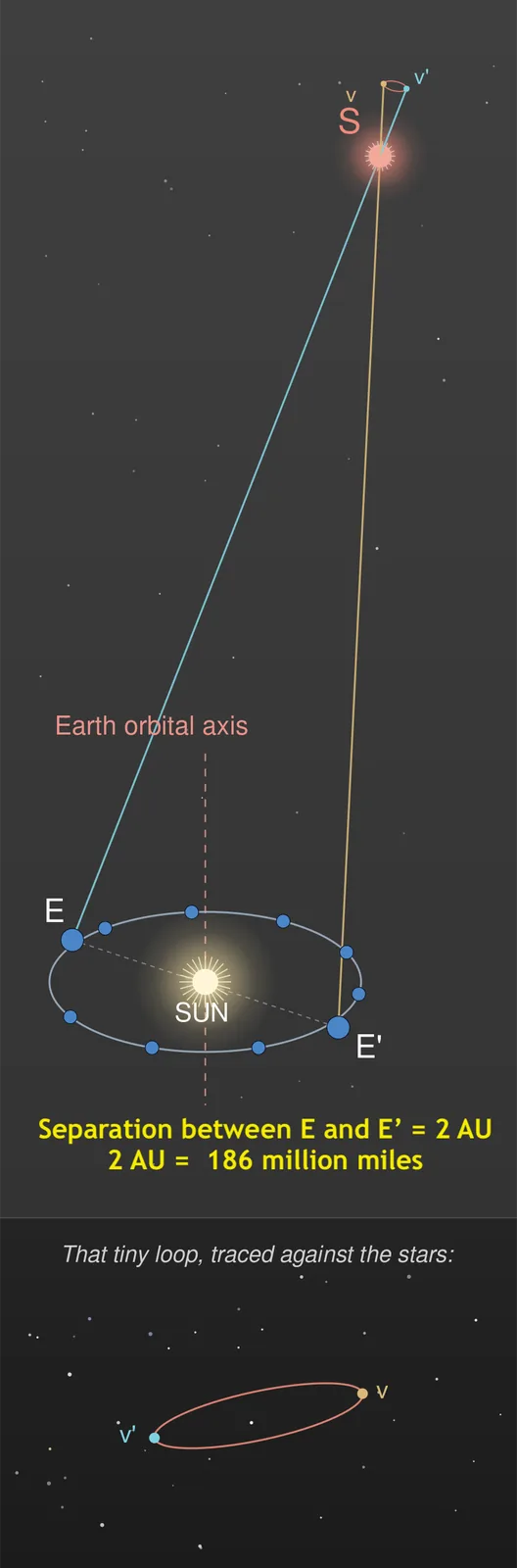
Parallax is the oldest trick in the distance-measuring book, and it’s built entirely out of geometry you already understand. Hold a finger up at arm’s length and close one eye, then the other — the finger appears to jump against the background. Do the same thing with a star, using the two ends of Earth’s orbit as your “eyes,” six months apart, and a nearby star will appear to shift very slightly against the distant background stars behind it. Measure that shift in arcseconds, take its reciprocal, and you have the star’s distance in parsecs. It’s a beautifully simple idea. Making it work on an actual star, with an actual 1830s telescope, turned out to be brutally difficult.
A parade of astronomers tried and came up short. François Arago and Claude-Louis Mathieu measured 500 milliarcseconds in 1812. Christian Peters reworked their data and got 550 mas. Peters tried again with Bernhard von Lindenau’s observations from Seeburg and got 470 ± 510 mas — an uncertainty larger than the number itself, which von Lindenau took as evidence he’d seen no parallax at all. Friedrich Georg Wilhelm von Struve ran his own series between 1818 and 1821 and concluded, bluntly, that every one of these values was more precise than the instruments used to get them. Even Friedrich Bessel took a swing in 1812, estimating 460 mas indirectly by assuming a 400-year orbital period for the pair and working backward from their angular separation. None of it held up.

1784-1846
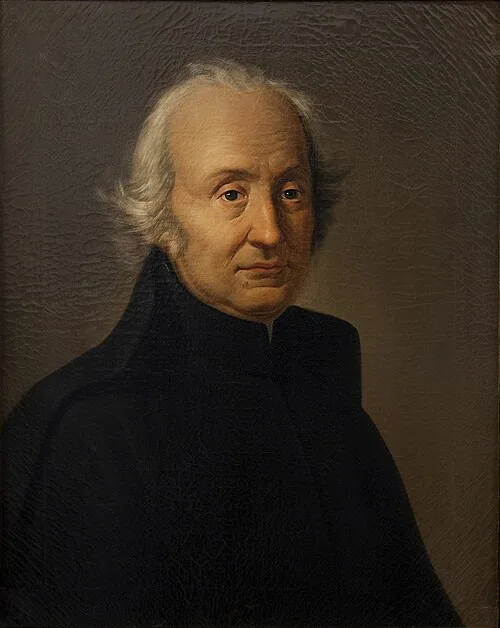
The breakthrough came when Joseph von Fraunhofer built a new kind of instrument, the heliometer, and Bessel got his hands on one at Königsberg. Between 1837 and 1838 he ran a careful series of measurements and arrived at a parallax of 313.6 ± 20.2 milliarcseconds — a distance of about 657,000 astronomical units, or roughly 10.4 light-years. He announced it in the autumn of 1838. Struve had already published a tentative parallax of Vega the year before, and Thomas Henderson announced Alpha Centauri’s about two months after Bessel. But Bessel’s was the result that convinced, and it’s remembered as the first reliable distance to any star besides the Sun. (In 1840 he revised it to 348.3 mas — further from the truth than his first number.)
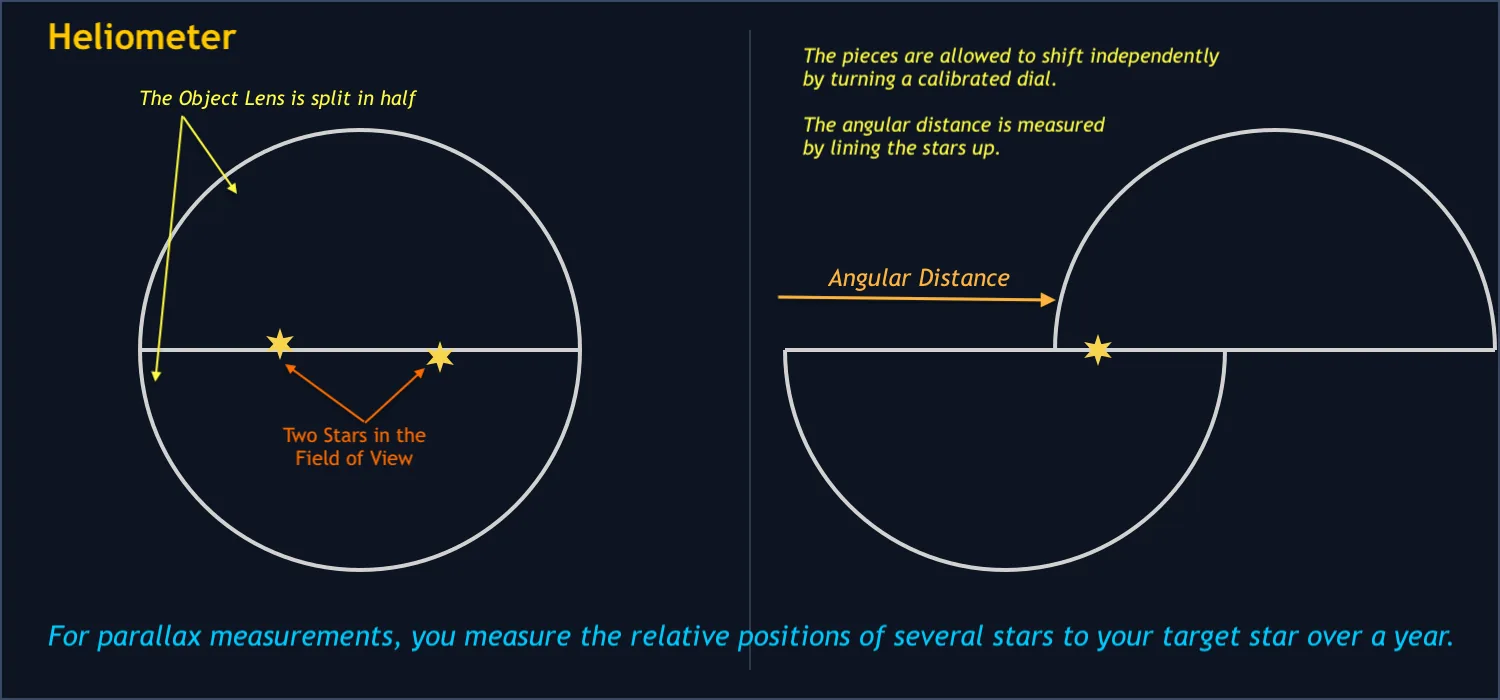
The modern number, from Gaia’s third data release, is 285.9949 milliarcseconds — a distance of 11.404 light-years. Bessel’s original figure was off by about nine percent. For a measurement made by eye with 1830s optics, and no way to check the answer against anything, that’s not a rounding error to apologize for. It’s a genuinely remarkable result, and it’s why finding this star in your own eyepiece means looking at the star that first proved the universe has measurable depth.
Two Old Suns Next Door
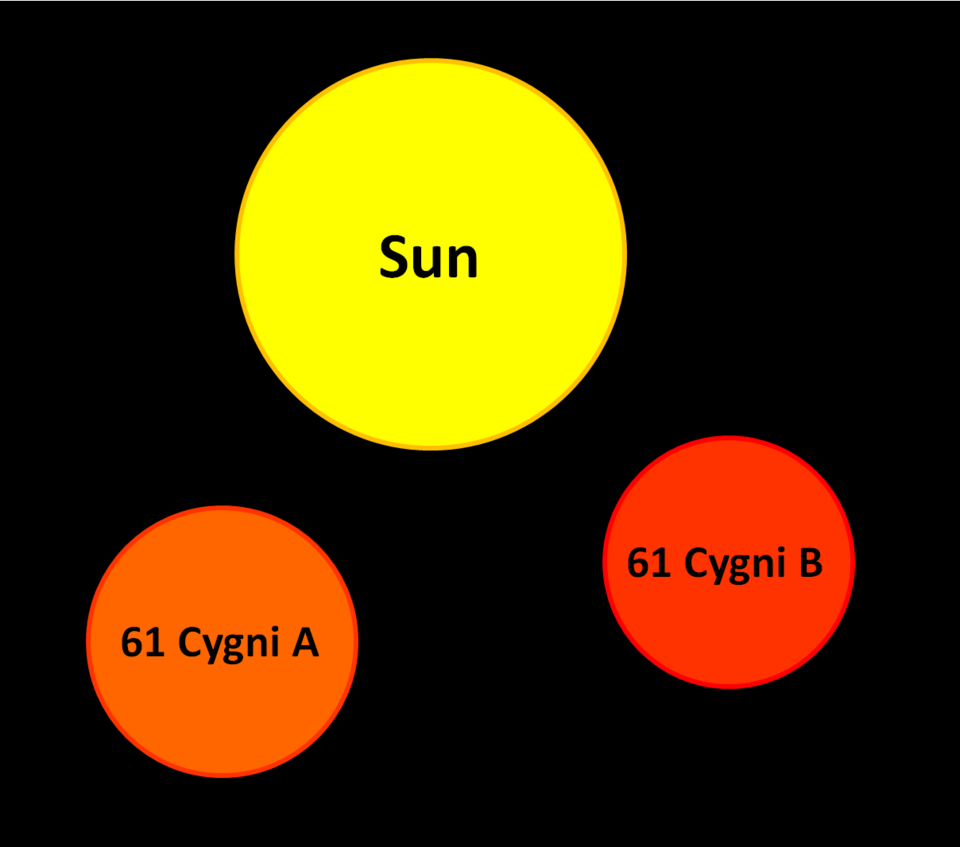
Neither star in this system is intrinsically bright. 61 Cygni A is a K5V dwarf with about 68% of the Sun’s mass; 61 Cygni B is a slightly cooler K7V dwarf at about 63%. Both are smaller, dimmer, and objectively less interesting to look at than the Sun. What makes them naked-eye objects isn’t luminosity — it’s proximity. At 11.4 light-years, this is the 15th-nearest star system to Earth, and 61 Cygni A specifically is the fourth-nearest star visible without a telescope from mid-northern latitudes, trailing only Sirius, Epsilon Eridani, and Procyon A. It’s a clean, concrete demonstration of something the magnitude system trips people up on constantly: how bright a star looks from here depends on both how bright it actually is and how far away it happens to be, and distance can win. They’re not just examples of K5V and K7V stars, either — they’re the examples: A has served as the Morgan-Keenan system’s anchor point for K5V since 1943, and B has done the same for K7V since 1953. When any astronomer anywhere says “K5V,” part of the definition traces back to this exact star.
Proximity is also why Piazzi’s “Flying Star” nickname still applies. 61 Cygni’s proper motion is a touch over 5.2 arcseconds per year — the highest of any star visible to the naked eye, and the sixth-highest of any star in Gaia’s entire catalog. Every star that beats it, including the outright record holder, is too faint to see without a telescope.
That speed isn’t just an optical illusion of proximity — the system is genuinely moving fast relative to the Sun, and it’s old. 61 Cygni belongs to what astronomers call the old-disk population — a class Olin Eggen formally characterized in a 1969 study of exactly this kind of star: stars kinematically different from younger, more Sun-like populations, formed early and settled into orbits that carry them through the galaxy at a brisker clip. Benjamin Boss identified 61 Cygni in 1911 as part of a comoving group of roughly two dozen stars; Eggen himself expanded that group in 1959 to include stars like Beta Columbae and Pi Mensae, all sharing space velocities on the order of 100 km/s relative to the Sun. Measured against the local standard of rest — the average motion of stars in our part of the galaxy — 61 Cygni is cutting through the neighborhood at roughly seven times the Sun’s own pace. 61 Cygni is the fast, old neighbor cutting across the block while the rest of us amble.
It won’t stay a neighbor forever, or rather — it’ll become a much closer one. The system’s trajectory carries it to within about 9 light-years of the Sun around 20,000 CE, its closest approach — at which point both stars will have brightened by about half a magnitude (A to roughly 4.7, B to roughly 5.5) before the system continues on its way.
Splitting the Pair
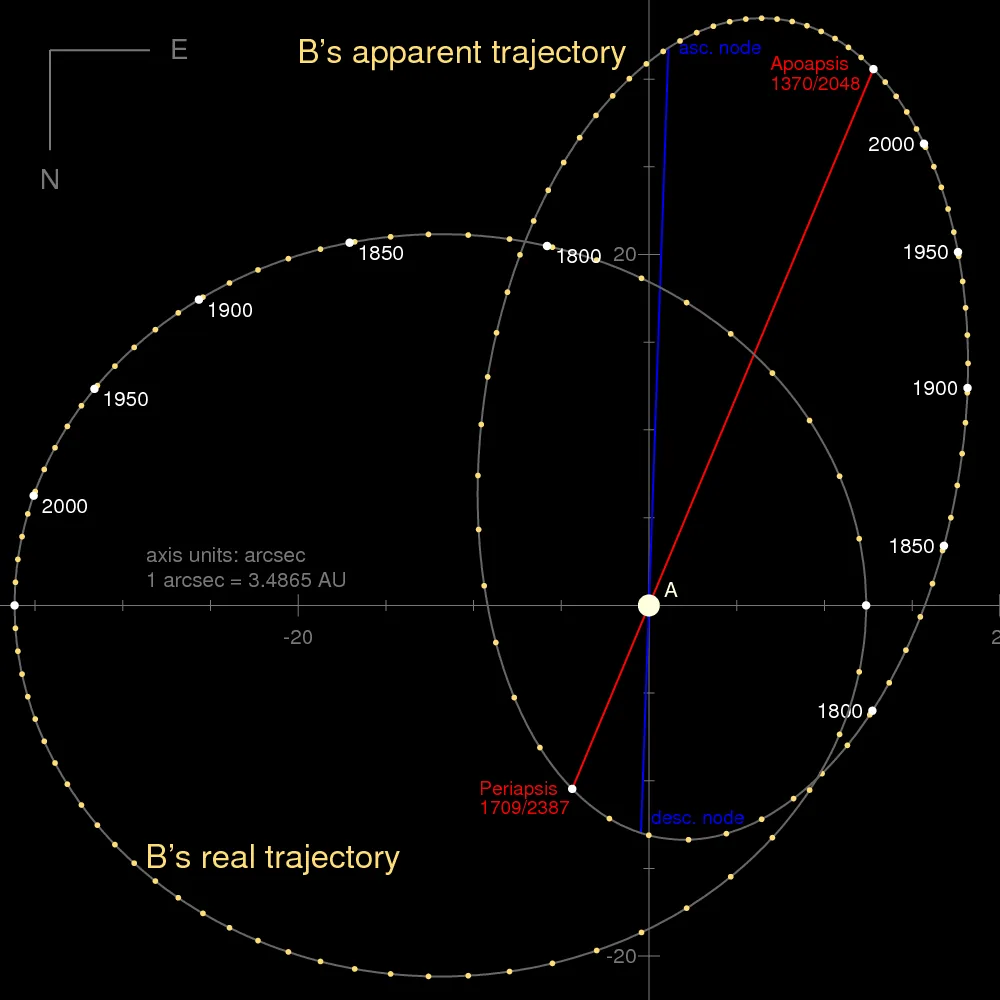
To the naked eye 61 Cygni is a single point of light. It doesn’t stay that way for long once you add any optical aid. The two components currently sit about 30 arcseconds apart — slowly widening toward roughly 34 arcseconds by the year 2100 — which is comfortably within reach of steadily-mounted 7×50 binoculars (10x magnification makes it easier still), and trivial in any small telescope. You’ll find the pair about two binocular fields southeast of Deneb.
It wasn’t always obvious that this was a genuine pair rather than two unrelated stars that happen to line up. James Bradley first noted 61 Cygni as a visual double back in 1753, but whether A and B were actually orbiting each other, bound by gravity, or just a chance alignment along the same line of sight, stayed an open question for more than 150 years. Refined parallax measurements in 1917 showed the two stars’ distances were essentially identical, and by 1934 astronomers had worked out full orbital elements: a period classically cited as around 659 years (a 2024 orbital solution using Gaia astrometry refines this to closer to 707 years), a mean separation around 84 astronomical units, but with a fairly eccentric orbit that carries the pair anywhere from 44 to 124 AU apart.
What makes this particular double star scientifically useful, and not just visually pleasant, is that A and B share the same age, the same original composition, and — obviously — the same distance from us. The only thing that meaningfully differs between them is mass, which is exactly the kind of controlled comparison stellar astrophysics rarely gets handed for free. When two stars agree on everything except one variable, that one variable is much easier to study in isolation.
A Tale of Two Cycles
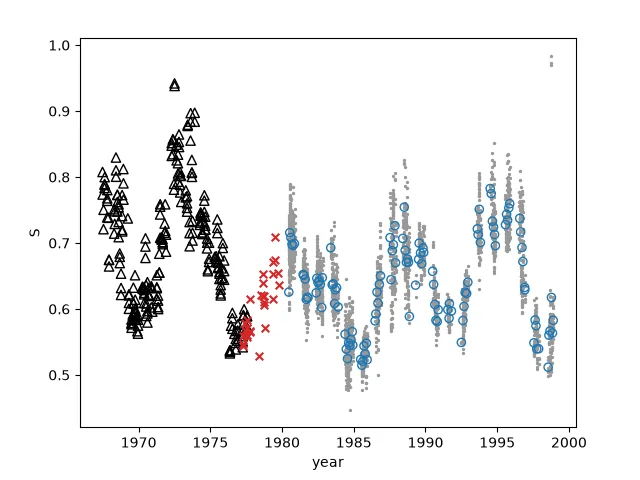
Both components of 61 Cygni are magnetically active, spotted stars, and they’ve been watched closely for long enough to reveal genuine long-term behavior — not unlike the Sun’s own eleven-year sunspot cycle, just with a different rhythm and, in one case, a lot more noise.
61 Cygni A carries the formal variable-star designation V1803 Cygni and is classified as a BY Draconis variable: a star whose brightness varies as starspots rotate in and out of view. Its long-term chromospheric activity traces a fairly clean cycle of roughly 7.5 years. 61 Cygni B, by contrast, is a flare star with a messier, more chaotic pattern of variability layered on top of a less regular cycle of about 11.7 years — its chromosphere runs about 25% more active than A’s.
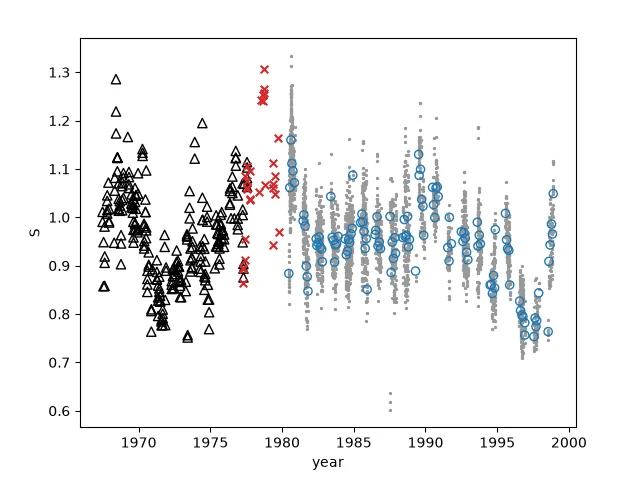
Both stars also show differential rotation — their surfaces don’t spin as a rigid body, the way a solid ball would, but rotate faster at some latitudes than others, just like the Sun’s. A’s rotation period ranges from 27 to 45 days depending on latitude (averaging around 35 days); B’s ranges from 32 to 47 days (averaging around 38). (The Sun rotates at roughly 25 days near the equator and about 34 days near the poles.)
That long baseline matters for a reason beyond curiosity: figuring out how old this system actually is has turned out to be surprisingly contentious. Depending on the method, published age estimates for 61 Cygni range from under a billion years (isochrone fitting) to roughly ten billion (pure kinematics), with gyrochronology and detailed evolutionary modeling clustering closer to the middle, around 3.6 to 6.1 billion years. That’s a wide spread for two stars this well-studied, and it’s an honest one — different aging techniques rely on different assumptions, and for old, slowly-evolving K dwarfs like these, none of those assumptions is bulletproof. Long-term activity monitoring, like the century-plus of data behind the plots above, is one of the more promising ways to eventually narrow that range down.
Planets?
61 Cygni has a longer, and more thoroughly debunked, history of claimed planets than almost any other nearby star.
Act One. In 1942, K. Aa. Strand, working at Sproul Observatory, reported systematic wobbles in the orbital motion of 61 Cygni A and B that implied a third body of roughly 16 Jupiter masses. The claim was influential enough to inspire Hal Clement’s 1953 science-fiction novel Mission of Gravity, built around a massive planet orbiting this very star. Strand refined the claim in 1957, narrowing it to about 8 Jupiter masses on a 4.8-year, 2.4 AU orbit. In 1977, a Soviet team at Pulkovo Observatory went further still, proposing three planets total: two around A (6 and 12 Jupiter masses) and one around B (7 Jupiter masses).
Act Two. In 1978, Wulff-Dieter Heintz, also at Sproul, reexamined the astrometric data and found no evidence of any companion down to about 6% of a solar mass — roughly 60 Jupiter masses, an order of magnitude above what had been claimed. The wobbles, it turned out, weren’t real. Decades of precision radial-velocity monitoring since then (Wittenmyer et al. 2006 at McDonald Observatory, Howard & Fulton 2016) have pushed the limits far lower still, ruling out anything substantial around either star, though both do show slow linear drifts in radial velocity — almost certainly the signature of the two stars’ own long, slow orbit around each other, not a hidden planet.
Act Three. The story wasn’t quite finished. In 2019, an analysis of Gaia’s second data release found the two stars weren’t orbiting their common center of mass quite the way a clean two-body system should, hinting at a possible unseen third object tugging on B. Follow-up work using the more precise Gaia DR3 astrometry (2024) and a dedicated radial-velocity survey (the NEID Earth Twin Survey, 2025) both concluded the data are fully consistent with an ordinary binary — no third body required.
So, no planet has ever been confirmed around either star. That hasn’t stopped astronomers from looking — both components were “Tier 1” targets for NASA’s never-launched Space Interferometry Mission, and both sit in what’s been called the K-dwarf “sweet spot” for future biosignature searches, precisely because they’re close enough and bright enough to study in detail. The same proximity and brightness that made this system perfect for the first parallax measurement, and effortless for naked-eye and binocular observers, has also made it an irresistible target for planet hunters for over eighty years running — even though, so far, every single claim has come back empty.
Finding 61 Cygni
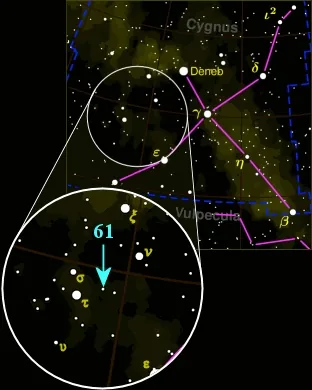
At magnitude 5.2 and 6.0, the pair sits right at the edge of naked-eye visibility — easy from a dark rural sky, invisible from most suburbs. Binoculars pull it in from anywhere; a steadily-mounted 7×50 pair under good conditions starts to show two points instead of one, and any small telescope splits it easily. 61 Cygni sits in Cygnus, about two binocular fields southeast of Deneb.
What you’ll actually see is unglamorous: an orange dot with a fainter orange companion nearby. Nothing about the view hints at the parallax history, the century of retracted planets, or the century of activity monitoring behind it — the reward here is entirely in knowing what you’re looking at.
A Star You Can Watch Move
There’s one more thing worth trying, and it takes nothing but patience. 61 Cygni’s proper motion — about 5.2 arcseconds per year — is Piazzi’s “Flying Star” in action: the highest proper motion of any star visible to the naked eye. The overall record holder, Barnard’s Star (highlighted in a previous “A Closer Look” article), moves about twice as fast at 10.3″/yr, but at magnitude 9.5 it’s invisible without a telescope, so it doesn’t count for this particular title.
That “about half of Barnard’s Star’s speed” is the key number: the smart-scope motion challenge from that article works here too, just on a longer clock. The animation above compresses a nine-year baseline into a few seconds — here’s what that same shift looks like stretched out to something you could actually image and compare yourself:
| Telescope | Pixel Scale | Shift per Year | Shift over 9 Years |
|---|---|---|---|
| Unistellar eQuinox 2 | 1.33″/px | ~3.9 px/yr | ~35 px |
| Seestar S50 | 2.39″/px | ~2.2 px/yr | ~20 px |
| Seestar S30 Pro | 3.74″/px | ~1.4 px/yr | ~13 px |
| Seestar S30 | 4.00″/px | ~1.3 px/yr | ~12 px |
Where Barnard’s Star rewards patience measured in single years, 61 Cygni asks for a bit more: on the finer end of that table, three or four years starts to show something real; on the coarser end, you’ll want closer to the full multi-year baseline the animation above demonstrates. Either way, it’s the same experiment Bessel ran with a heliometer in 1838, and that Piazzi ran by comparing decades-old star charts in 1804 — just with a CMOS sensor and plate-solving software doing the tedious part now. Find it, wait, and look again. The universe really does have depth, and this star is still proving it.