Introduction
In the Summer, the Milky Way takes front and center stage with nebulae and star clusters overlaying the background disk of our Galaxy. Now, as we move into the Fall constellations, the Milky Way - slightly dimmer, but still very noticeable overhead - presents a different perspective of the Galaxy’s structure; one that might not be immediately apparent.
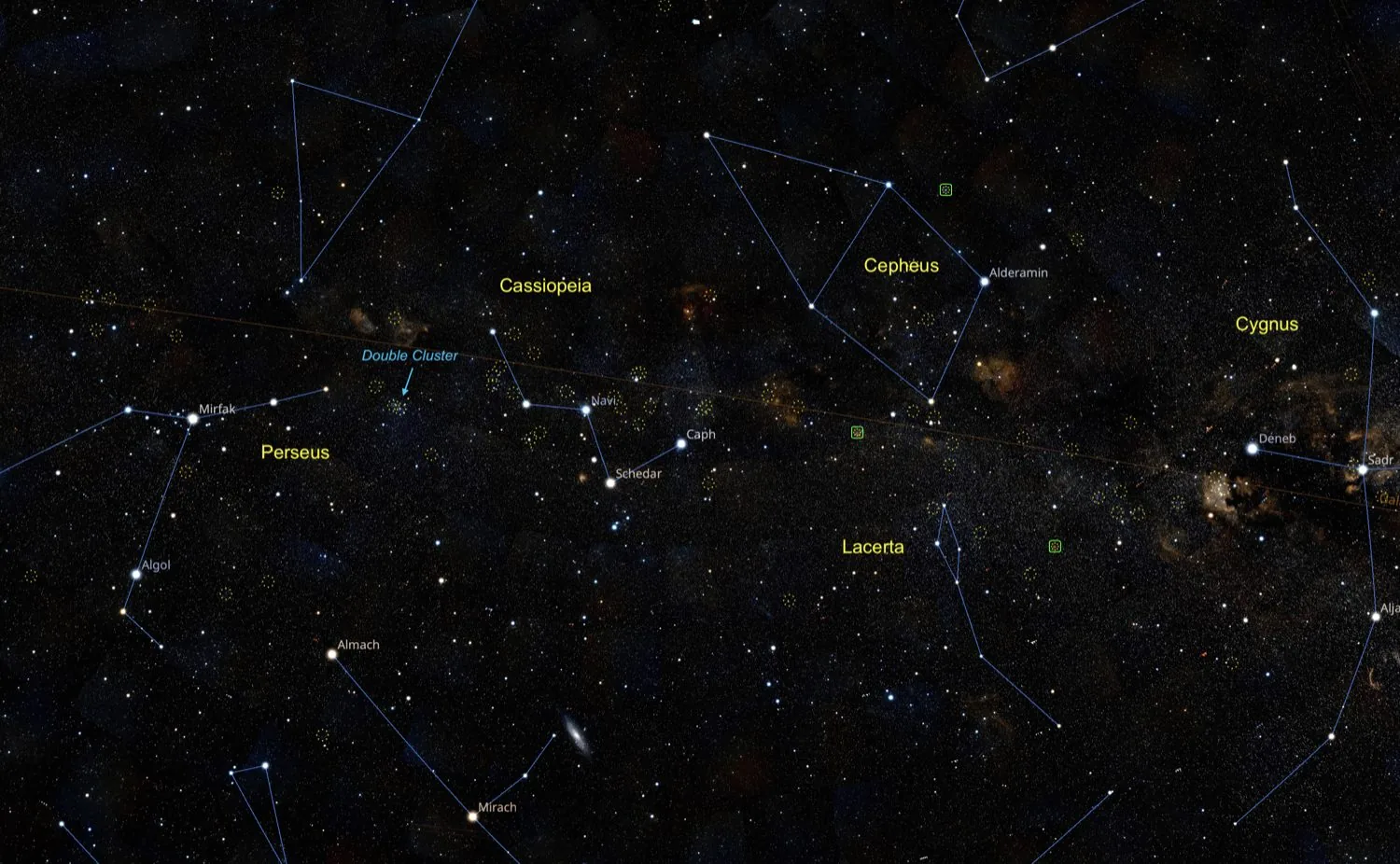
Starting at Deneb, the anchor of the Northern Cross, and following the glow of the Milky Way northeast, it carries you through Cepheus, across the “W” of Cassiopeia, and lands you at the Double Cluster on the Perseus border. That walk happens to pass through two constellations full of bright open clusters — but the constellations are incidental. What you’re actually doing, without necessarily realizing it, is walking outward through the disk of our own Galaxy: starting near the edge of the arm we live in, and ending inside the next arm out.
Scanning the Milky Way
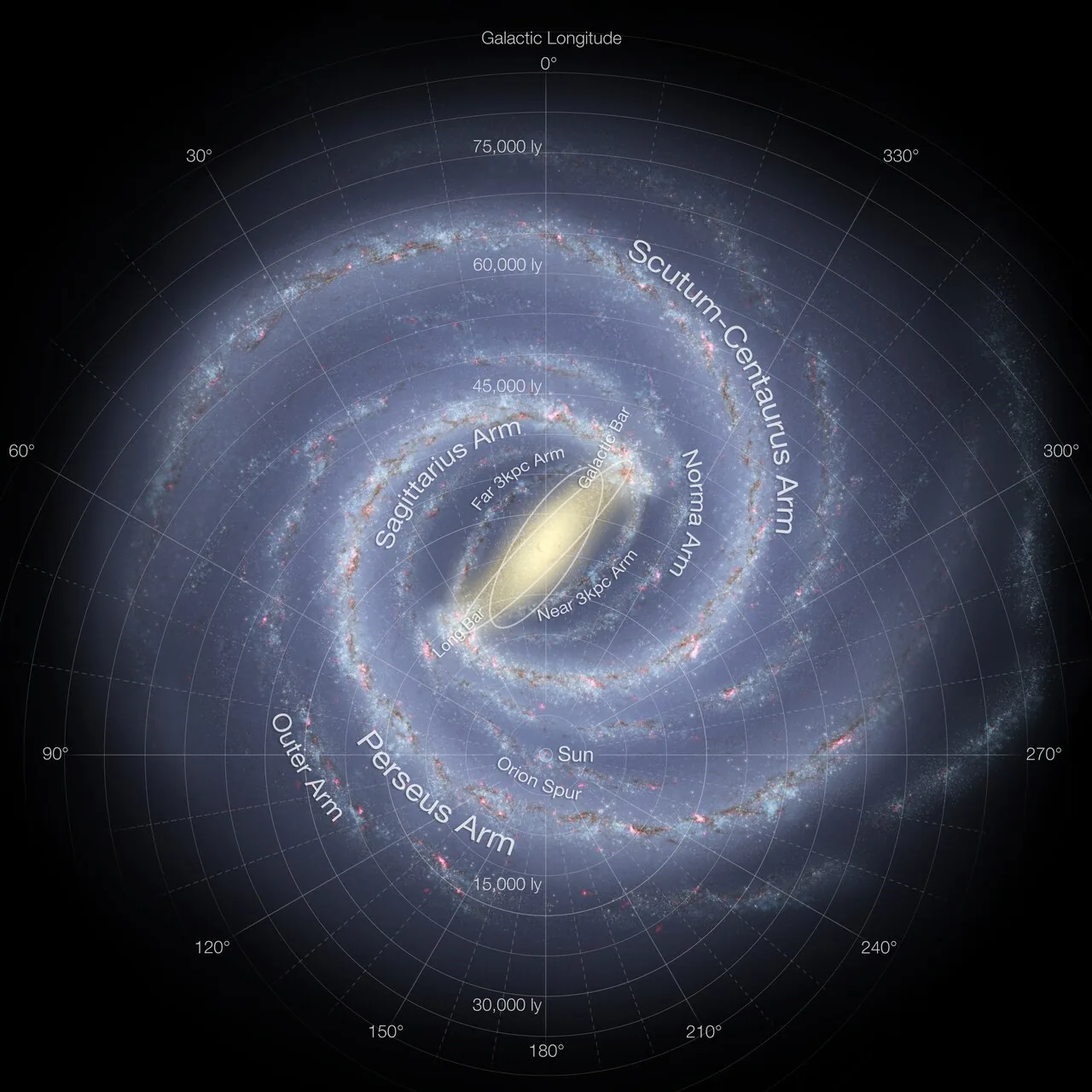
The Milky Way is a barred spiral galaxy: a central bar with arms winding out from it, and we live inside one of those arms — specifically a minor one called the Orion Spur (also known as the Local Arm). Which part of that structure you’re looking at on any given night depends entirely on which way the sky has you facing.
Immediately outward from the Orion Spur lies the Perseus Arm, one of the Galaxy’s two true major arms. Immediately inward lies the Sagittarius Arm — which, despite the name, is itself a minor arm, not a major one. It’s the Scutum-Centaurus Arm, further in still, that ranks as the Galaxy’s other major arm, connecting to the ends of the central bar.
In summer, the Milky Way climbs highest toward Sagittarius and Scorpius, low in the south. That direction points inward, toward the galactic center, and the first spiral structure you cross looking that way is the (minor) Sagittarius Arm, followed by the Scutum-Centaurus Arm, and beyond that the bar and bulge at the Galaxy’s core.
By Fall, as Cygnus gives way to Cepheus and Cassiopeia climbing into the evening sky, the geometry has flipped entirely. Now you’re facing outward, away from the center. The Orion Spur itself runs out toward Cygnus — it’s one of the reasons that stretch of sky is so rich to begin with — but beyond it lies the Perseus Arm, the next major spiral structure out from our own.
Looking through Cassiopeia and Cepheus
Scan through Cepheus and Cassiopeia with any telescope (or even binoculars), and you encounter many open clusters: there are dozens. But the distances to those clusters tell the real story. On the Cygnus end coming into western Cepheus, you’re still largely within our own Orion Spur — close, as these things go, out to a couple thousand light-years. Keep going, however, and by the time you’re deep into Cassiopeia and across into Perseus, most of the bright clusters along that same line of sight sit consistently farther out: roughly 6,200 to 9,200 light-years away.
That consistency is the evidence. A single cluster sitting several thousand light-years away tells you nothing on its own. All of them — cataloged independently, discovered independently, decades or centuries apart — yet clustering around the same distance, along the same line of sight, is not coincidence, though. It’s a cross-section of real structure, and we’re looking straight down its length.
Other Galactic Features
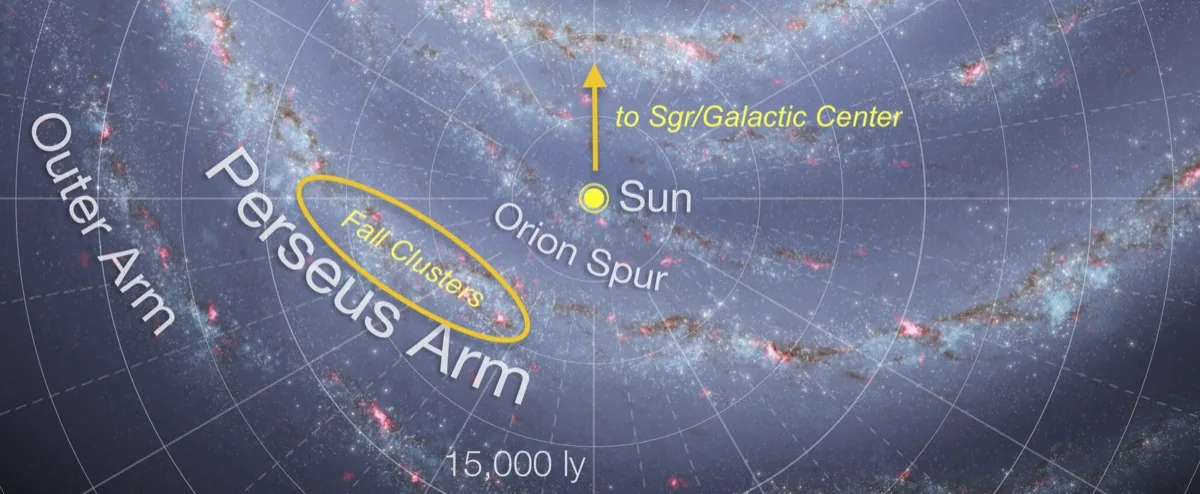
It’s worth naming here because it undercuts any temptation to draw a hard boundary. Some of what you’re looking at along this walk isn’t cleanly “near” or “far” — it’s the connective tissue between the two.
Open Clusters in an Outer Spiral Arm
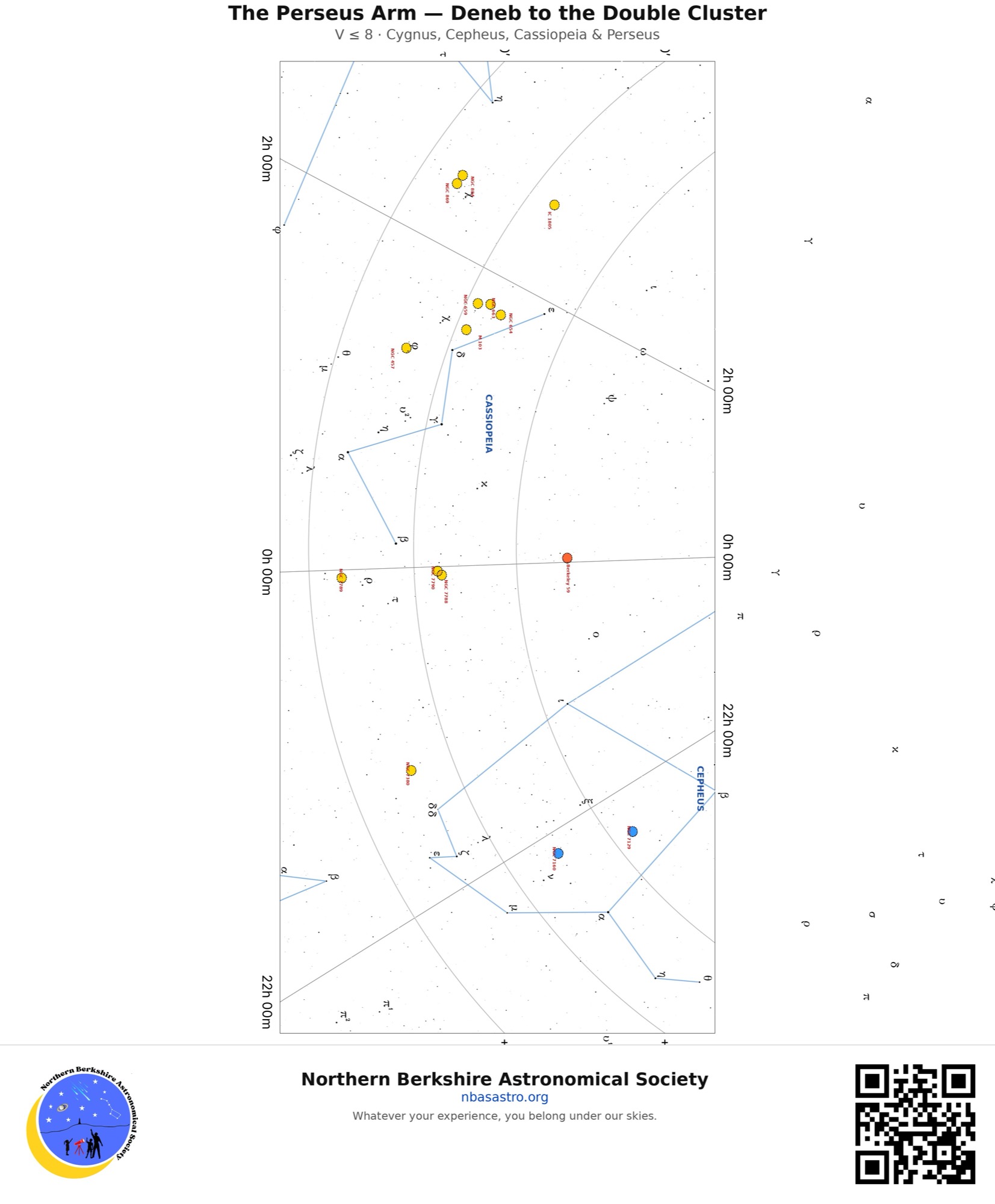
Here’s the walk itself, roughly in the order you’d sweep across it on a fall evening — starting in Cepheus, crossing Cassiopeia, and finishing at the Perseus border.
Into Cepheus
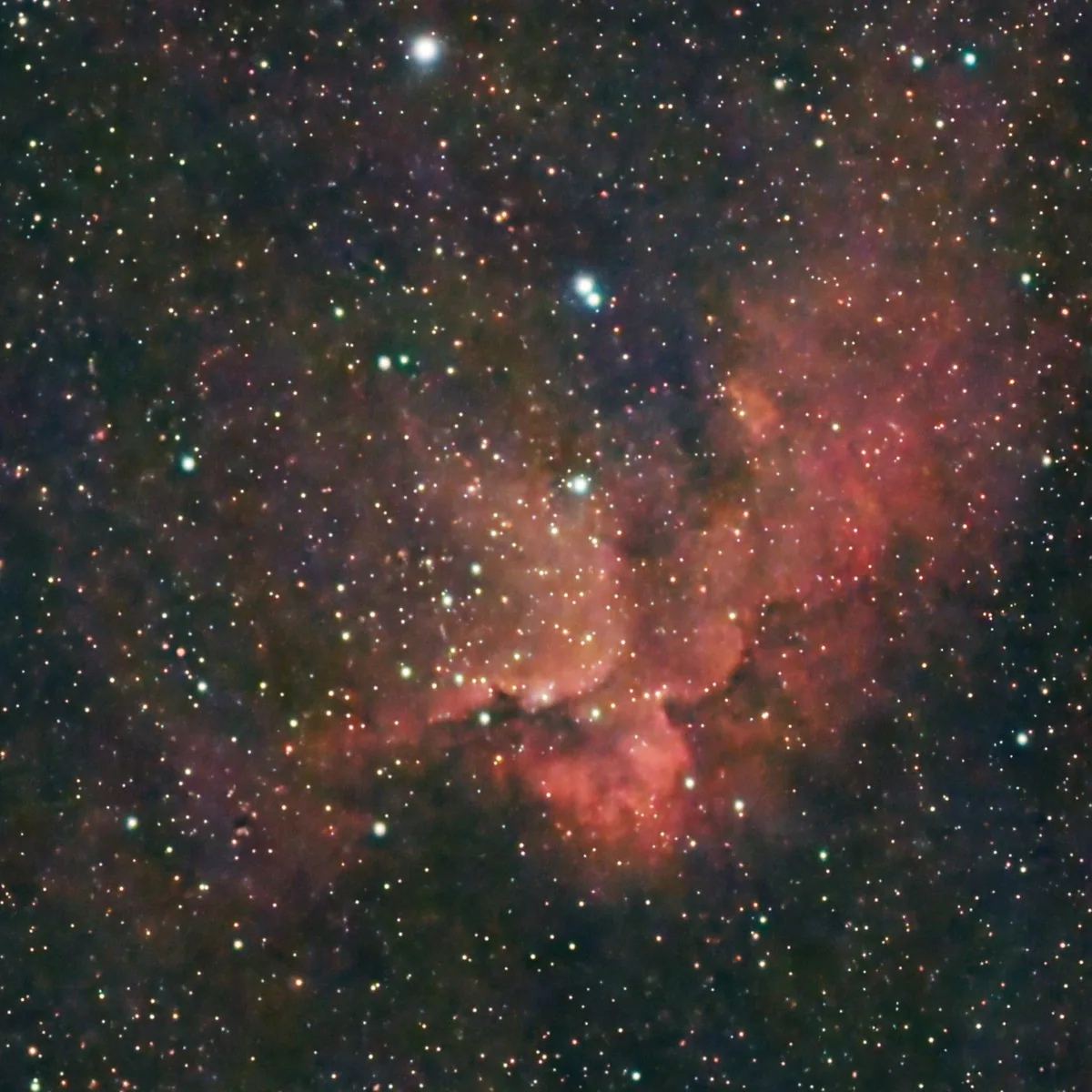
The walk opens with NGC 7380, the “Wizard Nebula” cluster — a young cluster still embedded in the emission nebula that formed it. At roughly 7,800 light-years, it’s already squarely a Perseus Arm object, and the nebulosity around it is a direct look at the raw material an arm is made of.
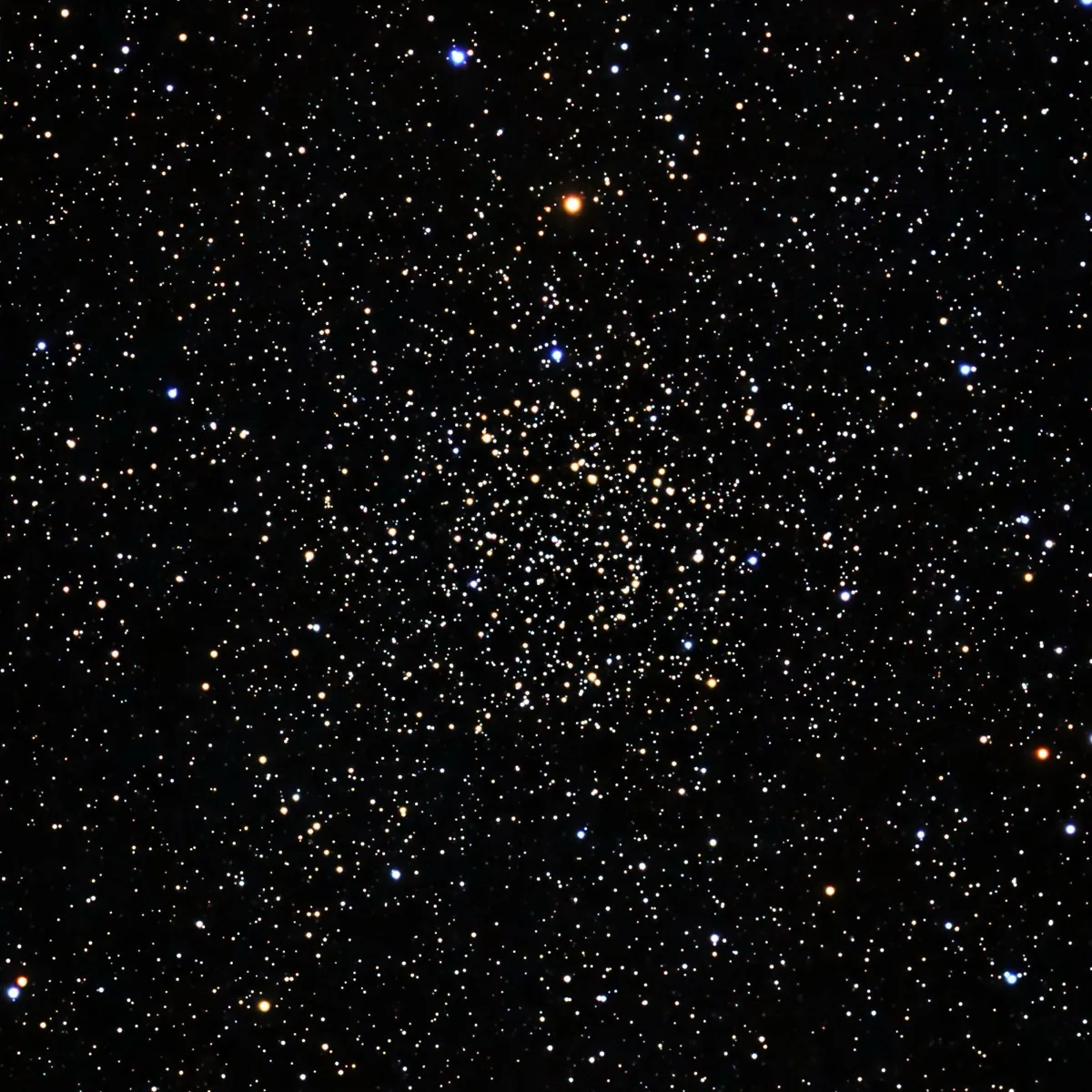
A little further along sits NGC 7789, the “White Rose,” or Caroline’s Rose — a dense, richly populated cluster whose looping chains of stars give it its nickname. Around 6,200 light-years out.
Into Cassiopeia
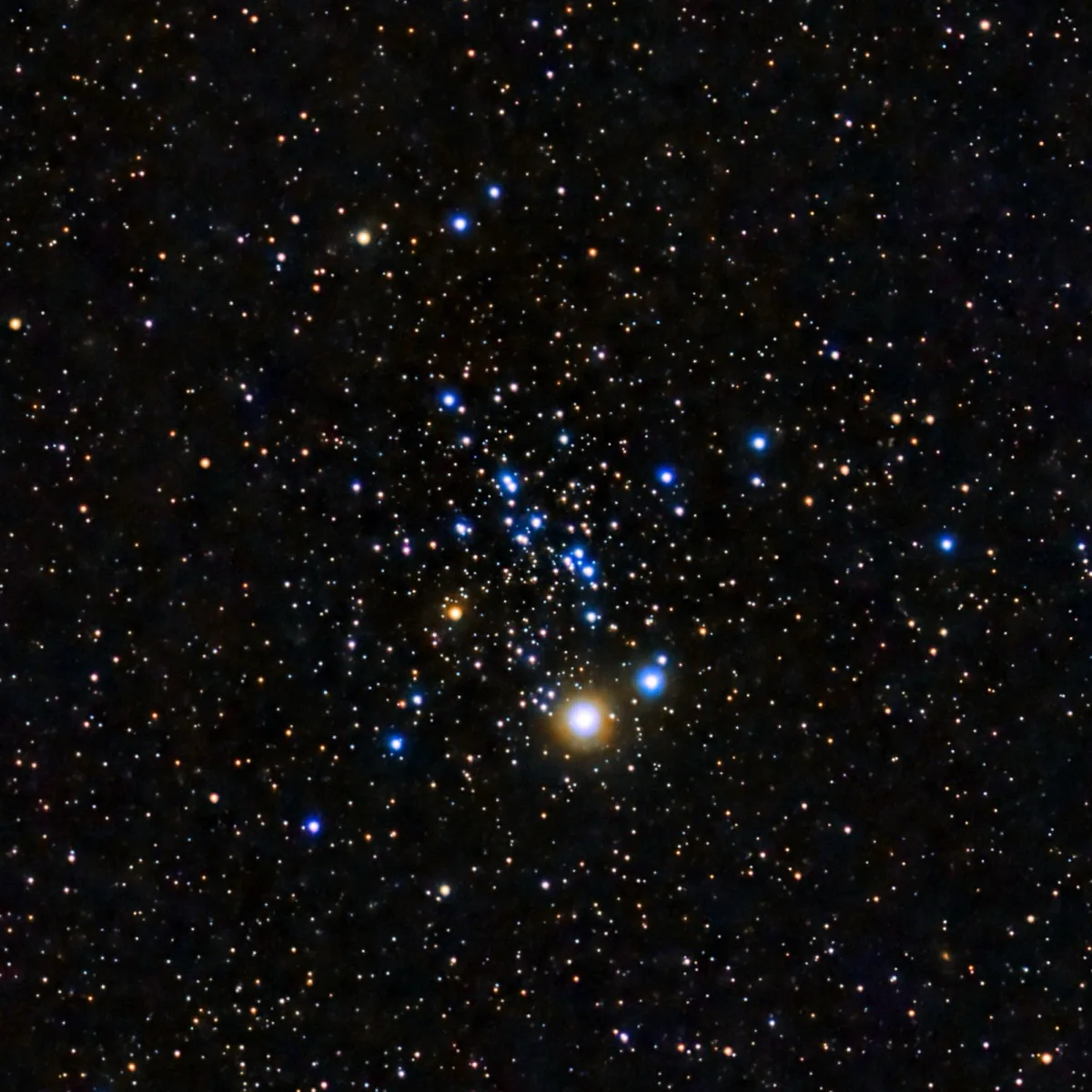
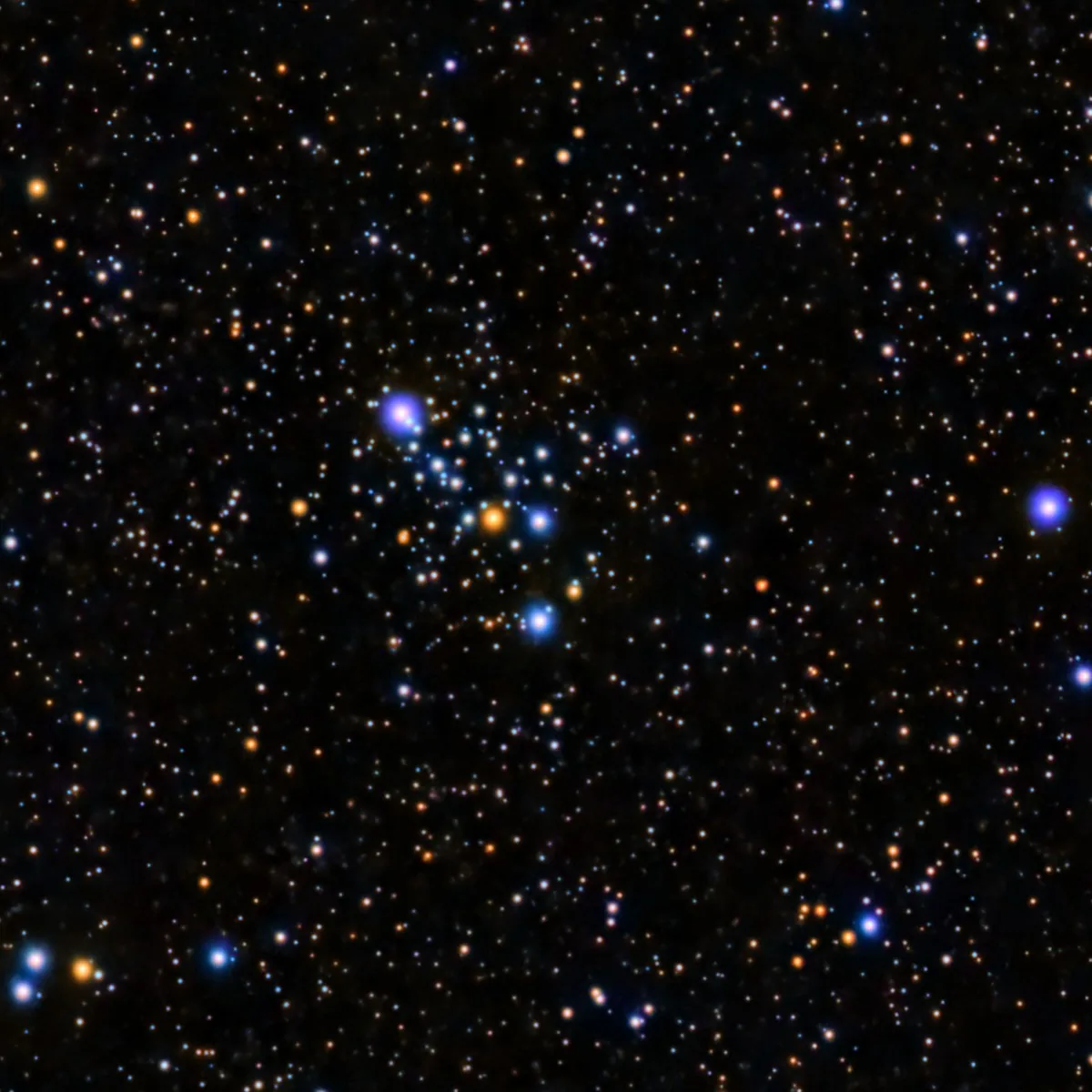
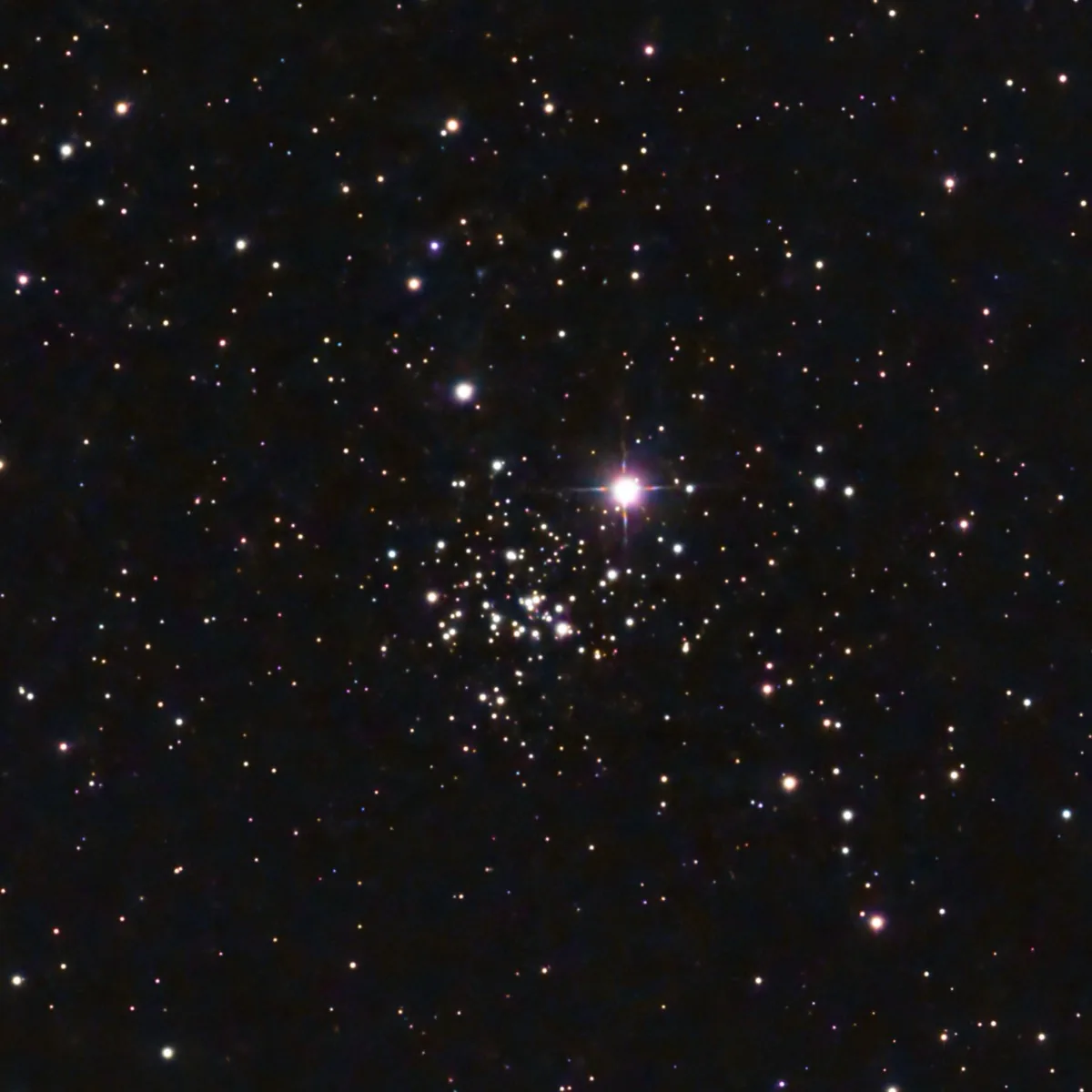
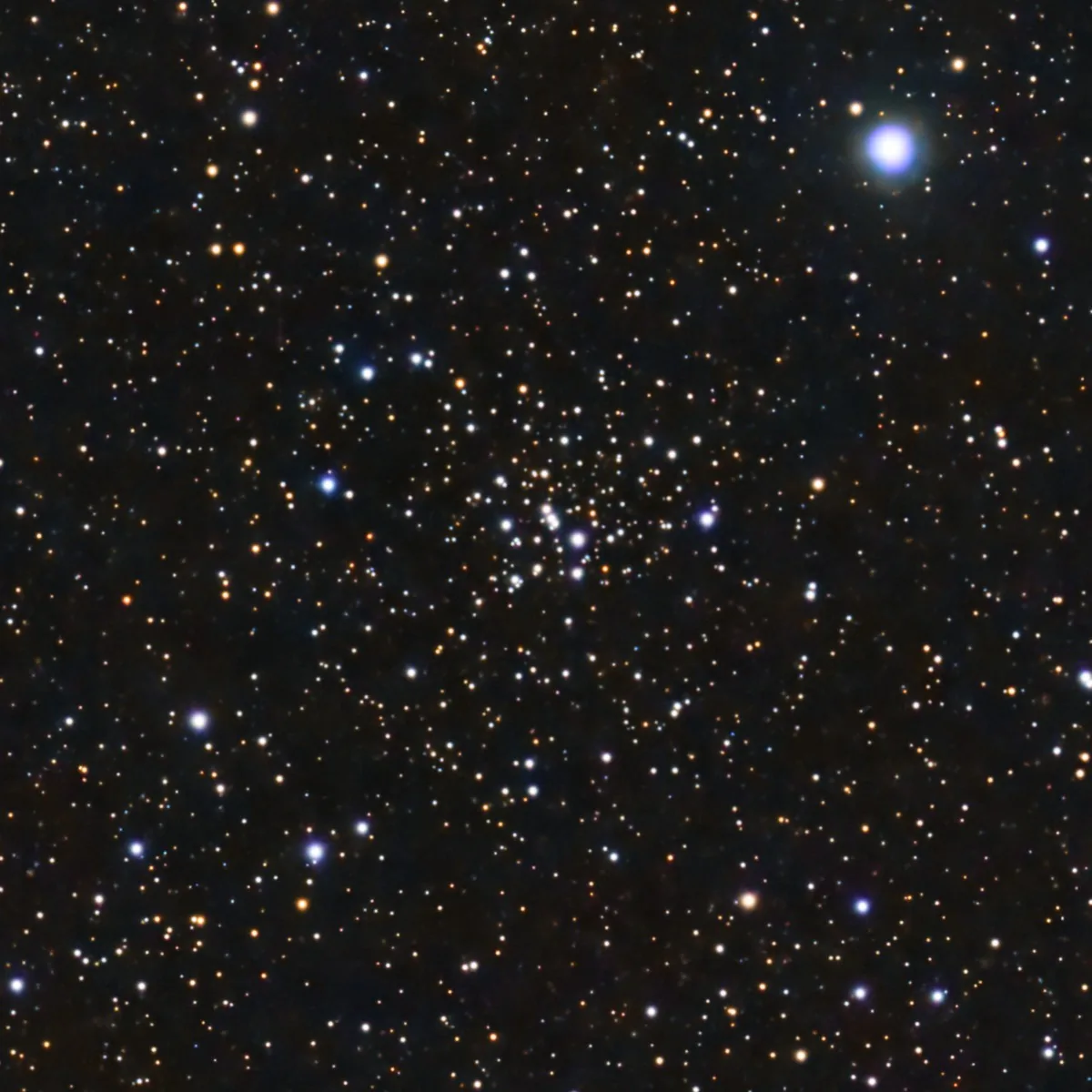
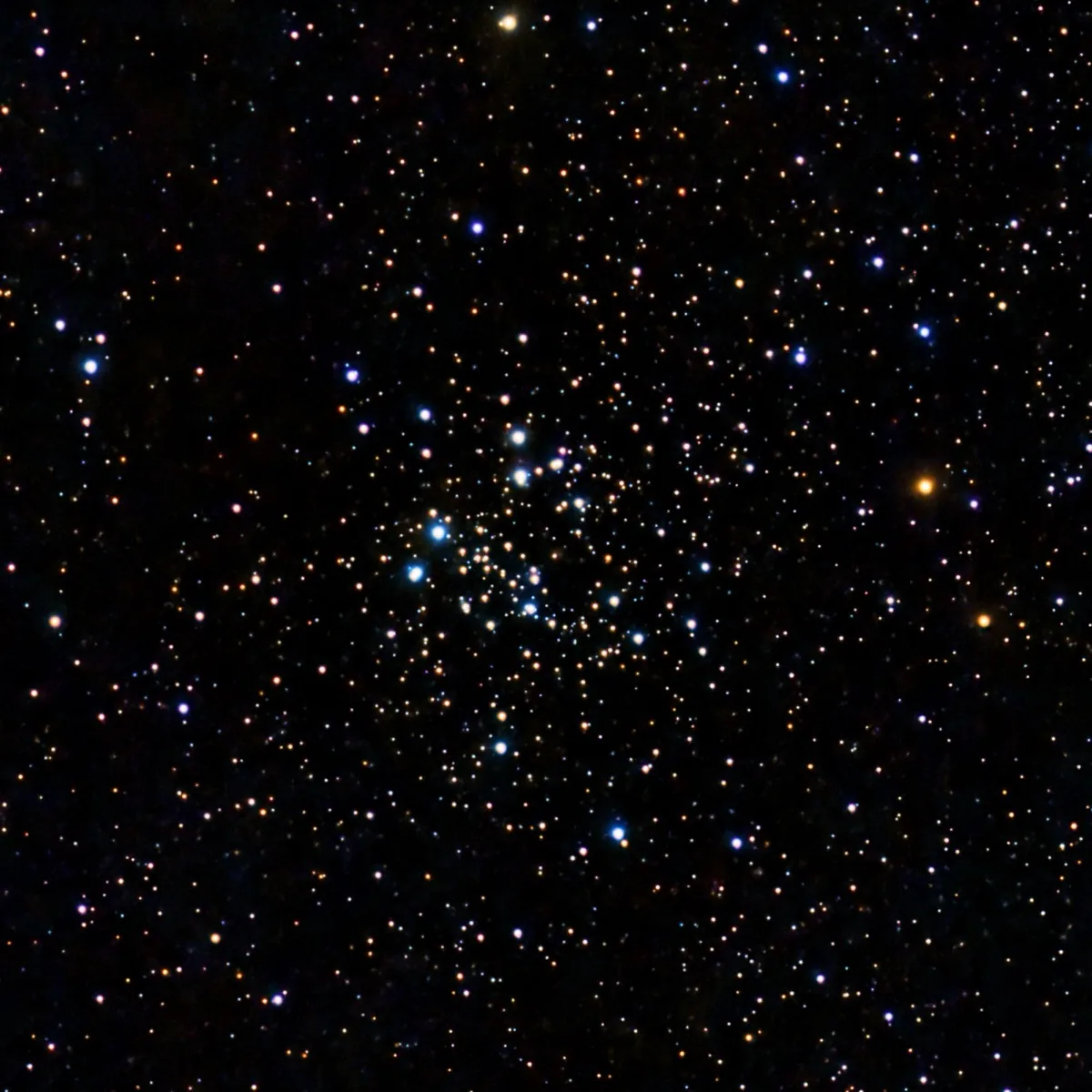
From here the walk enters Cassiopeia’s dense cluster field, where five bright clusters sit within a few degrees of each other. NGC 457 — Caldwell 13, better known as the “ET” or Owl Cluster for the two bright “eyes” and trailing “legs” its brightest stars form — sits about 8,300 light-years out. M 103 (NGC 581), the only Messier object on this walk, is compact and easy at around 7,500 light-years. NGC 654 and NGC 659, two more members of the same field, sit at roughly 8,200 and 8,500 light-years respectively. And NGC 663, Caldwell 10, is the richest of the group, at around 7,700 light-years out.
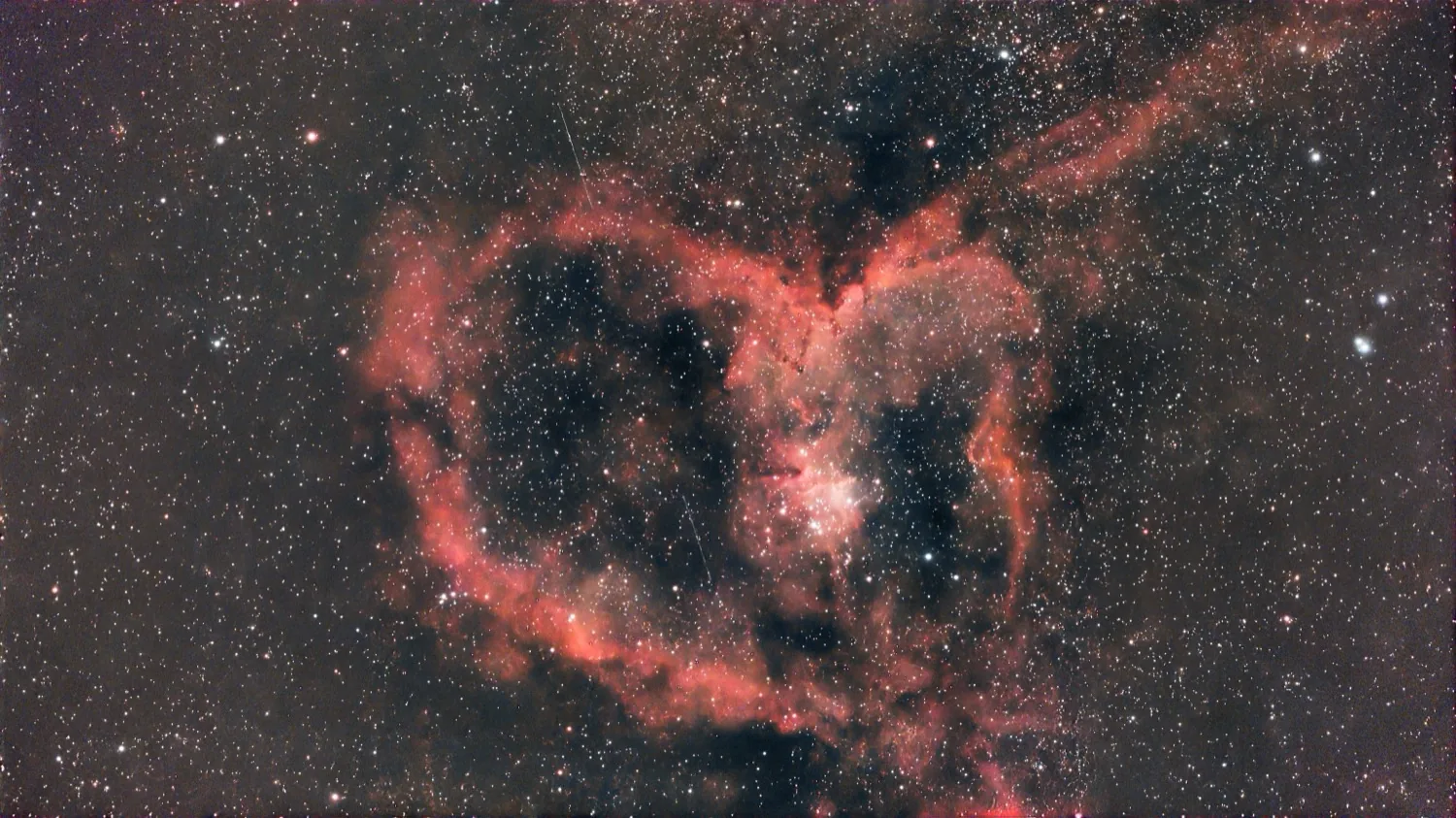
IC 1805 (Cassiopeia) — the “Heart Nebula,” with its central cluster Melotte 15 lighting up the surrounding gas from the inside. About 7,100 light-years out.
Quick reference:
| Object | Constellation | Also known as | Distance |
|---|---|---|---|
| NGC 7380 | Cepheus | “Wizard Nebula” | ~7,800 ly |
| NGC 7789 | Cassiopeia | “White Rose” / Caroline’s Rose | ~6,200 ly |
| NGC 7788 | Cassiopeia | ~8,800 ly | |
| NGC 7790 | Cassiopeia | ~9,200 ly | |
| NGC 457 | Cassiopeia | Caldwell 13, “ET” / Owl Cluster | ~8,300 ly |
| M 103 | Cassiopeia | NGC 581 | ~7,500 ly |
| NGC 654 | Cassiopeia | ~8,200 ly | |
| NGC 659 | Cassiopeia | ~8,500 ly | |
| NGC 663 | Cassiopeia | Caldwell 10 | ~7,700 ly |
| IC 1805 | Cassiopeia | “Heart Nebula,” central cluster Melotte 15 | ~7,100 ly |
| NGC 869 | Perseus | h Persei | ~7,300 ly |
| NGC 884 | Perseus | χ (chi) Persei | ~7,000 ly |
Distances above are from Dias, W.S., et al. 2021, MNRAS 504, 356 (“Updated parameters of 1743 open clusters based on Gaia DR2”). A second Gaia-based study, Poggio et al. 2021, A&A 651, A104, gives systematically higher values for most of these clusters — for NGC 663 specifically, the two studies disagree by about 25% (2353 pc vs. 2950 pc), so treat that one distance as less settled than the others.
Double Clusters Aren’t Adjacent!
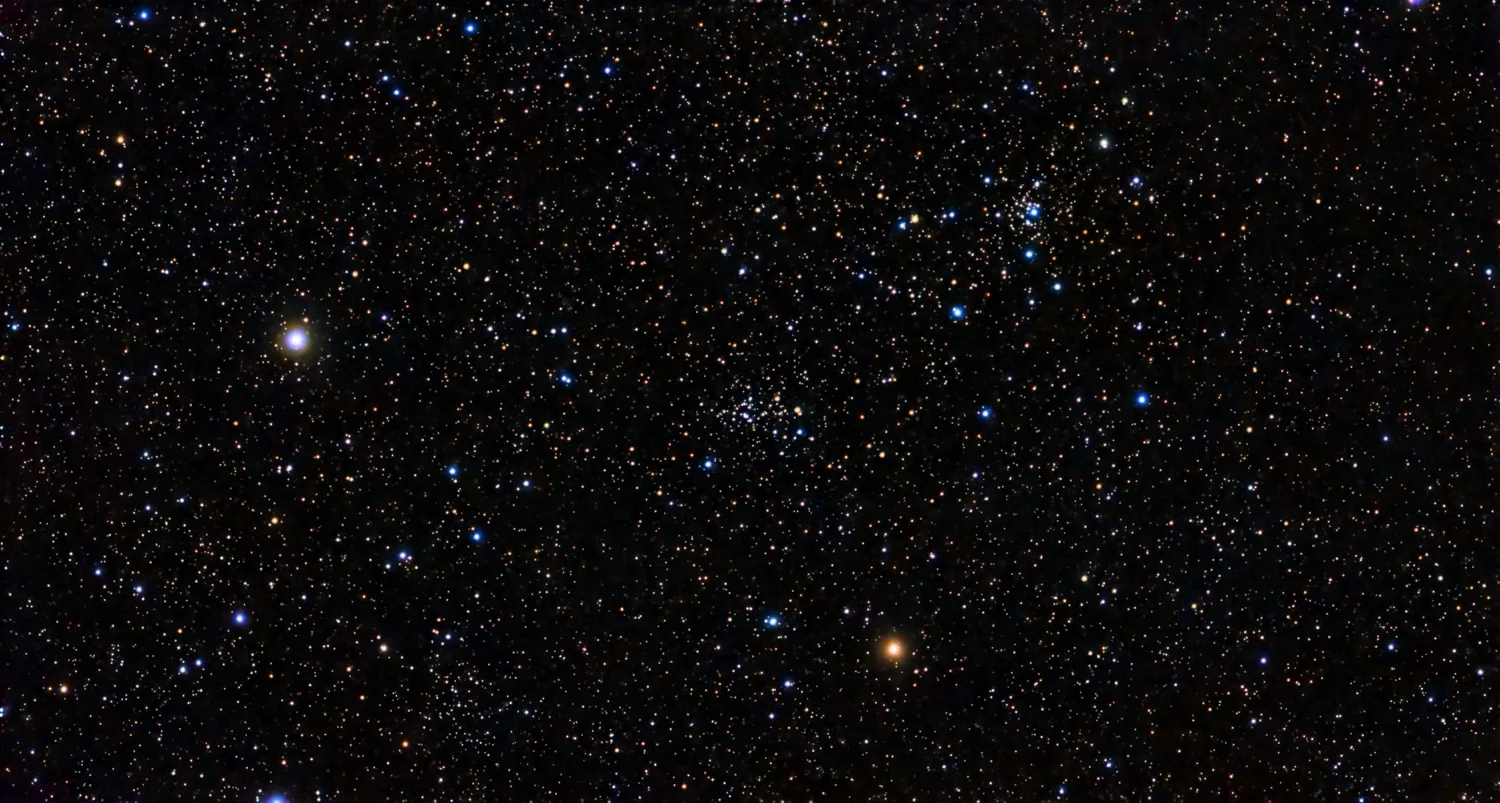
NGC 7788 and NGC 7790 (Cassiopeia) — a pair that shares a field of view much like the Double Cluster does, and makes a good preview of the point below. NGC 7788 sits at roughly 8,800 light-years, NGC 7790 at roughly 9,200 light-years — about 400 light-years apart, despite sitting in the same frame. NGC 7790 is also notable for containing several classical Cepheid variable stars.
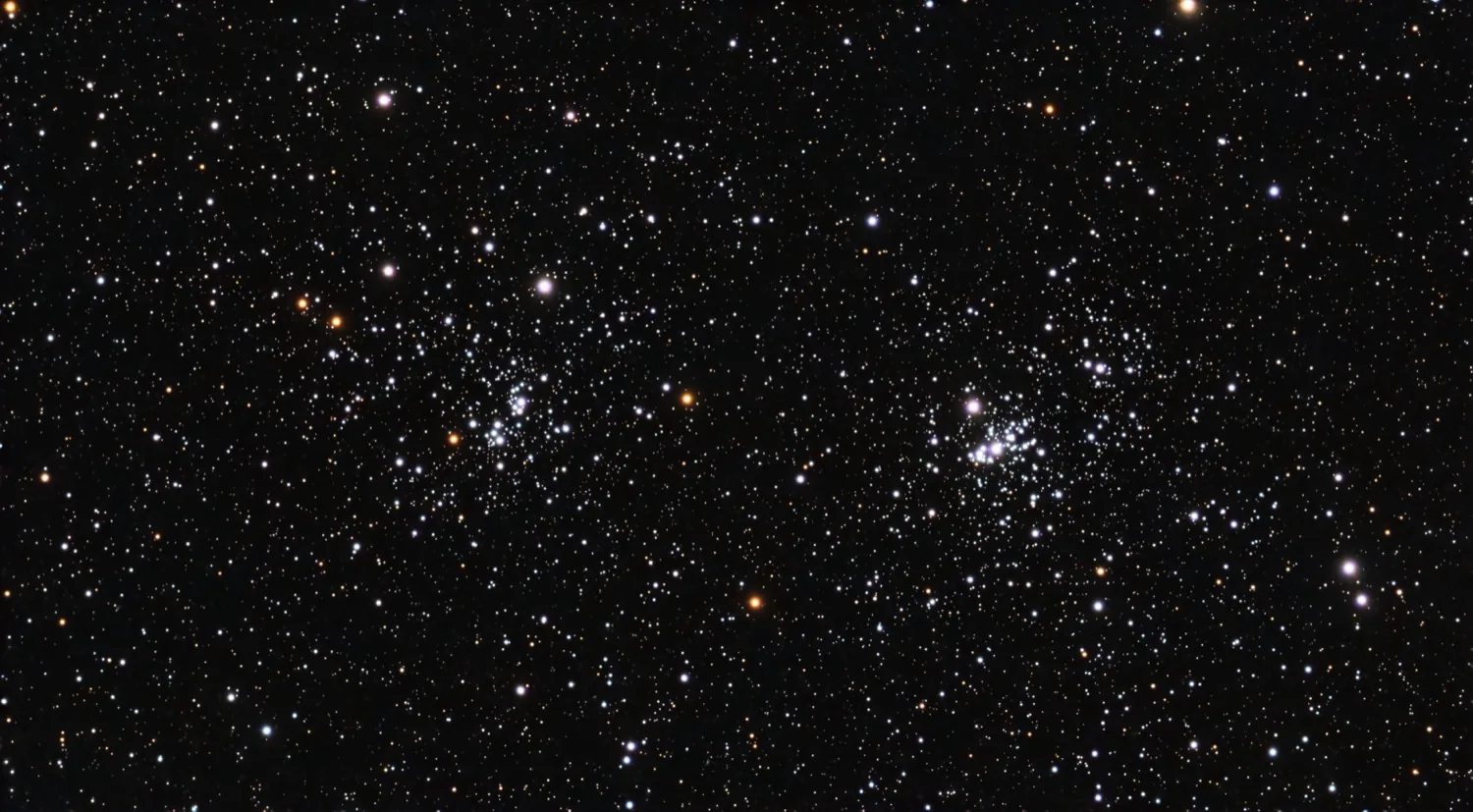
The Double Cluster is the payoff of this walk, and it’s a good place to make a point that surprises people: despite sharing practically the same patch of sky, NGC 869 and NGC 884 are not sitting right next to each other in space. NGC 884 is the closer of the two, at roughly 7,000 light-years; NGC 869 sits about 300 light-years beyond it, at roughly 7,300 light-years. They only look adjacent because we’re viewing them almost perfectly end-on, down the length of the line connecting them.
There’s a wrinkle worth keeping, though: despite that separation, the two clusters come out at nearly identical ages in recent studies — around 13 million years each — with matching reddening and distance modulus. That combination is the signature of a shared origin: they likely formed together, in the same burst of star formation, within the same association (Perseus OB1), and have simply drifted apart in the time since. Not adjacent doesn’t mean unrelated — it means related, but no longer neighbors.
Cassiopeia’s NGC 7788 and NGC 7790, above, make the same “not adjacent” point on a smaller scale — proximity on the sky is not proximity in space.
A Wider View
Why does a spiral arm come pre-loaded with open clusters in the first place? The standard explanation treats a spiral arm as a standing compression wave moving through the galactic disk. Gas drifting into the arm gets squeezed, and squeezed gas is gas that starts collapsing under its own gravity — which is star formation. The stars born this way stay loosely bound to their siblings for a few tens of millions of years, as an open cluster, before the Galaxy’s tides eventually pull them apart. The Sun itself might’ve been born in a star cluster, ripped apart long ago as the stars made several orbits around the Galactic center. Arms aren’t brighter because they hold more stars overall; they’re brighter because they’re where stars are actively being made, and new stars run hot and blue.
That said, it’s not a fully settled picture — some spiral galaxies without strong, well-defined arms form stars at comparable rates, so how much of the credit really belongs to the arm structure itself is still an open research question.
And not every nearby cluster plays along. NGC 188, technically within Cepheus’s borders, is one of the oldest known open clusters in the Galaxy. It survived for billions of years by doing the opposite of everything above — drifting far out of the galactic plane, away from the tidal disruption that eventually shreds most clusters.
Finding and Observing These Clusters
Practically, this whole walk is easy to fit into an evening. Both constellations are circumpolar for most of the northern hemisphere, so there’s no clock to race — they’re up all night, all season. This isn’t a smart-scope-only list, either: most of these clusters have been enjoyed through binoculars and modest telescopes for a very long time, and honestly that’s one of the more rewarding ways to take them in — slower, and now with the added weight of actually knowing what you’re looking at. A smart scope earns its keep specifically on the two objects with real nebulosity, NGC 7380 and IC 1805, where a dual-band filter pulls the surrounding gas out of the background in a way the eye alone can’t manage. Whatever’s in your hands when you find them, you’re seeing the same clusters, in the same arm, that this whole article is about.