Introduction

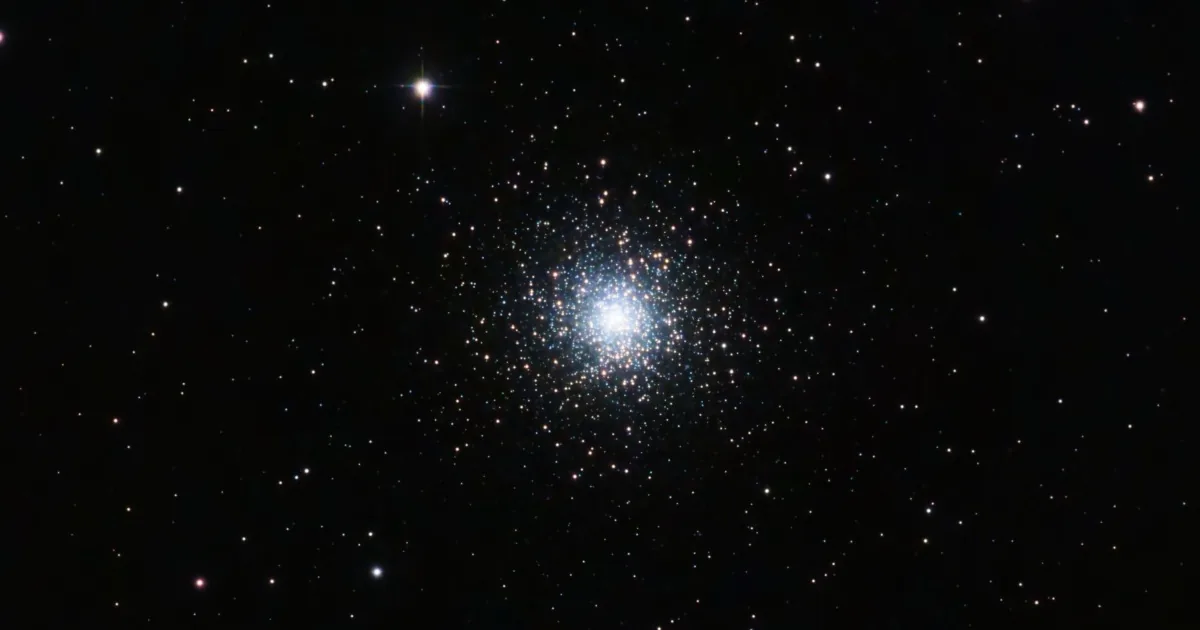
For once, this isn’t a William Herschel find. M 15 was discovered on September 7, 1746, by Jean-Dominique (Giovanni Domenico) Maraldi, an astronomer at the Paris Observatory – and he wasn’t even looking for it. Maraldi was tracking a comet when he ran across a small, fuzzy patch of light that clearly wasn’t a comet at all. He noted it and moved on – and four days later, using the same comet-tracking sweep, ran across a second one: M 2, in Aquarius. Charles Messier picked up M 15 independently in 1764 and gave it the 15th slot in his catalog of “things to not mistake for comets” – the same catalog that, two and a half centuries later, still gives amateur astronomers a lifetime of targets.
That’s a fitting origin story for an object that keeps surprising people who look closely at it. M 15 is one of the oldest things in the Milky Way, one of the densest globular clusters known, and – almost impossibly – home to a kind of object that, by most theoretical predictions, shouldn’t exist inside a cluster like this one at all.
An Old(er) Cluster
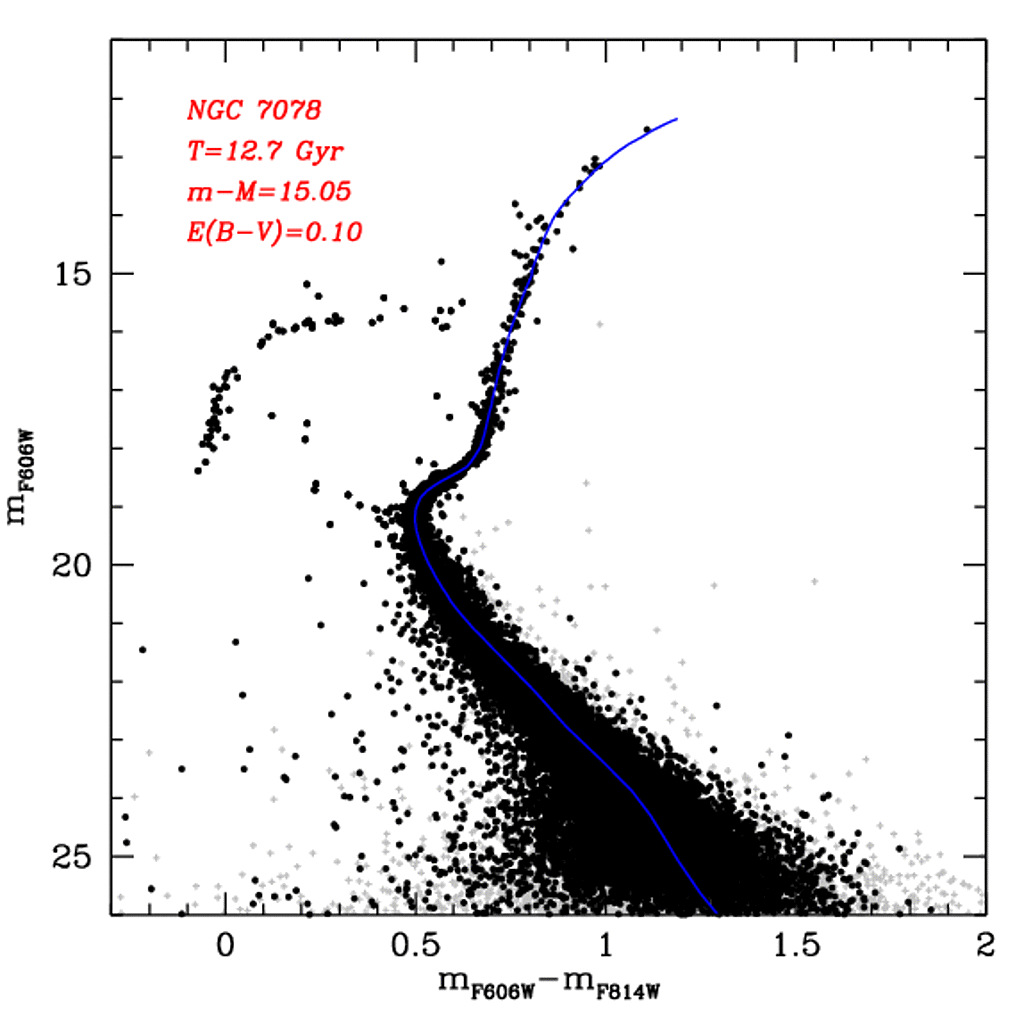
At an estimated 12.7 billion years old (per Gaia-based modeling from Baumgardt, Sollima, Hilker, et al. 2023), M 15 is among the oldest known globular clusters in the Milky Way. The universe itself is about 13.8 billion years old, which means M 15 likely came together within its first billion years or so – long before the Sun, the Earth, or anything resembling our galaxy’s present-day spiral disk existed. Looking at M 15 is about as close as you can get, with a backyard telescope, to looking at something from the universe’s infancy.
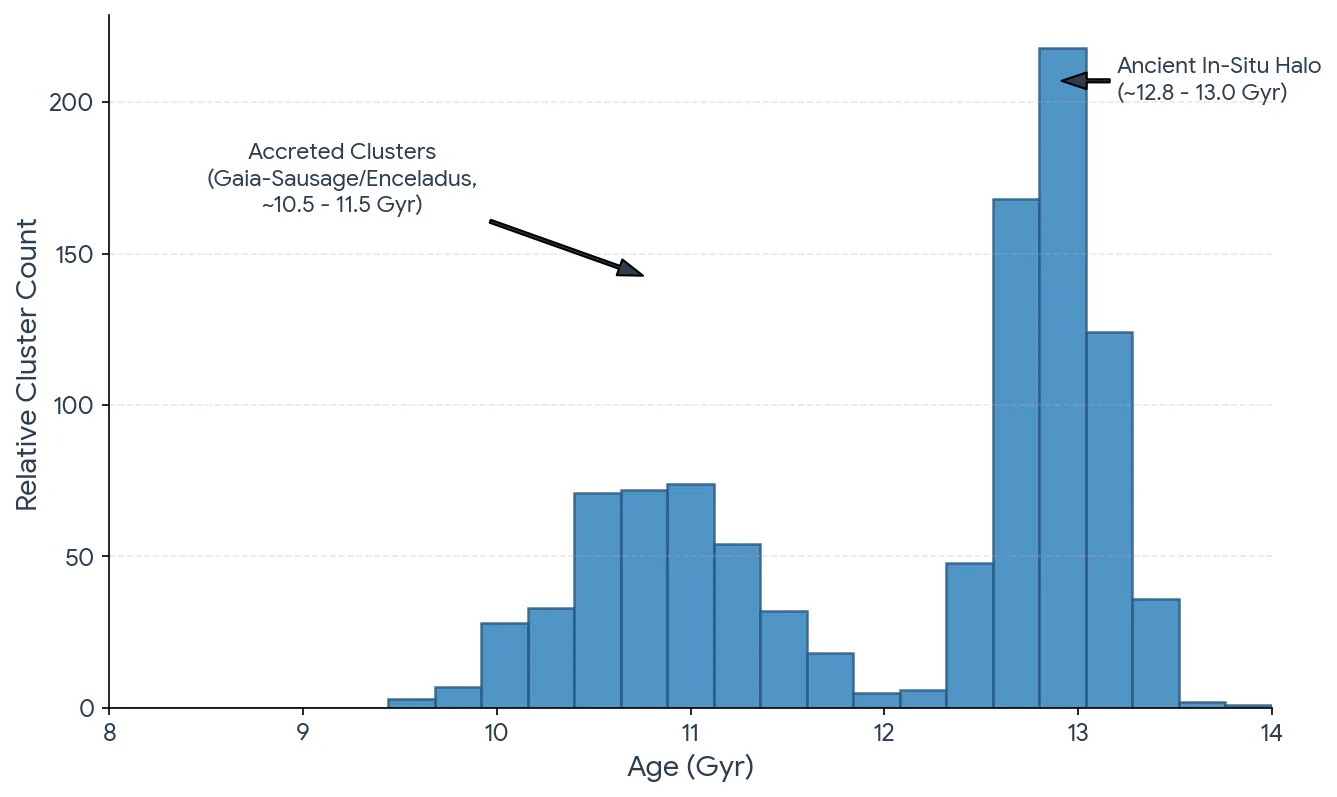
M 15 is currently classified as having formed in place, as part of the Milky Way’s own original population, rather than being carried in later from a smaller galaxy that merged with ours. That distinction is part of a bigger, ongoing story: a substantial number of the Milky Way’s globular clusters are now understood to have originally formed within smaller dwarf galaxies – Gaia-Enceladus, Sequoia, and Sagittarius among the better-known examples – star clusters that came along for the ride when the Milky Way tore those galaxies apart and absorbed them, effectively inherited rather than home-grown. A rarer, more extreme version of that story may be playing out even closer to home: Omega Centauri, the Milky Way’s largest globular cluster by far, is increasingly thought to actually be the stripped-down nucleus of an entire dwarf galaxy in its own right, not just one of its star clusters – everything else that dwarf galaxy once had has already been pulled apart and absorbed into the Milky Way’s halo. M 15, by contrast, isn’t understood to be either kind of import. It’s original equipment.
Where M 15 sits in the galaxy is also worth a look. Recent Gaia-based modeling (Baumgardt, Sollima, Hilker, et al. 2023) puts it about 10,710 parsecs from the Sun, and separately about 10,760 parsecs from the center of the Milky Way – two numbers that turn out to be nearly identical, despite M 15 sitting a full 27 degrees below the plane of the galaxy’s disk. That’s real geometry, not a coincidence in the data: the Sun’s own distance from the galactic center (about 8,200 parsecs) is modest compared to M 15’s roughly 10,700-parsec distance from us, so shifting the reference point from “centered on the Sun” to “centered on the galaxy” barely moves the number. What the 27-degree tilt actually shows up in is the third dimension: M 15 sits roughly 4,900 parsecs – about 16,000 light-years – below the disk plane. So it isn’t especially remote in the “distance from the center of the galaxy” sense; it’s remote in the “well off to the side” sense, parked well outside the flattened disk where the Sun and nearly everything visible to the naked eye actually lives. That’s a common trait among the galaxy’s oldest globular clusters: twelve-plus billion years of gravitational stirring is enough time for an orbit to drift a long way from wherever it started.
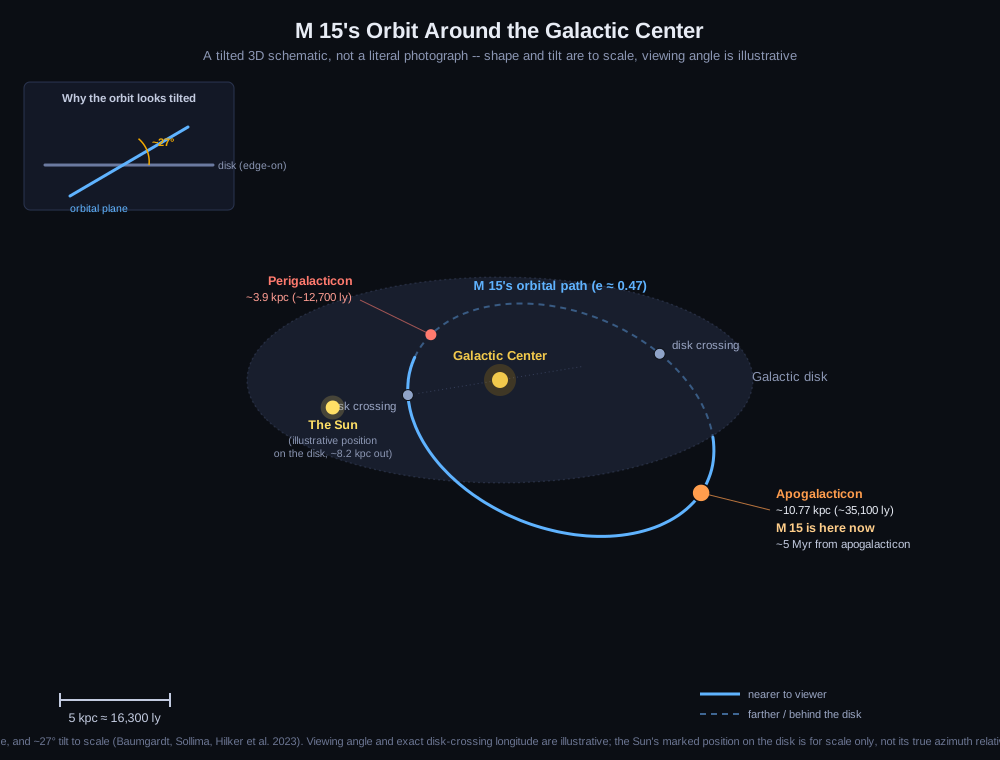
M 15 doesn’t sit still in that halo position, either. Orbital modeling built from that same Gaia data (Baumgardt, Sollima, Hilker, et al. 2023) has it on a markedly eccentric path around the galaxy – an orbital eccentricity of about 0.47, swinging between roughly 3.9 kiloparsecs (about 12,700 light-years) from the Galactic center at its closest, and 10.77 kiloparsecs (about 35,100 light-years) at its farthest, once every 140 million years or so. That farthest point happens to be almost exactly where M 15 sits right now – current modeling puts it within about 5 million years of reaching apogalacticon, the outer turning point of its loop.
That eccentric path matters. Twice each orbit, M 15’s swing carries it plunging through the flattened, star-and-gas-rich disk of the Milky Way itself, rather than staying safely out in the halo the whole time. Each disk passage subjects the cluster to a real tidal jolt – gravitational “shocking” from the disk’s own concentrated mass that nudges the cluster’s more loosely bound outer stars toward escaping altogether. Working out roughly how often that’s happened: a 140-million-year orbit means a disk crossing about every 70 million years, which, spread across M 15’s 12.7-billion-year lifetime, works out to somewhere in the neighborhood of 180 crossings and 90 full trips around the galaxy. Treat that as an order-of- magnitude figure rather than a precise count – it assumes the cluster’s orbit and the galaxy’s own gravity have stayed roughly constant the entire time, which almost certainly isn’t exactly true over 12.7 billion years. Still, it’s a reasonable way to picture just how much repeated stress this ancient system has weathered, on top of whatever is happening in its own collapsed core.
What You Observe
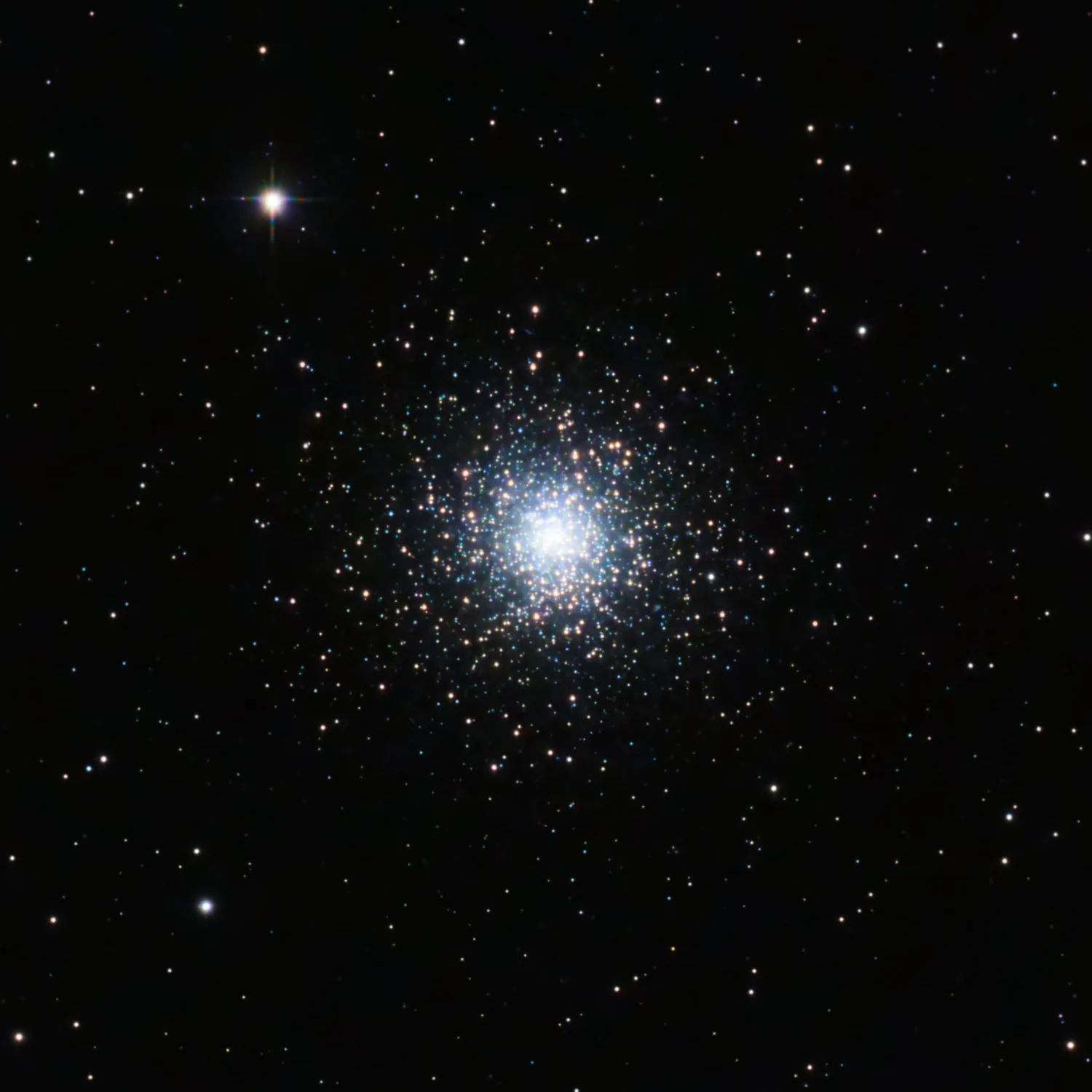
At magnitude 6.2-6.3, M 15 is right at the edge of naked-eye visibility – technically within reach under an excellent, dark sky, though most people will want at least binoculars to pick it out with confidence. Through binoculars it shows up as a small, soft, fuzzy “star” that doesn’t quite resolve into anything more detailed. Step up to a 6-inch telescope or larger and it starts to come apart: individual stars begin resolving around the cluster’s edges, with the core remaining a tight, unresolved blaze of light even in larger amateur instruments.
That core is the interesting part. M 15 is rated Class IV on the Shapley-Sawyer concentration scale, which runs from I – the most tightly concentrated clusters known, like M 75 in Sagittarius – to XII, the loosest and most diffuse, like NGC 5466 in Boötes, where stars are spread thin enough that the cluster barely stands out from the surrounding star field. M 15 sits solidly on the dense side of that scale, but not at the extreme end. What the classification doesn’t fully capture is that M 15’s very center has undergone an actual dynamical event called core collapse: gravitational interactions between stars over billions of years have packed the innermost region into an extraordinarily dense cusp, with more than half the cluster’s stars crammed into a central span only about ten light-years across – close to the cluster’s measured half-mass radius of 11.9 light-years, the radius that by definition contains half its total mass. It’s one of the most centrally concentrated cores of any known Milky Way globular cluster, and what’s actually driving that density cusp is still a genuine, active argument. Early studies proposed a single intermediate-mass black hole at the center, with mass estimates that have shifted around in the range of roughly 1,000 to 3,200 times the Sun’s mass as the modeling improved. A rival explanation – championed by some of the same researchers behind the distance and orbit figures used throughout this article – argues that a dense, sunken concentration of stellar-mass remnants (neutron stars and stellar-mass black holes, settled toward the center over billions of years through ordinary mass segregation) fits the observed stellar motions just as well, without needing a single dominant object at all. Nobody has definitively ruled either picture out, and it’s not just an academic distinction: a single massive black hole would put the innermost stars into comparatively tidy, ordered orbits around one dominant anchor, the way planets orbit a star. A swarm of many separate dark remnants would mean something closer to the opposite – more individual gravitational anchors, not fewer, adding to the chaos rather than calming it down.
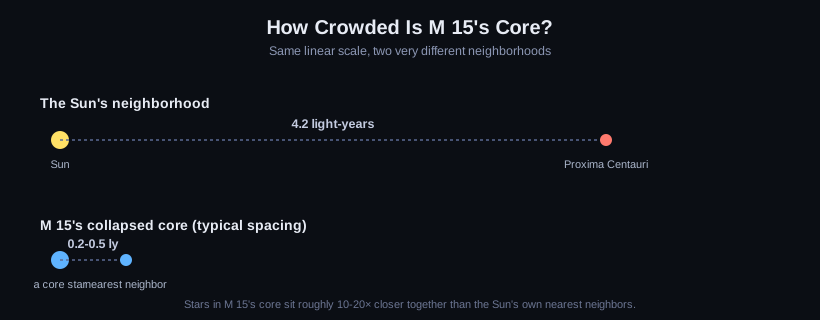
Stars in that collapsed core aren’t just close together – they’re moving fast, and constantly rearranging themselves as a result. Measurements of the core’s motion put the velocity dispersion at somewhere around 15-25 kilometers per second, rising toward the very center – exactly the kind of high-speed traffic you’d expect this tightly packed. Combine that speed with a typical stellar spacing on the order of a fifth to half a light-year – roughly 12,000 to 32,000 astronomical units, putting your nearest neighbors at about the same distance as the outer reaches of our own Sun’s hypothesized Oort cloud – and the core becomes a genuinely violent place on stellar timescales. Working the numbers, a star there sweeps past that kind of distance from its neighbors roughly every few thousand years, not the roughly 225 million years it takes the Sun to complete one orbit of the galaxy without a single close call.
That kind of environment leaves a mark. Direct stellar collisions and close encounters in M 15’s core are thought to be common enough to explain its unusually large population of blue stragglers – stars that appear anomalously young and massive for their position on the cluster’s color-magnitude diagram, because they aren’t single, unaltered stars at all. They’re the product of two older, smaller stars that collided or merged, effectively cheating the clock. It’s also not the kind of place you’d expect a planet to survive, or to have formed in the first place: repeated close passages at those distances are more than enough, over billions of years, to strip away or fling out any original planetary material. The one confirmed planet-like object found in any globular cluster – a strange world orbiting a pulsar-and-white-dwarf pair in M 4 – is thought to have arrived by capture during exactly this kind of dynamical shuffling, rather than forming quietly around its current stars the way planets do out here.
Pease 1 – a Planetary Nebula
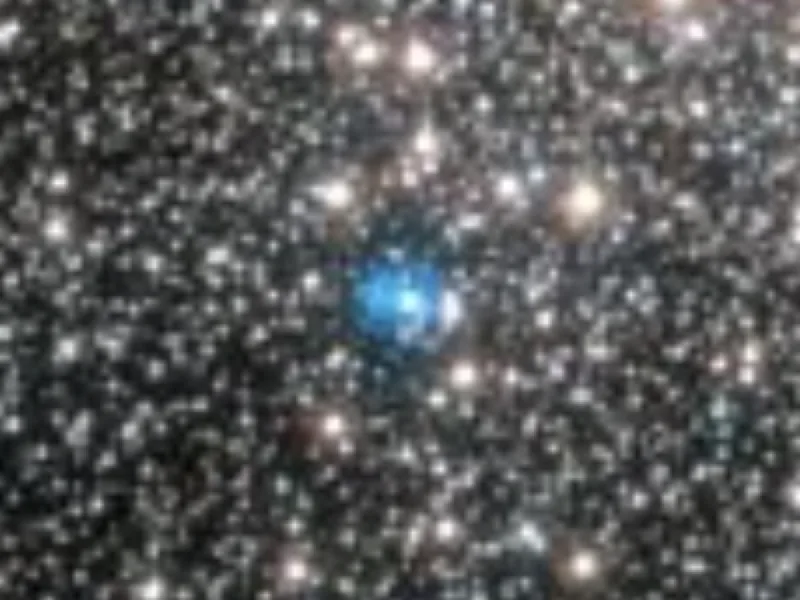
Here’s where M 15 stops being just an old, dense cluster and becomes something genuinely strange. Buried in its outer reaches is Pease 1, a planetary nebula – the glowing, expelled outer layers of a dying star – discovered in 1928 by American astronomer Francis G. Pease, using the 100-inch Hooker Telescope at Mount Wilson Observatory. It was the first planetary nebula ever found inside a globular cluster, anywhere.
That “first” still counts for something, though the tally needs an asterisk. Three planetary nebulae are now confirmed members of Milky Way globular clusters: Pease 1 here in M 15, one in M 22 (Sagittarius), and one called JaFu 2 in NGC 6441 (Scorpius). A fourth, JaFu 1 in Palomar 6 (Ophiuchus), was long counted alongside them too – until a 2024 study (Bond, Bellini, and Sahu) used high-precision Hubble proper motions to show its central star isn’t actually moving with the cluster at all. It’s now considered a foreground or background object that just happens to sit in the same direction, not a genuine member. So: three real ones, one demoted, out of the Milky Way’s 150-plus known globular clusters. Pease 1, the original discovery, is still the one that started it all.
The rarity itself is the interesting part. Planetary nebulae are a brief phase – the visible shell typically only lasts on the order of tens of thousands of years before it disperses into space, which is a blink of an eye against a 12-billion-year-old cluster. On top of that short window, the most massive stars still alive in M 15 today top out around 80% of the Sun’s mass – old, faint, and by most models simply not massive enough to go through the kind of dramatic late-life mass loss that produces a genuine planetary nebula. Pease 1 existing at all is a real challenge to that expectation, and one of the leading explanations ties directly back to the collisions already reshaping this cluster’s core: Pease 1’s central star may itself be the product of two smaller stars merging into one – the same collisional process thought to build M 15’s blue stragglers – effectively boosting a star past the mass threshold it would have needed to produce a planetary nebula on its own. It isn’t proven, but if true, Pease 1 and M 15’s blue stragglers would be two visible symptoms of the same underlying chaos.
It’s also a genuine challenge to find and image. At around magnitude 15.5, and sitting in a crowded field of similarly-faint cluster stars, Pease 1 is not an object you stumble across – you need to know exactly where to look.
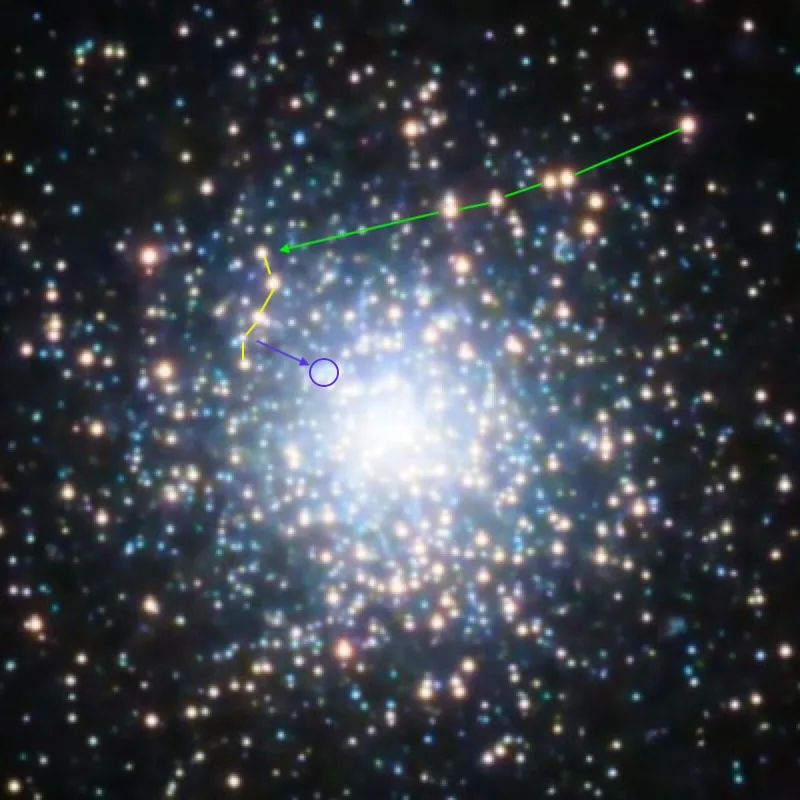
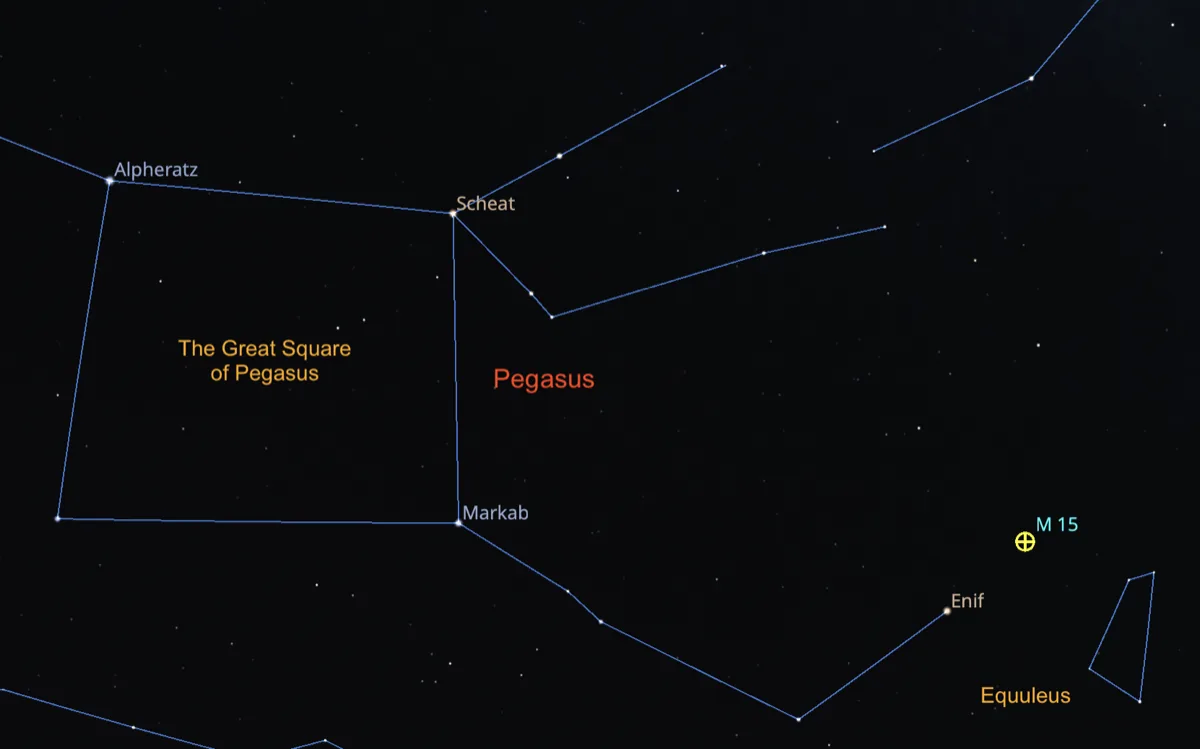
That’s the challenge once you’ve already got M 15 centered in your eyepiece or sensor. Finding M 15 itself in the first place is the easy part: it sits only about 4° from Enif (Epsilon Pegasi), the bright star anchoring one corner of the Great Square of Pegasus, close enough that a single low-power star-hop gets you there directly.
Closing
When M 15 comes up on your fall observing list, it’s worth resisting the urge to treat it as just another globular cluster to check off. This is one of the oldest things you will ever point a telescope at – a system that has been orbiting the Milky Way for the better part of 13 billion years, older than the Sun by a factor of nearly three. And yet it hasn’t stopped surprising the people who study it: its pulsars weren’t found until the 1980s, its double neutron star not until later still, and the true nature of Pease 1’s own existence is still being argued about in journals published within the last two years. An object can be ancient and, at the same time, still actively rewriting what we thought we knew about it.
If you’re imaging rather than just observing, that’s your invitation to try the Pease 1 challenge – not because it’s easy, but because succeeding means picking out a planetary nebula that, by the standard rules for how old, low-mass cluster stars are supposed to die, shouldn’t be there at all. Whatever equipment you’re using, you’ll be looking at the same patch of sky Maraldi swept past in 1746, thinking he was chasing a comet. He had no idea what he’d actually found. Neither, really, do we – not completely. That’s usually the best reason to go look at something again.