Always Worth a Look
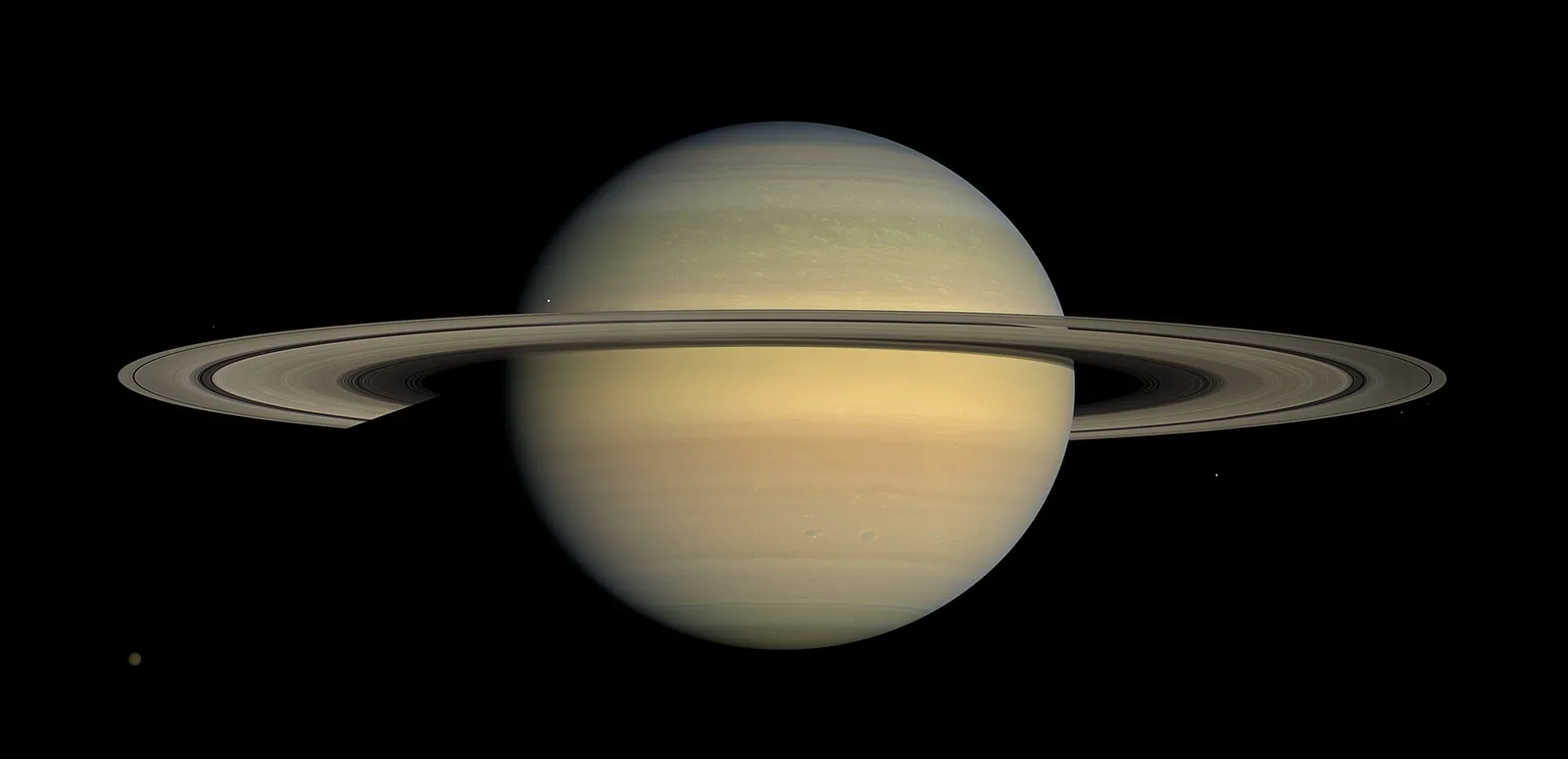
Saturn is one of the most requested sights at every NBAS star party, and it’s easy to see why: aim a telescope at a dim, unremarkable dot, nudge it into focus, and it stops looking like every other point of light in the sky. It doesn’t matter how many times you’ve looked — there’s a real, almost visceral jolt the first moment the rings resolve in the eyepiece, and that reaction doesn’t fade with experience. If you only point a telescope at one thing this fall, make it Saturn.
Saturn reaches opposition on October 4, 2026 — its closest, brightest night of the year. But unlike Mars, where opposition is the whole event, Saturn doesn’t swing wildly in brightness or apparent size from month to month, so there’s no need to circle that date and wait. Early September is simply “Saturn season” already underway: it rises around 8:40–8:45 PM EDT from North Berkshire, early enough that you don’t need to wait until well past midnight to catch it. This is Saturn on a normal bedtime.
And this year there’s something extra. After disappearing edge-on in March 2025, Saturn’s rings are back — showing their southern face for the first time since around 2009, and opening wider by the week. Not the dramatic, wide-open view we’ll get in a few years yet — but a real, visible change. More on exactly how much, below.
The Rings
Everything else about Saturn is worth seeing, but the rings are why people ask for it by name — so it’s worth knowing what you’re actually looking at before you get to the eyepiece.
The rings aren’t a single object; they break into distinct zones, and knowing them changes what you notice. Working outward from the globe: the faint C Ring sits closest in, the bright, wide B Ring is the ring most people picture when they picture Saturn, and the dark gap between the B Ring and the fainter A Ring just outside it is the Cassini Division — the first real ring detail most observers resolve, and the benchmark the aperture guide below is built around.
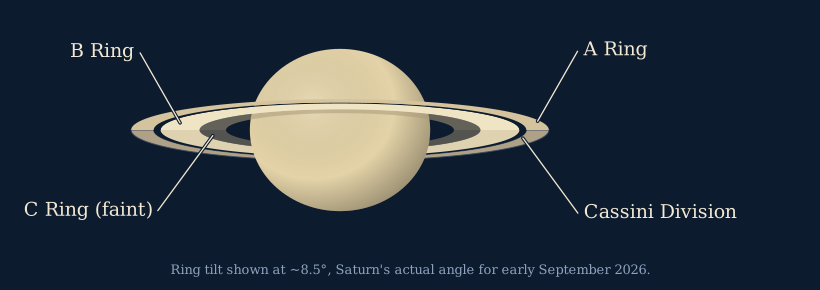
The rings’ tilt toward Earth isn’t fixed, either — it changes slowly over decades as Saturn orbits the Sun, and 2025 was a genuine milestone. On March 23rd, the rings passed edge-on, briefly vanishing to a thin line as seen from Earth. Before that, in 2024, we were looking at the rings’ northern face, tilted only a modest 3.5–4.6°. Now, as of September 2026, they’ve flipped to show their southern face, open to roughly 8.5° — more than double 2024’s tilt, and a face of the rings unseen since around 2009.
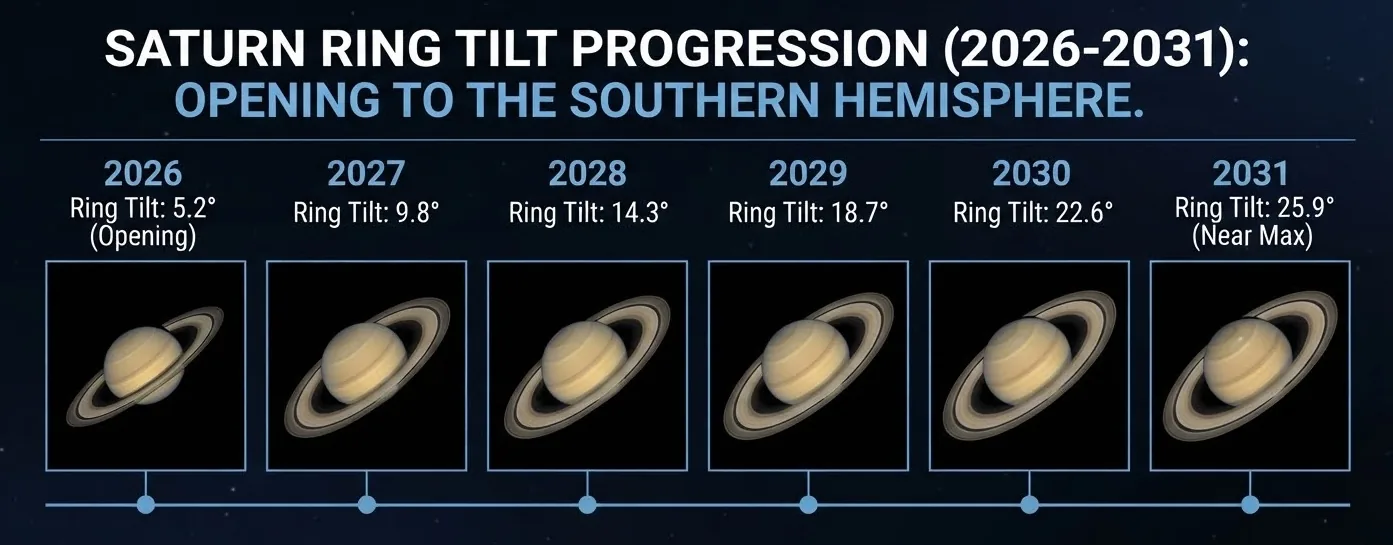
The chart above shows how that opening continues: the rings won’t go edge-on again until October 2038, and keep widening toward a maximum of about 27° around 2032. 2026 isn’t the dramatic, wide-open postcard view yet — but it’s a real, visible change from just two years ago, and the start of more than a decade of steadily improving views.
How to Experience Saturn
However you observe, Saturn scales with you. There’s a real, satisfying progression here — naked eye, then binoculars, then a telescope at whatever aperture you’ve got, then a smart scope if you have one — and each step shows you something genuinely new, not just a bigger version of the last. Start wherever you are.
Naked Eye
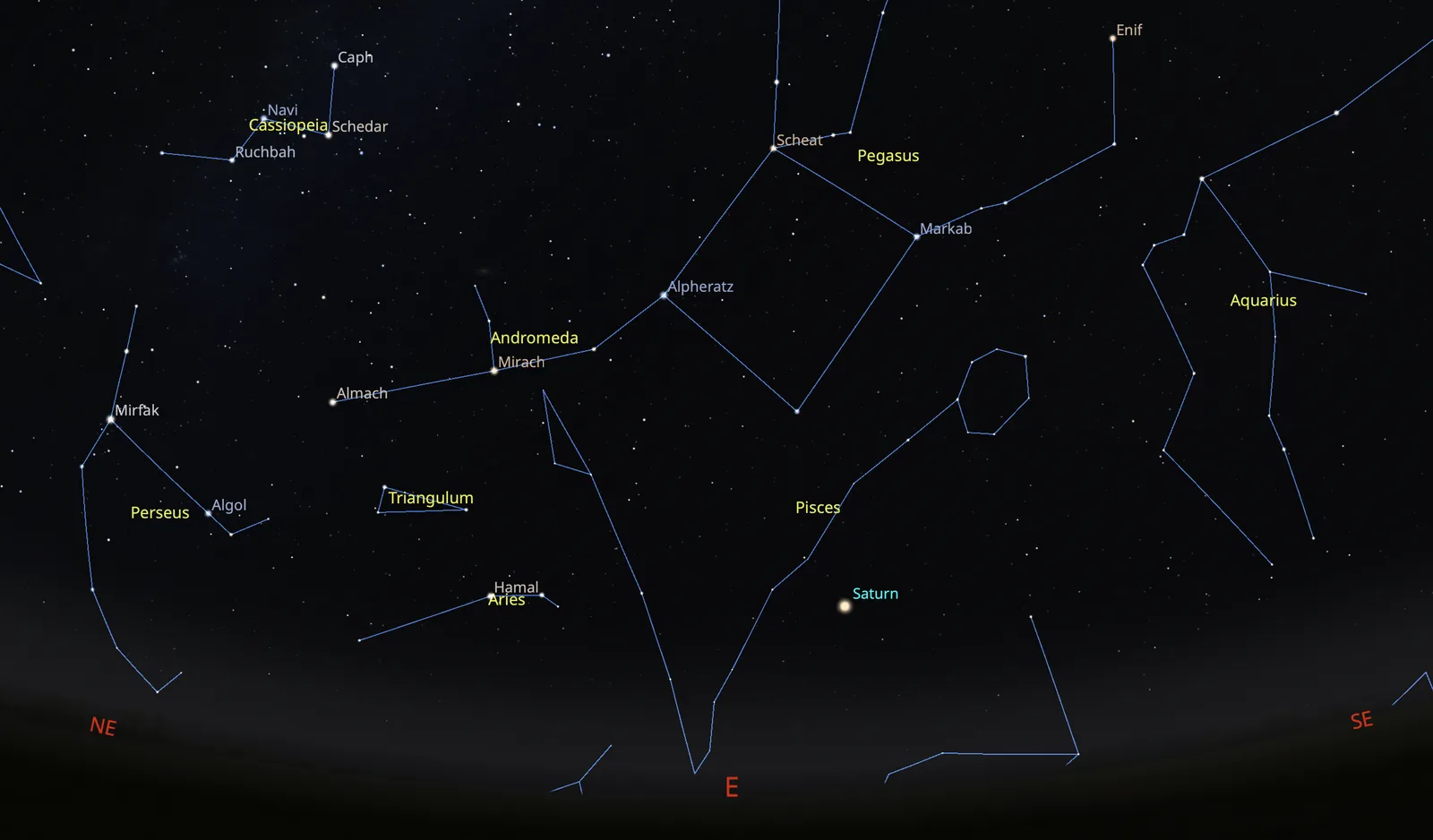
You don’t need any equipment to start — and you don’t need to pick Saturn out from a field of similarly bright stars, either. In early September, Saturn sits in Pisces, a faint, sprawling constellation with nothing in it that comes close to Saturn’s brightness; once you’re looking in the right direction, there’s no mistaking which “star” is the planet. The harder part for most people is simply knowing where in the sky Pisces is in the first place, which is exactly what the wide-field chart above solves better than any comparison star could: orient off something recognizable — the Great Square of Pegasus is the obvious anchor nearby — and Saturn is the one steady, non-twinkling point of light in the dim stretch of sky below/east of it. Our weekly-updated starmaps show exactly where to look on any given night, if you’d rather not do the orienting yourself.
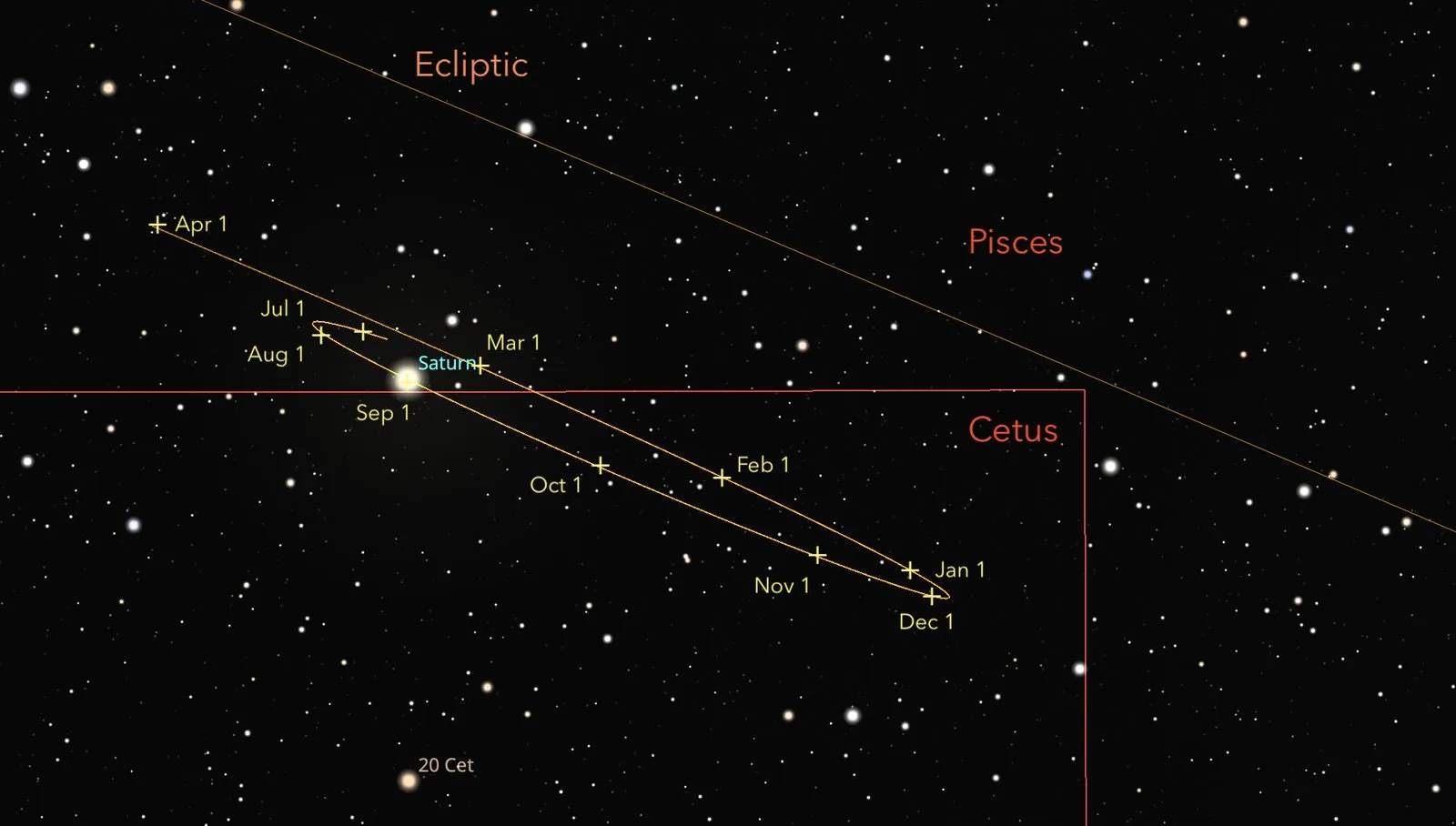
Saturn won’t stay put, either — the chart below tracks its path against the background stars through the fall. By the time it reaches opposition in October, it will have drifted from Pisces into neighboring Cetus, so if you’re coming back to this later in the season, it’ll appear a little further to the southwest.
Watch it long enough and you can catch it changing direction. Saturn has been sliding westward against the stars (retrograde motion — an illusion from Earth overtaking it in our faster orbit) since late July, and keeps drifting that way until mid-December, when it pauses and starts moving eastward again for the rest of its apparition. It’s a slow effect, but a real one: note Saturn’s position against a couple of background stars now, check back in a few weeks, and see if you can detect the shift yourself.
Binoculars
Standard 7x50 or 10x50 binoculars — the kind most people already own — won’t show you Saturn’s rings the way a telescope does, and it’s worth saying that plainly rather than promising more than they can deliver. What you will see is something that doesn’t look quite like every other point of light around it: Saturn reads as a small, distinctly non-round blob rather than a clean dot. That’s genuinely something you’re detecting with your own eyes, not a consolation prize for lacking a telescope. You won’t “see” the rings in the way a telescope shows them — but if that blob doesn’t look quite round, you’re perceiving them anyway, and that’s a real accomplishment worth having before you ever look through an eyepiece.
Telescopes, by Aperture
Where binoculars leave off, a telescope picks up immediately — and the jump in what’s visible is dramatic even with a modest scope. Here’s roughly what to expect at each size:
| Aperture | What You’ll See |
|---|---|
| Small (60–90mm) (2.4–3.5") | The rings pull cleanly away from the globe into an unmistakable ring, not just an elongated blob, around 25–50x — the moment binoculars were building toward. Titan (mag ~8.4) sits nearby as an easy “extra star” at almost any power. On a good night, the Cassini Division is even catchable at 100x+. |
| Medium (6–8") | The Cassini Division is reliably visible in good seeing. Beyond Titan, a few more moons (Rhea, Dione, Tethys, and sometimes Iapetus) are within reach in principle — though in practice they’re often dimmer and harder to pick out than their magnitudes suggest, thanks to Saturn’s glare and typical sky conditions. Check the Solar System Dashboard for what’s actually well-placed tonight rather than guessing. |
| Large (10"+) | Subtle belts or festoons on the globe itself become realistic in excellent seeing, and Enceladus joins the moon list — with Mimas a genuine challenge even here, buried deep in Saturn’s glare. Worth keeping expectations in check: of Saturn’s 270-plus known moons, only six or seven are ever within reach of a backyard telescope. |
Smart Scopes
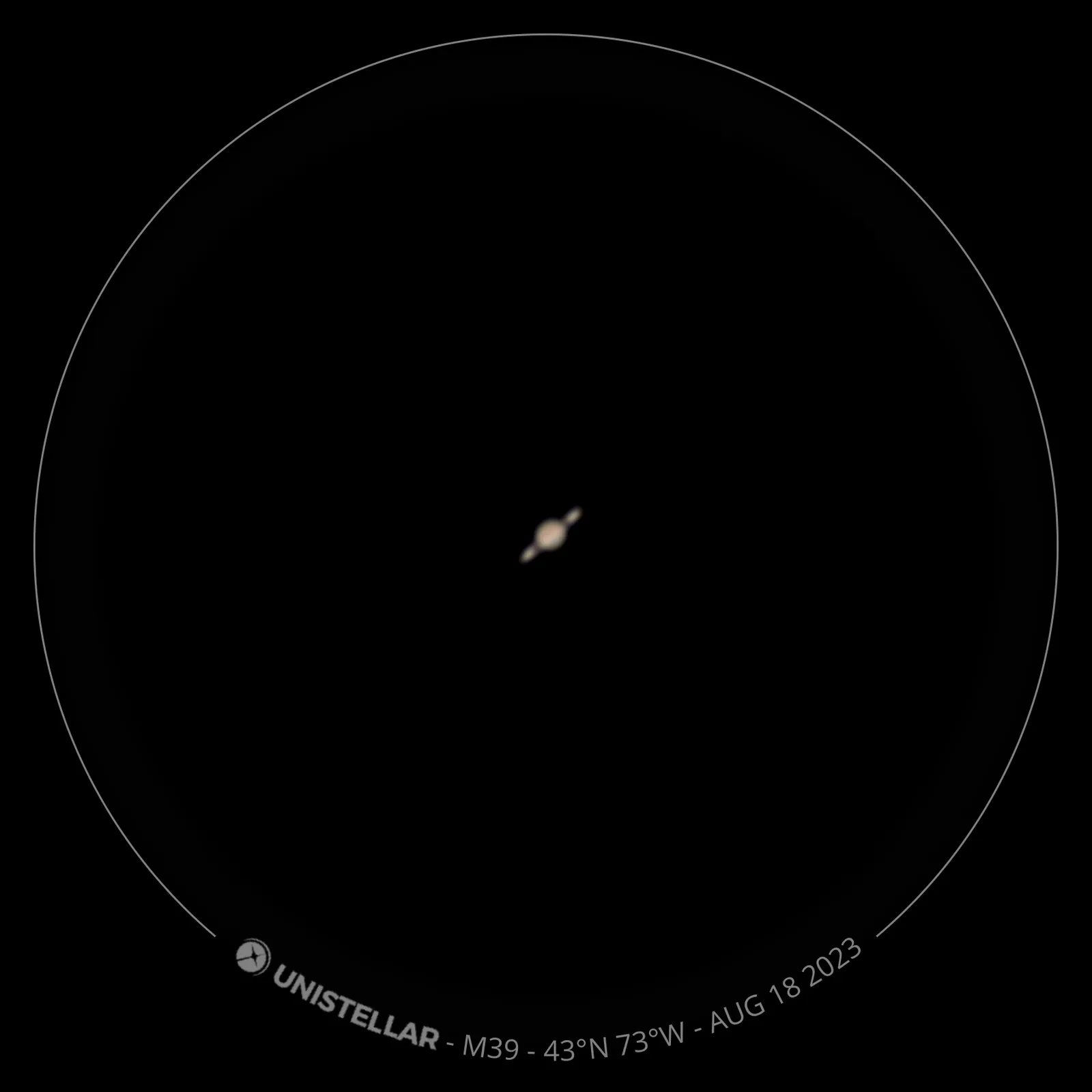
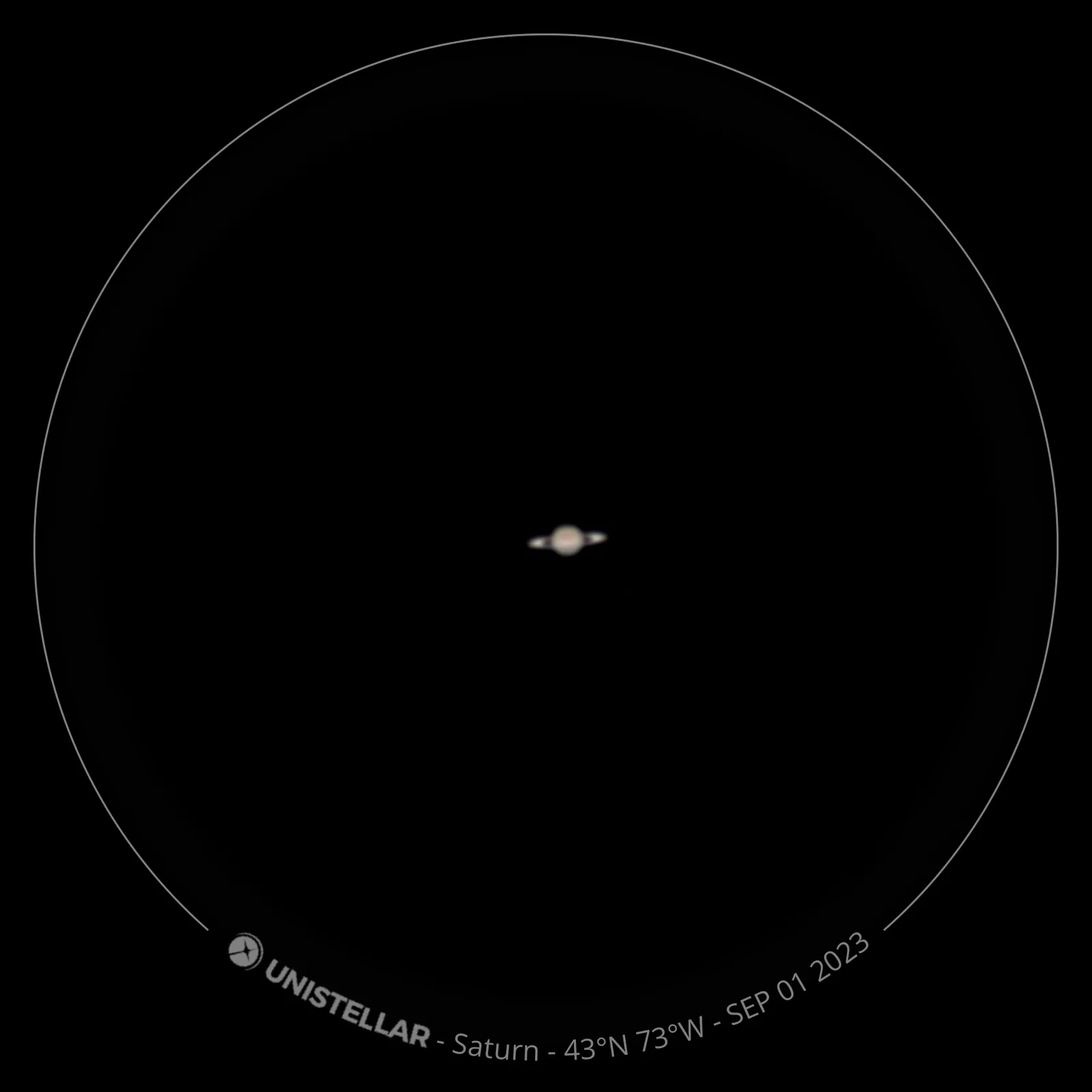
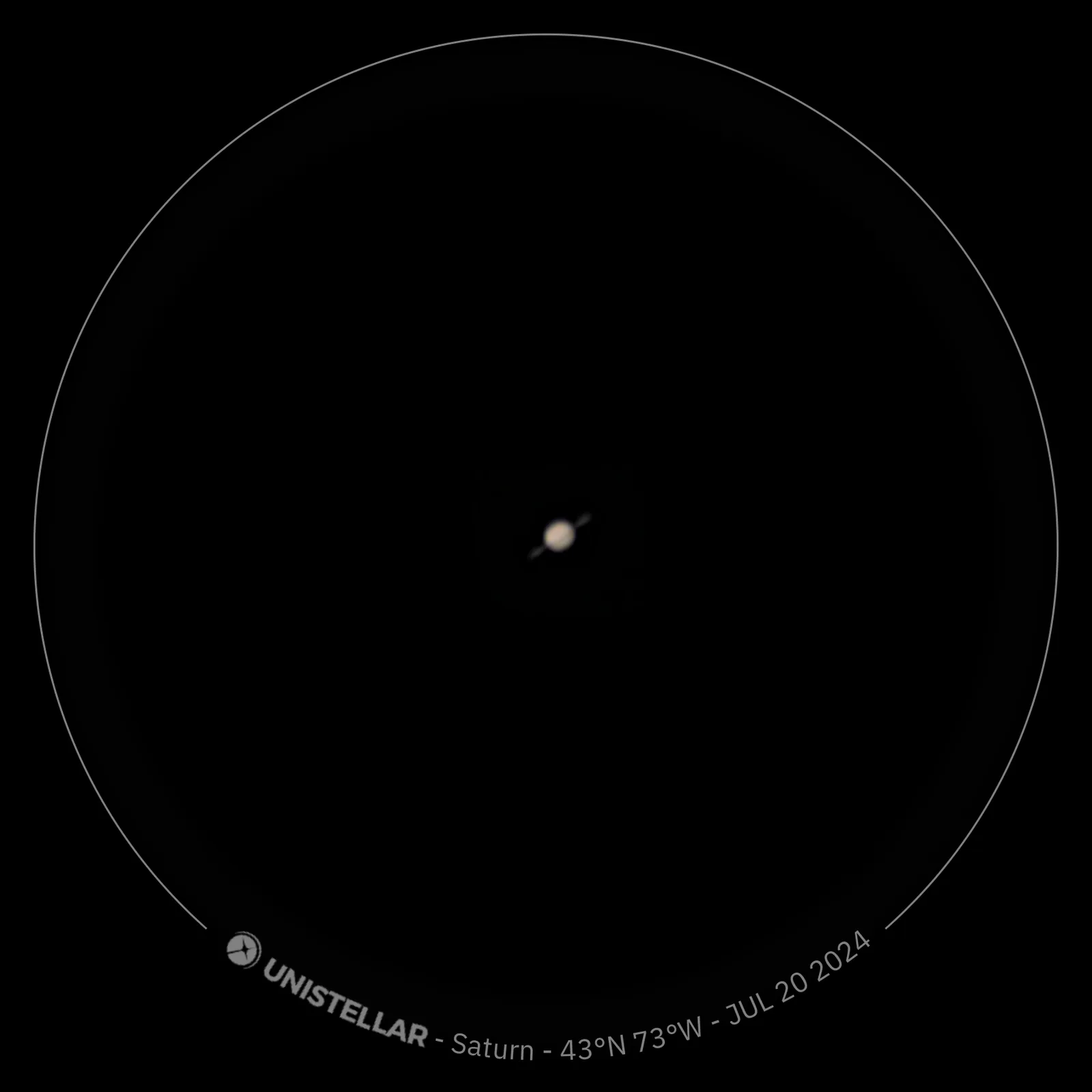
None of these were stacked or processed at all — just quick eQuinox 2 snapshots, single short frames straight out of the app. Don’t expect Cassini Division detail or festoons on the globe; what you’re aiming for is exactly what you see here: a clear disk and a clear ring, unmistakably Saturn, with minimal effort.
Smart scopes work differently here than they do on deep-sky targets, and it’s worth knowing that going in — the usual “frame it and let it stack for twenty minutes” approach isn’t how Saturn works. Planets are small, bright, and blurred mostly by our own atmosphere, not by a lack of signal, so the app needs a different mode entirely.
Unistellar (eQuinox/eQuinox 2): switch to Planet Mode — the app recognizes Saturn as a bright planet and adjusts exposure automatically, but you’ll get a better result capturing video and processing afterward rather than taking the single auto-stacked still. Center Saturn carefully with the joystick (optical quality falls off toward the edge of the frame), and don’t bother if Saturn is low in the sky — under about 25° altitude, atmospheric blur usually wins regardless of settings. It’s worth trying on more than one night; turbulence varies, and some nights are simply steadier than others. For processing the video afterward, AutoStakkert! is the free, go-to tool most planetary imagers reach for — it aligns and stacks only the sharpest frames from your clip automatically.
ZWO Seestar: switch to Planetary mode, capture RAW video rather than a stack, and keep clips short — 10-30 seconds is usually plenty before turbulence changes the picture anyway. Nudge the gain up a little (roughly 80-120) since Saturn is fainter than Jupiter, and use the app’s zoom to fine-focus before you start recording. Both approaches lean on “lucky imaging”: you’re capturing far more frames than you need and keeping only the sharpest ones, either automatically in-app or by running the video through free stacking software afterward.
For anything not covered here — or for other smart scopes entirely — the instructions in your app’s own planetary/lucky-imaging mode will get you further than guessing. The gallery above is a realistic bar to aim for on a first attempt, not a best-case result: modest effort, default settings, no prior planetary-imaging experience.
Solar System Dashboard
For anything time-sensitive — which moons are up, exactly where Saturn sits right now, when it sets — you don’t have to wait for a clear night to check. The “Above Horizon Now” widget at right is a live snapshot of our Solar System Dashboard, updated automatically. If Saturn isn’t listed there when you look, that just means it’s below the horizon at that moment, not that anything’s wrong — check back later in the evening.
For the complete picture, click through to the full Solar System Dashboard: it includes a panel showing Saturn’s brighter moons and their current positions relative to the planet — exactly the “what am I actually looking at” answer that’s hard to get any other way — plus an adjustable date and time (defaulting to right now), so if clouds push your observing night past September 3rd, you can check conditions for whichever night you actually get clear skies.
Come See It With Us
If you don’t have a scope and want “the Saturn experience” - check our Upcoming Events widget in the sidebar and come to one of our public observing nights! If Saturn is above the horizon in the evening (and it will be through the end of the year and into 2027), it will definitely be on our observing list!