Detecting moons orbiting the major planets is typically a challenge of aperture, magnification, and seeing. Most of the brighter moons orbit close enough to their planet that you can find them by pointing at the planet and consulting an ephemeris or using an app that will show you their orientation. Phoebe won’t let you do that. It orbits Saturn from so far out — roughly four times farther than Iapetus — that by the time you find it, Saturn itself may not even be in the frame. What you’re actually hunting is a 16th magnitude point of light, indistinguishable from the field stars around it except that, night over night, it moves and they don’t.
So this challenge — similar to our previous challenges looking for Haumea and Makemake — is an exercise in precise pointing, patience, and old-fashioned needle-in-a-haystack searching. But the payoff is a moon with a strange history and an outsized influence on the rest of the outer Saturnian system.
History
Only a few decades after Galileo first spied the four major moons of Jupiter, Titan was found by Huygens in 1655, then followed by Iapetus and Rhea in the early 1670s, Tethys and Dione in 1684, Mimas and Enceladus in 1789, and finally Hyperion in 1848 — each discovery made by pushing to a larger telescope and a fainter limit than the last. By the time Phoebe came along, fifty-one years after Hyperion, that count stood at eight. Phoebe broke the pattern in a genuinely new way: nobody watched it appear at the eyepiece. It showed up on a piece of glass, and even then, nobody noticed for the better part of a year.


It took William Henry Pickering, back at Harvard, until March 1899 to notice it. Comparing plates taken on different nights, he found a faint object whose position shifted in a way that didn’t match any of Saturn’s eight known moons. He announced the discovery that month. Phoebe became the first moon in the solar system ever discovered photographically rather than visually — a preview of how nearly every moon discovered since has been found: on film, then on CCDs, rather than at the eyepiece.

What we have learned about Phoebe
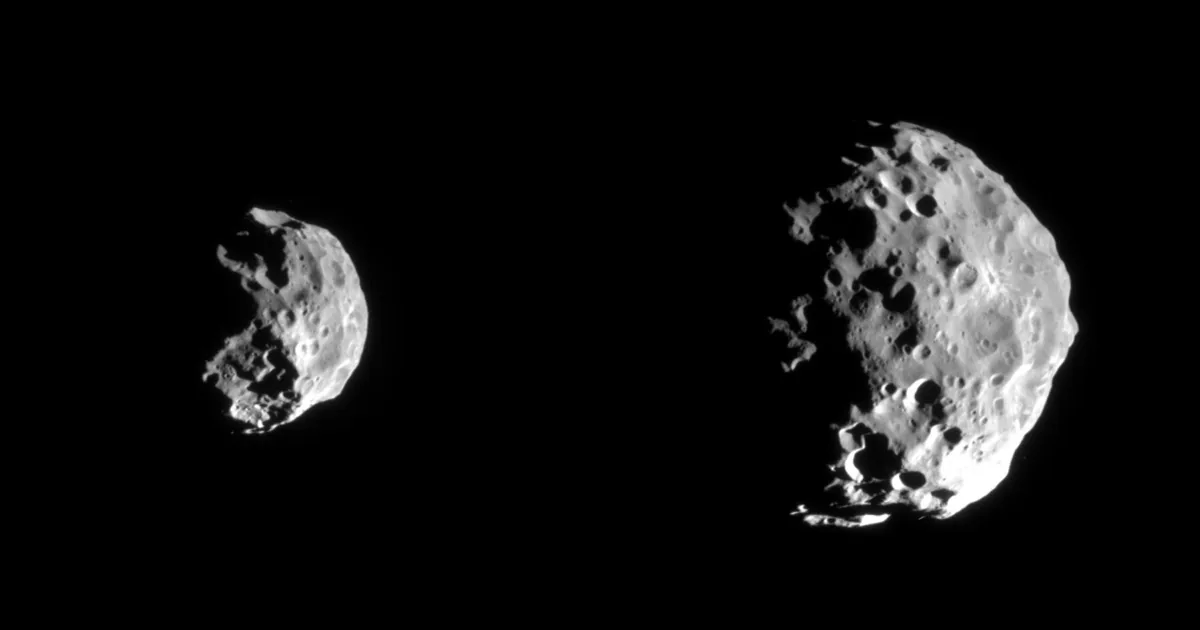
Phoebe is Saturn’s largest irregular moon, a lumpy, heavily cratered world about 213 km across — roughly one-sixteenth the diameter of our own Moon. “Irregular” is a specific term: unlike Saturn’s regular moons, which orbit close to the plane of the rings in tidy, nearly circular paths, Phoebe orbits far out, on a tilted, moderately eccentric path, and it goes around Saturn “backwards” — retrograde, opposite to Saturn’s rotation and to the direction every regular moon travels. That combination of traits places it in a family of moons called the Norse group, and Phoebe is by far the largest member. It’s also the second-largest retrograde satellite in the entire solar system, behind only Neptune’s Triton.
This size and its orbit made Phoebe a genuine bully among Saturn’s outer moons — though “the Norse group” is really shorthand for several unrelated families, not one. The outer retrograde zone is a stable dynamical parking spot (retrograde orbits out here resist solar perturbations better than prograde ones do), so multiple bodies have likely been captured into it independently over the solar system’s history. What turned those captures into 200-plus known moons is collision: packed into a shared orbital neighborhood, irregular satellites smash into each other far more often than asteroids do, and with by far the largest cross-section out there, Phoebe has likely been involved in roughly half of those impacts. Some Norse moons may be its fragments, though whether a genuine surviving Phoebe family exists is still debated; the best recent attempt to sort the wreckage (Ashton et al., 2025) instead finds three looser subgroups by inclination, one of which looks like the debris of a single breakup roughly 100 million years ago.
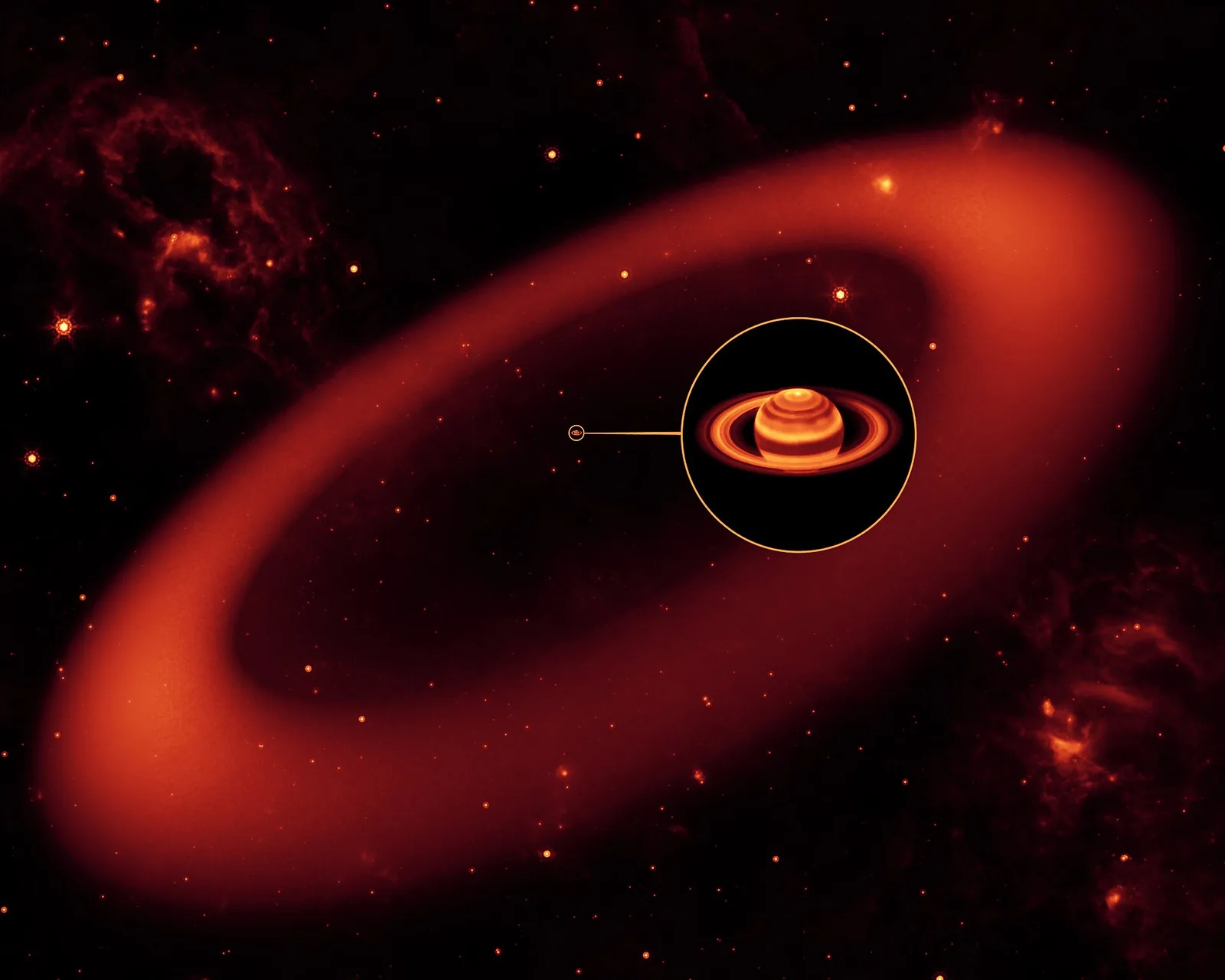
Phoebe’s most surprising influence on its neighbors, though, is invisible to the eye. In 2009, NASA’s infrared Spitzer Space Telescope discovered an enormous, extremely tenuous ring of dust extending outward from Phoebe’s orbit — the so-called Phoebe ring, tilted 27° from Saturn’s other rings and vastly larger than any of them. That dust, kicked off Phoebe’s surface by countless small impacts, drifts slowly inward on Phoebe’s backward orbit and rains down on the leading hemisphere of Iapetus, the next major moon in. That’s now the leading explanation for one of Saturn’s oldest visual mysteries: why Iapetus has one hemisphere as bright as snow and one as dark as coal.
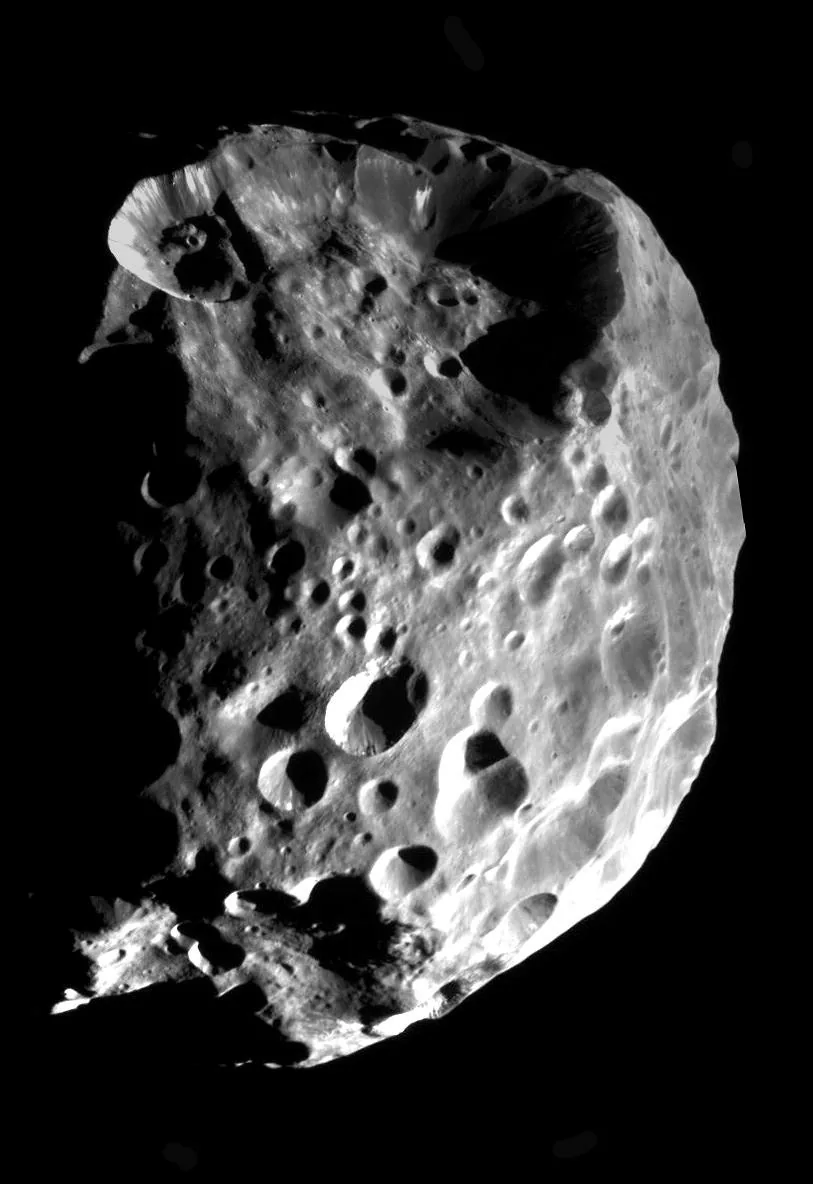
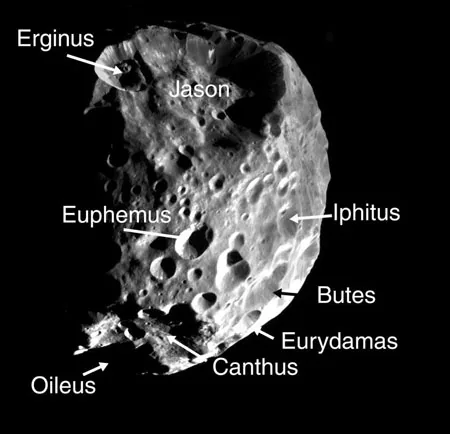
Where did Phoebe actually come from? For decades after its discovery, its dark, carbon-rich surface looked like an asteroid’s, and that was the working assumption. Cassini changed the picture. Arriving at Saturn in 2004, Cassini made Phoebe its very first target, flying past at just 2,068 km on June 11, 2004 — weeks before the main engine burn that put the spacecraft into orbit around Saturn itself. That flyby, plus later spectroscopy from Cassini’s instruments and, more recently, the James Webb Space Telescope, found abundant water ice just beneath Phoebe’s dark surface crust, along with carbon dioxide — a combination that has never turned up on a genuine asteroid. Phoebe also turns out to be roughly half rock, denser and rockier than Saturn’s icy inner moons. The emerging consensus is that Phoebe isn’t a captured asteroid at all, but a captured Centaur: a body that formed far beyond Saturn, out among the icy dwarf planets of the Kuiper Belt, before gravity pulled it in and Saturn caught it. It’s one of the only Kuiper Belt-type objects ever photographed as more than a dot.
The View from Phoebe
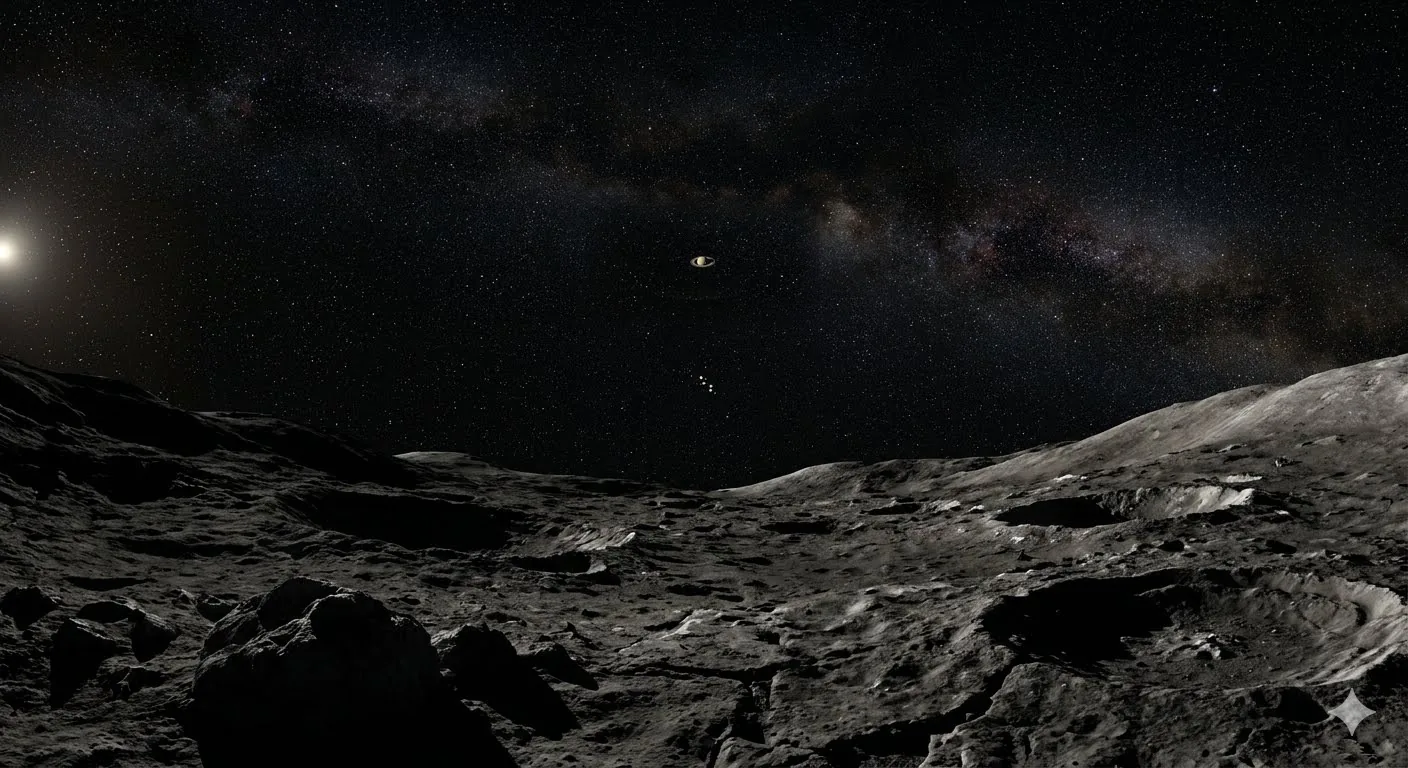
Space art has a habit of blowing planets up for drama, and it’s worth pausing on what Saturn genuinely looks like from way out here before you go hunting for its faintest large moon. Phoebe orbits at roughly 12.9 million km from Saturn on average — about 34 times the Earth-Moon distance, on a path eccentric enough that the real distance swings between about 10.8 and 15.1 million km. From that far out, Saturn’s globe alone spans only about 30 arcminutes in the sky, essentially the same apparent size as our Moon seen from Earth. Add the rings and you get roughly 1° to 1.4° across, depending on where Phoebe sits in that orbit — two to three Moon-widths, not a horizon-filling giant.
That’s the real backdrop for this challenge: a small, pale ringed disk hanging in a genuinely dark, star-crowded sky, with Phoebe itself lost somewhere in the surrounding field — just another point of light, indistinguishable from its neighbors except that it moves.
Finder Charts
Here are the JPL/Horizons ephemeris positions overlaid on DSS images spaced every 15 days. The blue line traces Phoebe’s path across the sky over each chart’s date range, with dots marking its position on each date and labels for the first and last night. The red circles mark field stars of roughly the same brightness as Phoebe during that window — use them to calibrate what you’re actually looking for before you go hunting for a point of light that, unlike its neighbors, won’t be in the same place tomorrow night.
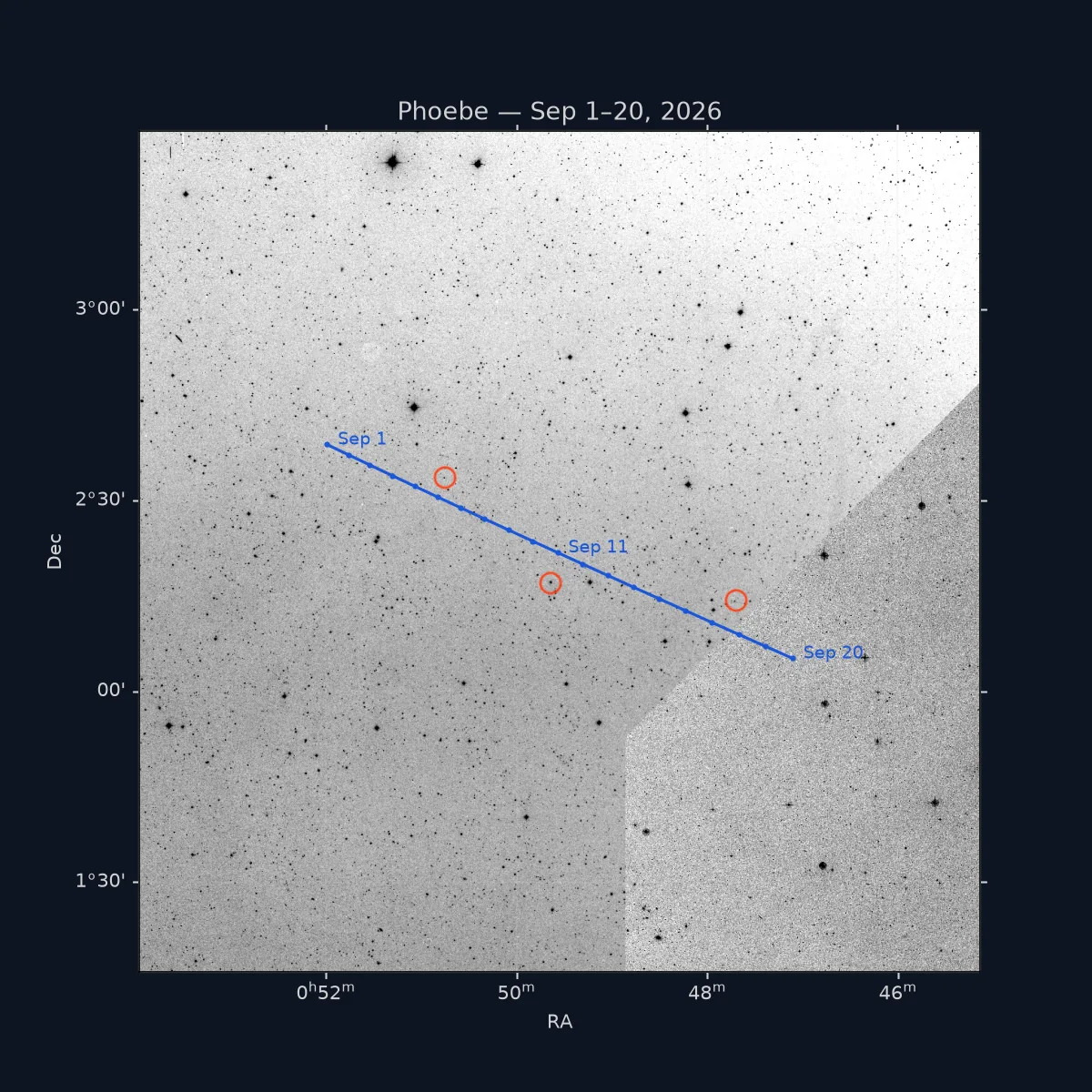
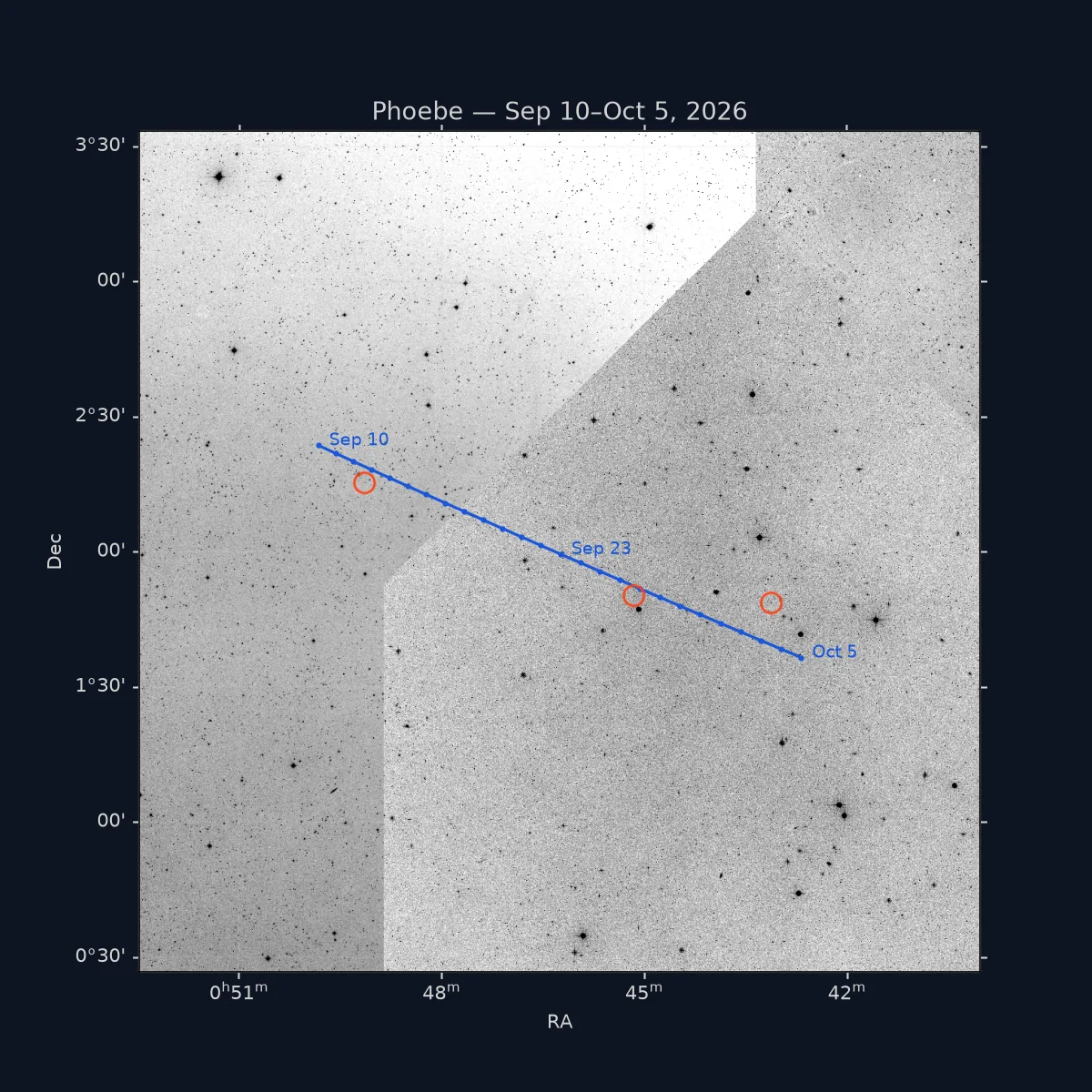
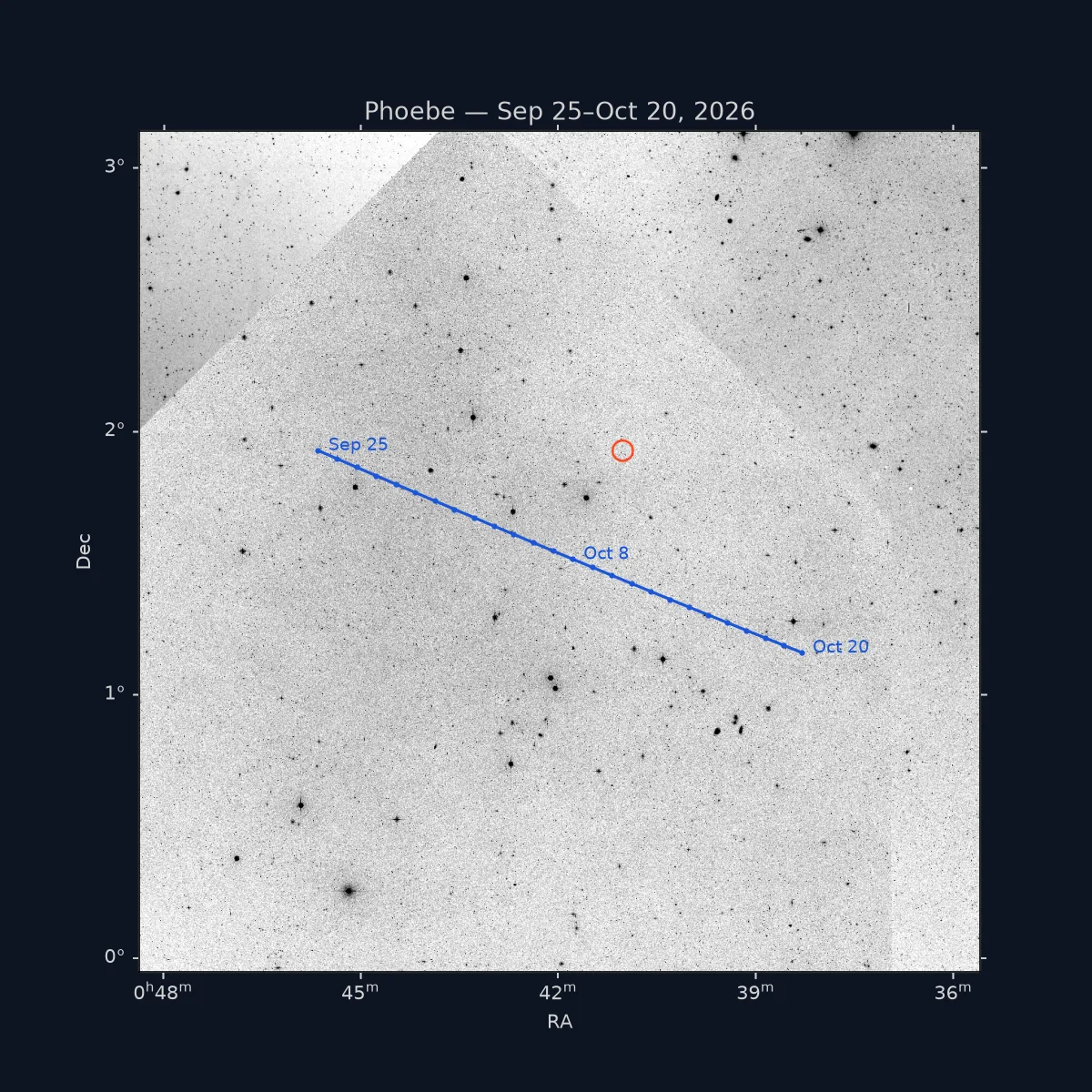
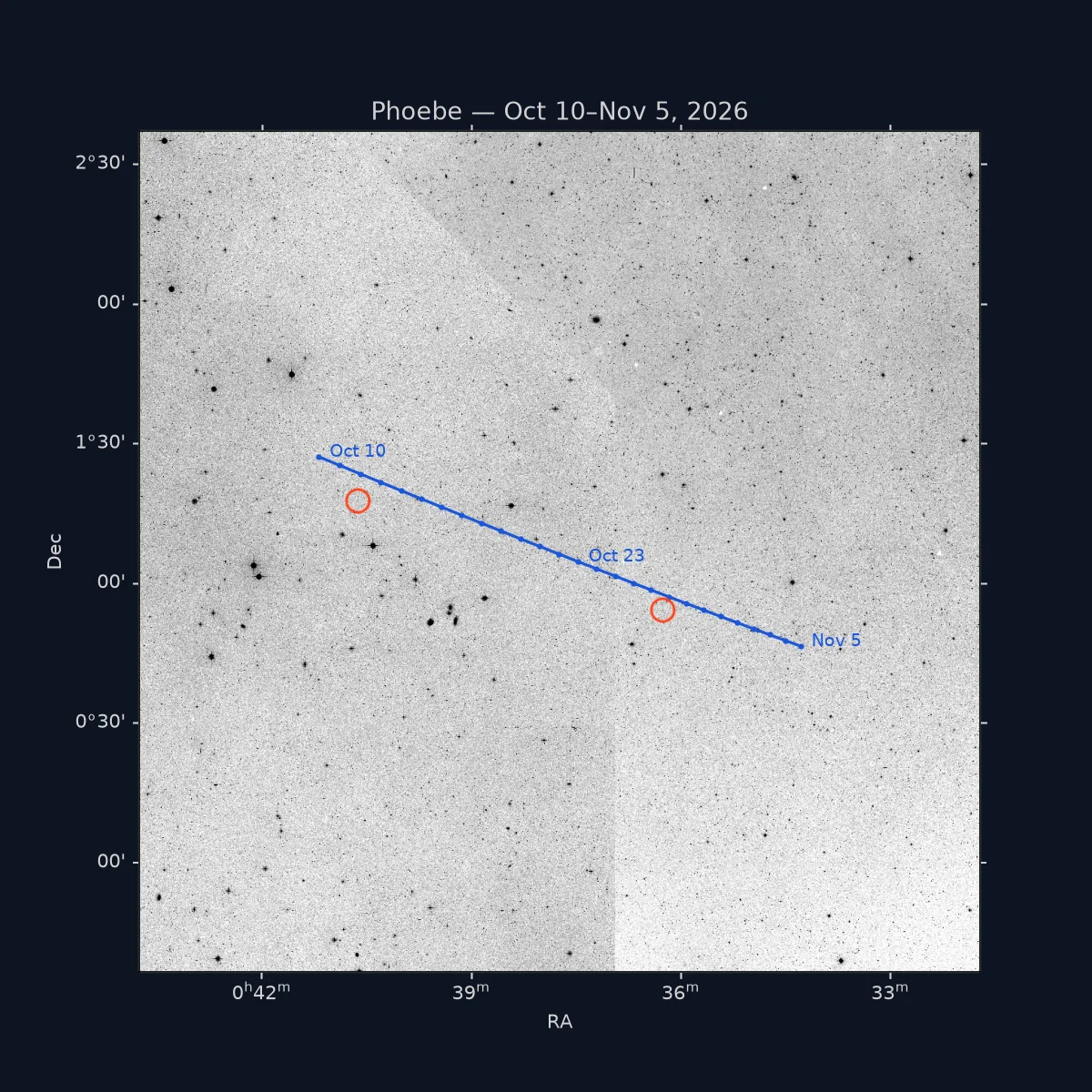
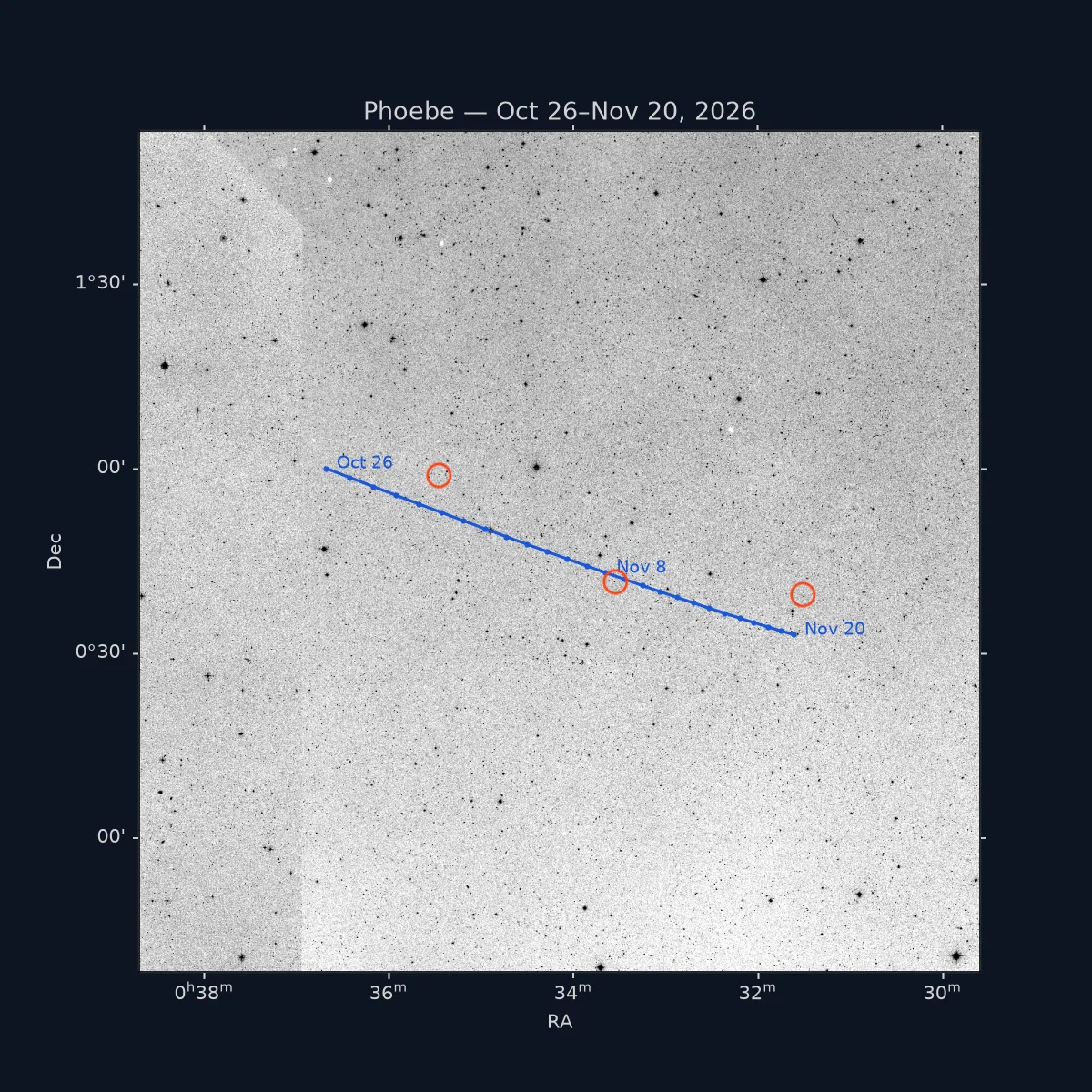
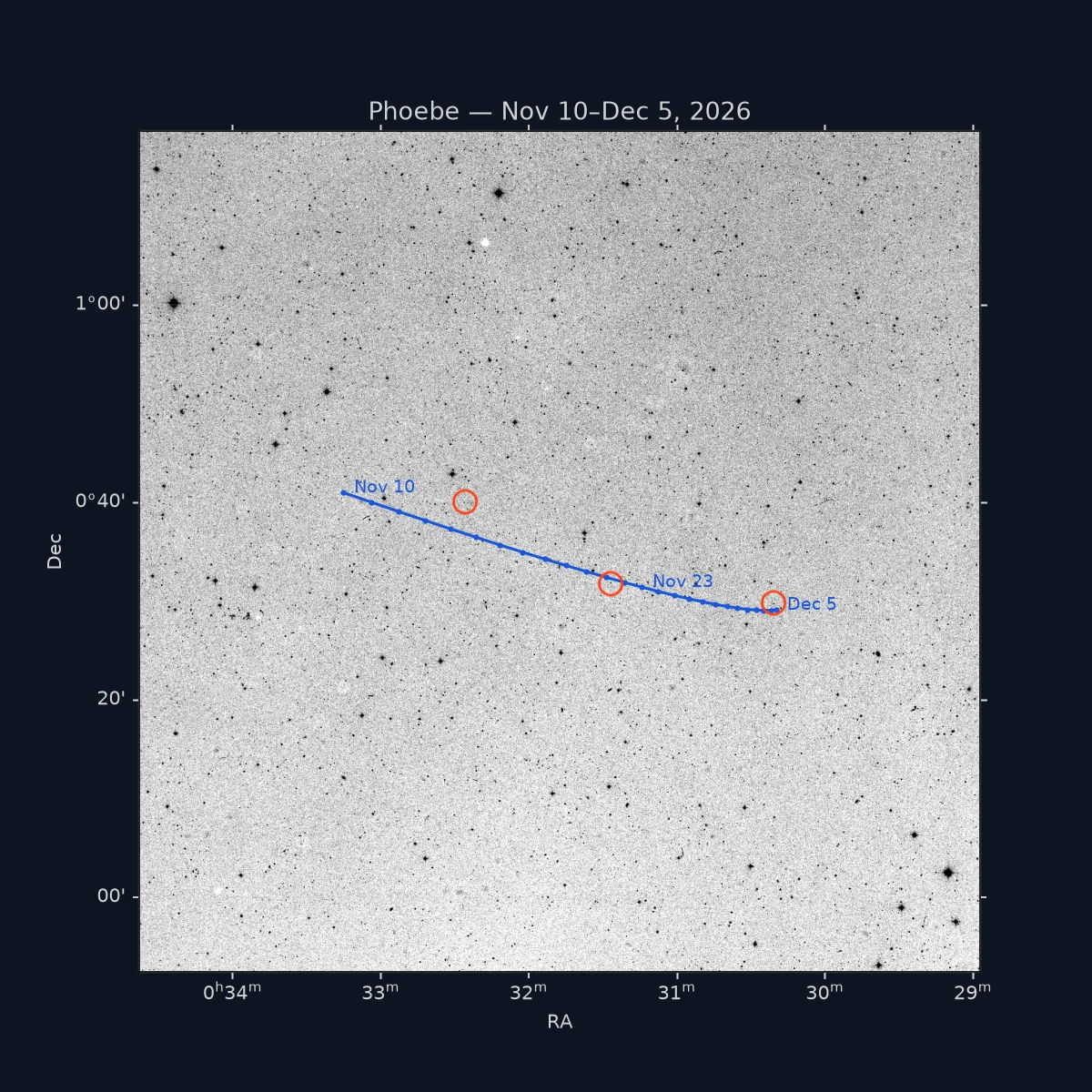
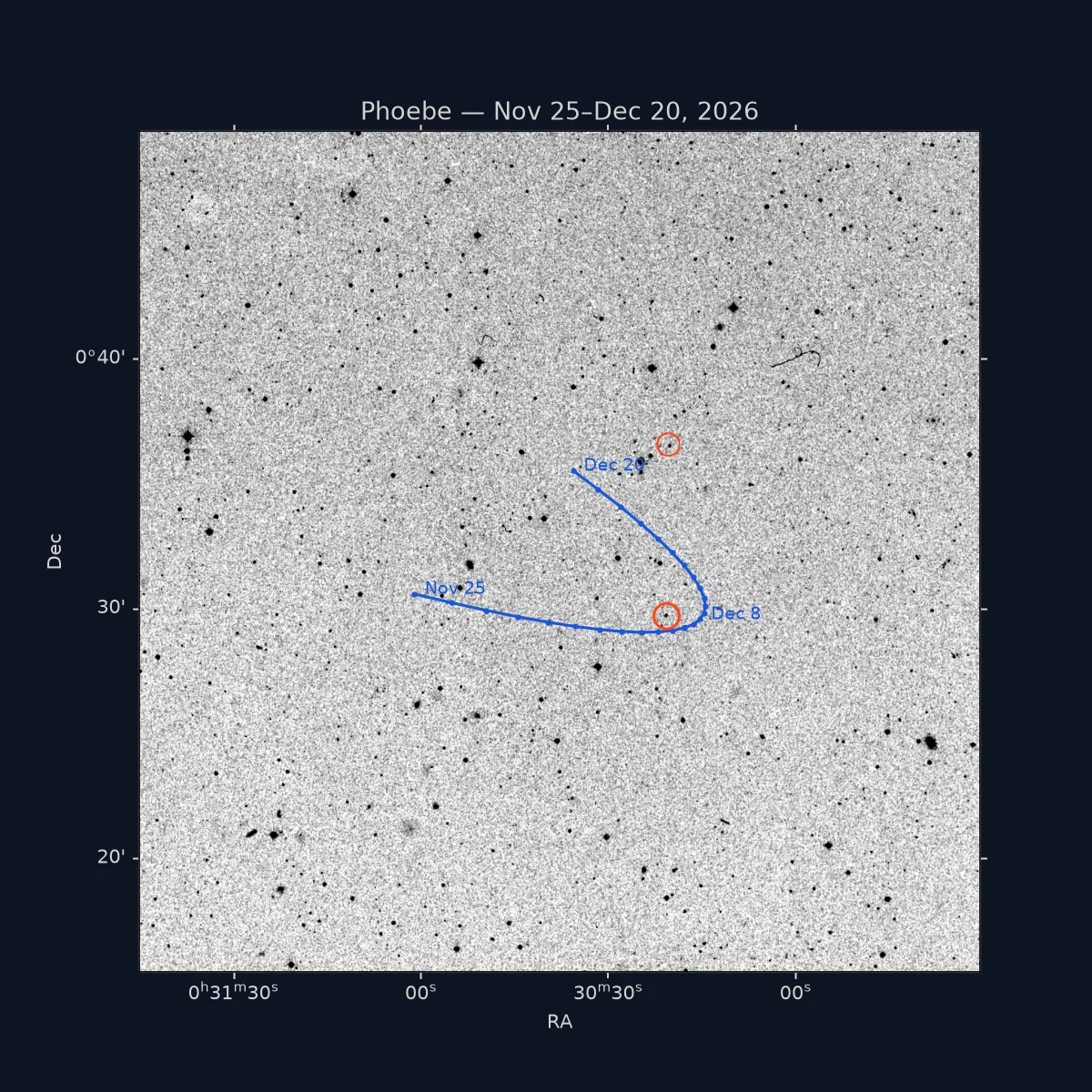
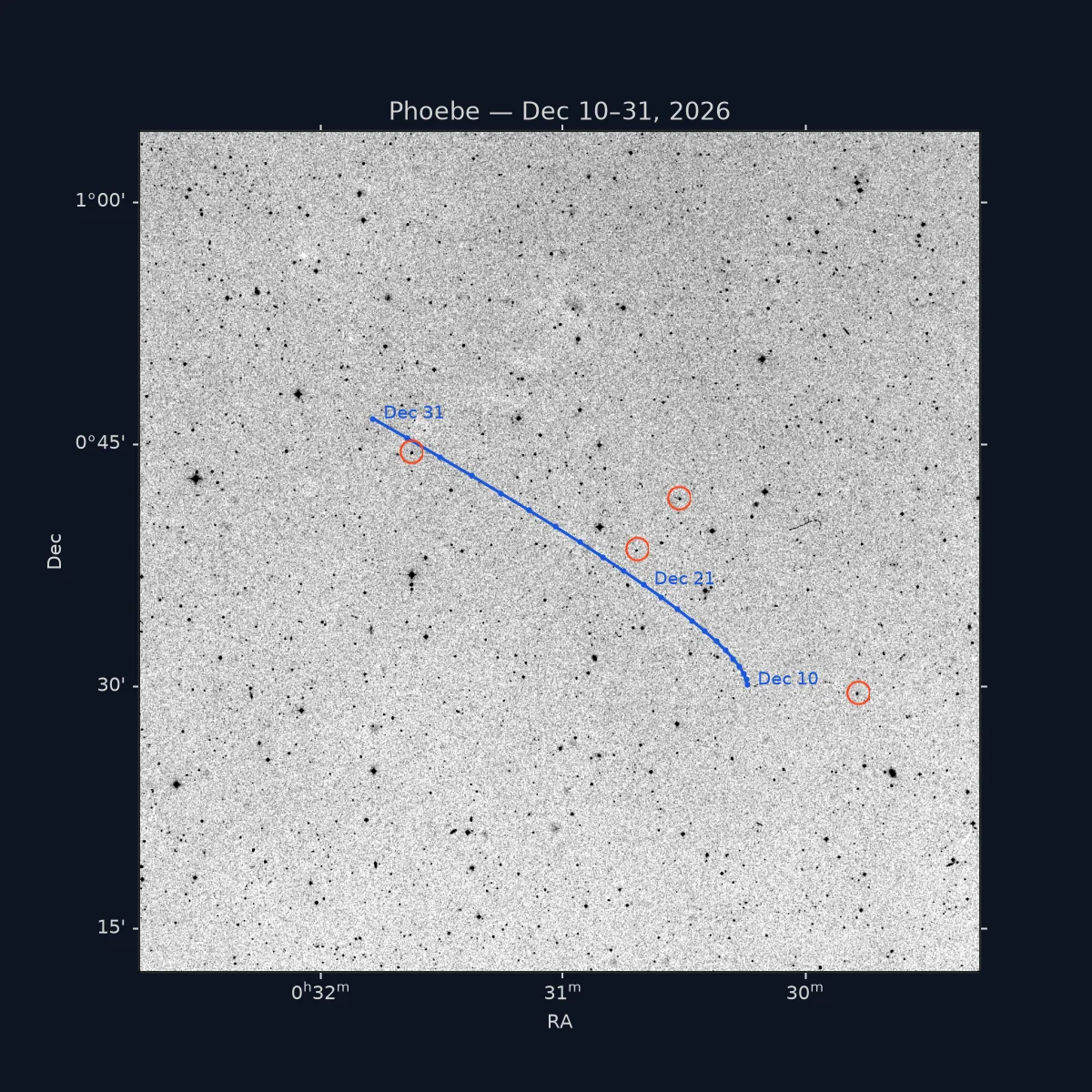
Over this whole September-through-December window, Phoebe holds steady at magnitude 16.3–16.5 — it barely brightens or dims, since its distance from Earth and its phase angle change only gradually. What does change fast enough to matter is where it sits relative to Saturn: at its widest, Phoebe is nearly half a degree from the planet (about 29 arcminutes, per the ephemeris), meaning Saturn’s glare usually won’t even share the frame with your target. This is a pure star-field hunt.
Get the full ephemeris — or make your own
The finder charts above are generated from a JPL/Horizons ephemeris covering September 1 through December 31, 2026, sampled once per day. If you’d like the complete day-by-day table — right ascension, declination, apparent magnitude, and angular separation from Saturn for every date in this window — download the full Horizons ephemeris used to build these charts.
You can also generate your own ephemeris directly from JPL — for any date range, any step size, and from any observing location — using the Horizons web interface. Search for target body “Phoebe” (or its designation, Saturn IX / 609), set your observer location and date range, and select “Astrometric RA & DEC” plus “Apparent magnitude” under the table settings. JPL’s Horizons documentation walks through the rest of the options if you want to dig further — including generating ephemerides for practically any object in the solar system.
Setting up your smart scope for this challenge
At magnitude 16.3–16.5, Phoebe sits well beyond what any smart scope will show you live on screen — this is strictly a stack-and-inspect target, not a “look at the eyepiece and see it” target. How comfortably your scope gets there depends heavily on aperture, and the honest answer is that this challenge is easy for some current smart scopes and genuinely marginal for others. Under a Bortle 4–5 sky (reasonably dark suburban-to-rural conditions, no moon in the sky), here’s roughly where the common models land:
| Aperture class | Example models | How this challenge goes |
|---|---|---|
| ~35–50 mm | Dwarf 3, Seestar S30/S50, Vaonis Vespera II/Pro | Challenging. You’re pushing near the edge of what these scopes can pull out of the background sky glow even with a long stack; a positive detection isn’t guaranteed every session. Figure at least and hour, maybe two. |
| ~114 mm | Unistellar eVscope 2, eQuinox 2 | Comfortable, given enough integration time. This is squarely the aperture class this challenge was designed around. A half hour under good dark skies should complete the task. |
| ~150 mm+ | Celestron Origin | Straightforward. The combination of aperture and fast optics gets you a confident detection well within a normal session - under ½ hour. |
A few things worth doing regardless of which scope you’re using:
Plan the session for a night when the Moon is below the horizon or well out of the sky; a target this faint loses a lot of ground to any extra skyglow. And don’t trust a single frame or a single night’s stack as your detection: use the finder charts above (or your own Horizons ephemeris) to confirm that the point of light you found has actually moved between two sessions a few nights apart, in the direction and amount the ephemeris predicts. That motion — not the dot itself — is your real evidence that you caught Phoebe and not a background star.
If your scope’s field of view is wide enough to catch one of the comparison stars circled in the finder charts, that’s your built-in sanity check: if a same-brightness field star shows up clearly in your stack, your equipment and conditions are good enough that a non-detection of Phoebe on the same frame is a real result, not just insufficient depth. Additionally you can use planetarium apps like Stellarium (though make sure you have up-to-date ephemerides: you don’t want to be misled looking in the wrong place).
Go Find It
Phoebe is a strange thing to hold in a single eyepiece-adjacent frame: a captured wanderer from the outer solar system’s icy frontier, sitting quietly in your stack as a single moving dot among thousands of stationary ones. It was hiding in plain sight on a photographic plate for seven months before anyone noticed it in 1899. It won’t take you nearly that long — but it will take patience, a couple of clear nights, and a willingness to trust the motion of a faint point of light over your first instinct about what you’re looking at. That’s the whole game with irregular moons, and it’s a good one to get good at.
(And Phoebe isn’t the only small outer moon that can be captured - future challenges will point out some of them as they return to our skies!)