Introduction
On a dark, clear Fall night, the Andromeda Galaxy is probably the most distant object most people will ever see with their own eyes – a smudge of light roughly 2.5 million light-years away, more than twenty times farther than anything else visible without help. That’s already a strange thing to hold in your head while looking at what appears to be a faint, unremarkable oval of light.
And that’s really the first surprise about M 31: visually, it can be a bit of a letdown. Through binoculars or a modest telescope, you mostly get a soft glow with a brighter core – none of the spiral structure that makes it famous in photographs. To really see this galaxy, you need long exposures, which is exactly where a smart scope earns its keep.
But M 31 isn’t traveling alone. Like the Milky Way, it has a retinue of smaller companion galaxies – some bright enough to observe directly, some so faint they’re only reachable through imaging, and one whose membership in the family is still debated. This A Wider View article is about that whole household: who’s really related to whom, what its structure tells us, and how it stacks up against our own Milky Way.
History
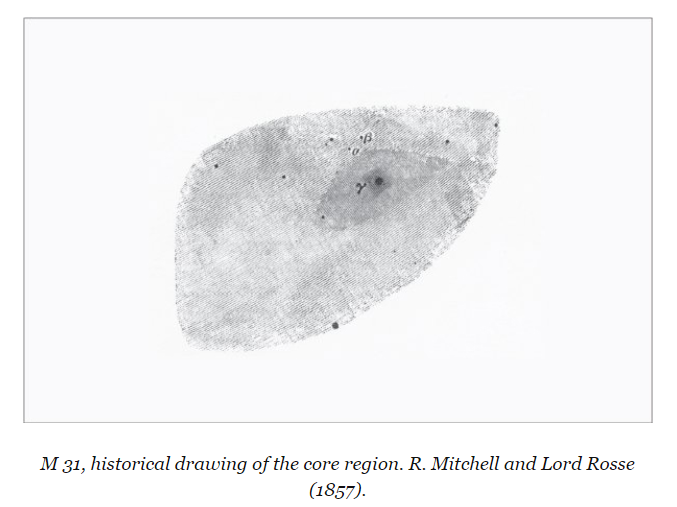

Andromeda has been watched for a very long time. The Persian astronomer Abd al-Rahman al-Sufi recorded it in his Book of Fixed Stars around 964 AD, describing it simply as “a little cloud” – the earliest known written mention of the object, though it’s probably been noticed for millennia. For nearly a thousand years after that it stayed a curiosity: one of many faint, fuzzy “spiral nebulae” catalogued by 18th- and 19th-century observers, with no way to tell whether these were nearby clouds of gas inside our own galaxy or something else entirely.

That question – whether these “nebulae” were part of the Milky Way or independent galaxies of their own – was one of the biggest open debates in astronomy through the early 20th century. It was settled on October 5, 1923, when Edwin Hubble identified a Cepheid variable star in M 31 at Mt. Wilson Observatory. Cepheids pulsate at a rate tied directly to their true brightness (a relationship worked out by Henrietta Leavitt a decade earlier), so timing the pulsation tells you the star’s real luminosity – and comparing that to how faint it looks from here gives you distance. Hubble’s answer put M 31 roughly a million light-years away (later revised up to today’s 2.5 million), far outside the Milky Way by any measure. Andromeda wasn’t a nebula. It was another galaxy entirely – an “island universe,” and proof that ours wasn’t the only one.
Galaxies and Satellites
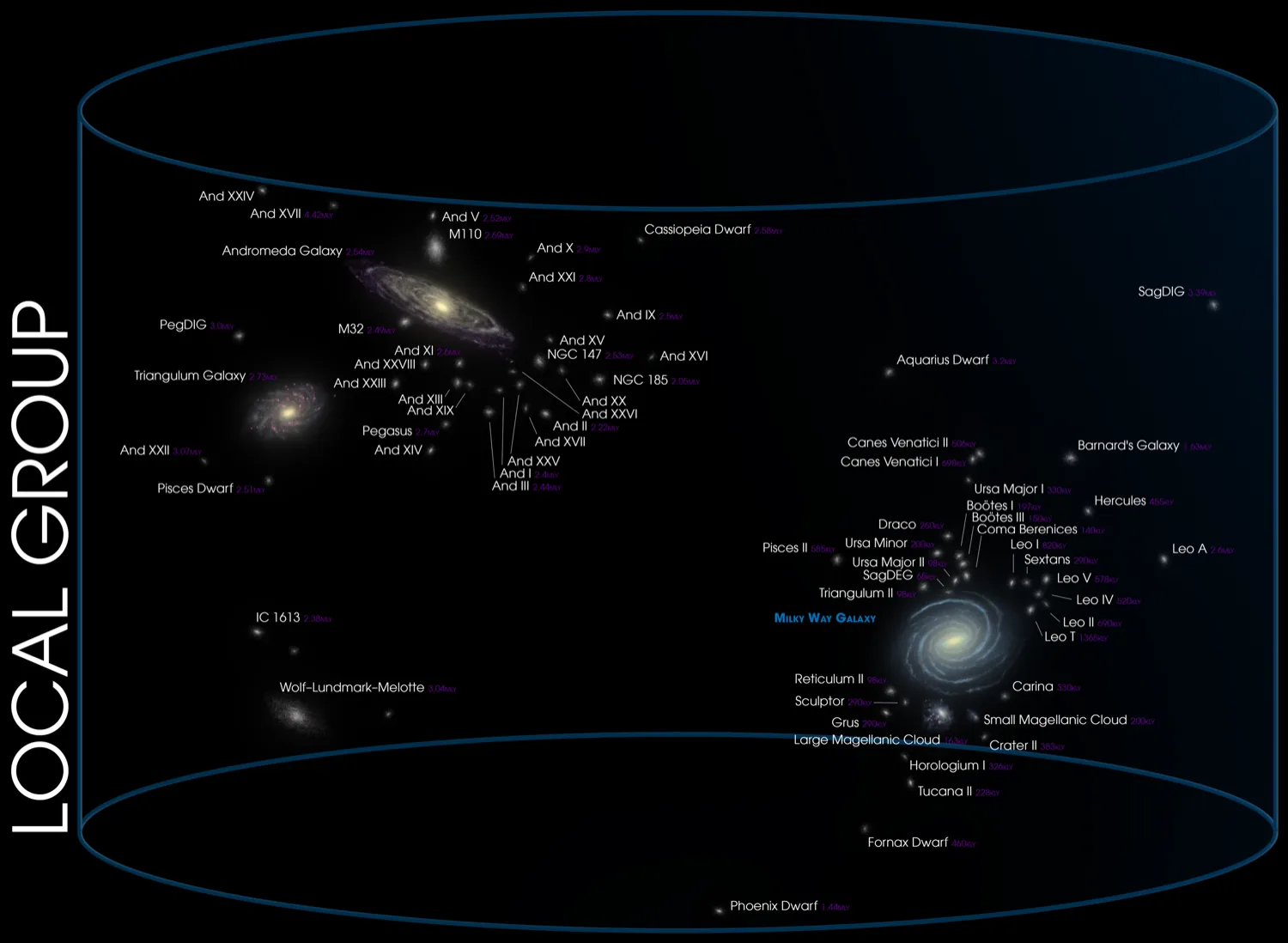
The Milky Way isn’t a solitary galaxy either. We have our own retinue of satellites – the Magellanic Clouds most famously, plus a crowd of much fainter dwarfs – and we have our own history of eating smaller neighbors. Gaia-Enceladus, a galaxy roughly the size of a Magellanic Cloud, collided with and was absorbed by the Milky Way about 10 billion years ago, adding an estimated 50 billion solar masses of stars, gas, and dark matter, along with at least eight globular clusters in the process. The Sagittarius Dwarf Galaxy is still being consumed today, in slow motion: it’s made at least three close passes, roughly 5-6 billion, 2 billion, and 1 billion years ago, getting stripped down a little more each time.
Andromeda has the same kind of story, just easier to see from the outside. It has its own set of satellite galaxies – more of them than we currently know of around the Milky Way, though some of that gap may simply be how thoroughly each system has been surveyed – and its two brightest companions, M 32 and M 110, both show signs of having been shaped by past run-ins with M 31 itself. Big galaxies build up their mass this way: by accreting the small.
The Head of the Household: Messier 31
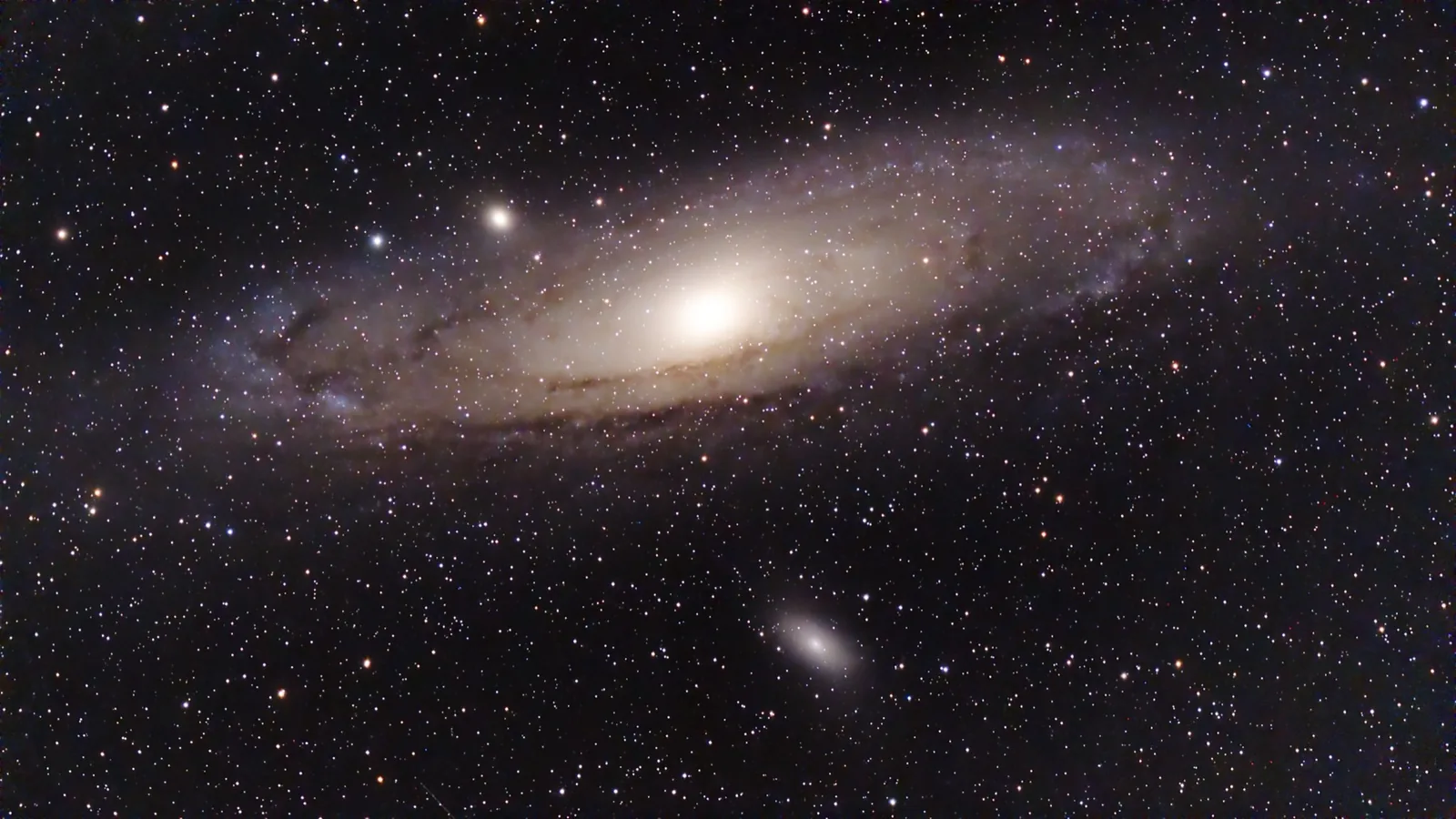
At around 220,000 light-years across, M 31 is more than double the Milky Way’s diameter, and it’s often quoted at roughly a trillion stars to our galaxy’s 200-400 billion – though that stellar count is a rough, frequently-repeated figure rather than a tightly-measured one, so treat it as “clearly bigger,” not as a precise ratio. Total mass (stars, gas, dust, and the dark matter that dominates the budget) is harder to pin down for both galaxies, but recent estimates of the mass within 300,000 light-years put the Milky Way at around 0.9 trillion solar masses and M 31 at around 1.4 trillion – Andromeda is the more massive of the two, though not by the lopsided margin its size alone might suggest.
The Primary Satellites
Messier 32 and 110
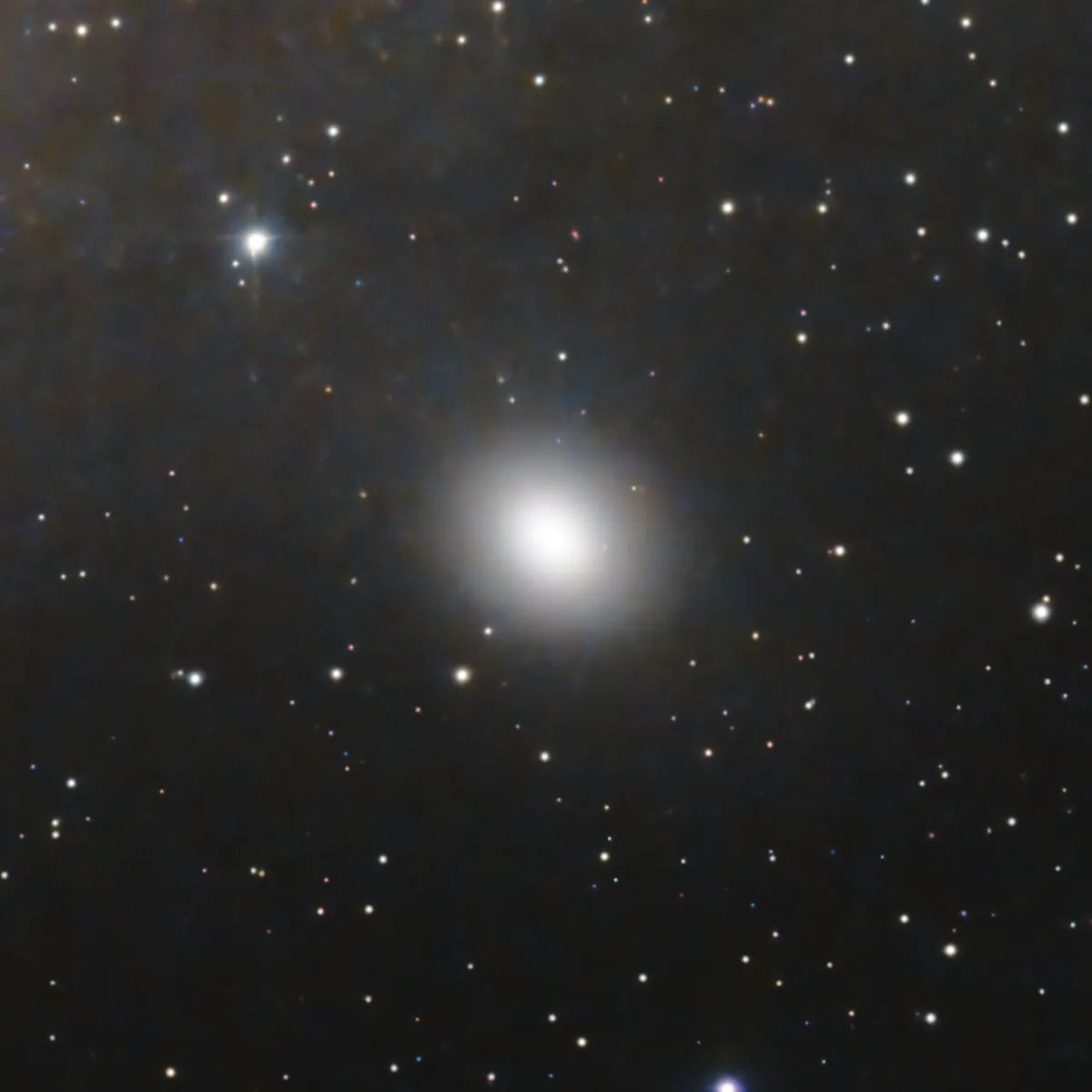
M 32 (NGC 221) is a compact elliptical galaxy – a rare, dense type thought in many cases to be the stripped-down remnant core of a larger galaxy that lost its outer layers to a close encounter. M 32 sitting essentially right against M 31’s disk makes it a strong candidate for exactly that kind of history, though the details are still debated. Visually and photographically it’s a fairly featureless, bright, compact blob – there isn’t much structure to chase here even with a smart scope. It’s still small: roughly 5,800 ly across, a fraction of M 31’s own 220,000 ly span – though a typical wide-field photo makes the gap look smaller than it really is. M 32’s light is compact and bright enough to show up fully in one exposure, while most of M 31’s own faint, extended outer disk doesn’t register at the same exposure depth at all.
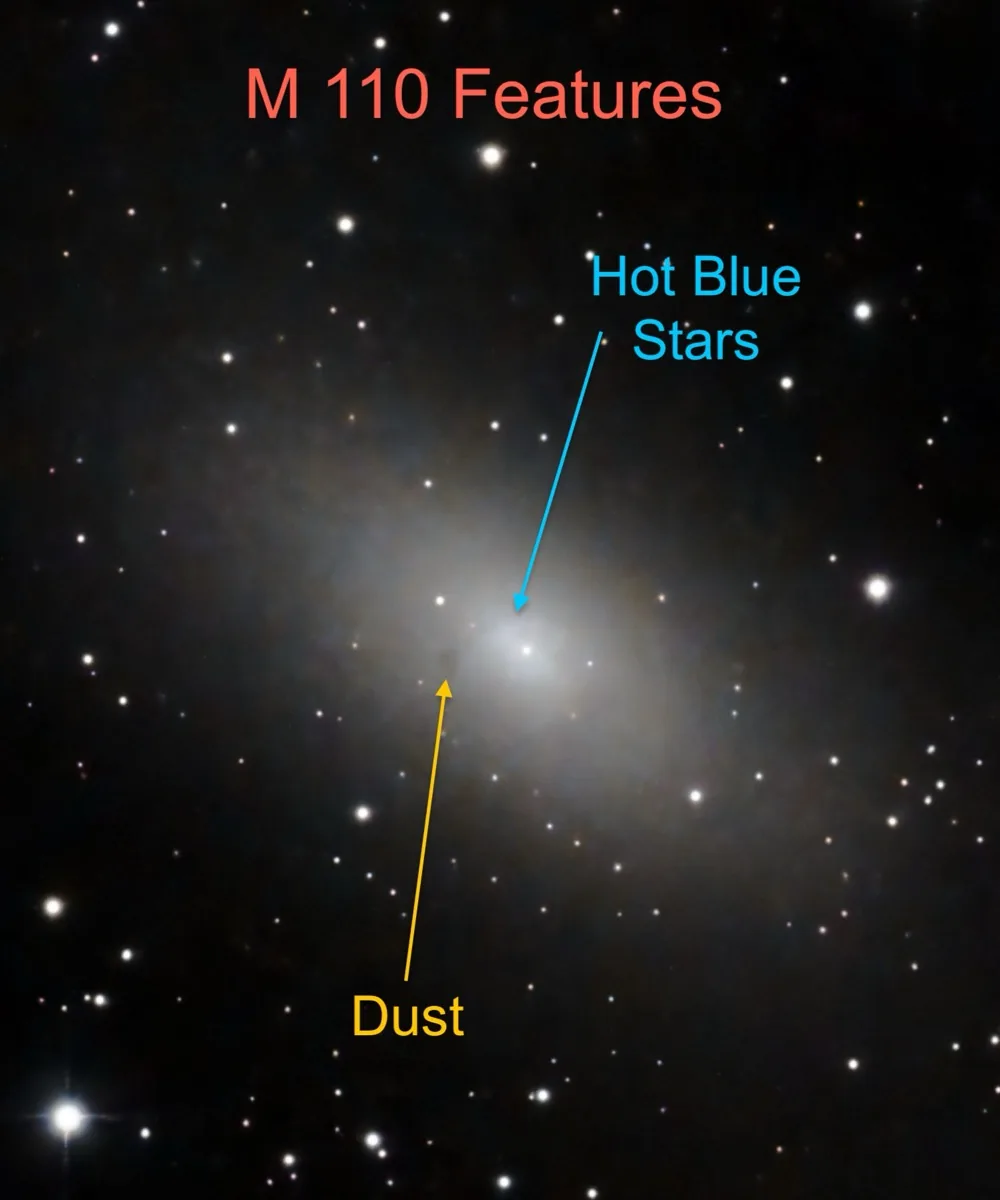
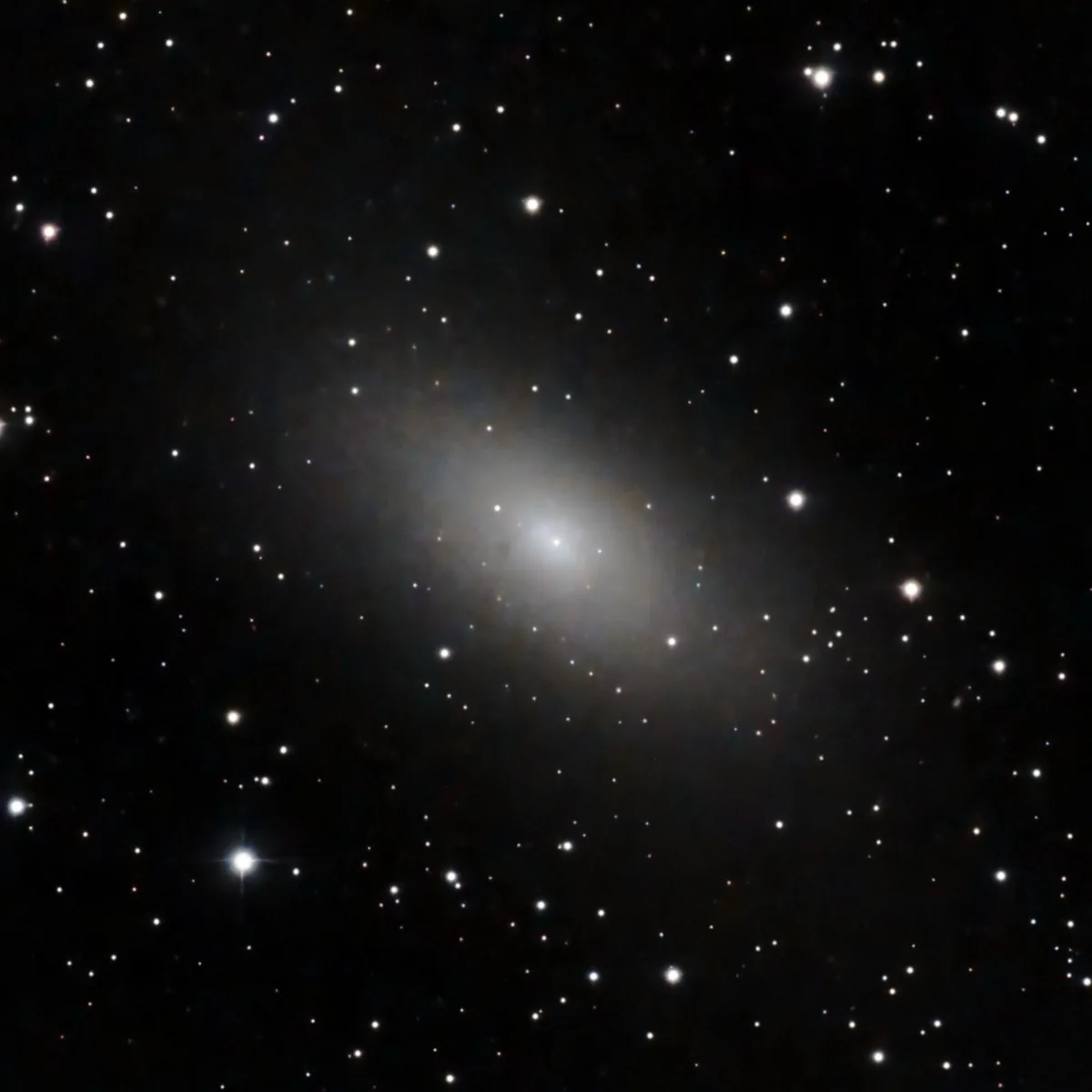
M 110 (NGC 205) is the more interesting of the pair. It’s classified as a dwarf elliptical, but it doesn’t act like a typical one: it has visible dust lanes, unusual for this class of galaxy, and a population of young blue stars concentrated near its center – stars that formed in bursts as recently as roughly 25 million years ago. That’s not something a “dead,” gas-free elliptical should be doing, and the leading explanation is that it’s connected to a past interaction with M 31 itself, possibly funneling in fresh gas. It’s also considerably bigger than M 32 despite the resemblance in a quick look – roughly 12,300 ly across – which makes it genuinely worth trying to capture with a long exposure. It’s one of the few objects in this family where a smart scope might reveal something that isn’t visible at all in a quick look.
Caldwell 17 (NGC 147) and 18 (NGC 185)
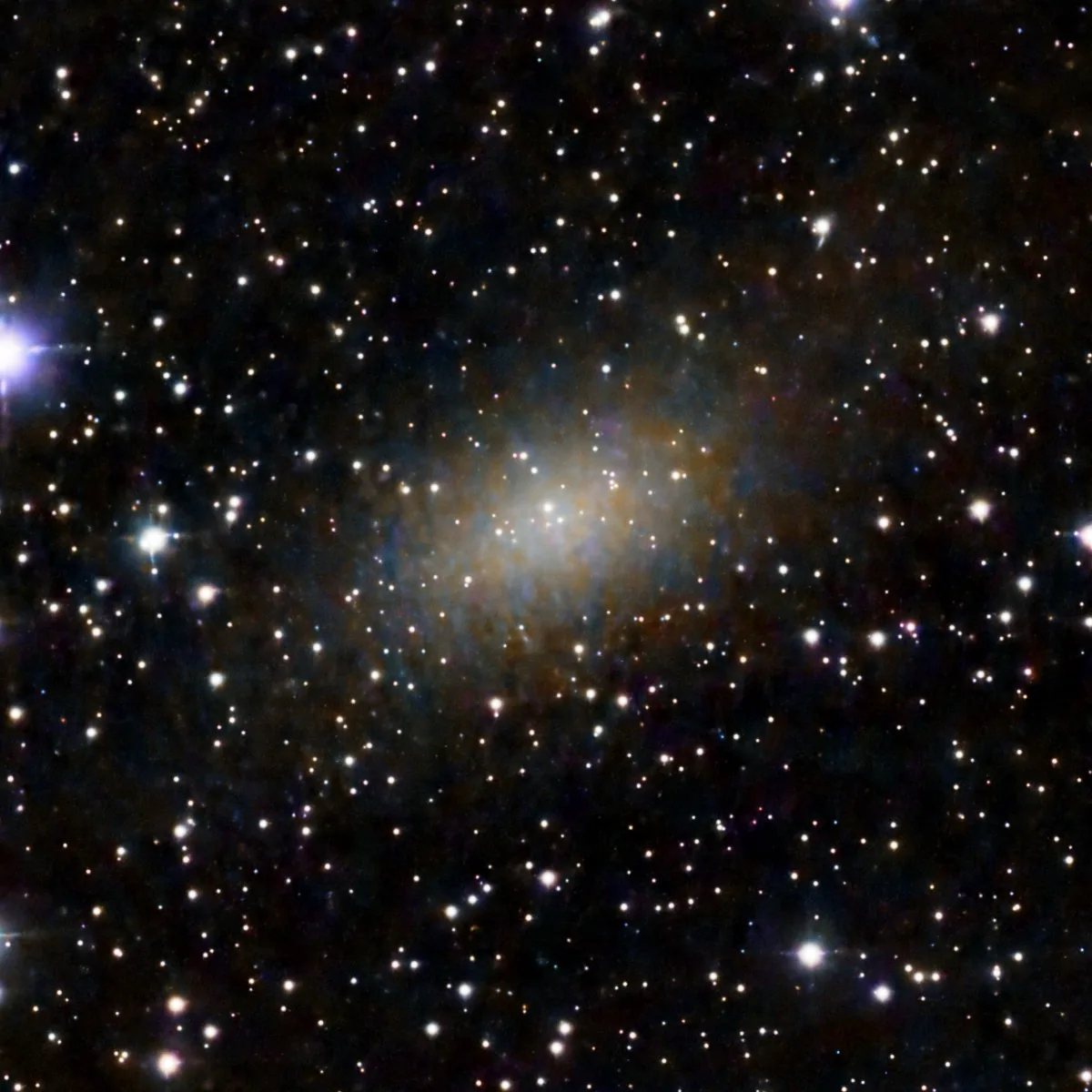
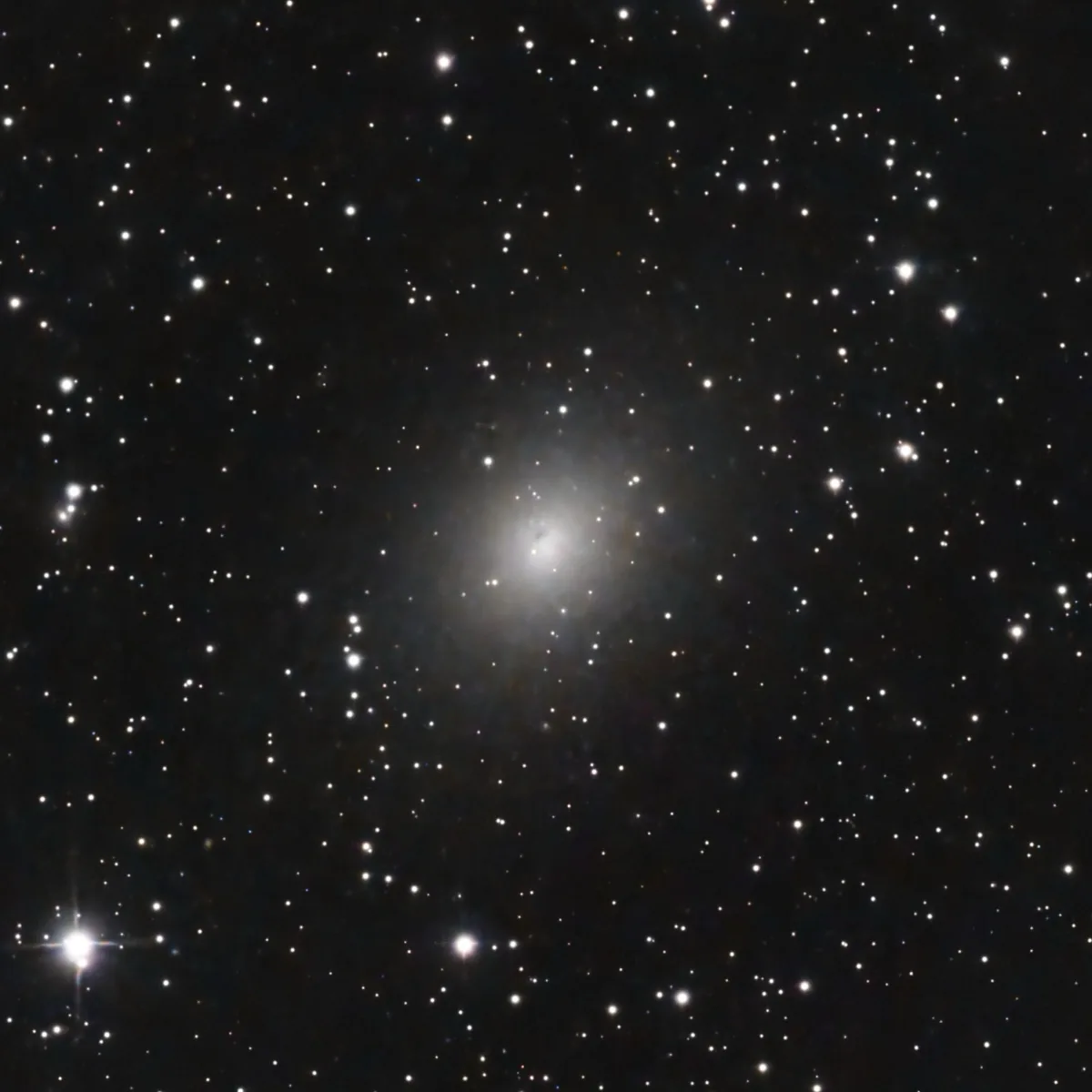
NGC 147 and NGC 185 are a second pair of dwarf companions, sitting well off to the side, over in Cassiopeia, rather than tucked against M 31 like M 32 – and they turn out to be a study in contrast with each other, not as a matched pair. NGC 147 is close to the dwarf elliptical “prototype”: old stars, essentially no dust, nothing to chase beyond overall glow, a genuine patience game. NGC 185 is the exception – much like M 110, it carries real, documented dust clouds and a pocket of star formation confined to its central few hundred parsecs, active as recently as roughly 100 million years ago. That’s the mottled, patchy darkening visible near its core rather than a smooth glow – a real feature of the galaxy, not a foreground dark nebula or an imaging artifact. Why NGC 185 held onto star-forming gas and dust while its near-twin NGC 147 apparently didn’t is still an open question. NGC 185 is, in fact, the larger of the two – roughly 7,600 ly across, against NGC 147’s roughly 6,300 ly – so size isn’t what set their different histories apart either.
Even though they sit near each other in the sky, there’s no evidence they share a past, or have ever had any encounters with each other – which makes their very different evolution (one dead and dust-free, one still holding onto star-forming material) even more of an open question rather than a shared-history explanation.
IC 10
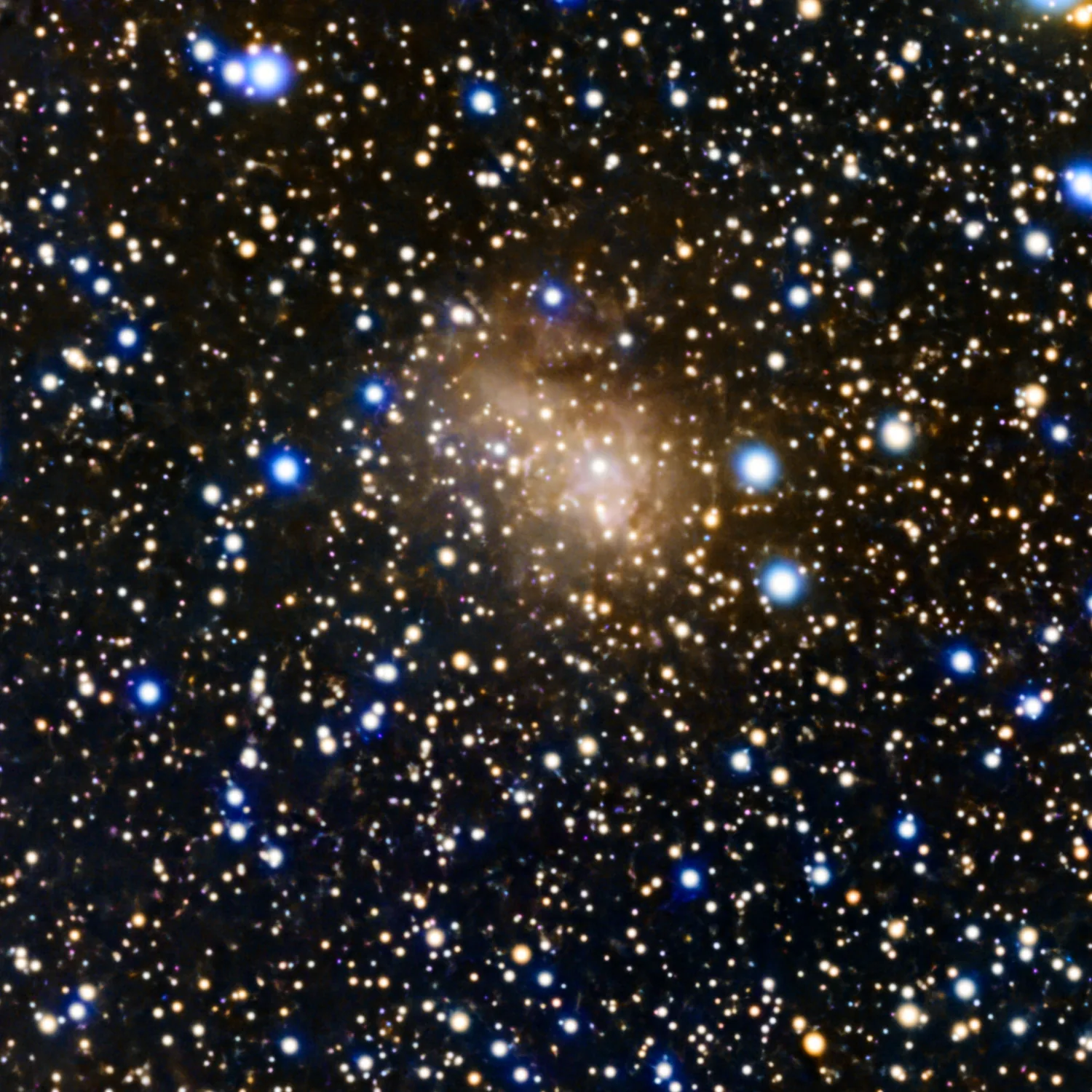
IC 10 is the wild card of this family. It’s a dwarf irregular galaxy – and specifically a starburst galaxy, the only confirmed one in the entire Local Group, meaning it’s forming stars at an unusually high rate for its size. Whether it’s actually a gravitationally bound satellite of M 31, though, is genuinely an open question. Based on distance and position it’s typically grouped with the “M 31 subgroup” (which also includes M 33), but nobody has demonstrated it’s actually bound in orbit around Andromeda the way M 32, M 110, or NGC 147/185 are. The honest framing is: maybe a member, or just a neighbor that happens to be nearby.
It’s also a genuine observing and imaging challenge, and not because it’s faint – it sits at a low galactic latitude (-3.3°), meaning we’re looking at it through a thicker slice of our own Milky Way’s dust and stars than most of the rest of this family, which dims and reddens it. At roughly 5,100 ly across – the smallest of this primary group – that starburst activity is spread across the whole galaxy rather than concentrated the way M 110’s young core is.
Even Smaller Faint Satellites!
Beyond these five, M 31 has a whole population of much fainter dwarf spheroidal satellites, cataloged with Roman numerals (Andromeda I, II, III, and on up past XXX at this point). None of these are “observing” targets in any traditional sense – they’re imaging-only, and even then, some are a serious stretch.
| Galaxy | PGC ID | Const. | V Mag | Ang. Size | Surf. Brightness (mag/arcmin²) |
|---|---|---|---|---|---|
| And II | 4601 | Psc | 12.14 | 10.36’ x 10.36' | 17.54 |
| And I | 2666 | And | 12.75 | 5.92’ x 5.92' | 16.53 |
| And III | 2121 | And | 14.27 | 4.22’ x 4.22' | 18.09 |
| And V | 3097824 | And | 15.71 | 2.77’ x 2.77' | 18.02 |
| And IX | 4689222 | And | 16.41 | – | – |
| And X | – | And | 16.92 | – | – |
| Galaxy | Distance from Earth | Angular sep. from M 31 | Dist. from M 31 (kpc) |
|---|---|---|---|
| And II | 2.05 Mly (630 kpc) | 10.3° | 195.1 |
| And I | 2.37 Mly (727 kpc) | 3.3° | 67.5 |
| And III | 2.36 Mly (723 kpc) | 3.1° | 69.1 |
| And V | 2.42 Mly (742 kpc) | 8.0° | 112.7 |
| And IX | 1.96 Mly (600 kpc) | 2.7° | 181.9 |
| And X | 2.18 Mly (670 kpc) | 5.6° | 129.9 |
And II is the brightest of the group by far, and probably the best first target to attempt. One fun wrinkle: And IX looks like the closest of the six to M 31 on the sky (2.7°), but it’s actually one of the more physically distant in 3D, at 182 kpc – it just happens to sit much nearer to us along our own line of sight, so a small angular separation hides a real, much larger one.
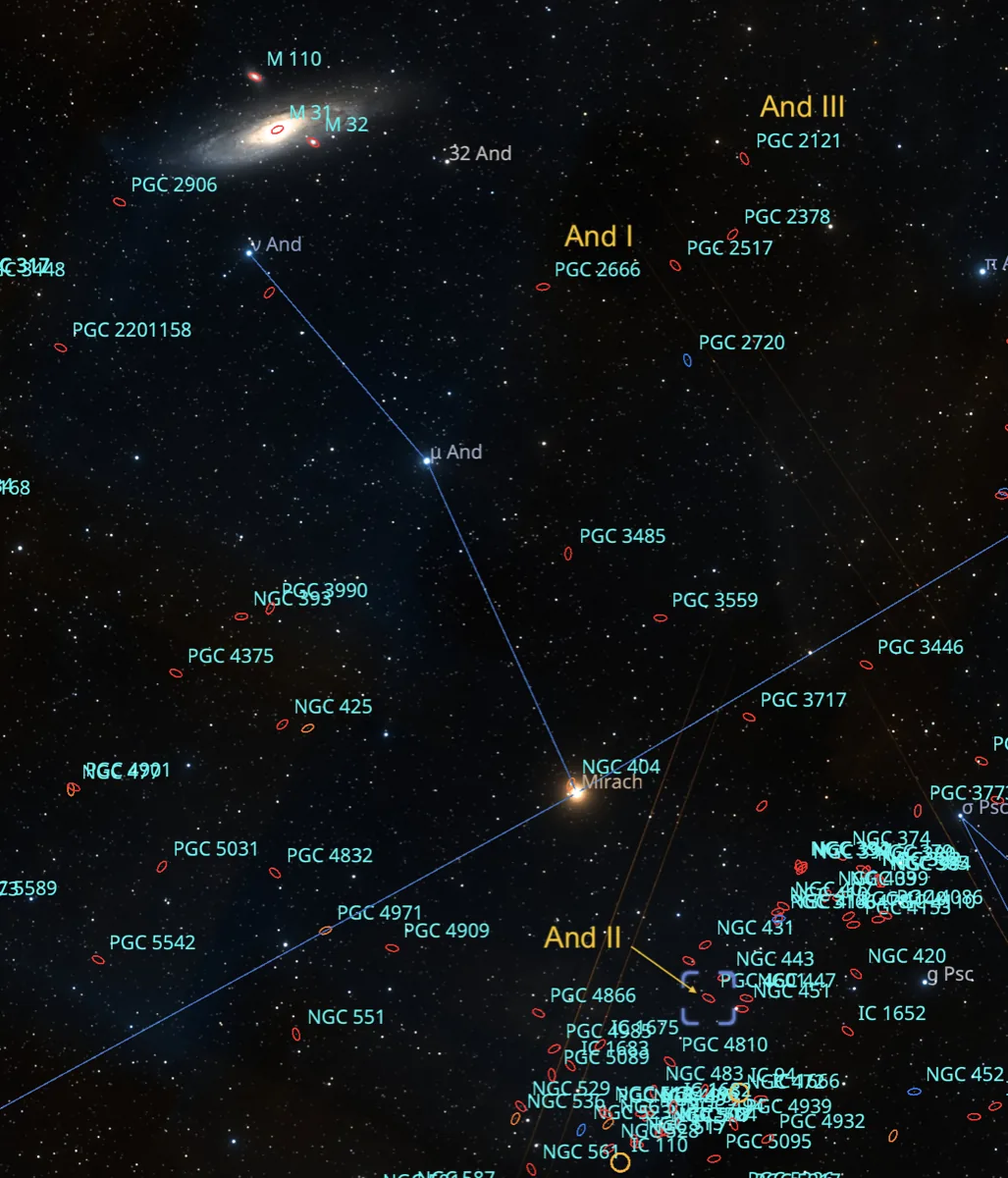
All six cluster within about 1.96 to 2.42 million light-years of Earth, close to M 31’s own 2.54 million – exactly what you’d expect if they’re actually orbiting the same galaxy rather than just sharing a direction in the sky.
It’s also worth pausing on how much sky this “family” actually covers. Just among the twelve objects in this article, M 31’s satellite system already reaches into Cassiopeia and Pisces, not just the Andromeda constellation itself – and the wider census goes further still: Andromeda VI, for instance, sits over in Pegasus (it even has its own name, the Pegasus Dwarf Spheroidal). Either way, the underlying point holds: this is a genuinely nearby, physically compact system, and the only reason it sprawls across so much of the sky is that M 31 itself is close enough for a few hundred kiloparsecs to translate into double-digit degrees.
A Wider View
Inferred Histories (and Futures)
For decades, the Milky Way and Andromeda were described as being on a slow, near-certain collision course, expected to merge in about 4.5 billion years. New research published in June 2025 (Sawala et al., Nature Astronomy) complicates that considerably. Running thousands of simulations using updated Hubble and Gaia data – and critically, factoring in the gravitational pull of other Local Group galaxies, especially M 33 and the Large Magellanic Cloud – the study found only about a 50% chance of a merger within the next 10 billion years if at all, and just a 2% chance of it happening on the old 4-5-billion-year timeline. The pull of other nearby galaxies has an effect: M 33’s gravity nudges the odds of a merger up; the LMC’s orbit runs roughly perpendicular to the Milky Way-Andromeda approach and nudges them back down. If a merger does happen, the revised timing looks more like 7-8 billion years from now.
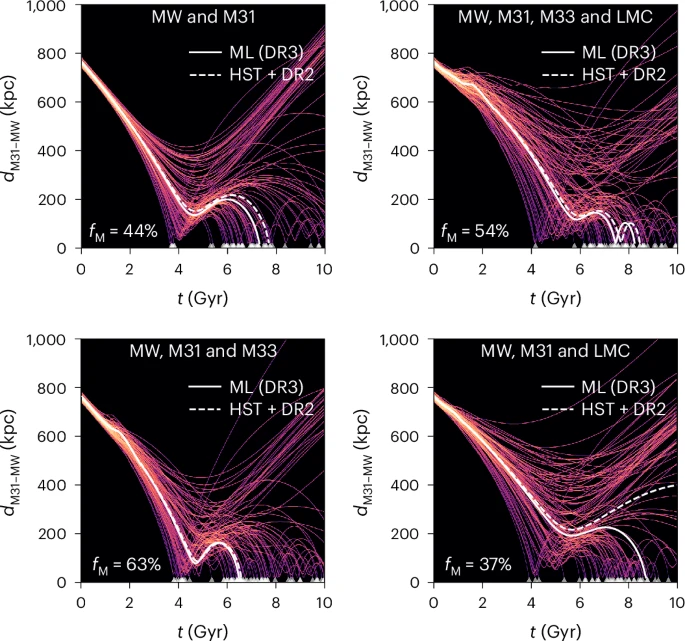
That’s what this figure shows: the odds shift a lot depending on which nearby galaxies get included, from 37% up to 63% across the four scenarios tested. And even the runs that don’t end in an outright merger still bring the two galaxies past each other at some real, close distance – just an uncertain one, for the same reason.
Closer to home, M 31’s two brightest satellites both carry fingerprints of past interaction with the parent galaxy. M 32’s compact, stripped-down structure is widely suspected (though not proven) to be what’s left of a larger galaxy after a close pass tore away its outer regions. M 110’s young central stars point to a more recent and gentler nudge – something that funneled fresh gas into an otherwise “quiet” dwarf elliptical and triggered a small burst of star formation as recently as ~25 million years ago.
Atypical Distribution
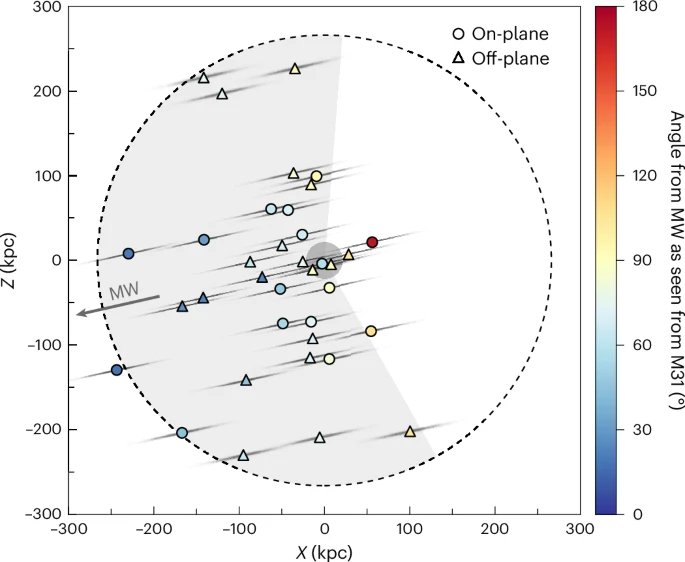
Here’s a genuinely strange feature of M 31’s satellite system: of its 37 known satellites, all but one sit within 107° of the direction toward the Milky Way – overwhelmingly bunched onto our “side” of Andromeda rather than spread evenly around it. A 2025 study (Kanehisa, Pawlowski, and Libeskind, Nature Astronomy) checked this against standard cosmological simulations and found that fewer than 0.3% of simulated satellite systems are ever this lopsided. Nobody has a settled explanation for why.
It gets stranger still. A related 2013 study found that most of M 31’s satellites don’t just favor one side – 15 of 27 surveyed satellites sit in a thin, corotating plane, all orbiting the same direction, with roughly 1-in-800 odds of that happening by chance.
And it isn’t only an Andromeda thing: the Milky Way has its own version of this, the Vast Polar Structure, where our own brightest satellites also cluster into a thin, corotating plane. Whatever is producing this seems to be happening at both of the Local Group’s big spirals, not just the one we can see clearly from outside.
One caveat worth keeping for our own satellite count specifically: the Milky Way’s own disk blocks part of our view of the sky, so a few of ours may simply be hiding behind it, undiscovered – Andromeda doesn’t have that same blind spot from our vantage point.
Comparing Households
Andromeda currently has somewhere between 35 and 39 known dwarf satellite galaxies. Within about 100 kiloparsecs the two systems look similar; farther out, M 31 outnumbers the Milky Way by roughly a factor of 2-4. That’s not because the Milky Way has nothing out there – it has real, confirmed satellites well past 100 kpc too (Fornax, Leo I, Leo II, and a couple of genuinely remote ultra-faint dwarfs) – current research suggests the Milky Way’s own census that far out is probably still incomplete, likely missing a number of faint dwarfs that would close some of this gap. So this may be more about what we haven’t found yet than a real difference in how each galaxy built up its family.
It’s also worth stepping back from just these two galaxies. The SAGA survey has cataloged satellite populations around 101 Milky-Way-like galaxies, and the results cut both ways for us: the Milky Way’s raw satellite count turns out to be unremarkable – comparable hosts in our luminosity range have anywhere from 1 to 9 known satellites, so we’re well within the normal range. But our satellites’ behavior isn’t typical: most of ours are quiescent, essentially “dead” to new star formation, while satellites of similar galaxies elsewhere in the survey are still actively forming stars.
The Close Neighbor: Messier 33
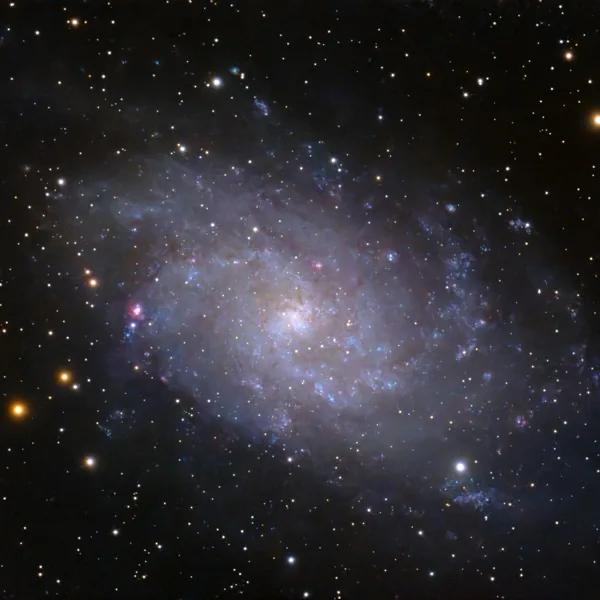
For a sense of how differently this can go, M 33 – the third major galaxy in the Local Group – has essentially no comparable system at all: just two confirmed dwarf satellites (Andromeda XXII/Triangulum I and Pisces VII/Triangulum III), against a predicted dozen or so for a halo its size.
But why is anyone’s real guess – lower halo mass, an early close pass that stripped satellites away, M 33 having absorbed some of its own smaller satellites over time, or some mix of the three. Nothing published points clearly at one over the others yet.
Three big Local Group galaxies, three very different-looking families. Andromeda gives us the clearest view of a satellite system simply because it’s close enough to resolve in detail – not necessarily because it’s the typical example.
Finding and Observing
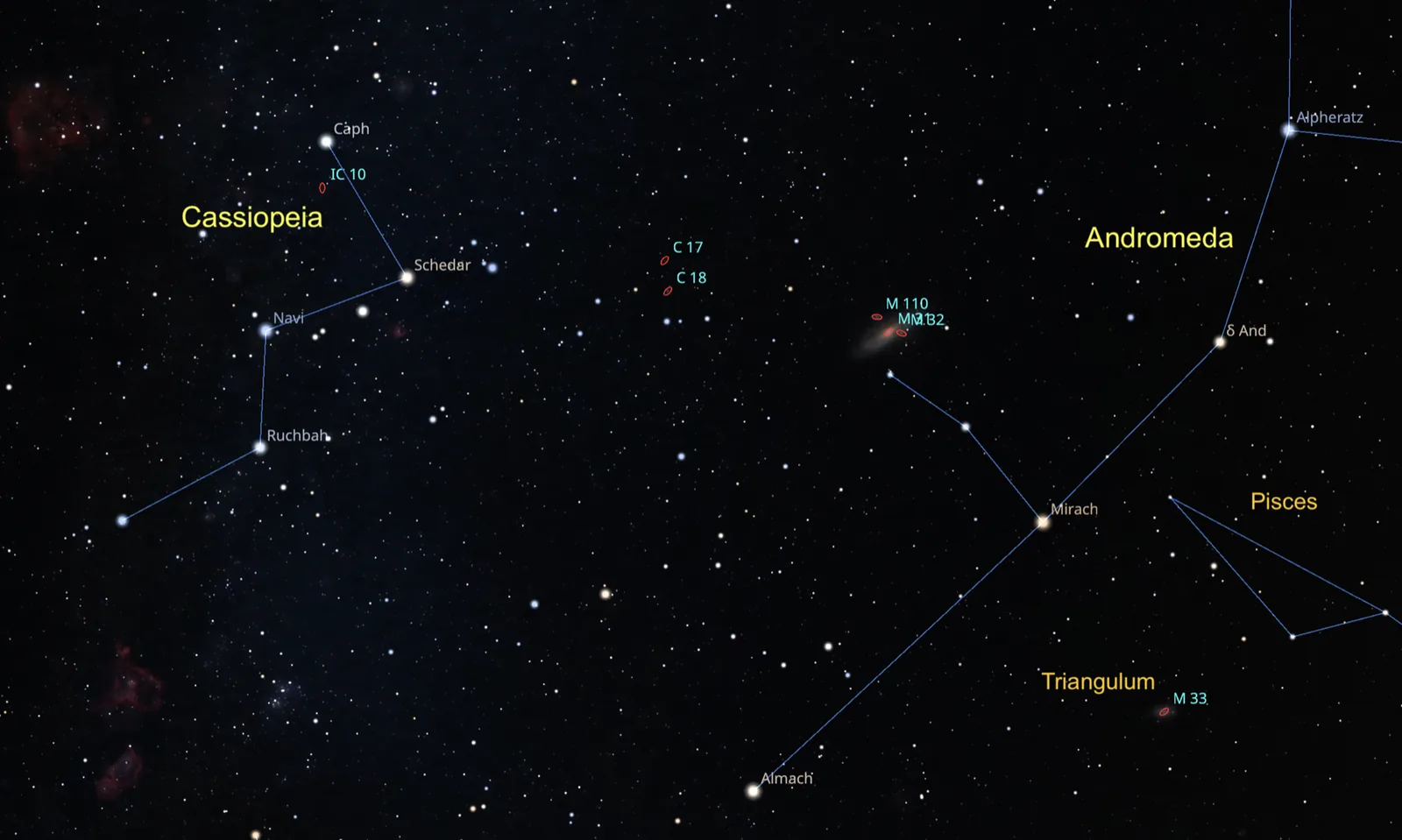
M 31 rides high in the northeast on Fall evenings and is visible to the naked eye from a reasonably dark site – its position is shown in the finder chart at the top of this article. Binoculars bring M 32 and M 110 into the same field of view as the main galaxy itself; both are genuinely visible, not just theoretical, targets with a modest pair of binoculars from a dark sky. Stepping up to a telescope gets you to Caldwell 17 and 18 (NGC 147/185) with enough aperture and dark skies, though they reward patience rather than technique. IC 10 is the real test in this group – faint to begin with, and further dimmed by its low position relative to our own Milky Way’s disk.
The faint numbered satellites (And I, II, III, V, IX, X, and the rest) are past the point where “observing” and “imaging” are the same activity – at magnitude 12-17 and fainter, spread out over low-surface-brightness dwarf galaxies, they’re not going to reward a visual look through an eyepiece the way the brighter objects in this article will. Probably at best they’ll be a faint smudge like you see in the field of view of other galaxies.
Imaging with a Smart Scope
M 31
M 31 itself is a challenging case here, somewhat counterintuitively – you need a very wide field of view and substantial exposure time to bring out any real structure (dust lanes, spiral arms, the glow of the disk beyond the bright core), and different rigs handle that very differently.
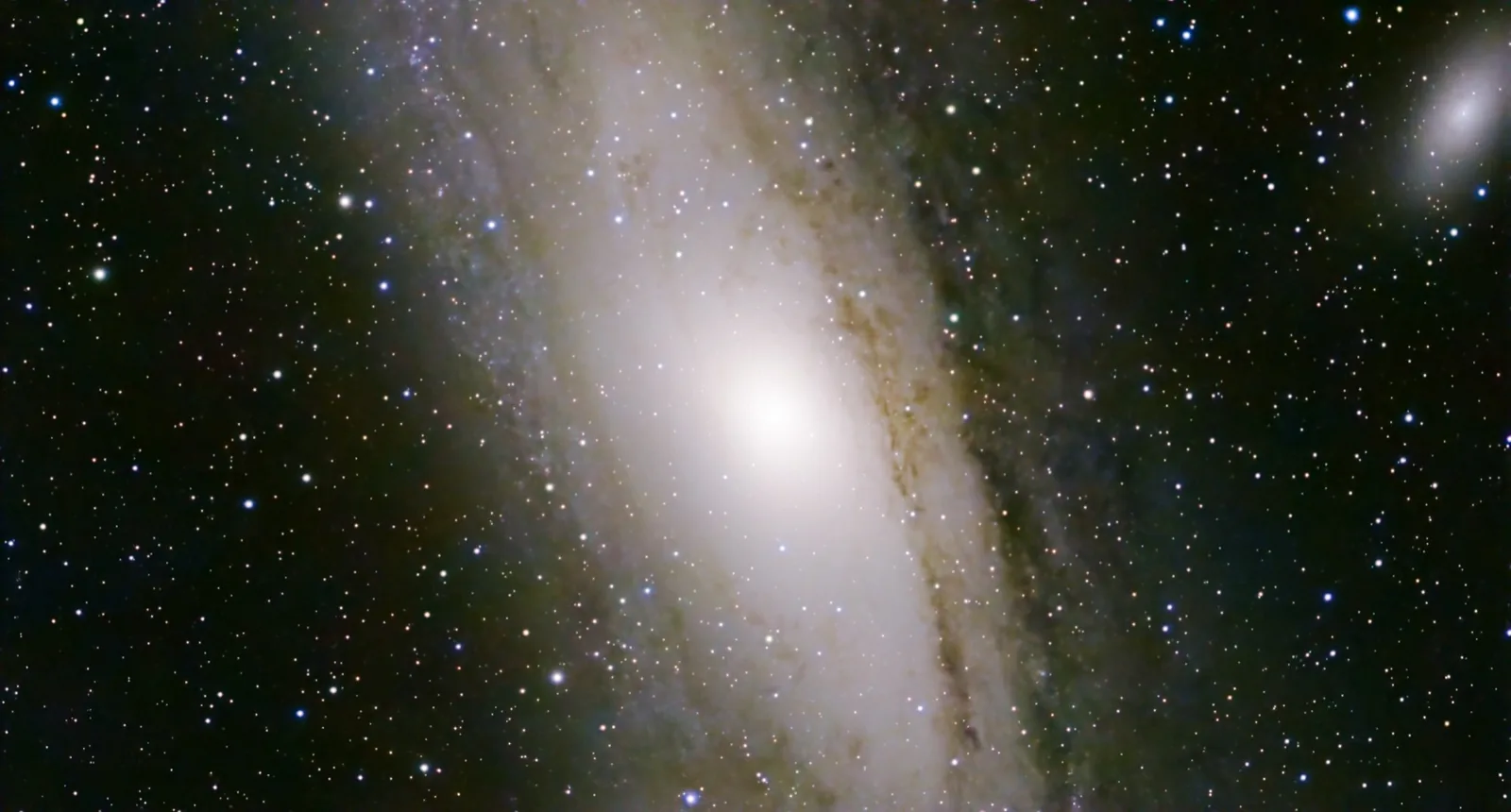
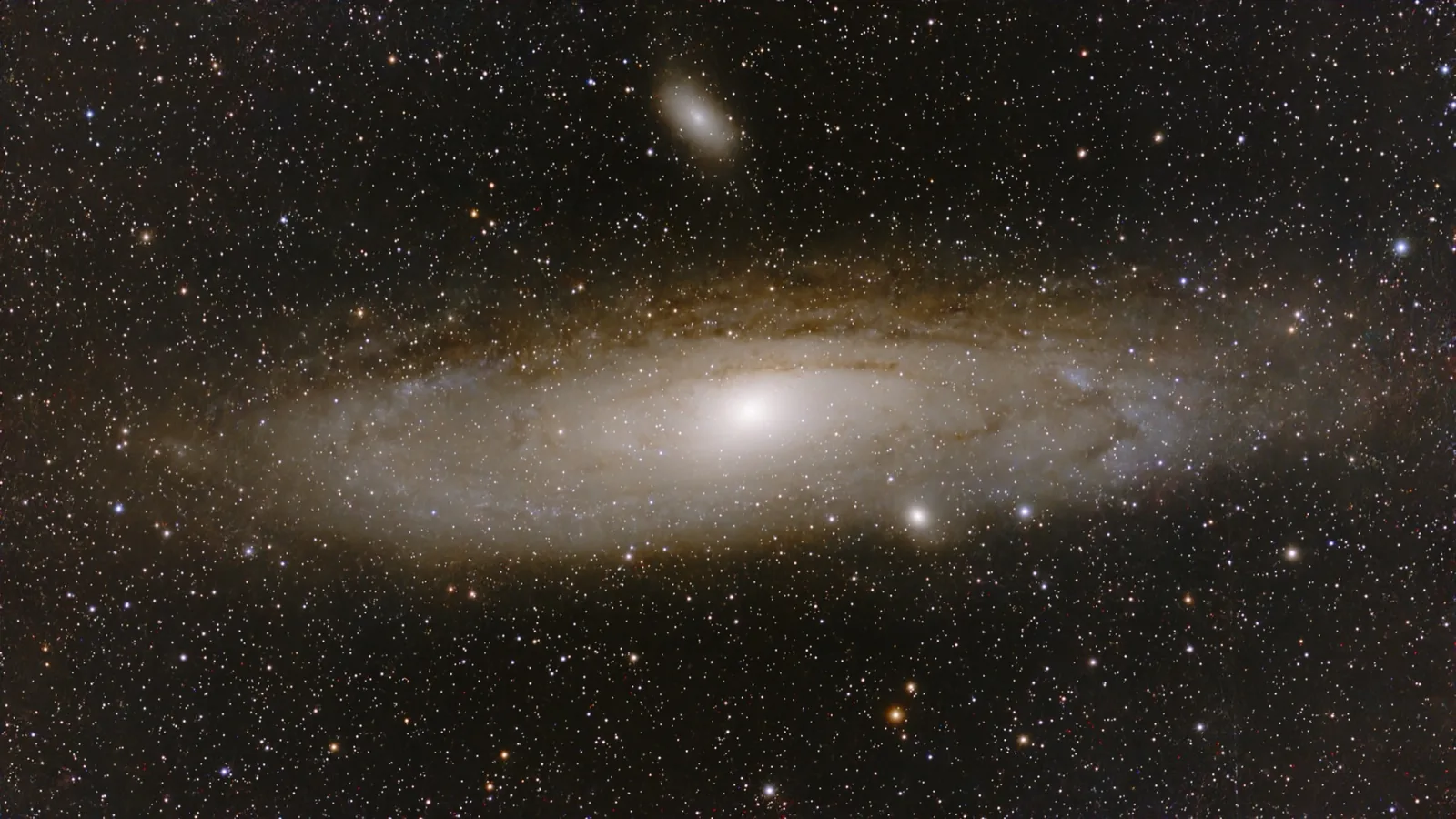
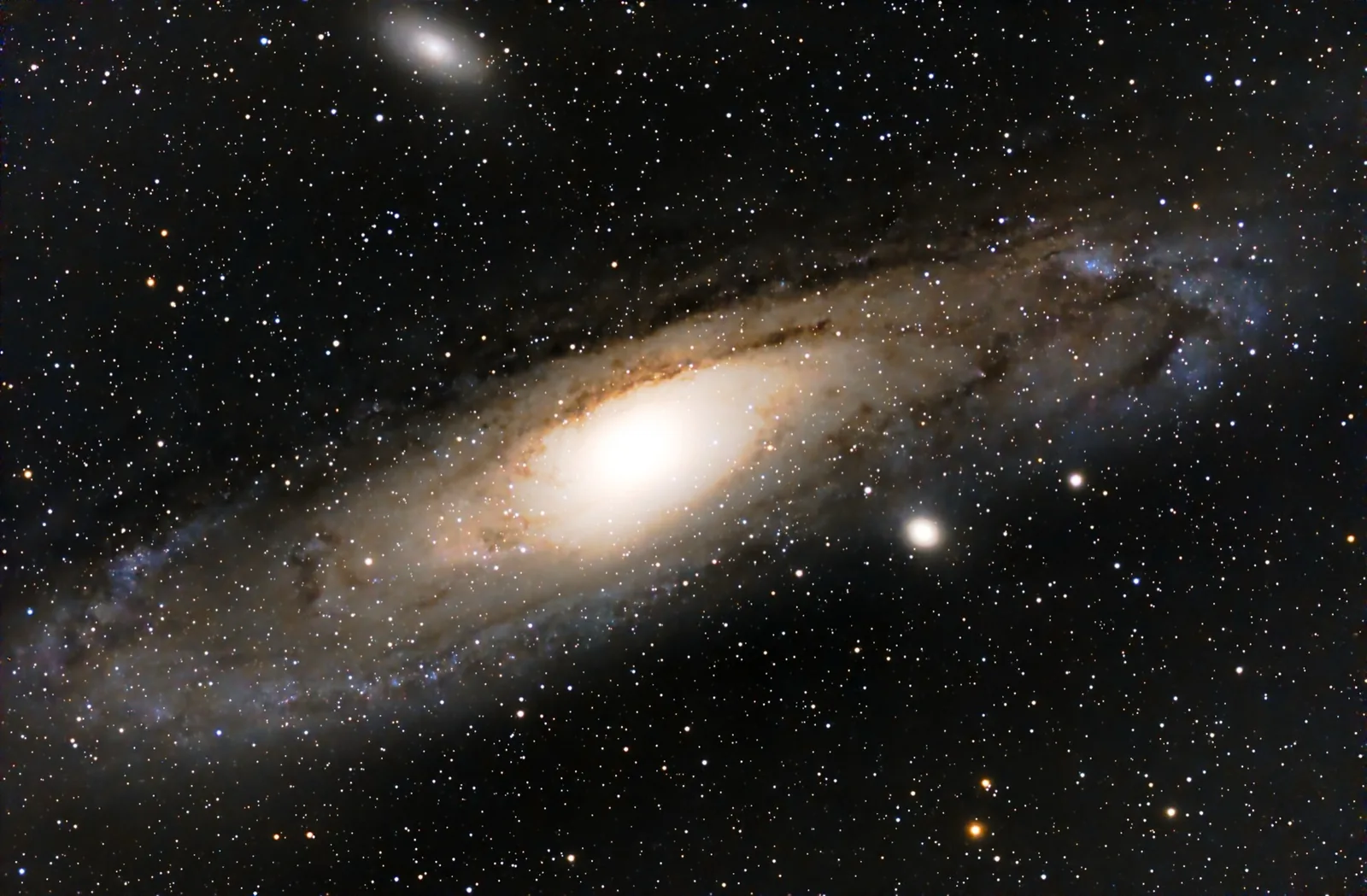
Here are four images taken with different telescopes on different nights. While M 31 comfortably fits in the FOV of the Seestar 30, to truly capture it with an S50 you need to use mosaic mode. The eQuinox 2 – with its narrower FOV – only images part of the galaxy (and the alt/az orientation on the night I did it was about the worst case scenario!).
M 32 and M 110
M 32 and M 110 are comparatively easy, in part because there’s little structure to expose in the first place – with one notable exception. M 110’s dust lanes and young blue core are a real, documented feature, and unlike M 32’s smooth glow, that’s something a careful long exposure has an actual chance of pulling out. Worth treating as a deliberate target rather than an afterthought next to M 31.
Caldwell 17 and 18
Caldwell 17 (NGC 147) is mostly a matter of exposure time and dark skies – no particular technique required, just patience. Caldwell 18 (NGC 185) is worth treating more like M 110: its central dust patch is a real, documented feature, not just a brightness threshold to clear, so it’s worth deliberately trying to pull that mottling out rather than just stacking for overall glow.
IC 10
IC 10 is the genuine challenge of the set: its low galactic latitude (-3.3°) means fighting through more of our own galaxy’s dust and stars than usual, on top of IC 10’s own faintness.
The Other Satellites
As for the faint numbered satellites: And I, II, and III are, per the table above, theoretically within reach of a very long smart-scope exposure – but treat these as a “did I detect it at all” challenge, not a picture. There’s no structure to bring out at that distance and surface brightness; success looks like confirming a faint smudge in the right spot, or even just a fuzzy “star” – not a photogenic result.