Introduction
Point almost any telescope at Caldwell 55 and the first impression is: that’s a star. It isn’t — it’s a tiny, brilliant blue-green disk, and one of the few planetary nebulae bright and compact enough to survive a bump in magnification without dissolving into mush. At magnitude 8.0, it’s an easy catch even from suburban skies. What it doesn’t give up easily is its structure. That takes patience, aperture, or a camera — and it took astronomers the better part of two centuries to work out what they were actually looking at.
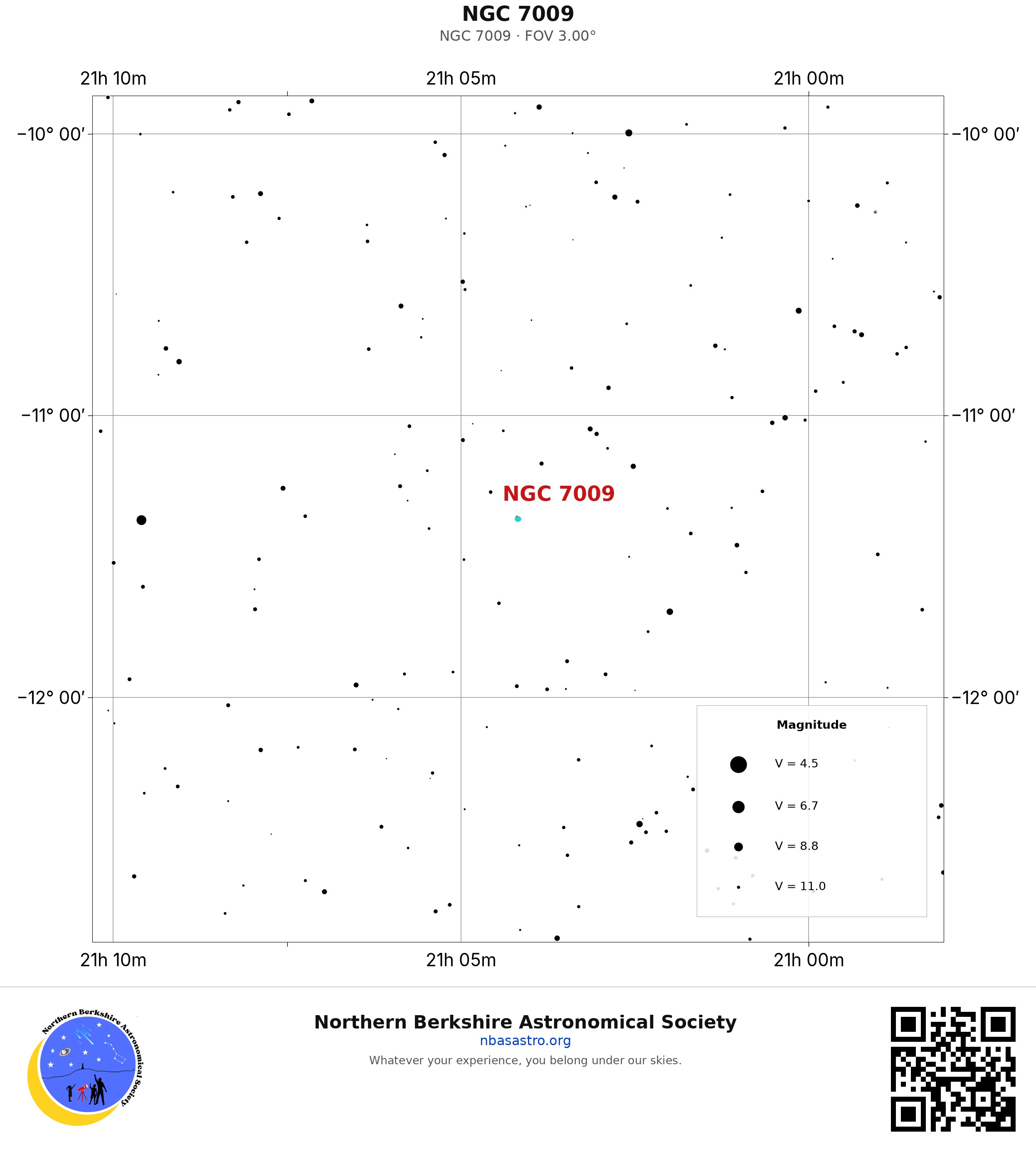
This is NGC 7009, better known as the Saturn Nebula, sitting in Aquarius about a degree west of the star Nu (ν) Aquarii. The name is the whole reason to take a closer look: nobody who first found this object thought it looked like Saturn at all.
Discovery: Herschel’s “Not Well-Defined Disk”
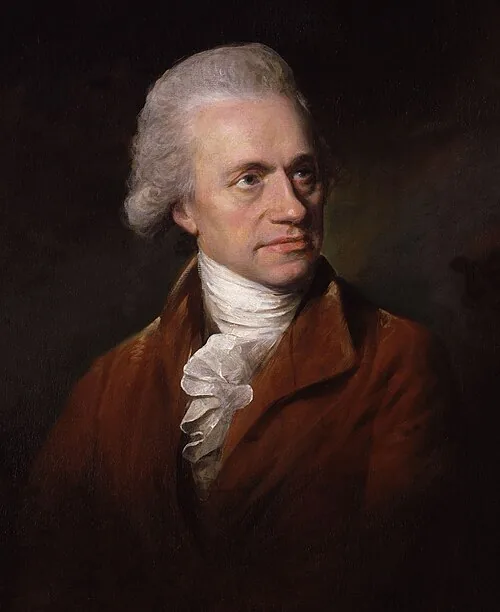
William Herschel logged this object on September 7, 1782, using a 6.2-inch reflector of his own design in the garden of his home in Datchet, England. It was one of his earliest catalog entries — he filed it under his Class IV, the bin he used for planetary nebulae and other objects that didn’t look like ordinary stars or star clusters.
His own description was modest: “very bright, nearly round planetary, not well defined disk.” That’s it. No rings, no handles, nothing Saturn-like at all — just a bright smudge that refused to resolve into a point. Given what his telescope was working with, that’s exactly what he should have seen.
There’s a second layer to Herschel’s connection to this object, and it’s a bigger one than the discovery date. Three years later, in an 1785 paper to the Royal Society, Herschel used this same object — identified only by its position, “5.4 minutes in time” ahead of Nu Aquarii — to introduce an entirely new category of object: “The planetary appearance of the first two is so remarkable, that we can hardly suppose them to be nebulae; their light is so uniform, as well as vivid, the diameters so small and well defined, as to make it almost improbable that they should belong to that species of bodies.” That sentence is where the term “planetary nebula” comes from — and this object was Herschel’s lead example. (He wasn’t quite the first person to make the comparison: Antoine Darquier de Pellepoix had already described the Ring Nebula as looking like “a fading planet” back in 1779. But it was this paper, built around this object, that turned the comparison into the formal name for an entire class of objects.) So the “Saturn” nickname came sixty years later — but the far more consequential name, “planetary nebula” itself, traces back to this exact nebula.
Why “Saturn”? A Name From Sixty Years Later
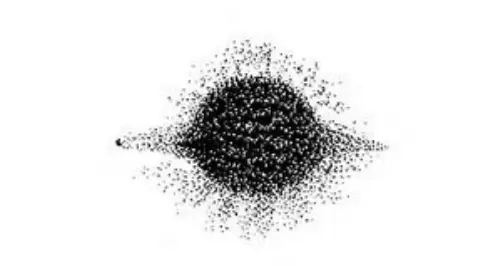
The nebula didn’t get its nickname until the 1840s, when Lord Rosse — working with telescopes dramatically larger than Herschel’s, including his famous 72-inch “Leviathan” — resolved two faint extensions on either side of the central disk. These are the ansae, Latin for “handles,” and they’re what give the object its passing resemblance to Saturn’s rings seen nearly edge-on. Rosse sketched what he saw, and the name stuck.
Nothing about the nebula changed between 1782 and the 1840s. What changed was the instrument pointed at it. That’s the pattern that keeps repeating with this object right up to the present day: bigger apertures and better detectors keep finding more structure in the same patch of sky.
An Atypical Planetary Nebula
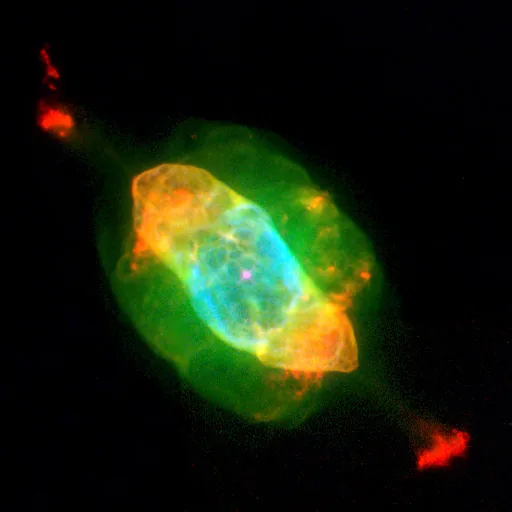
Modern imaging — from Hubble down to amateur setups with enough resolution — shows that the Saturn Nebula is a lot more complicated than “a disk with two handles.” It’s built from several nested, non-concentric shells, a faint outer halo, jet-like streams, and small knots and filaments embedded in the ansae, which turn out to be expanding away from the central star at an angle rather than straight out. It’s one of the more structurally complex planetary nebulae known, and features first identified here — like the ansae themselves — have since been recognized in several other planetary nebulae.
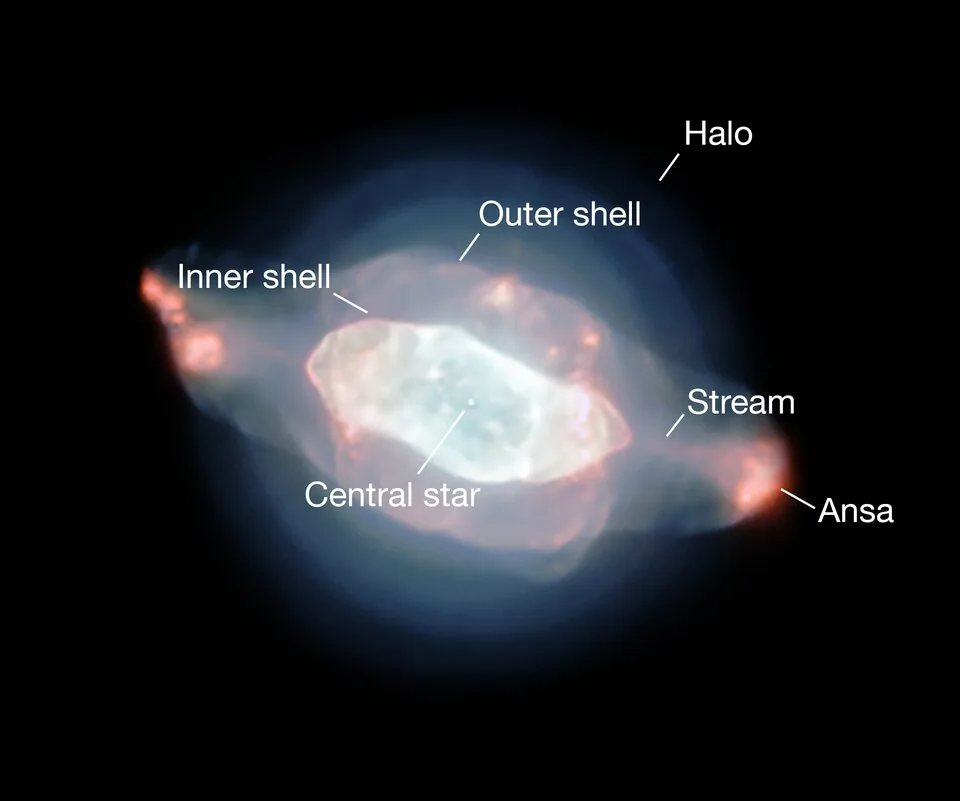
All of it is powered by the central star, what remains of the original star’s core, now a white dwarf. Direct spectroscopic modeling of the star’s own absorption lines (Méndez et al. 1992) puts its surface temperature at roughly 80,000 K — about 14 times hotter than the Sun. A star that hot radiates most of its light as ultraviolet, so despite pumping out several thousand times the Sun’s total energy output, it looks like a faint 11.5-magnitude pinprick through any telescope tuned to visible light, buried in the glow of the nebula it’s powering.
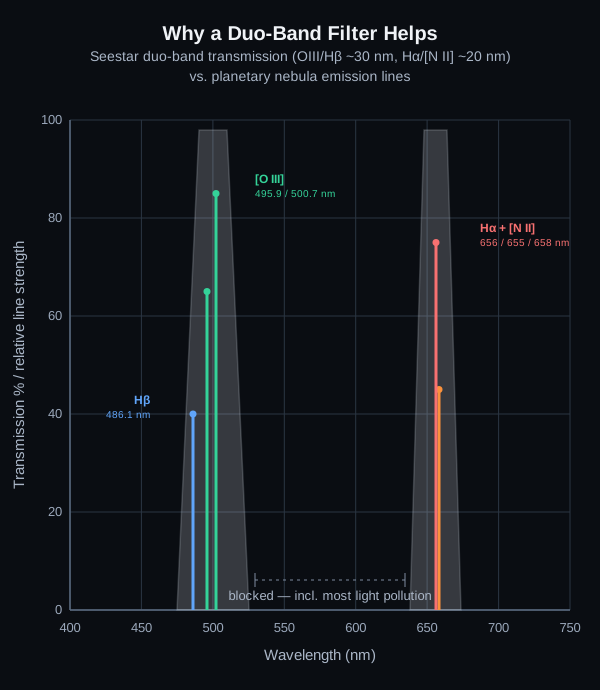
That flood of ultraviolet light is also why the nebula has the color it does. The blue-green tint comes mainly from a pair of “forbidden” lines produced by doubly-ionized oxygen ([O III]), plus a smaller contribution from hydrogen-beta. Stripping two electrons off an oxygen atom takes real energy, so [O III] marks the hottest gas, closest to the central star.
Move outward toward the ansae and the fainter edges, and the ionization drops: cooler species like singly-ionized nitrogen ([N II]) and neutral oxygen ([O I]) take over. That’s part of why the ansae carry their own name in the literature — “fast, low-ionization emission regions,” or FLIERs. Color here isn’t decoration; it’s a rough temperature and ionization map.
It’s also worth knowing that the eye at the eyepiece is a poor color camera. Night vision at typical amateur-scope light levels is green-biased and nearly blind to red, which is why visual observers overwhelmingly report this nebula as green, while long-exposure images pull out the red [N II]/H-alpha light no eye will ever catch directly. If you don’t see red at the eyepiece, that’s not a failure of observing — nobody does.
One more thing worth knowing before you look for it: “0.7 arcminutes across” is a simplification. The bright central disk that dominates visually is closer to 25–28 arcseconds, while the fainter outer shell extends to roughly 41 by 35 arcseconds. What you can actually resolve depends on your aperture and sky conditions — a good excuse to look more than once.
From What You See to What It Is
Most of the numbers in the info box above aren’t measured directly — they’re worked out by combining a couple of simpler observations.
Start with size. Nobody can lay a ruler across a nebula 4,000-plus light-years away; all that’s directly measurable is its angular size, in arcseconds. Angular size plus distance is geometry: at roughly 4,000-4,500 light-years, the bright central disk (about 26 arcseconds across) works out to roughly half a light-year in diameter, and the fainter outer shell (about 41 arcseconds) to something like 0.8 to 0.9 light-years. Neither number was ever “seen” directly — both come from multiplying two other measurements together.
Add one more ingredient — expansion speed, read off the Doppler shift of the emission lines — and space turns into time. The bright shell is expanding at roughly 20 km/s. Divide its physical radius by that speed and you get an age on the order of 5,000-6,000 years — which is essentially how the published dynamical age for the main shell (Sabbadin et al. 2004) was derived in the first place.
Run the same math on the ansae, though, and the answer changes completely. Radio and Hubble measurements clock the two “handle” knots moving at roughly 100-140 km/s (Fernández et al. 2004; Rodríguez & Gómez 2007) — several times faster than the shell. Worked backward, that gives them an age of only a few hundred years, perhaps 850 at the outside. The shell and the ansae are not the same age, and were very likely not made the same way.
Why Doesn’t It Look Like the Ring or the Dumbbell?
It’s a fair question. M57, the Ring Nebula, is a tidy circle. M27, the Dumbbell, is an obvious two-lobed hourglass. The Saturn Nebula looks like neither.
Part of the answer: those two may be more alike than they appear. Three-dimensional reconstructions of the Ring Nebula (O’Dell et al. 2007) show it isn’t a ring at all — it’s a barrel-shaped shell, viewed almost straight down one open end. Seen pole-on like that, a barrel projects onto the sky as a simple circle. The Dumbbell appears to be a broadly similar barrel-like ejection, just viewed much closer to its equator, so the two ends splay outward into the familiar two-lobed shape instead. Seen from its pole, the Dumbbell would likely look a good deal like the Ring.
The Saturn Nebula’s elongated shell is probably, in part, the same kind of orientation effect — an angle that’s neither fully pole-on nor fully edge-on. But orientation alone doesn’t explain the ansae, and this is where the object earns its “atypical” label. The ansae are a separate, much faster, more tightly collimated outflow, launched long after — and much faster than — the wind that built the main shell. Their motion over time hints that whatever launched them has been slowly changing its aim, a pattern often attributed, in other planetary nebulae, to a hidden binary companion perturbing the outflow, though no companion has been directly confirmed here. Unlike the Ring or the Dumbbell, which look the way they do largely because of viewing angle alone, the Saturn Nebula’s shape is the result of at least two separate ejection events, at different speeds, layered on top of each other.
Observing the Saturn Nebula
Visually, small scopes show a small, distinctly colored disk — greenish or blue-green — that holds up well to magnification without going soft, which is part of what makes it fun to observe. It’s easy to walk right past it as “just another star” on a first pass; the color and the refusal to snap to a point are the tells. Push aperture and dark skies further and the ansae start to show themselves as faint extensions off each end of the disk.
Dual passband filters — like those equipped on Seestar telescopes — are worth using for planetary nebulae like this one. They pass two narrow windows of light, tuned to where objects like this actually emit, and block almost everything in between, including most artificial light pollution.
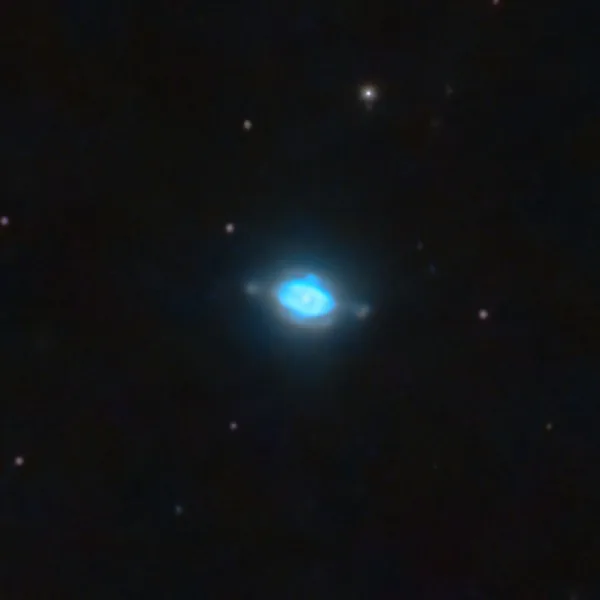
Smart scopes can absolutely capture this object, but it’s a genuine challenge: at well under an arcminute across, it can look like little more than a soft dot in a single unprocessed frame. The image above was built from about 10 minutes of integration with an eQuinox 2, and the structure only really emerged after applying 3x drizzle in post-processing — a technique that reconstructs finer detail than the sensor’s native resolution would otherwise allow. Don’t be discouraged by the live view; the disk and the beginnings of the ansae are in there, and drizzling is worth the extra step to bring them out.
The Saturn Nebula is well placed for observing from late summer into winter, reaching the meridian around local midnight in early August and remaining a good target through the fall evening sky.
Closing
The object hasn’t changed since Herschel logged it as an unresolved “not well defined disk” in 1782. What’s changed is us — bigger telescopes, better detectors, and now the ability to read distance, speed, and even chemistry out of a few pixels of light. When you find Caldwell 55 this season, in an eyepiece or on a screen, you’re looking at the same small green disk that puzzled Herschel and later reminded Lord Rosse of a planet — and the same nebula that gave its whole category a name — a still-expanding shell with a much younger, faster pair of jets stitched onto it. With a little patience, you can see more of it, and understand more of what you’re seeing, than either of them ever did.