
Introduction
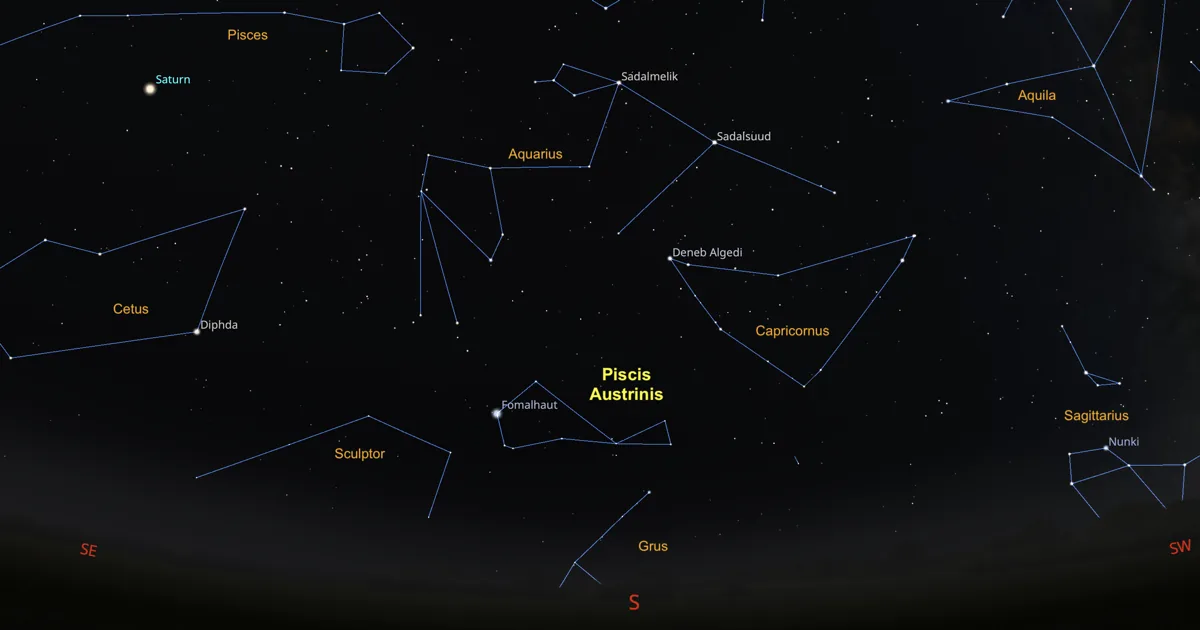
Fomalhaut’s name comes from Arabic, fum al-hut – “the mouth of the fish” – describing its position marking the mouth of Piscis Austrinus, the Southern Fish, in Ptolemy’s original constellation figure. The fish itself has a couple of different stories attached to it depending on which ancient source you read: Eratosthenes described it as the larger fish drinking the water Aquarius pours out, keeping the heavens from flooding; Hyginus told a different version, in which a fish carried Aphrodite and her son Eros to safety across the Euphrates while they fled the monster Typhon. Long before either story, Persian astronomers had already singled the star out on its own merits: as Hastorang, it was one of the four “Royal Stars” – along with Aldebaran, Regulus, and Antares – marking the sky’s cardinal points around 3000 BCE, with Fomalhaut standing watch over the winter solstice.
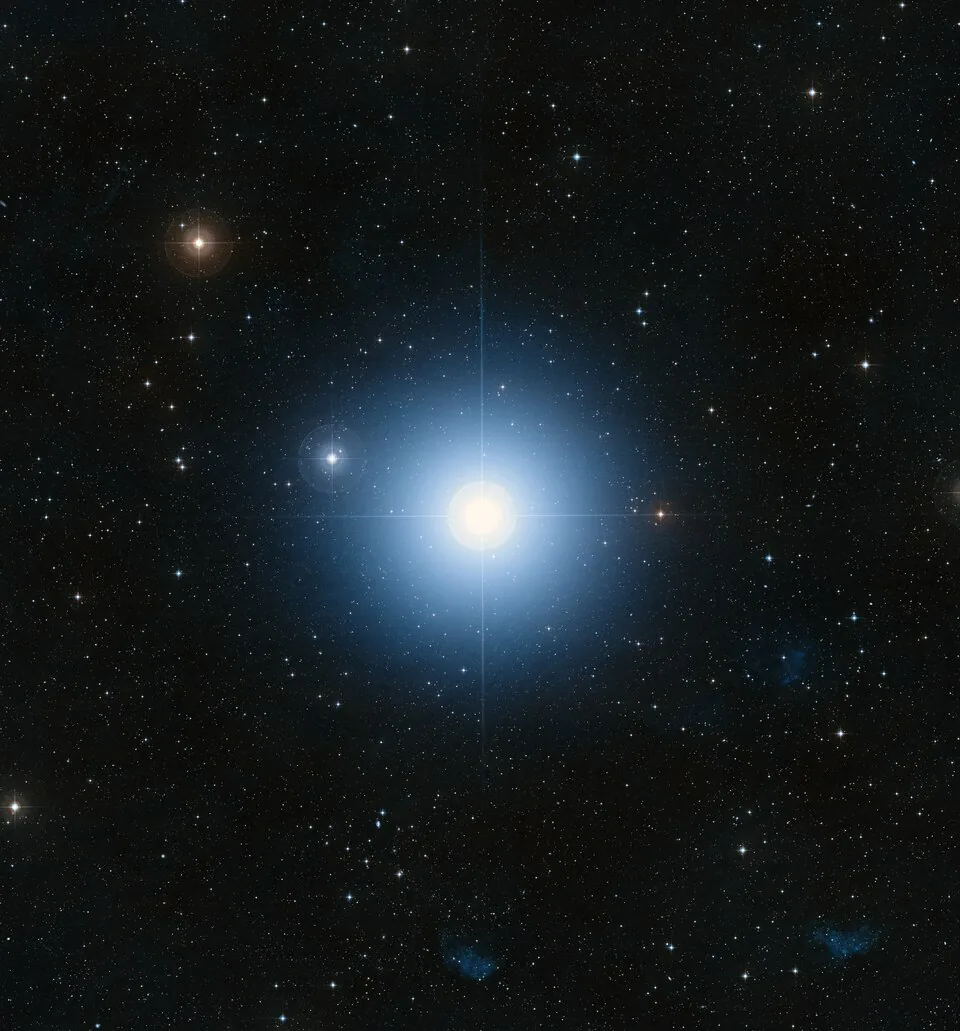
It’s picked up a more modern nickname too: the Loneliest Star, for sitting nearly by itself in a wide, dim stretch of autumn sky. That nickname is about what your eyes see. It’s not quite true – and the rest of this piece is largely about the family Fomalhaut turns out to actually have.
Similar to Vega
Fomalhaut and Vega make an oddly well-matched pair. Both are A-type main-sequence stars – Vega a slightly hotter, slightly more massive A0V, Fomalhaut an A3V – and both sit almost exactly the same distance from us, close to 25 light-years, essentially neighbors on the galactic scale. Their ages line up too: Fomalhaut at 440 ± 40 million years, Vega generally put at somewhere around 450 million, though – much like Fomalhaut’s own age – that number has moved around over the years as better methods came along, from an early estimate of 350 million up past 450 million and higher still in more recent interferometric work.
They share something more specific than coincidence, though. In 1983, the IRAS satellite was using Vega – already a standard reference star for calibrating other observations – for a routine calibration check, and found something nobody expected: far more infrared light than a plain star should give off. That excess turned out to be heat radiating from a disk of cold dust, and it was completely unanticipated; nobody had gone looking for it. The find was significant enough that it got its own name, the “Vega phenomenon,” and astronomers immediately started checking other bright, nearby stars for the same signature. Fomalhaut was one of the first three found to share it, along with Beta Pictoris and Epsilon Eridani – the founding members of what’s now an entire field of study: debris disks around ordinary stars.
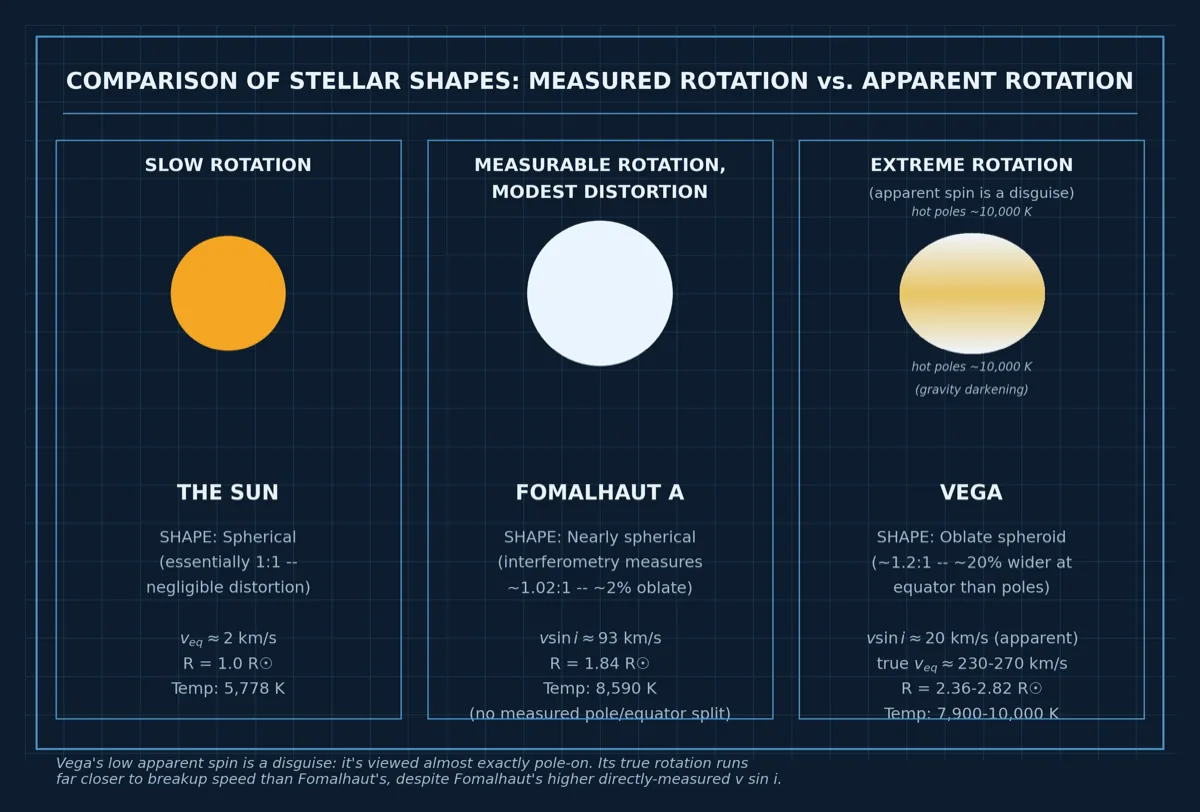
Where they actually part ways is shape, though not quite along the lines you’d expect. Vega is a genuinely extreme case: CHARA array interferometry revealed in 2006 that it’s spinning at somewhere around 91-93 percent of the speed that would tear it apart, distorting it into a visibly egg-shaped ellipsoid roughly a fifth wider at its equator than at its poles. That same rotation drags the effective gravity down enough at the equator to cool it by more than 2,000 K relative to the poles – gravity darkening – so Vega is genuinely two different temperatures depending on where on its surface you’re looking. We don’t see any of this by eye, or even in most images: Vega happens to be oriented almost exactly pole-on from Earth, so what actually reaches us is its hot, bright polar face, with the distorted, cooler equator hidden around the back. It took interferometry, not a telescope image, to catch it. Fomalhaut isn’t the calm, spherical contrast you might expect, though – its own measured rotation (about 93 km/s) is comparable to, if not faster than, Vega’s directly measured value of just 20 km/s, and interferometry has picked up a small oblateness of its own, on the order of 2 percent rather than 20. The real difference isn’t fast versus slow. It’s that Vega’s low apparent rotation is a disguise – we’re seeing it end-on – while its true spin is running far closer to its own breaking point than Fomalhaut’s ever gets.
Neither star has all that long left, relatively speaking. An A-type star this size burns through its fuel fast and has a total main-sequence lifetime of a bit over a billion years, well under a tenth of the Sun’s. Fomalhaut and Vega are both already more than a third of the way through their entire lives as stars.
Debris Disk
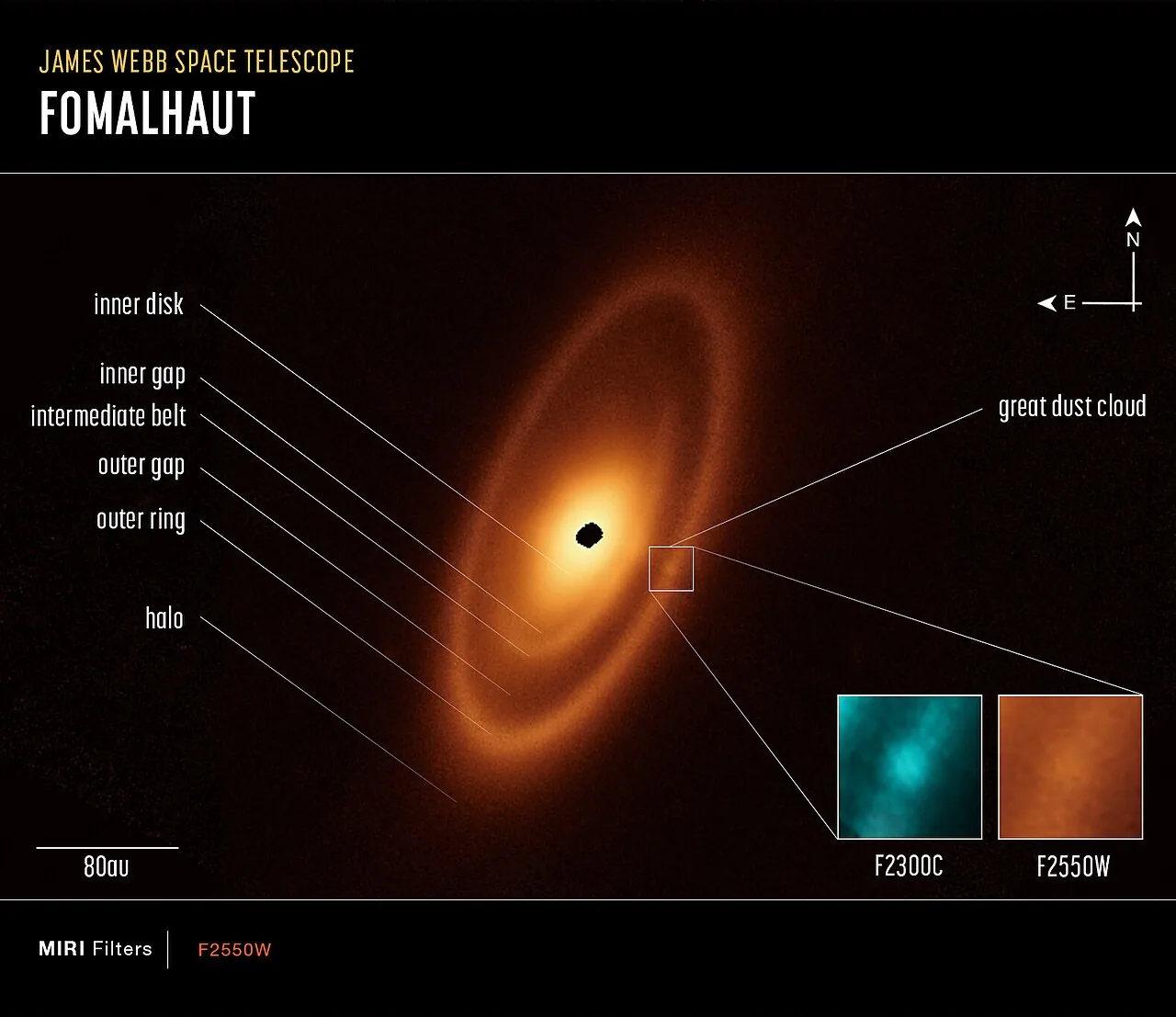
Fomalhaut’s disk isn’t one simple ring – JWST’s MIRI instrument imaged the system in 2023 and resolved three nested belts: a warm asteroid-belt analog close to the star, a newly discovered intermediate belt around 78-90 AU out that turned out to be misaligned with everything else and looks like it’s being shepherded by an unseen planet, and a cold, broad outer belt roughly 133 AU out and about 25 AU wide, sometimes informally called “Fomalhaut’s Kuiper belt.” Hubble’s 2008 coronagraph image of the outer ring picked up a striking, off-center glow that earned the whole system an unofficial nickname among astronomers: the Eye of Sauron. More recent ALMA observations, published in 2025, found an eccentricity gradient across the disk and other structural hints consistent with unseen planets gravitationally sculpting it from the inside – and a separate 2025 study found the disk isn’t dominated by large, Pluto-sized bodies the way some early models predicted. Mark Wyatt’s own estimate puts something like 300 million planetesimals in orbit out there, a debris field vastly larger than our own Kuiper belt’s.
Exoplanets?
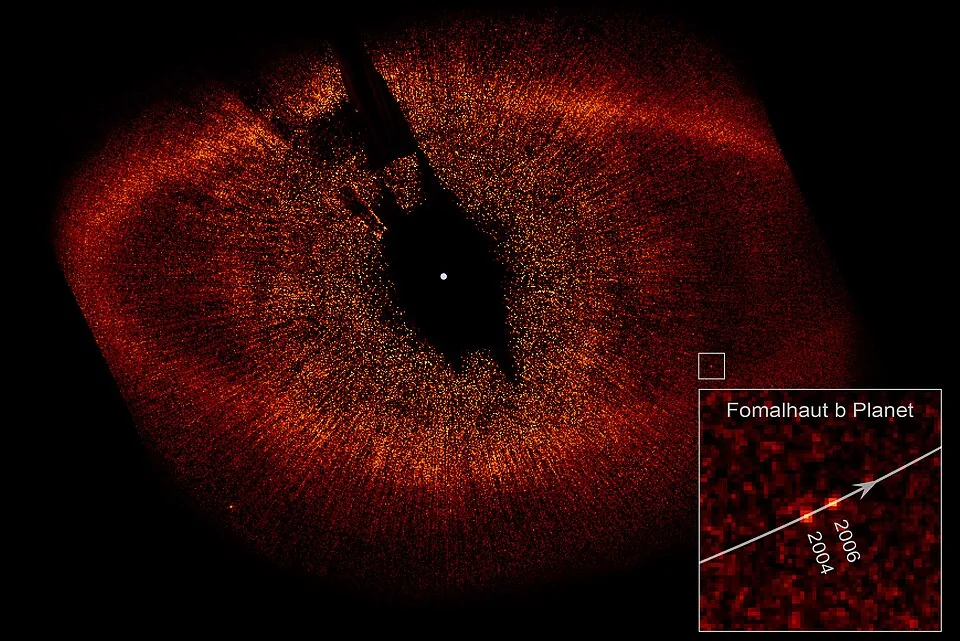
In 2008, a team led by Paul Kalas announced they’d directly imaged a planet inside that outer ring – Fomalhaut b, one of the first exoplanets anyone had ever actually photographed, rather than inferred from a star’s wobble or a transiting shadow. It got an official name a few years later through the IAU’s public NameExoWorlds process: Dagon, after the ancient Mesopotamian deity often depicted as half man, half fish – a fitting choice for something found in the mouth of the Southern Fish.
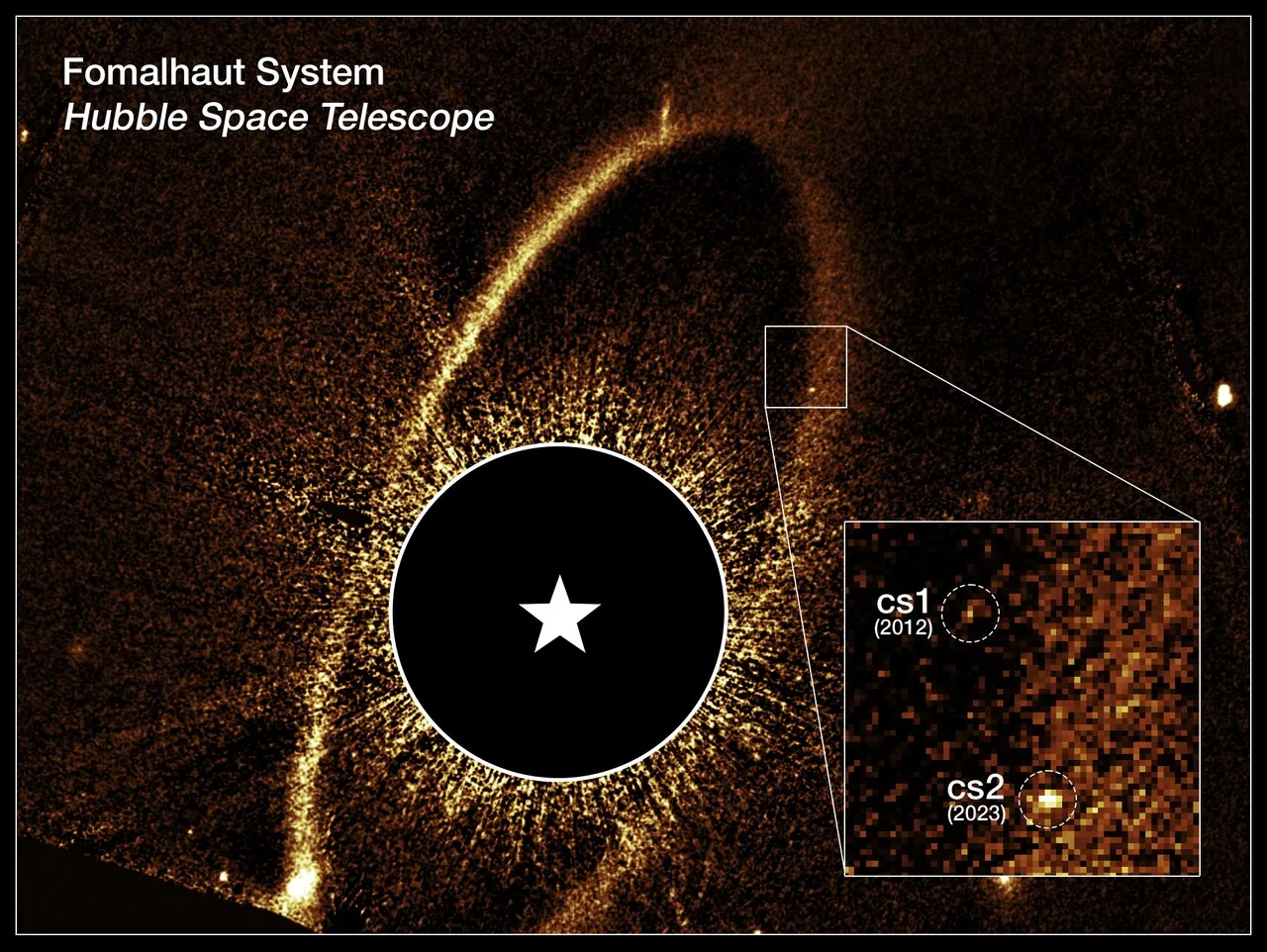
It didn’t hold up as a planet. Follow-up Hubble monitoring through the 2010s found Dagon behaving all wrong for a solid world: it kept fading, and by 2014 it had grown too faint to detect at all, while also visibly expanding – the signature of an enormous, dispersing cloud of debris from a collision between two large icy bodies, not a planet in a stable orbit. Then, in late 2025, Kalas’s team went back through the archive and found a second, independent compact source in a different part of the ring, in 2023 images – looking exactly like the original Dagon detection had looked twenty years earlier. Published in Science in January 2026, the interpretation is that this is a second planetesimal collision caught in the act, and that its resemblance to the first all but confirms Dagon itself was never a planet either – just the debris cloud from an earlier, similar collision that happened to get caught by Hubble right as it was forming.
So there’s an officially IAU-named exoplanet, Dagon, that in all likelihood isn’t a planet at all – named back when the 2008 detection still looked solid, the name simply never got walked back once the science moved on. It’s a good caution for anyone hunting for real exoplanets elsewhere: a big enough collision can look exactly like a world for years before it gives itself away.
Companions
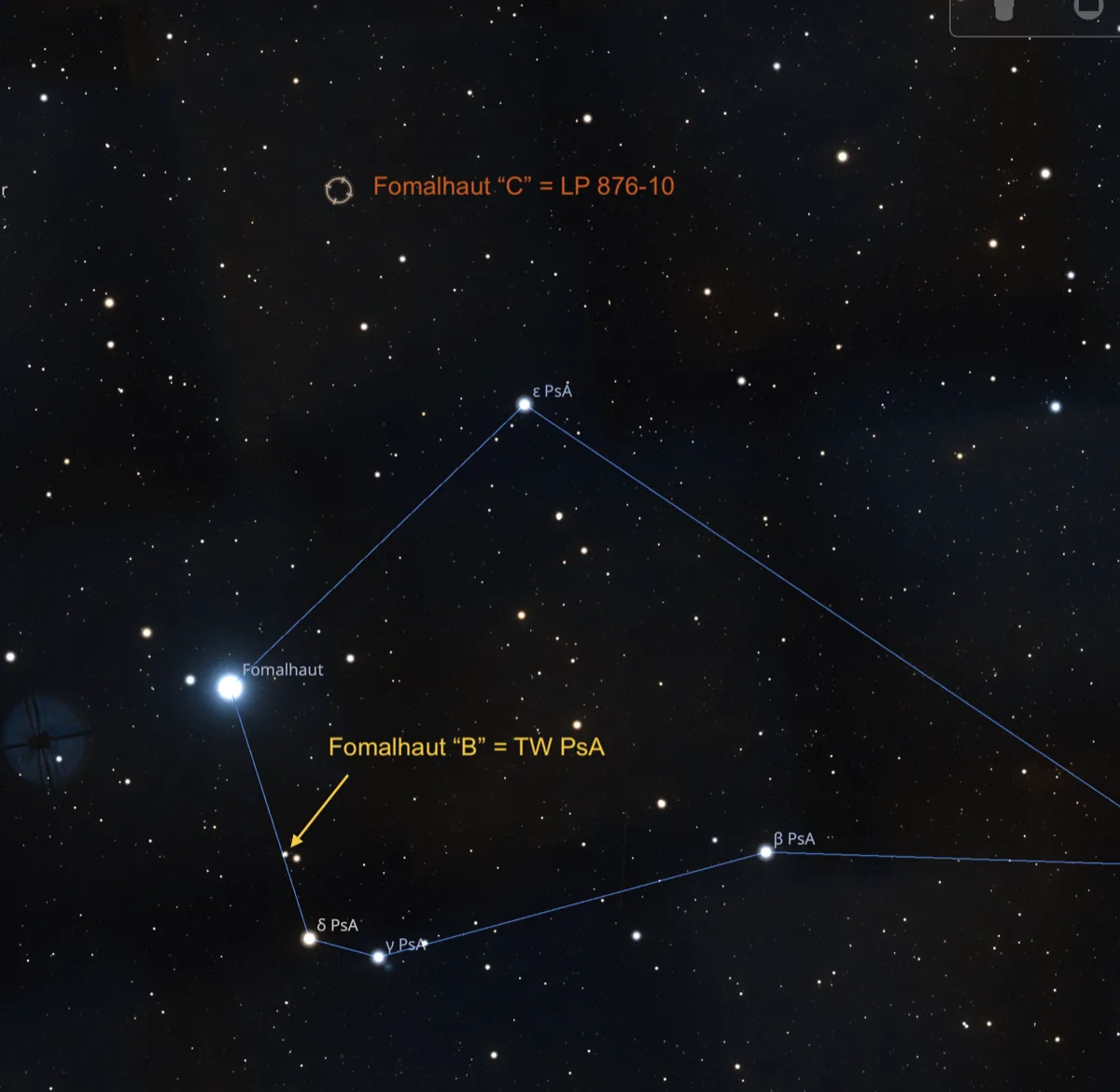
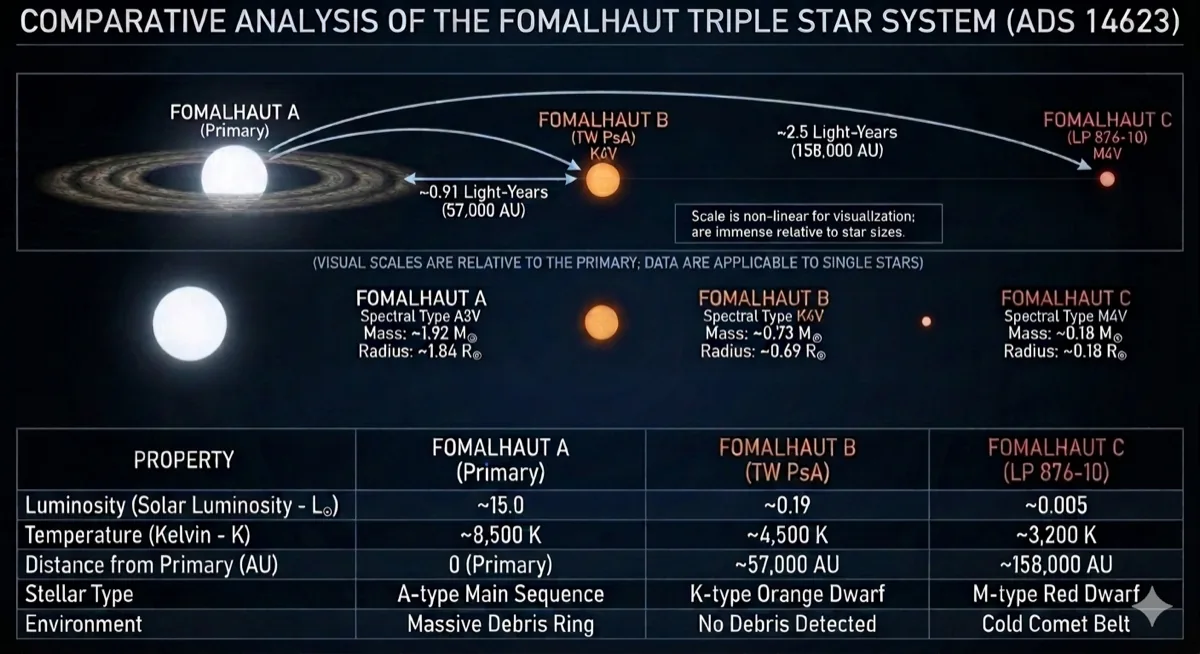
TW Piscis Austrini (Fomalhaut B) sits about 2 degrees away in the sky – roughly four full moons’ width – and around 0.91 light-years off in real distance, orbiting the system’s barycenter on a period estimated at 5.8 million years. It’s a K4 orange dwarf, noticeably smaller and cooler than Fomalhaut A, and a genuinely active one: it’s a BY Draconis-type variable, its brightness flickering between magnitude 6.44 and 6.49 on a 10.3-day cycle as starspots rotate in and out of view, with occasional flares on top of that. It was first suspected as a companion back in 1938, but not confirmed as genuinely bound to Fomalhaut until 2012. There’s even a hint, from 2019 astrometric data, that TW PsA might have a planet of its own – something in the neighborhood of 1.2 Jupiter masses – though the evidence is thin and the orbit poorly constrained.
LP 876-10 (Fomalhaut C) is stranger still: a red dwarf about 2.5 light-years from Fomalhaut A and roughly 5 degrees away across the sky – far enough that it technically sits in the neighboring constellation, Aquarius, while Fomalhaut A and B share Piscis Austrinus. At magnitude 12.6, it needs a real telescope to see at all. It wasn’t confirmed as part of the system until 2013. And it has its own debris disk – a genuine rarity around a star this small and faint, which makes the Fomalhaut system one of the few known multi-star, multi-disk arrangements anywhere nearby.
Observing
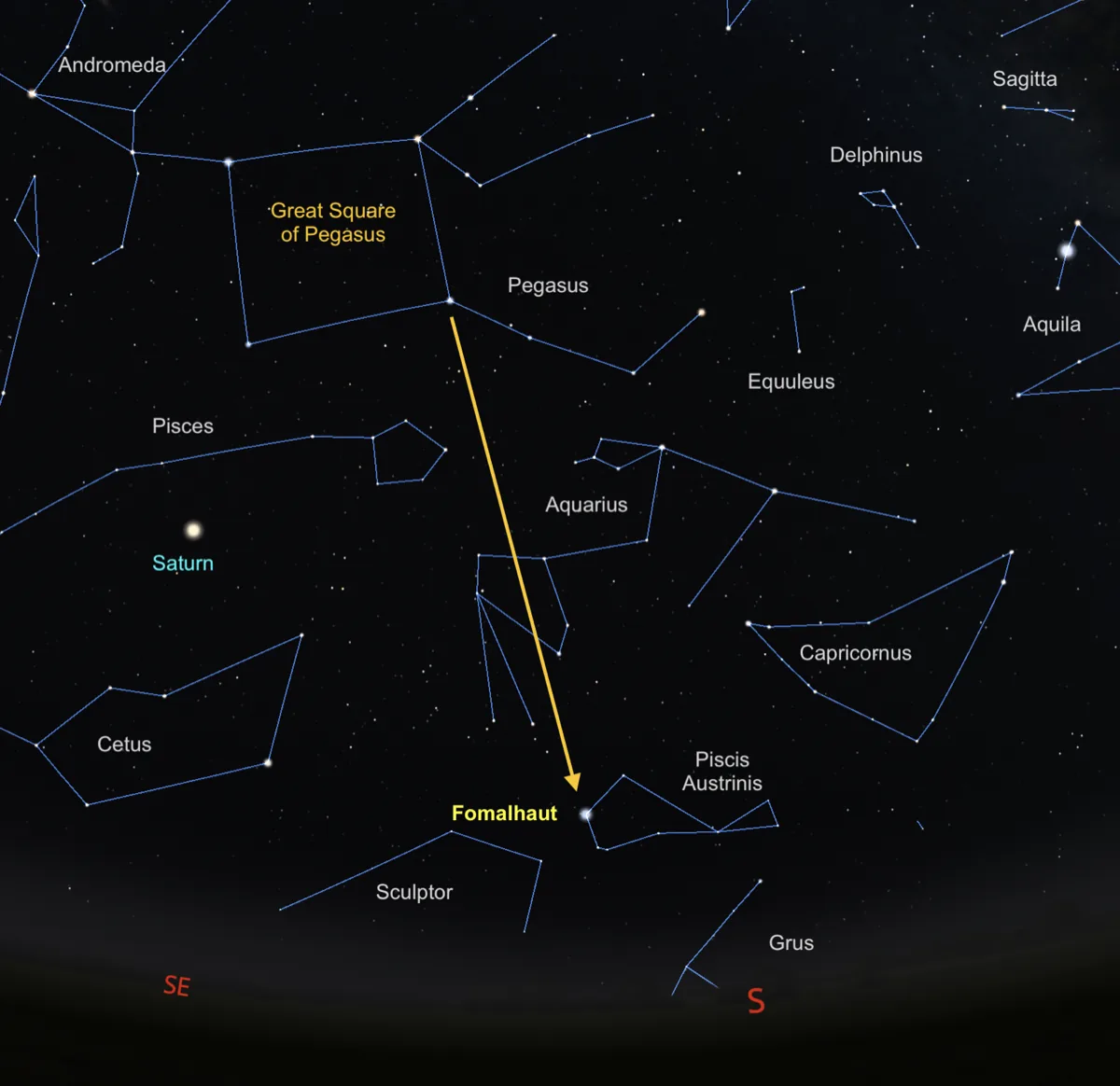
Fomalhaut is a naked-eye target, and an easy one to identify once you know where to look, precisely because there’s so little competition around it. From the Great Square of Pegasus, follow the western edge of the Square south, past Cetus, and continue down toward the horizon – Fomalhaut is the lone 1st-magnitude point sitting by itself low in the south. At our latitude it never climbs very high, topping out around 18 degrees above the horizon, so a clear, unobstructed view to the south is essential – this is one to try from the open parts of the hill, not from anywhere with trees or buildings in that direction.
If you want to chase the family resemblance, TW Piscis Austrini (Fomalhaut B) is technically a naked-eye object too, at magnitude 6.44-6.49 – right at the edge of visibility from a genuinely dark sky, an easy binocular catch otherwise, and only 2 degrees from Fomalhaut itself. LP 876-10 (Fomalhaut C), at magnitude 12.6 and 5 degrees further out in Aquarius, is a real telescope target – six inches of aperture or more, and a night when you’re willing to do some careful star-hopping for a genuinely obscure catch.
Next clear night with a good southern horizon, take a look – you’re looking at a very ordinary point of light with a family spread across a fifth of the sky and a genuinely strange story behind the ring of debris surrounding it.