Introduction – How Far Is Far?
Measuring and estimating distance is part of everyday life. We go for a nice two-mile walk. We commute to and from work. We take trips – by car, by train, by plane. Each of these has its own sense of near and far, and that sense scales with how we’re traveling: a 10-mile drive to work isn’t bad (traffic notwithstanding), but a 10-mile walk is strenuous, unless you’re a distance runner and used to that sort of thing. A trip that would take all day by car takes a couple of hours by air, and we can reach the other side of the globe in a day.
We also often think of distance in terms of time: a 5-minute walk to the bus stop, then a 20-minute ride downtown. The drive to the grocery store might take 10 or 15 minutes. Driving to your sibling’s house across the state might take 3 hours – and so might the flight to a work conference, which lies at a far greater distance.
Geographers have a name for this: time-space convergence. The miles between two cities don’t change, but a trip that once took days by stagecoach now takes hours by air.1 Traveling faster doesn’t seem to save us much time. People tend to spend roughly an hour a day getting around, whatever the vehicle; when the vehicle gets faster, they just go farther.2
In astronomy, we do much the same thing. Sometimes it’s easiest to state a distance in ordinary units, usually kilometers. Other times we borrow from time: the light-year, the distance light travels in a year, is the most familiar example. And often we build comparative units, like the astronomical unit. Either way, the idea is the same: we pick our “ruler” to suit how we’re traveling.
But astronomical scale is not our everyday scale: space is big. Even our standard “big” units quickly drown in zeros, and we begin to lose perspective.
Distances We Can Still Feel
In the US, we still cling to the mile – partly, I suppose, out of stubbornness. On its own terms, though, it works well. A few miles is near; a few hundred is a real trip; and even the width of the continental US (about 2,800 miles) is a distance we can relate to, even if we’ve never driven or flown it. The conversions are the inconvenient part: 5,280 feet or 1,760 yards to the mile usually means reaching for a calculator. The metric system scales the same way with far simpler conversions (1,000 meters to the kilometer): the width of the US is about 4,500 km.
We tend to clump things into groups and regions – neighborhoods, towns, states – with boundaries drawn either arbitrarily or along some natural feature, like a river or a ridge. The Universe does something similar: gravity gathers matter into galaxies, galaxies into groups and clusters, and clusters into even larger structures, up to a point.
We also judge distance by how crowded things are. Downtown, rowhouses share walls; in the suburbs, the next house is a few house-widths away; out in the country, your nearest neighbor might be hundreds of house-widths down the road. Without thinking about it, we measure the gap between neighbors in units of the neighbors themselves – and that’s a comparative ruler, too. Hold onto that idea: when we get out among the planets, the stars, and the galaxies, which neighborhoods are “downtown” and which are the boonies may surprise you.
Even larger distances aren’t a problem. The circumference of the Earth at the equator (24,900 miles, or 40,000 km) is about nine continental widths; we can picture that. And in the space age we’re used to satellites whizzing around the Earth. You may have seen the International Space Station pass overhead, about 250 miles (400 km) up, and you may know it circles the Earth every 93 minutes – numbers we can still “feel.”
Things start to slip when we consider the ISS’s orbital velocity: about 17,000 mph (~27,400 km/h). We’ve only gone just above the Earth’s surface, and already the numbers are getting hard to wrap our heads around. That’s nearly 5 miles every second – more than 250 times highway speed. Every second, the ISS covers the length of about 80 football fields.
The Moon: One Distance, Several Ways
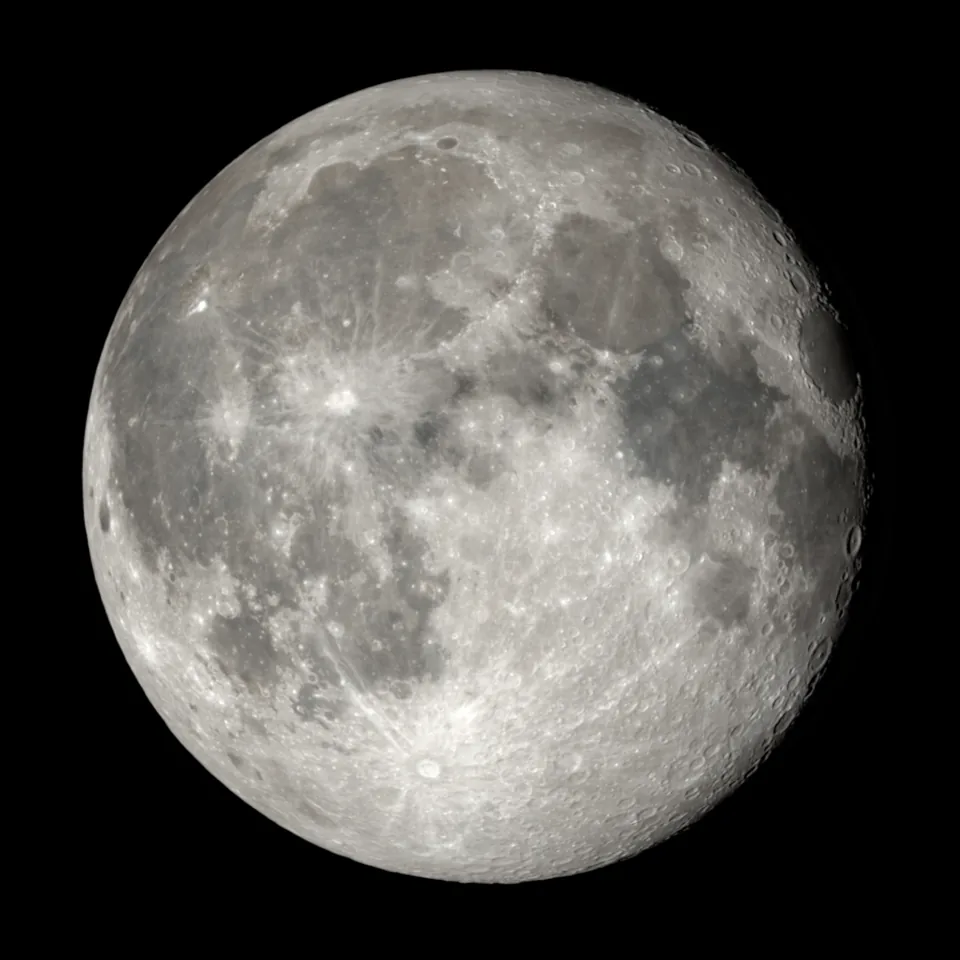
Apart from the occasional near-Earth asteroid passing by, the Moon is our nearest celestial neighbor. If we want to start thinking about astronomical distances, this is the place to start. Plus, we’ve actually been there.
The Moon’s average distance is 238,855 miles (384,400 km) – call it 240,000 miles, or 385,000 km. That’s just under 10 times the circumference of the Earth, so it isn’t too hard to fathom. But show that distance to scale, with the Earth and Moon drawn at their true sizes, and it’s quite a gap:

To build this as a model, use a basketball and a tennis ball: their sizes are close to the right ratio for the Earth and Moon. Then put them 24 feet apart. (Adding the Sun to this model, as we’ll see, isn’t so easy.)
Here’s another way to climb to the Moon: in steps of about 10.
| Distance | Example | Compared to the row above |
|---|---|---|
| 2½ miles | A good walk | |
| 26 miles | A marathon | ~10 good walks |
| 270 miles | A road trip: Los Angeles to Las Vegas | ~10 marathons |
| 2,800 miles | Coast to coast across the US | ~10 road trips |
| 24,900 miles | Around the world | ~10 cross-country trips |
| 238,855 miles | To the Moon | ~10 trips around the world |
We can also picture the gap as about 30 Earths lined up side by side, or 9.6 trips around the world. But there’s a more personal measure, too: your car’s odometer. The Moon is a distance real cars can and do actually cover. Roughly 1 car in 20 reaches 240,000 miles over its lifetime, and for a handful of long-lived models it’s as high as 1 in 3.3 A round trip is another story: only about 1 car in 5,000 is up to the task.3
Since we’re thinking in terms of transportation, we can also ask how long a one-way trip to the Moon would take:
| Vehicle | Assumed speed | Nonstop trip to the Moon |
|---|---|---|
| Walking | 3 mph | ~9 years |
| Car | 65 mph | ~5 months |
| Jetliner | 550 mph | ~18 days |
| Apollo | 3,500 mph | ~3 days |
These estimates assume no stops for sleep, refueling, or layovers. Interestingly, even though the numbers are small, I find these time frames harder to relate to – probably because nothing in my life corresponds to any of them. Even Apollo’s 3 days (Artemis II, in April 2026, took closer to 5 from launch to its lunar flyby) got broken up by sleep and work. “Are we – or they – there yet?”
An Exercise: Do All the Planets Fit Between Earth and the Moon?
You may have seen the claim that all the planets fit between the Earth and the Moon. The arrangement looks something like this:
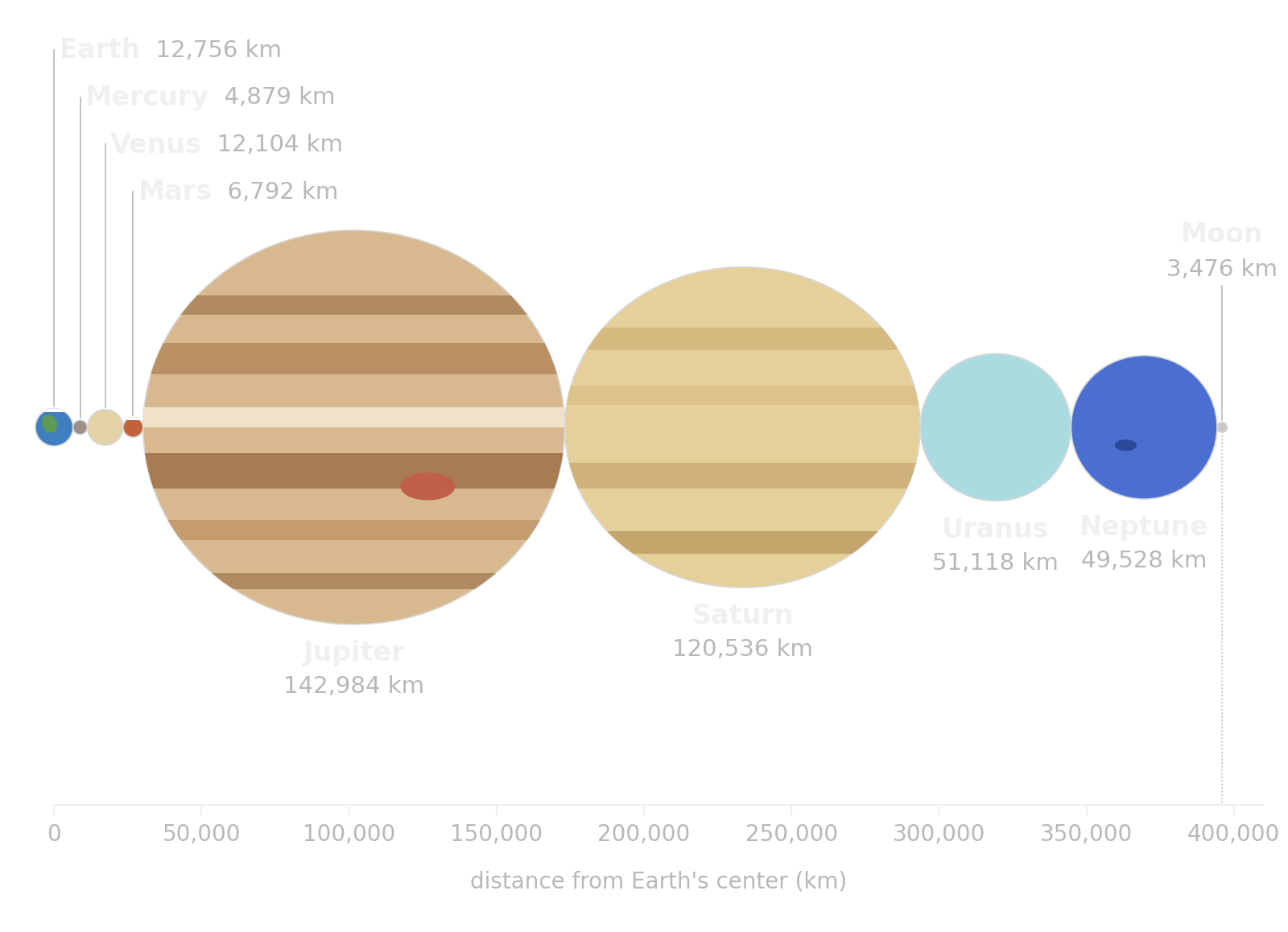
Is it true? Sort of – it depends. The Moon’s orbit isn’t a circle; it’s an ellipse with an eccentricity of 0.0549, so its distance from us ranges, on average, from 363,300 km at perigee (closest) to 405,500 km at apogee (farthest). That changing distance is also why some solar eclipses are total and others annular. Nor are the planets perfectly round: the gas giants spin so fast that they bulge at the equator, so it matters whether you measure them pole to pole (polar), across the equator (equatorial), or as an average (mean). It also matters which planets you include. Earth is one of the bookends, so it’s out. And to keep everyone happy in the Pluto debate, we can try it with and without Pluto, which adds another 2,377 km to the total. (Pluto is essentially round, so the same value works for every sum.)
One more detail: the Moon’s distance is measured center to center, but the planets have to fit between the surfaces, so Earth’s and the Moon’s radii (6,371 km and 1,737.4 km, respectively) count against us too.
| Diameters | Planets | Sum of diameters | Perigee | Average | Apogee |
|---|---|---|---|---|---|
| Polar | Without Pluto | 364,799 km | ❌ | ✅ | ✅ |
| Polar | With Pluto | 367,176 km | ❌ | ✅ | ✅ |
| Mean | Without Pluto | 380,016 km | ❌ | ❌ | ✅ |
| Mean | With Pluto | 382,393 km | ❌ | ❌ | ✅ |
| Equatorial | Without Pluto | 387,941 km | ❌ | ❌ | ✅ |
| Equatorial | With Pluto | 390,318 km | ❌ | ❌ | ✅ |
Image "earth-moon/fig-planets-fit-moon-distance-dark.svg" not found.
So the claim is true – sometimes. It always works when the Moon is near apogee and never when it’s near perigee. At the Moon’s average distance, it’s a squeeze that only works if you stack the planets pole to pole. Pluto, it turns out, never changes the answer.
The Sun: Where the Numbers Pile Up
If the Moon is the neighbor down the road, the Sun is our capital city: the center the whole Solar System is organized around, the source of nearly all our light, heat, and energy – and, by everyday standards, remote.
93,000,000 miles. That’s the distance from the Earth to the Sun most of us learned as kids. Today the International Astronomical Union defines it precisely: the astronomical unit (AU) is exactly 149,597,870,700 meters, or about 92,955,807 miles – so the grade-school figure is about 44,000 miles too high. At this scale, astronomy switches to kilometers, the global standard: about 150 million km. In metric prefixes that’s 150 gigameters, but nobody thinks in gigameters; instead we lean on scientific notation (1.5×10⁸ km). Either way, we’re entering the realm where the numbers themselves are hard to fathom. Our vehicles struggle too: trips to the Moon measured in days, months, or years now stretch to years or millennia, and even by car, the trip to the Sun outlasts a lifetime. I can’t imagine enduring a 19-hour flight, let alone a 19-year one.
| Vehicle | Assumed speed | Nonstop trip to the Sun |
|---|---|---|
| Walking | 3 mph | ~3,500 years |
| Car | 65 mph | ~163 years |
| Jetliner | 550 mph | ~19 years |
| Apollo | 3,500 mph | ~3 years |
The AU is close to, but not exactly, Earth’s average distance from the Sun, because that distance keeps changing. Earth’s orbit, like the Moon’s, isn’t a circle: it’s an ellipse with an eccentricity of 0.0167 (much rounder than the Moon’s), so our distance swings between perihelion, about 147.1 million km in early January, and aphelion, about 152.1 million km in early July – a difference of about 5 million km, or about 3%. The Moon and the other planets tug on us too, shifting those distances by thousands of kilometers from year to year.
Showing the Earth’s size and its distance from the Sun to scale is already impractical. Make the Earth one pixel, and the Sun is a circle 109 pixels wide but more than 11,700 pixels away – that’s a lot of scrolling. In print, with the Earth the size of the period at the end of this sentence, the Sun is a circle 5.5 cm across, almost 20 feet away. The numbers, and the scale, are already – well – “astronomical.”
Constructing a physical model gets a bit absurd, too. Reuse the basketball, this time as the Sun, and the Earth is about 2 mm across – a grain of sand, 1/109th of the Sun’s width – about 85 feet away. Or, if you prefer vegetables: make the Earth a garden pea, and the Sun becomes a very large pumpkin, 82 cm across, 88 meters away – almost the length of a football field.
Choosing the Right Ruler
It makes sense that astronomers switch rulers at this scale, to the astronomical unit, even though the ruler itself is enormous. But that only works as long as the numbers stay readable. By the time we reach the nearest star, Proxima Centauri, we’re at 40,200,000,000,000 km (40.2 trillion km, or 40.2 petameters) – about 268,600 AU. Even the outer fringes of the Solar System are vast: the Oort Cloud is thought to begin around 2,000 to 5,000 AU (300 to 750 billion km) from the Sun, and may extend a quarter to halfway to Proxima Centauri.
The problem compounds as we go farther. By the time we’re measuring distances within our own galaxy – let alone to other galaxies – there’s no everyday unit left to relate to, and each step up is another factor of ten, or a thousand.
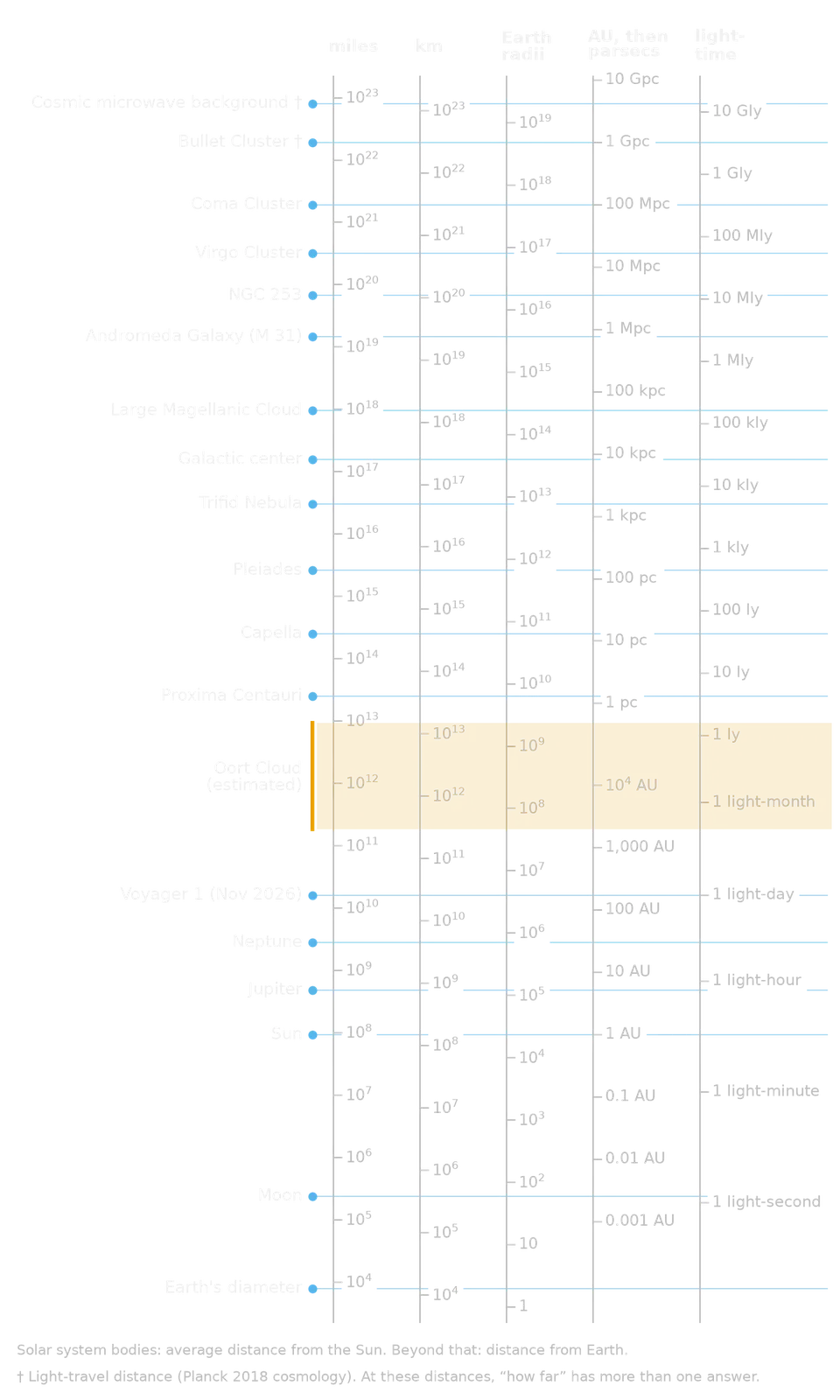
So astronomers do the same thing we do when we go from walking to driving: each scale gets its own natural ruler.
| Scale | Natural ruler | What “1” means | Example |
|---|---|---|---|
| Planet sizes | Earth diameters | 12,742 km | Jupiter is ~11 Earths wide |
| Stars | Solar radii | ~696,000 km | Arcturus is ~25 solar radii |
| Solar system | Astronomical unit (AU) | Earth-Sun distance | Neptune is ~30 AU from the Sun |
| Nearby stars | Light-years / parsecs | 9.46×10¹² km (light-year) | Alpha Centauri is 4.37 light-years away |
| Our galaxy | Kiloparsecs | 3.086×10¹⁶ km | The Eagle Nebula is 1.7-2.0 kpc from the Sun |
| Galaxy groups and clusters | Megaparsecs | 3.086×10¹⁹ km | The Virgo Cluster is about 16.5 Mpc from our galaxy |
You may have noticed two rulers sharing the “nearby stars” row. Light-years and parsecs measure the same kind of distance – one parsec is about 3.26 light-years – and astronomers use both. Why keep two units for the same job? That’s a story of its own, and we’ll get to it later in this series.
Notice that the reference point shifts, too: from Earth, to the Sun, to our galaxy as a whole.
The larger we go, the harder it is to “feel.” We use miles and kilometers every day. We “get” an AU because it’s where we live, more or less. A light-year at least has a simple story behind its definition. But a megaparsec has nothing to hang on to – at some point, you just have to trust the numbers.
Let’s Go Outside: The Whole Ladder in One Night
The Moon
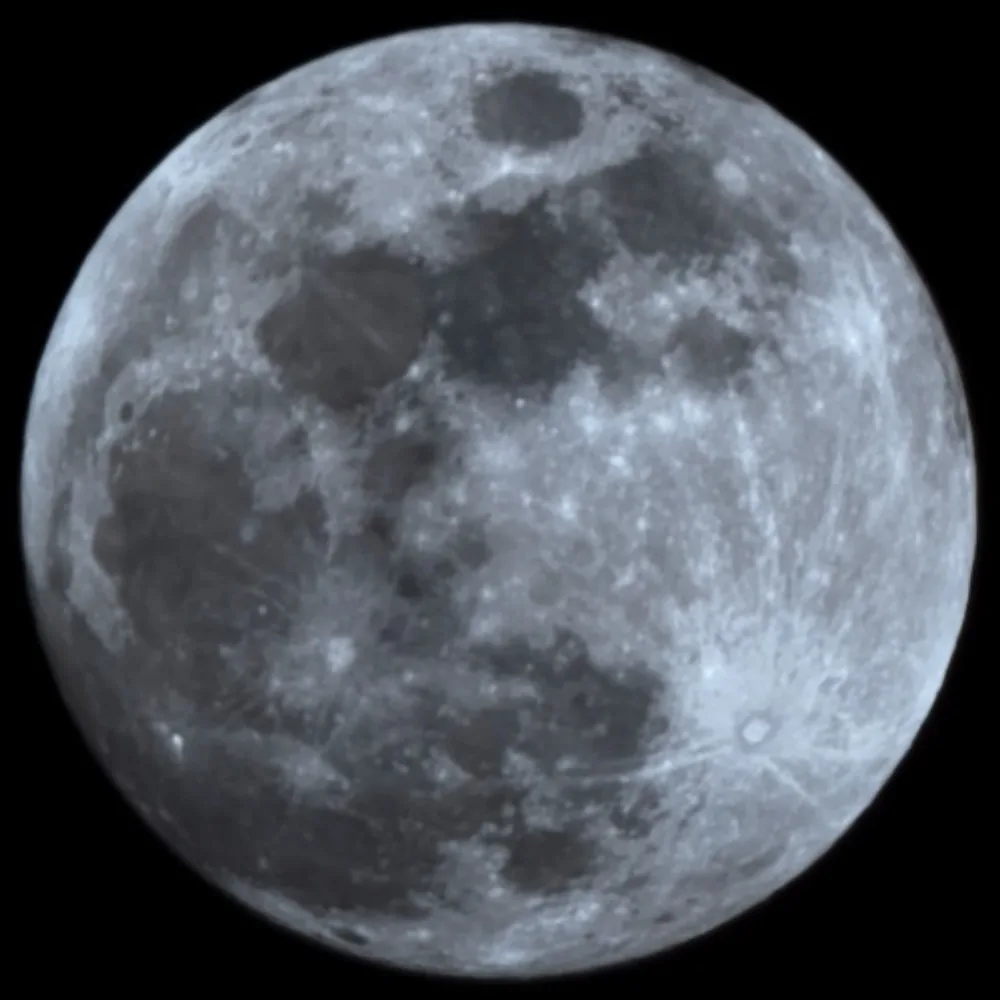
We covered the Moon’s distance in detail above, and with all those comparisons in mind, it’s the perfect starting point for any journey. It’s “out there,” but within reach of human exploration.
The Moon’s changing distance is visible, too: a Full Moon near perigee is up to about 14% wider than one near apogee. That’s nearly impossible to judge by eye alone, but photograph a few Full Moons with the same setup and compare. An almanac will tell you which is which, but it’s fun to try it “without peeking” first!
Saturn
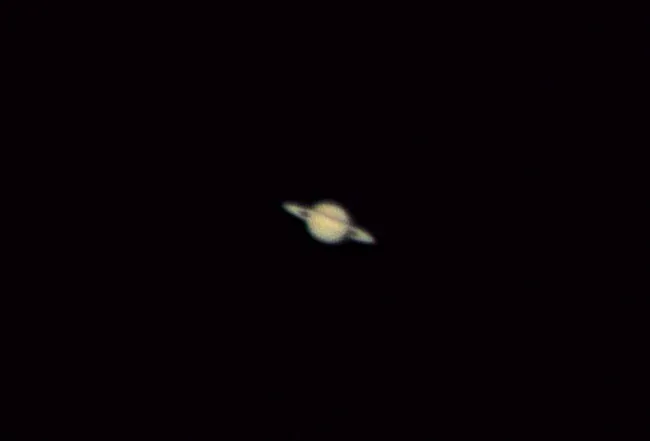
Observing Saturn brings an almost visceral response. There’s nothing quite like seeing it in a telescope, no matter how many times you’ve done it – and of course, it’s the rings. At opposition the planet is about 8.5 AU away (about 1.3 billion km). Can you build a mental picture of that distance, to scale with the Earth and Sun? Jupiter at opposition (4.2 AU) is only about half as far. And at Saturn, we’re still less than halfway to Uranus (about 18 AU at opposition) and not even a third of the way to Neptune (about 29 AU). The gaps between the outer planets keep getting larger, something you don’t “feel” from a table of planets with a “distance from the Sun” column.
Neptune
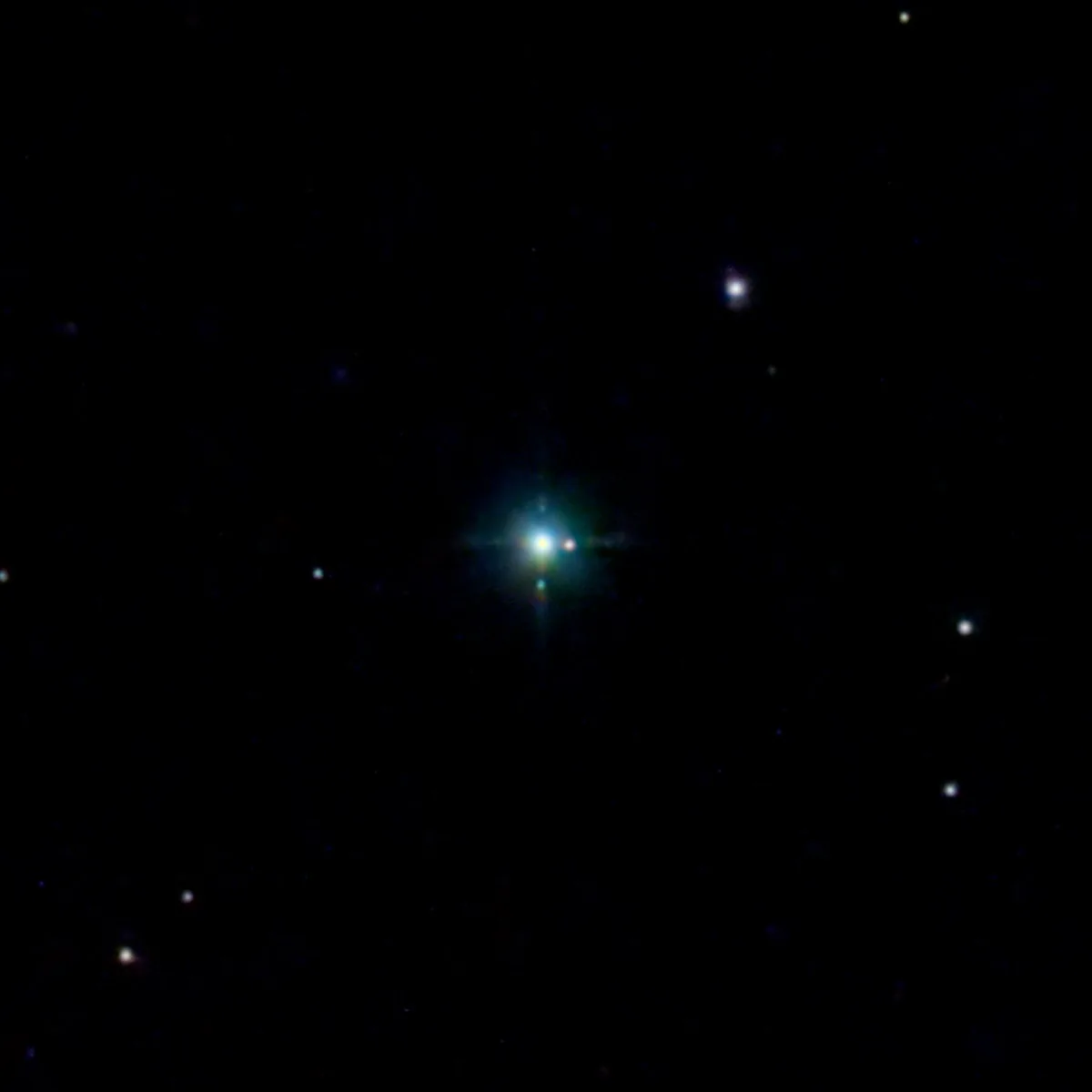
Neptune can be found in large binoculars or a small telescope – if you know where to look. It takes serious magnification and good seeing to show it as a disk; to most observers it’s a bluish point that isn’t quite star-like. Now we’re at the edge of the giant-planet region of the Solar System: just under 29 AU at opposition (4.32×10⁹ km), about 3½ times as far as Saturn. Yet even Neptune is close to the Sun compared with how far the Solar System extends. Voyager 1 is almost 6 times farther from the Sun (172 AU, 25.6 billion km), and Voyager 2 almost 5 times (143 AU, 21.4 billion km). Both have crossed the heliopause, where the solar wind gives way to the interstellar medium, so by that measure they’re in interstellar space. But they’re still well inside the Sun’s gravitational realm, out in the sparse Scattered Disk beyond the Kuiper Belt – and they won’t reach even the inner edge of the Oort Cloud for about 300 years.
The Summer Triangle
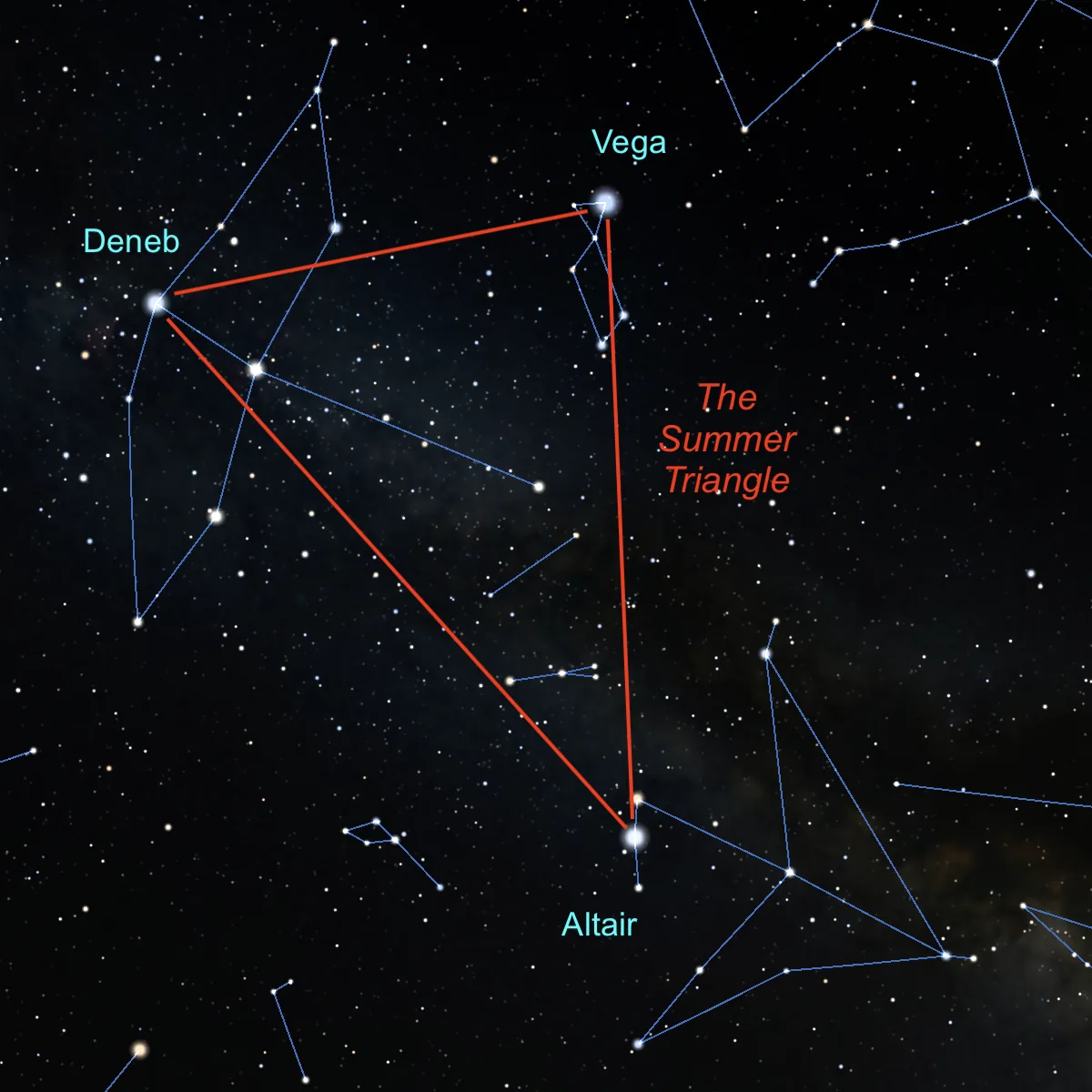
The three bright stars of the Summer Triangle make an interesting comparison. Altair is the closest, at 17 light-years, with Vega not far behind at 25. They’re in our solar neighborhood. Deneb, on the other hand, is estimated at around 2,600 light-years – roughly 100 times farther, though its distance is uncertain. Even the bright stars cover a lot of ground.
Messier 72
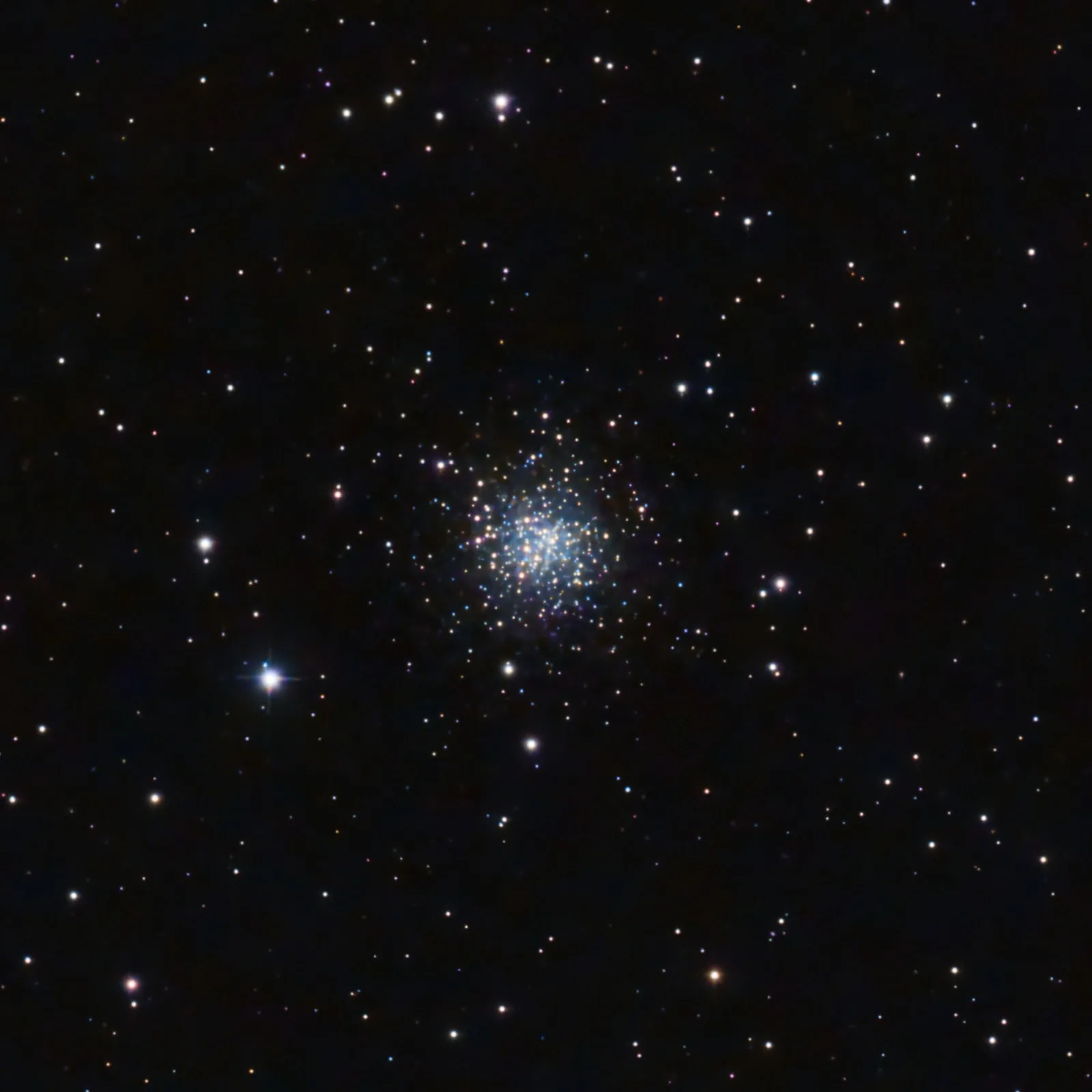
This globular cluster in Aquarius sits about 55,000 light-years (17 kpc) away, below the far side of the Milky Way’s disk, and shows up as a hazy ball in a small telescope. Now we’re looking across about half a quintillion kilometers (5×10¹⁷ km).
The Andromeda Galaxy
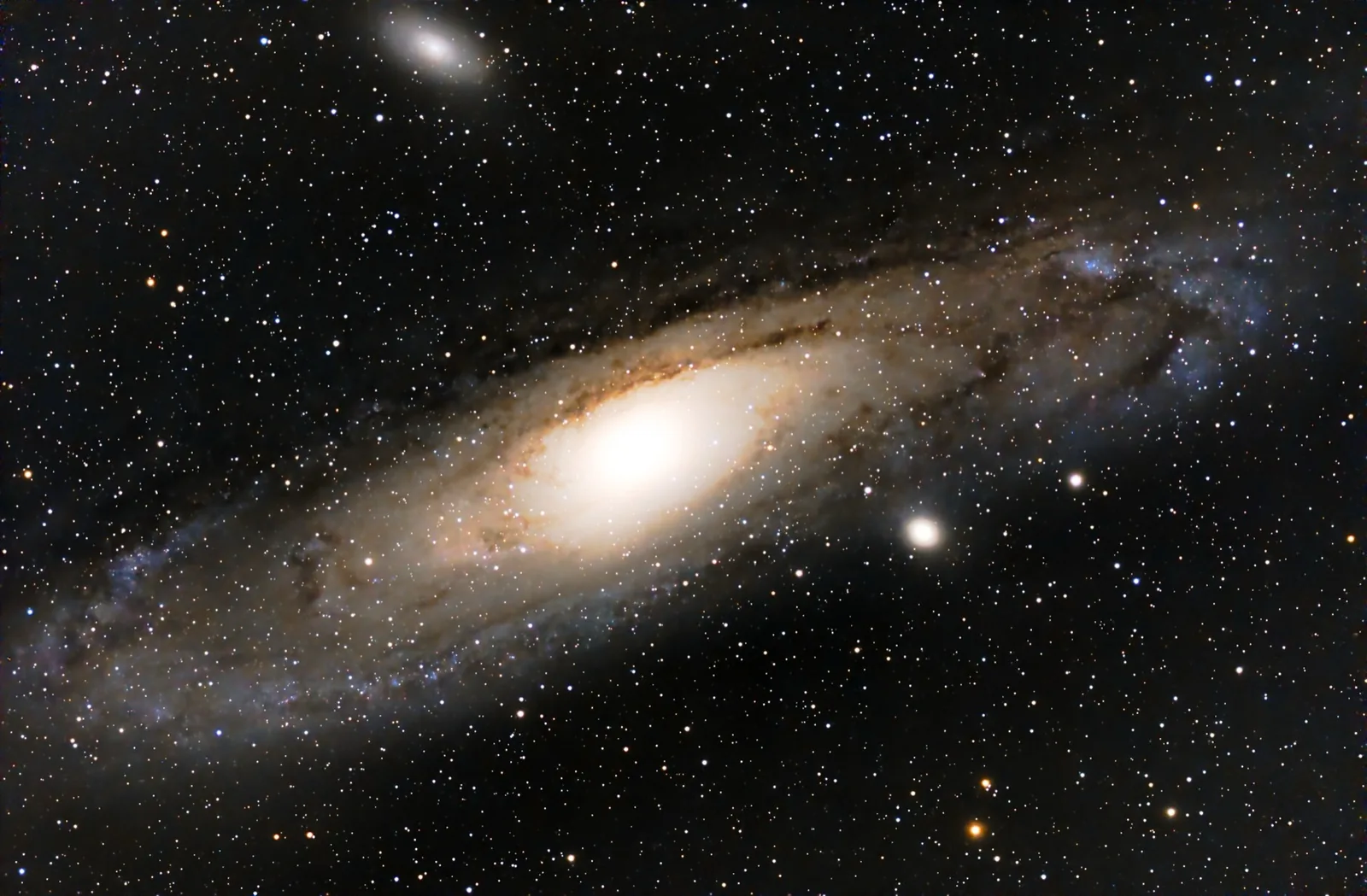
Messier 31 is often called the most distant object you can easily see with the naked eye under dark skies. (Under the very darkest skies, it’s possible to glimpse Messier 33, the Triangulum Galaxy, about 100 kpc farther.) Whichever you choose, and however you look, we’ve almost crossed into the megaparsec range: 0.78 Mpc, or 24 quintillion kilometers (2.4×10¹⁹ km).
Messier 77 and NGC 7331
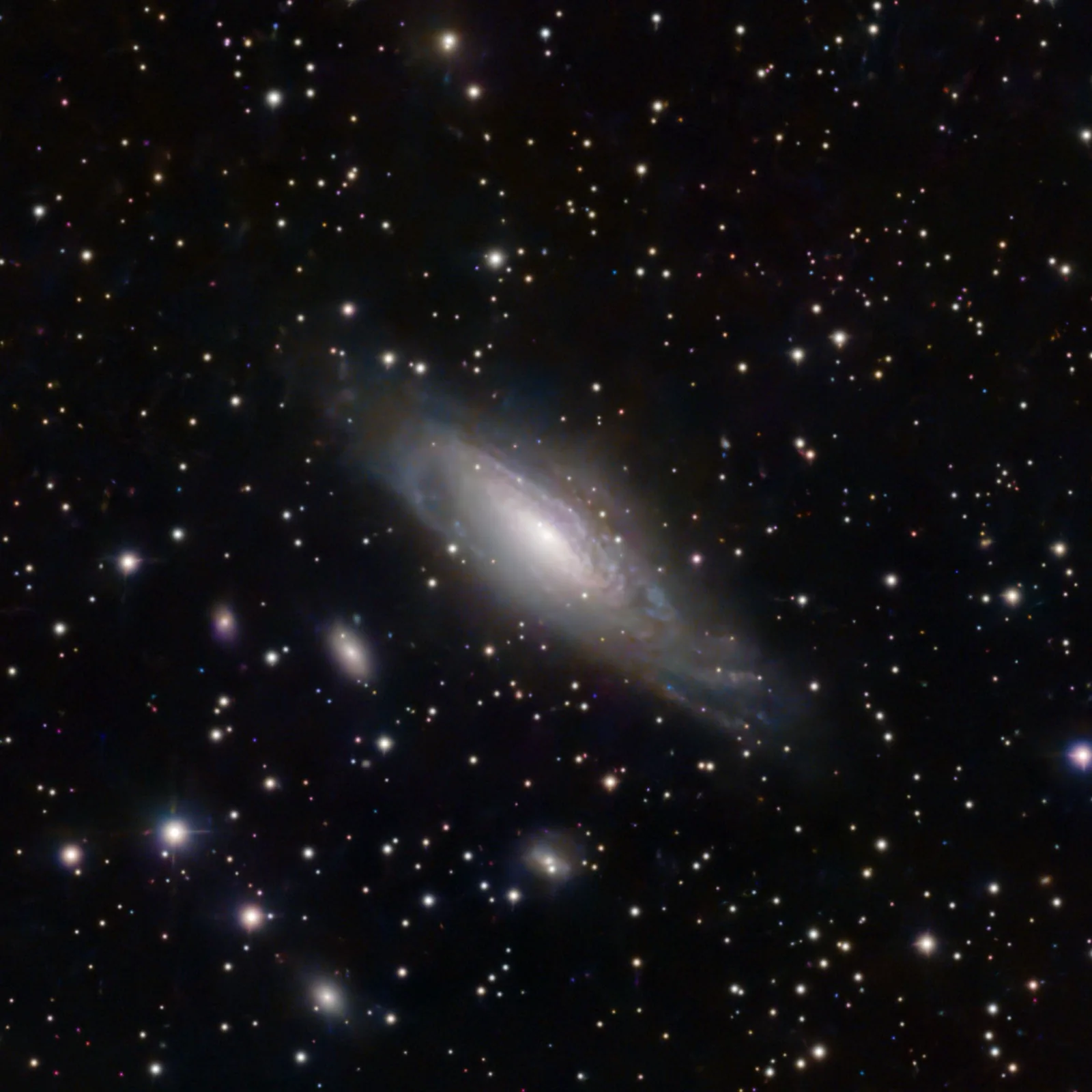
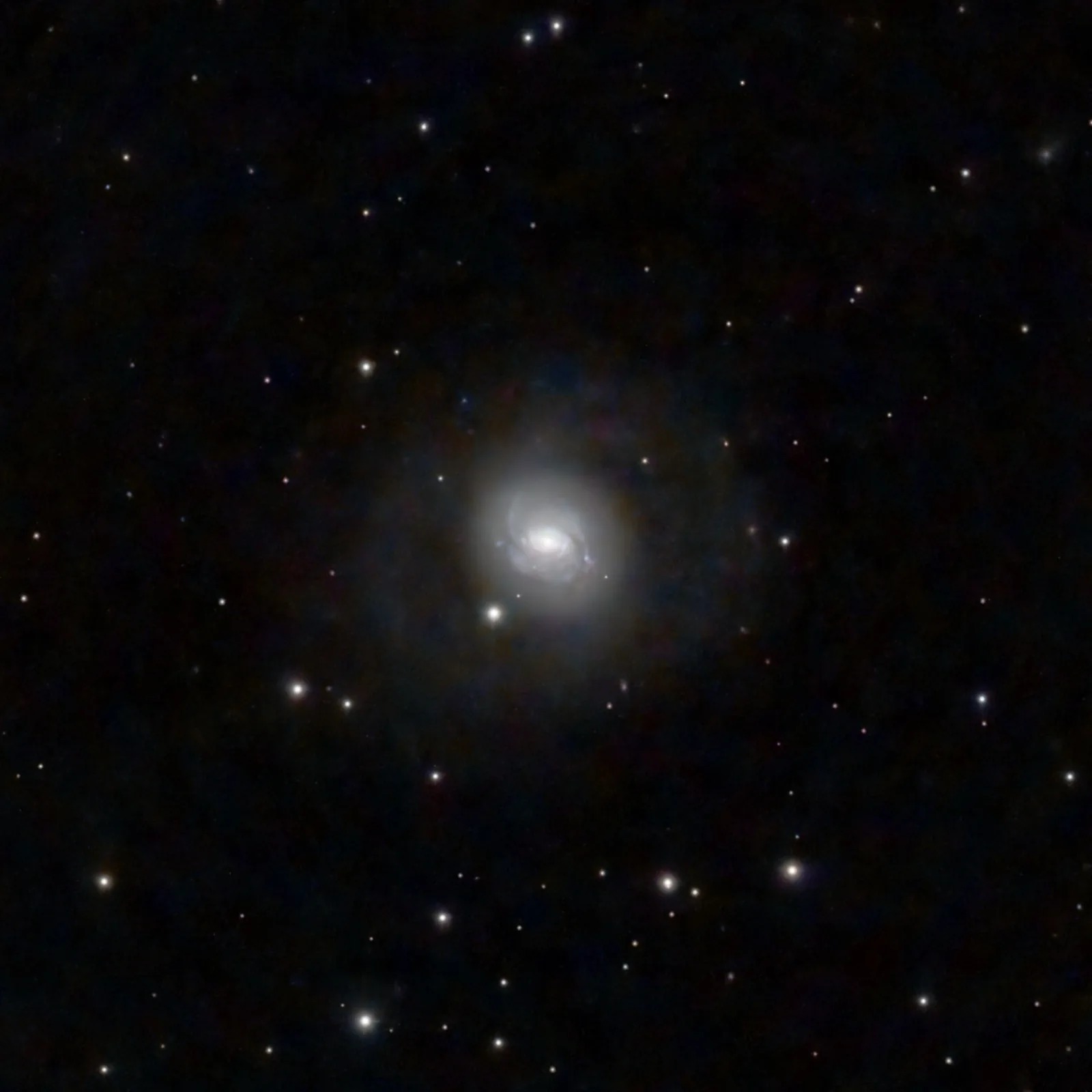
With a small-to-medium telescope, two fall galaxies push your reach past 10 megaparsecs: Messier 77, the “Squid Galaxy” in Cetus, and NGC 7331 (Caldwell 30), the “Deer Lick Galaxy” in Pegasus. Both are roughly 12 to 15 Mpc away. From the Moon to these galaxies, we’ve spanned about 15 orders of magnitude – from 4×10⁵ km to 4×10²⁰ km – in a single evening.
Wrapup
Tonight’s tour covered 15 orders of magnitude of distance without leaving the backyard. Marchetti’s travelers went farther when their vehicles got faster; astronomers go farther by changing rulers. Miles give way to kilometers, kilometers to AU, AU to light-years and parsecs – each one keeping the numbers small enough to hold in your head.
Every number in this article was hard-won. No one has stretched a tape measure to the Sun, let alone to M 77; each rung of the ladder was measured a different way, usually built on the rung below it. How astronomers did it – and where the ladder still creaks – is where this series is headed.
In the next article of this miniseries on astronomical distance, we’ll settle into the Solar System, where the AU becomes our everyday unit, and where light itself starts to become the vehicle of choice.
Footnotes
Travel times from Jean-Paul Rodrigue, The Geography of Transport Systems, “Regional Space/Time Convergence, London–Edinburgh and New York–Boston”, adapted from D. G. Janelle, “Central Place Development in a Time-Space Framework,” The Professional Geographer 20(1): 5–10 (1968). ↩︎
C. Marchetti, “Anthropological Invariants in Travel Behavior,” Technological Forecasting and Social Change 47(1): 75–88 (1994). Free reprint (IIASA) ↩︎
iSeeCars, “Longest-Lasting Cars”, accessed September 2026. ↩︎ ↩︎