Introduction
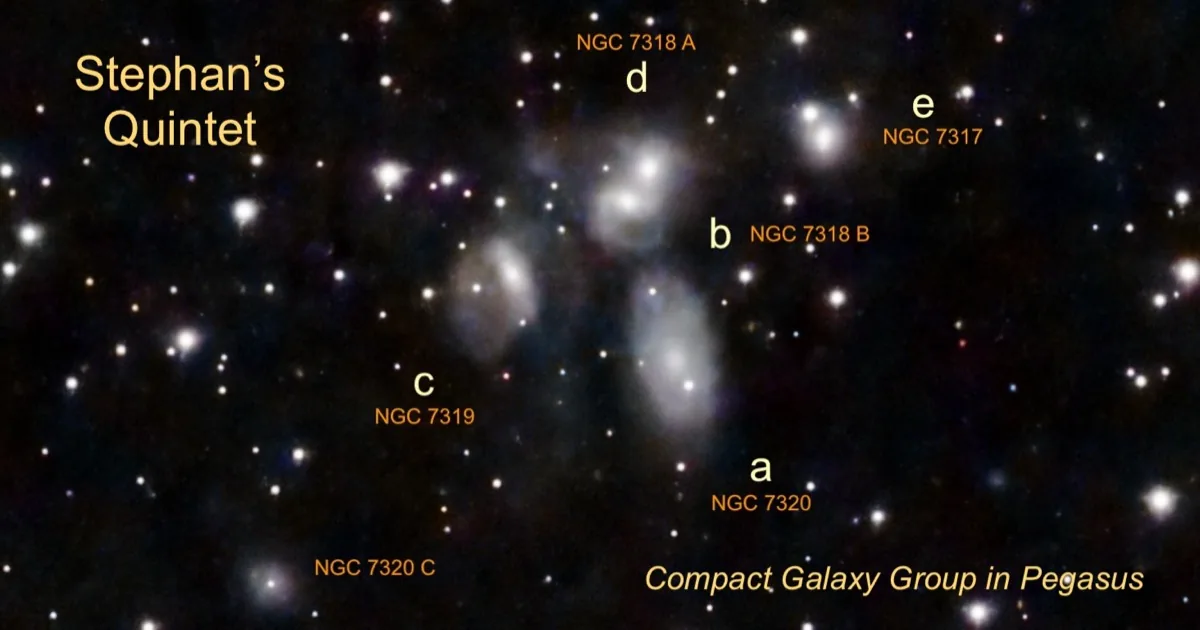
Stephan’s Quintet is one of the most photographed galaxy groups in the sky, and for good reason: it’s compact, it’s dramatic, and it comes with a genuinely good story attached. Five galaxies appear crowded into a patch of sky only a few arcminutes across. Only four of them are actually there together. The fifth is a bystander that happens to be sitting in the foreground, unrelated to the other four, caught in the frame by pure chance of alignment.
This is also the first compact group of galaxies ever recognized as such — found in 1877, well before anyone had a coherent picture of what a “galaxy” even was. Everything we now know about it — the collision in progress, the black hole quietly feeding in one of its members, the foreground galaxy hiding in plain sight — has been layered on top of that original 1877 sighting by generation after generation of better instruments. That’s the story worth carrying with you when you go find it yourself.
Discovery

Édouard Stephan discovered this group in 1877 while directing the Marseille Observatory in France, using an 80 cm Foucault reflector — a genuinely serious instrument for its era, built around one of Léon Foucault’s silvered-glass mirrors. Stephan cataloged five relatively bright objects packed into a tight knot near the bright spiral NGC 7331, in Pegasus. He had no way of knowing that one of the five didn’t belong, or that the other four were in the middle of tearing each other apart. Compact groups of galaxies weren’t even a recognized category of object yet; Stephan’s Quintet effectively became the founding example of one, formally cataloged over a century later as Hickson Compact Group 92 when Canadian astronomer Paul Hickson surveyed groups like it in 1982.
Five (minus one) Galaxies… Plus One?
| HCG 92 | Galaxy | Morph. Class. | Distance | Ang. Size | Mag. | S. Br. |
|---|---|---|---|---|---|---|
| a | NGC 7320 | SAcd | ~40 Mly | 2.6’ x 1.4' | 12.96 | 14.58 |
| b | NGC 7318B | SB(s)bc pec | 289 Mly | 2.4’ x 1.3' | 13.97 | 15.24 |
| c | NGC 7319 | SA(s)b pec | 296 Mly | 1.7’ x 1.0' | 13.48 | 14.61 |
| d | NGC 7318A | E2 pec | 289 Mly | 1.5’ x 1.3' | 13.39 | 15.14 |
| e | NGC 7317 | E3 | 304 Mly | 0.8’ x 0.8' | 13.66 | 14.15 |
| NGC 7320C | (R)SAB(s)0/a | ~300 Mly | 0.6’ x 0.5' | 15.54 | 15.35 |
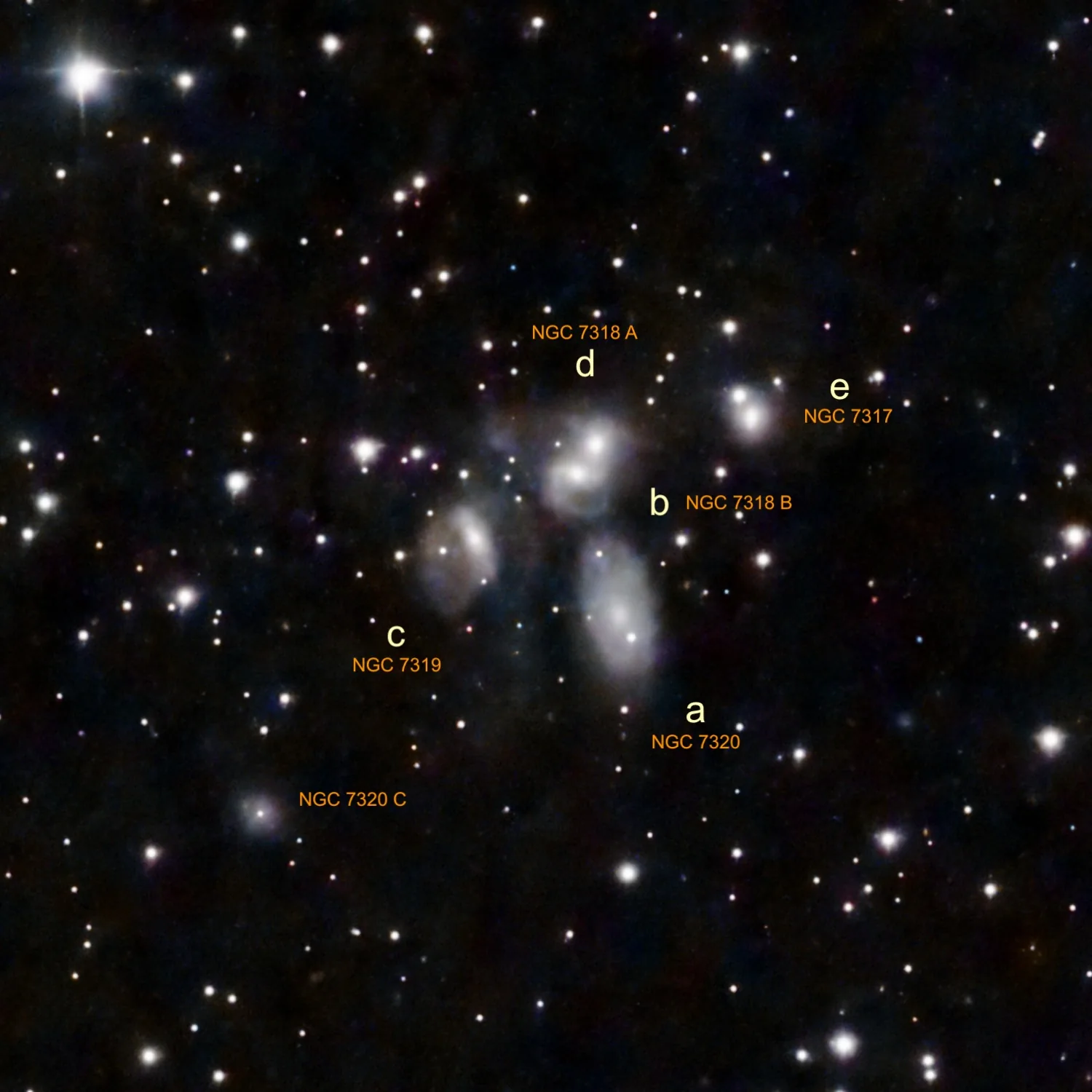
Look at the distance column above and the plot twist is right there in the numbers: NGC 7320 sits at roughly 40 million light-years, while everything else in the group is out at 289-304 million. That’s not a rounding error — it’s a critical part of this object’s story.
While each galaxy has an NGC catalog designation, the group collectively is Hickson Compact Group 92. The image shows both the NGC numbers and the Hickson Group letters.
NGC 7320 (HCG 92a): the “Photobomber”


In 1961, husband-and-wife astronomers Geoffrey and Margaret Burbidge took spectra of all five galaxies and found that four of them were receding at roughly 6,000–6,600 km/s, consistent with each other and with membership in a single, genuinely bound group. The fifth, NGC 7320, was receding at only about 800 km/s. Under Hubble’s law — recession velocity scales with distance — that low a redshift put NGC 7320 seven times closer than its neighbors: a small, nearby foreground galaxy that happens to line up with a much more distant group almost perfectly from our vantage point.
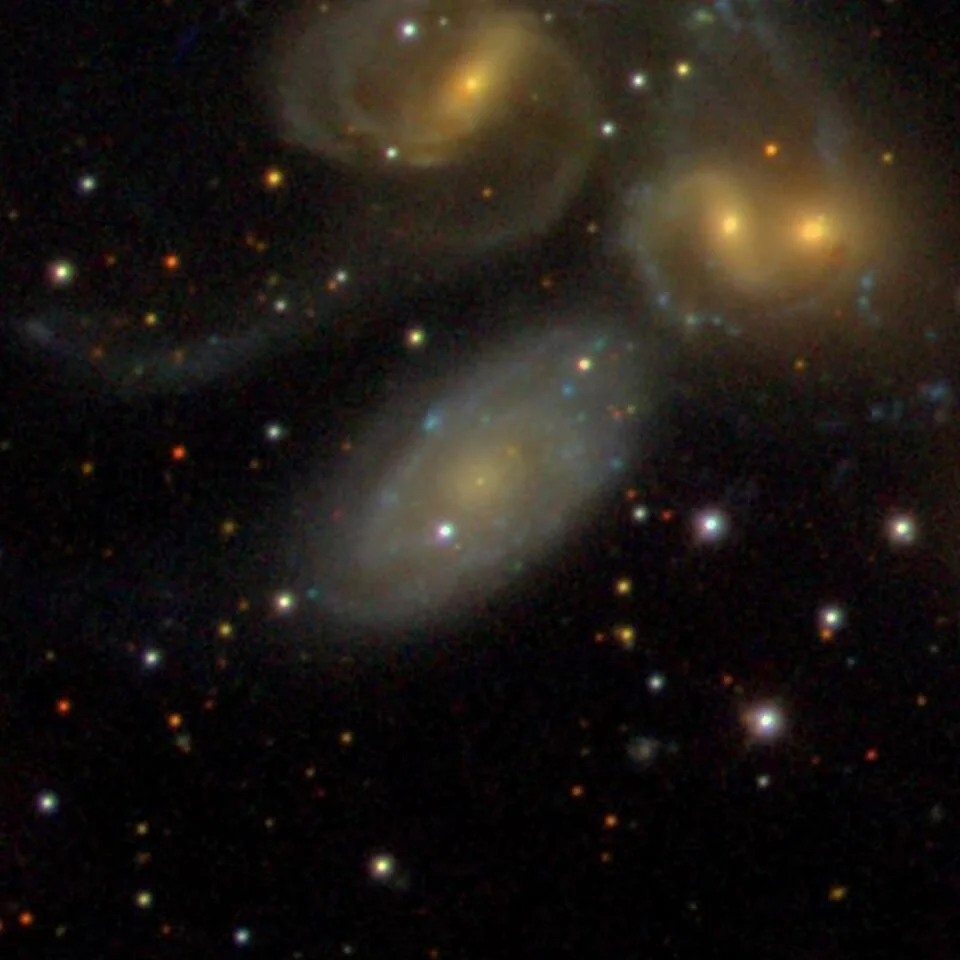
That explanation is the accepted one today, though it wasn’t always uncontested — Halton Arp catalogued the group as Arp 319 in his 1966 Atlas of Peculiar Galaxies and pointed to it for years as a challenge to using redshift as a distance measure at all. (That controversy, and how it eventually got resolved, is a good story on its own — one we may come back to in a future article.)
Looking at all the images and comparing them to the eQuinox 2 image, NGC 7320 is definitely bluer than the other galaxies in the group. Even without space-based imaging, the oval shape is distinct, with a hint of its spiral arm structure: the disk is clearly unevenly bright with some mottling across it.
NGC 7318 A and B (HCG 92b and 92d): The Main Event
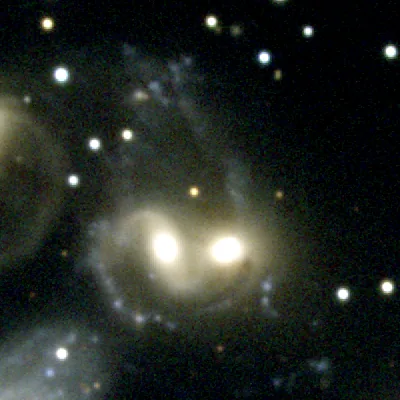
When Stephan first catalogued this group in 1877, he recorded four nebulae — what later received the designations NGC 7317, 7318, 7319, and 7320 in the New General Catalogue of 1888. What eventually became NGC 7318A and NGC 7318B was, at the time, just that single entry, NGC 7318; only later, higher-resolution observations split it into two distinct, genuinely colliding galaxies. That split is the accidental reason this is a “quintet” of five at all: one of Stephan’s four turned out to be two galaxies, and another (NGC 7320, see above) turned out not to belong to the group in the first place.
In Hubble’s 2009 WFC3 portrait, the pair appears as a single blob with two bright cores, ringed by young blue star clusters and pink clouds of glowing hydrogen — active stellar nurseries. Those clusters are less than 10 million years old, young enough that they haven’t yet cleared away the gas they were born from. Even more striking: off to one side, in a patch of space that isn’t part of either galaxy’s disk, more star clusters are forming in mid-air — stars being born directly out of the tidal wreckage between galaxies, with no parent galaxy underneath them at all.
Even modest smart-scope imaging shows the two galaxies’ spiral arms pulled visibly out of shape by the encounter. Look closer at NGC 7318B specifically and one of its arms appears to have come loose from the galaxy entirely — a separate strand of material trailing away and ending in a distinct, blobby knot rather than fading out smoothly. That’s a real, specifically studied feature: astronomers have identified several “tidal dwarf galaxy” candidates in this group, dense clumps of gas and stars stripped out during these encounters that may be compact enough to be gravitationally self-bound — essentially small, new galaxies condensing out of the wreckage. A couple of the strongest candidates are tied to tails associated with NGC 7318B specifically, and the most famous one in the whole group sits in NGC 7319’s own long tidal tail. Nothing about this is settled science yet — “candidate” is doing real work in that phrase — but it’s a legitimate live question, not just an odd-looking smudge.
NGC 7319 (HCG 92c): The Tail Keeper
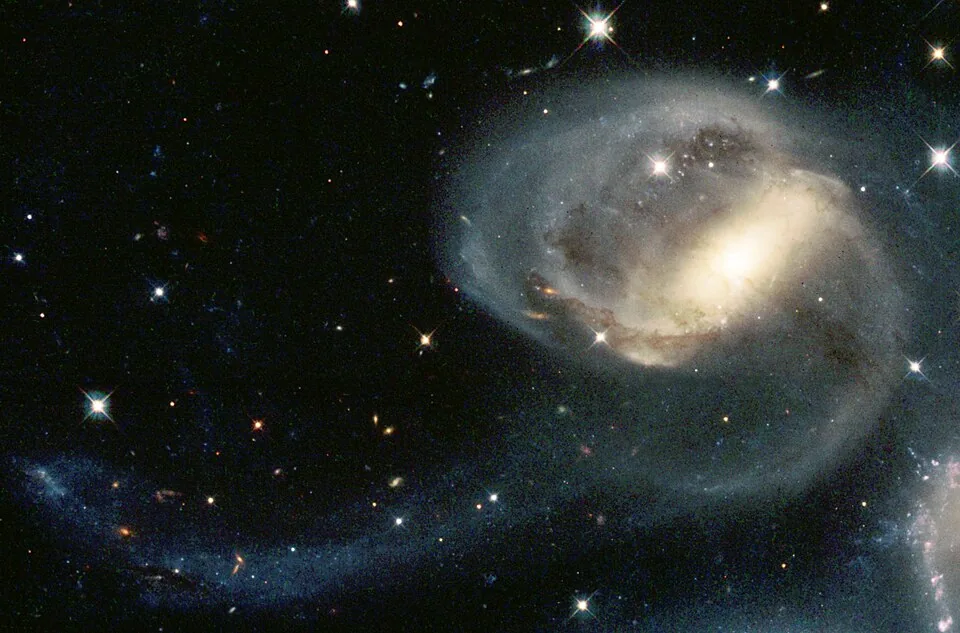
NGC 7319 shows the clearest scars of everything else in this group. It’s a barred spiral galaxy with a type 2 Seyfert nucleus — an actively feeding supermassive black hole — and it trails two long, roughly parallel tidal tails that curve away toward NGC 7320C. Those two tails appear to record two separate close passages by the same intruder: an older, fainter tail from an encounter several hundred million years ago, and a younger, more distinct tail from a second pass roughly 200 million years later.
In the Hubble image, NGC 7319’s spiral arms sweep almost all the way around, nearly 180 degrees back to the galaxy’s central bar. Blue specks along the upper arm and red dots near the core are both star clusters — the blue ones young, the red ones older or more dust-reddened — each one a grouping of many thousands of stars. Some of those clusters are younger than either known passage of the intruder, suggesting the interaction is still touching off new star formation well after the flyby itself ended.
This isn’t a detail that needs a space telescope to catch, either — even a smart-scope stack starts showing the group’s tidal tail and what look like three separate detached strands of spiral arm pulling away from the core. Real tidal structure, not just something confirmed on paper by infrared or X-ray data.
NGC 7317 (HCG 92e): The Quiet One
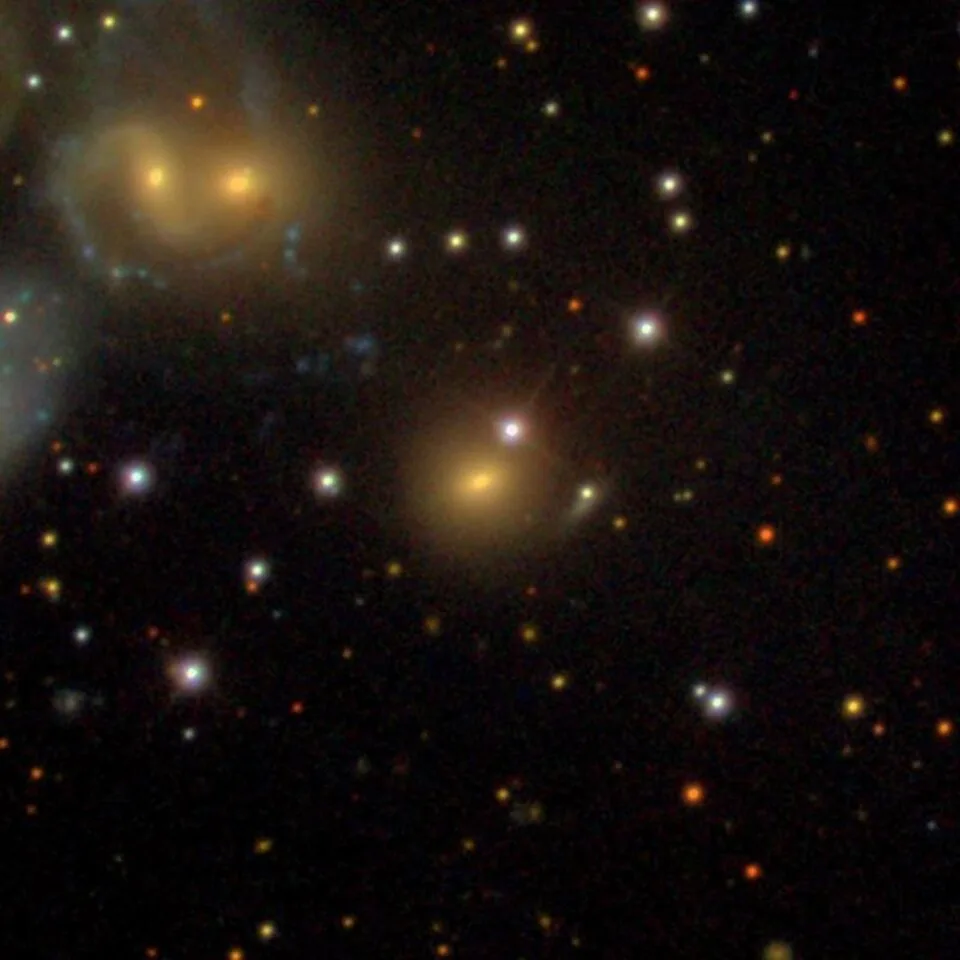
NGC 7317 is the smallest member of the group and, at first glance, the least interesting: Hubble’s own description of it is a plain, normal-looking elliptical, visibly less affected by the interactions than its neighbors. No spiral arms, no obvious tidal tail, no dramatic distortion of its own light — most models of the group’s collision history leave it out entirely, for lack of anything to explain.
You may also notice a thin, faint edge-on galaxy right on NGC 7317’s periphery in deep exposures — visible enough that it’s not some extreme-limiting-magnitude challenge, yet it doesn’t turn up under any designation we could find. That’s genuinely odd, since both the HST and JWST images of this field show plenty of even fainter background galaxies with their own catalog entries. For now it’s an open question rather than a settled one: whether it’s an unrelated interloper or something actually connected to NGC 7317 isn’t something we can answer without a redshift.
NGC 7320 C: Disruptor?
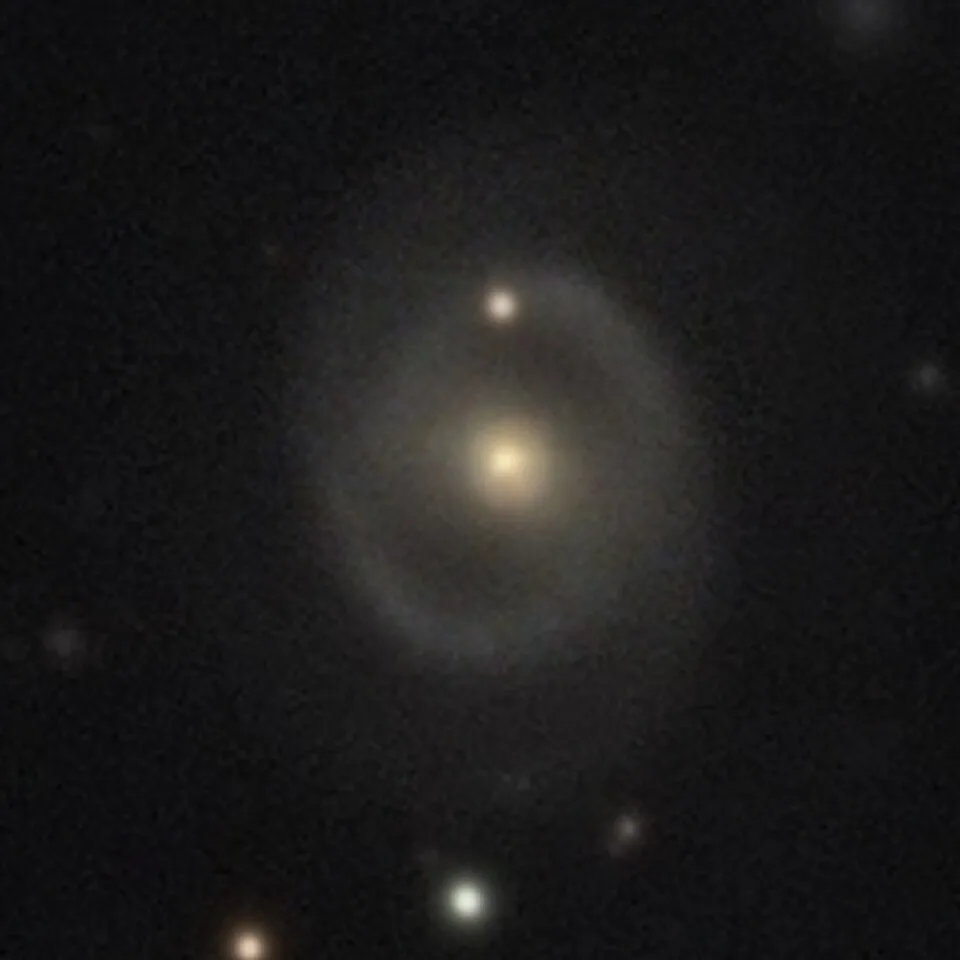
The group’s real headcount is stranger than “four instead of five.” NGC 7320C sits just outside the frame of most classic images of the Quintet, wasn’t part of Stephan’s original five, and yet its redshift (~6,000 km/s) matches the true group almost exactly — it belongs, even though it isn’t named in the group’s own title. The evidence suggests that a few hundred million years ago, NGC 7320C plunged through the group, stripping out gas and stars as it passed and leaving behind long tidal tails still visible in deep images today. It’s the drive-by member: not one of the “quintet” by name, but very much a participant in the collision that shaped everything else you see here.
How They Are Interacting
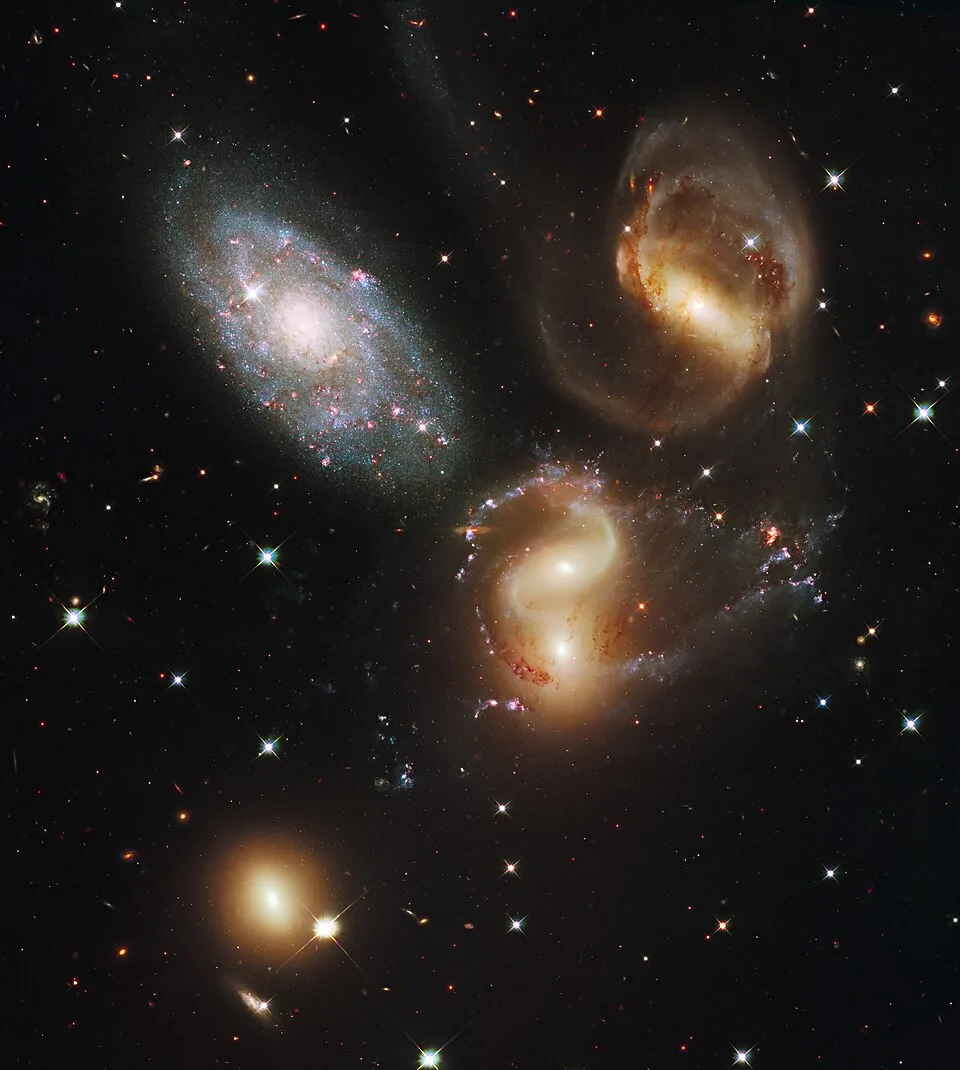
Take NGC 7320 out of the picture and what’s left is four galaxies genuinely caught up in a slow-motion collision. Three of them — NGC 7317, NGC 7318A, and NGC 7319 — share very nearly the same redshift and a small internal velocity spread, meaning they’re gravitationally bound to each other and likely to eventually merge. The fourth, NGC 7318B, is the group’s most recent arrival: it’s plowing into the group at roughly 800–1,000 km/s — almost two million miles per hour — relative to the others, smashing through gas that an earlier flyby by NGC 7320C already stripped out into the space between the galaxies.
Hubble’s WFC3 camera, which took the portrait above during the telescope’s 2009 servicing mission, was able to show this collision in more than one light at once: visible and near-infrared together, plus a filter tuned to glowing ionized hydrogen. The colors in the image trace the ages of different stellar populations directly — younger stars show up bluer, older ones redder — and the infrared channel sees straight through curtains of dust that would otherwise hide entire clusters of stars from a purely visible-light view. The three distant, actively interacting galaxies read distinctly redder than the foreground NGC 7320, both because their stars are on average older and because dust stirred up by the collision itself reddens their light further.
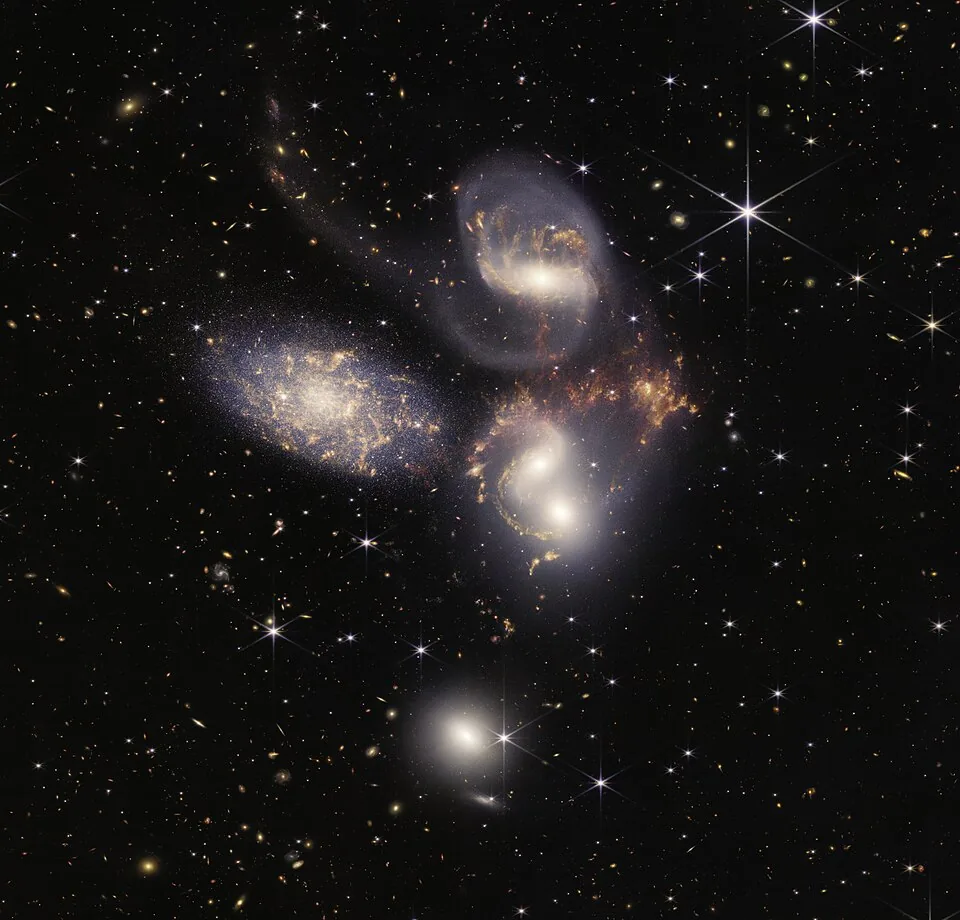
That collision between NGC 7318B and the group’s gas is also generating a shock wave larger than the entire Milky Way, heating gas to millions of degrees — one of the most energetic intergalactic shock fronts known. NASA’s Spitzer Space Telescope first revealed it in mid-infrared light in 2006; the Chandra X-ray Observatory has since imaged the hot gas it produces directly. When the James Webb Space Telescope imaged the group in July 2022 — Stephan’s Quintet was one of the five targets chosen for Webb’s very first released images — its MIRI instrument captured the shock front and the surrounding tidal debris in extraordinary detail, along with pockets of star formation triggered by the ongoing interaction. In the composite image below, the yellow and orange tones mark MIRI’s mid-infrared view of hot dust and the shock-heated regions around the colliding pair, while the blue and white tones are stars picked up by NIRCam at near-infrared wavelengths — so the collision itself is quite literally shown in a different color than the galaxies producing it.
Look closely at that MIRI feature and it appears to extend well past NGC 7318B, reaching up into NGC 7319 itself — and that’s not an illusion, but it’s also not one single thing. Published analysis of the JWST data identifies a genuine shocked filament roughly 40,000 light-years long running between NGC 7319 and NGC 7318B, produced by NGC 7318B’s high-speed plow through the group’s stripped gas. But NGC 7319 also happens to host its own separately bright feature at almost the same spot: a supermassive black hole, around 24 million times the Sun’s mass, actively feeding and normally hidden behind dust — exactly the kind of thing MIRI’s infrared vision is built to see straight through. What reads as one continuous sparkly smear connecting the two galaxies is more likely two real, physically distinct phenomena sitting right next to each other in the frame: an intergalactic shock front, and a dust-shrouded black hole finally showing its face.
Compact groups like this one are thought to have been far more common in the early universe, where similar collisions may have helped fuel the very energetic black holes we see as distant quasars. Stephan’s Quintet gives us a nearby, present-day laboratory for a process that mostly played out billions of years ago, everywhere else.
What You’re Looking At
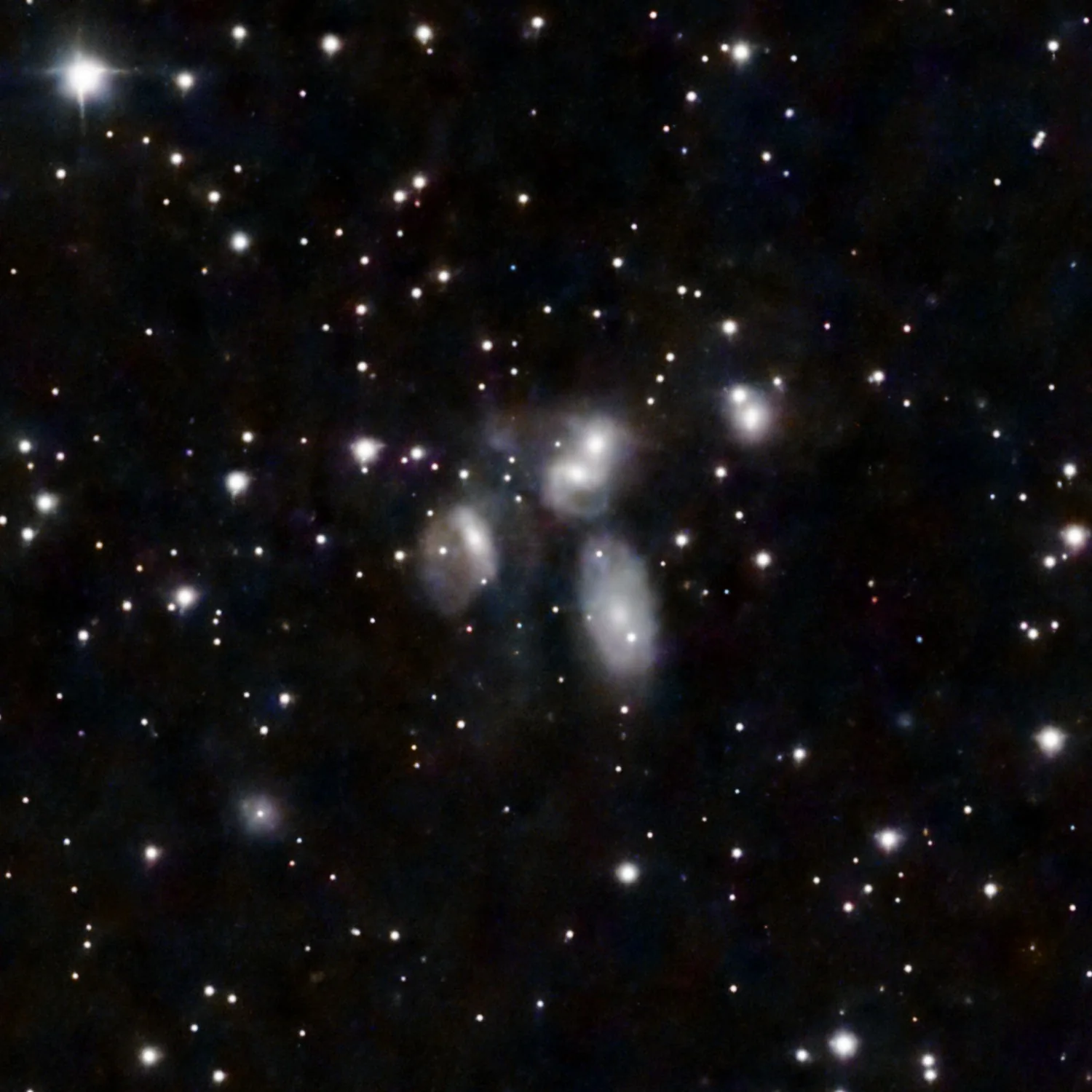
Through modest amateur equipment, Stephan’s Quintet reads through the eyepiece as a tight, faint knot of smudges rather than a dramatic collision — a testament to how much context those Hubble and Webb images are quietly supplying. NGC 7320, the foreground interloper, is usually the easiest member to pick out even in smaller scopes, simply because it’s marginally brighter and slightly larger in angular size. The other four are individually faint (magnitude 13–15.5) and smaller, which is exactly why the group’s combined light adds up to a deceptively bright-sounding integrated magnitude of 11.1 while any single galaxy in it is a real challenge. Dark skies and some aperture matter here — this is not a target that gives up much to a quick glance from a light-polluted backyard.
Smart scopes narrow that gap considerably. Stacking even a modest integration time — the eQuinox 2 image above is 37 minutes — starts separating the individual galaxies and hinting at their shapes in a way that’s genuinely hard to achieve visually without a large-aperture Dobsonian and a very dark site. But whatever you’re using, the galaxies in the frame are the same ones Stephan picked out with an 80 cm mirror in 1877, the same ones the Burbidges measured in 1961, that Hubble resolved around 2000, and now Webb in 2022. Each generation of instrument told us something the last one couldn’t. Yours will show you something too.
Finding and Observing It
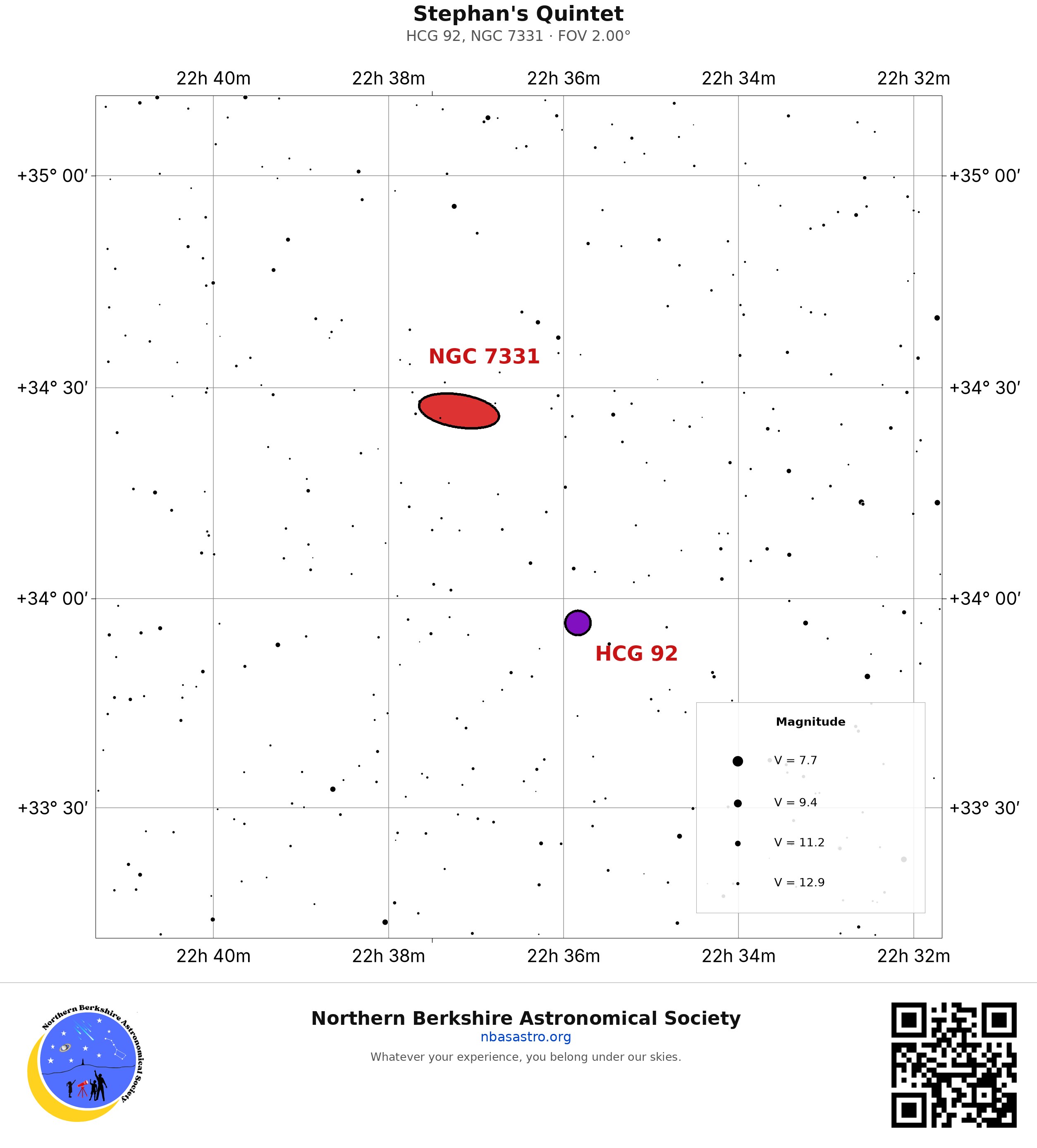
Stephan’s Quintet sits about half a degree southwest of NGC 7331, a bright, easy-to-find unbarred spiral in Pegasus — star-hop to NGC 7331 first (it’s a rewarding target in its own right), then nudge half a degree to pick up the Quintet’s tight little knot nearby. Because the group is so compact, higher magnification helps more than usual once you’ve located the field; at low power the whole group can look like a single fuzzy smudge that’s easy to dismiss as nothing. Give it aperture, give it time, and give it magnification, and it starts resolving into the individual pieces of the story above.
Wrapup
Stephan’s Quintet is a good reminder of what “a closer look” is really about. The raw view — five smudges of light in a small patch of Pegasus — hasn’t changed since 1877. What’s changed is everything we’ve learned to see within it: an accidental foreground galaxy that briefly threatened to upend redshift cosmology, a genuine sixth member hiding just outside the frame, and a present-day collision generating a shock wave bigger than our own galaxy. None of that is visible at the eyepiece. All of it is true anyway, and it’s waiting in the same spot of sky whether you’re pointing an 80 cm reflector at it in 1877 or a smart scope at it tonight.