Introduction
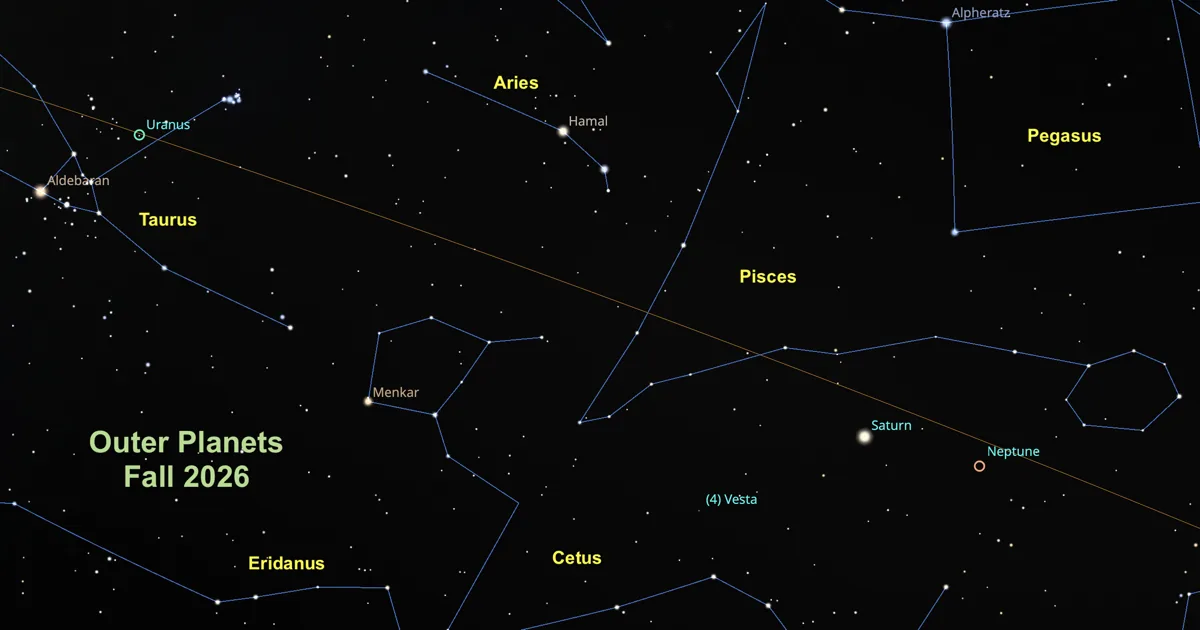
For the rest of the year (and into 2027), Saturn, Uranus, and Neptune are all in the evening sky. While Saturn is one of the most popular observing targets and never disappoints, our solar system’s ice giants might seem to be “too faint to try” compared to the brighter planets.
Not so.
If you have good binoculars and a tripod, Uranus is an easy find, especially where it’s located in Taurus. Neptune is a little more challenging, but is well within the reach of a small telescope (or big binoculars) - if you know where to look for it.
As a bonus for anyone with a smart scope, each planet also comes with its own imaging challenge — moons and companions that are well within reach of that gear specifically. And for the truly ambitious, we’ll close with dwarf planet Eris: about as far out on the edge of amateur astronomy as it gets.
Saturn
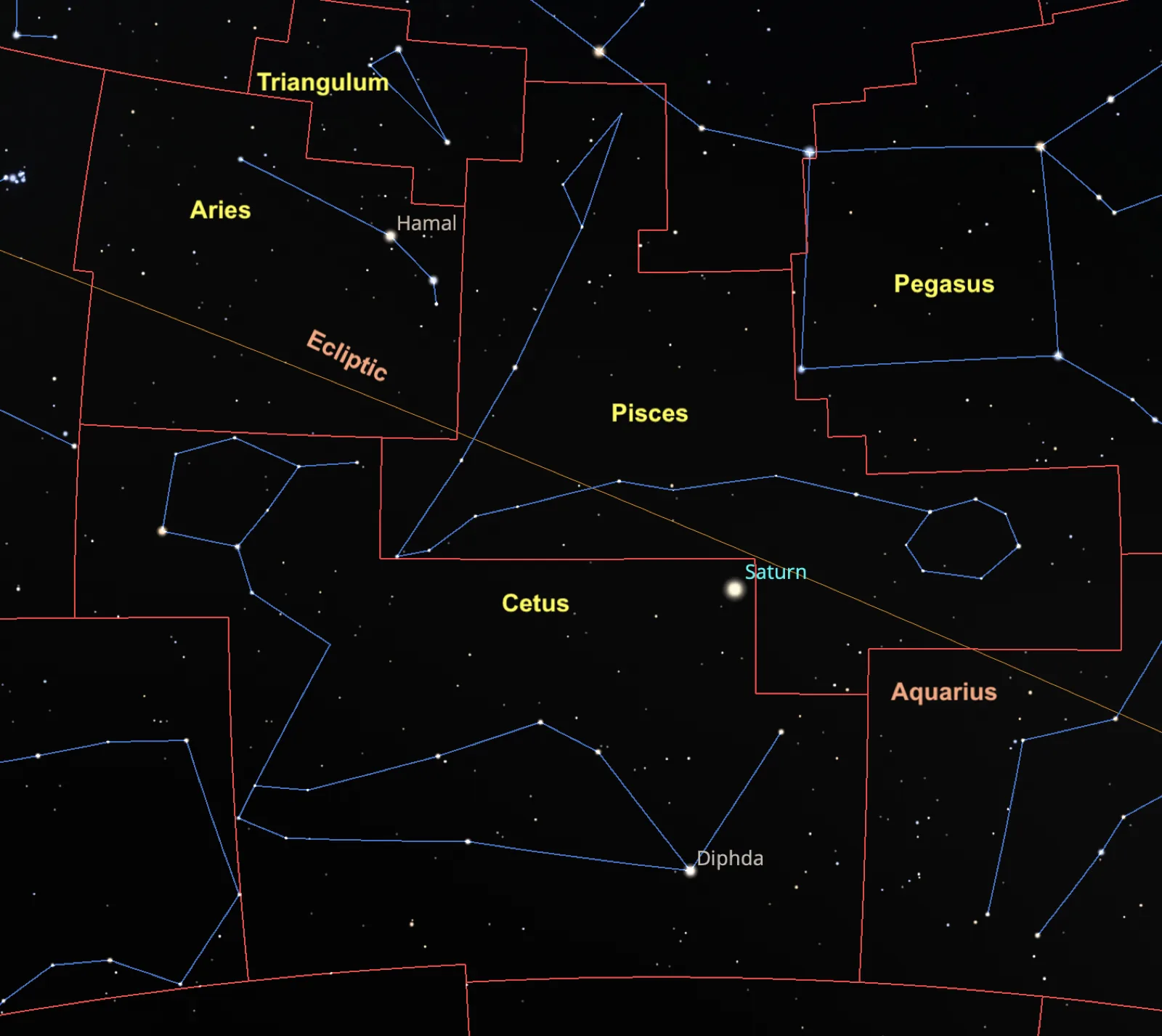
Saturn this Fall is in the constellation Cetus. That might sound a little odd: planets typically are in one of the constellations of the Zodiac, what’s going on?
While the planets do follow the path of the Ecliptic and that’s traditionally defined by the twelve Zodiacal constellations, they can stray from it by a few degrees, because each planet’s orbit around the Sun has a different inclination. But another entirely artificial and arbitrary effect is also going on here: the boundaries of the constellations were set by the International Astronomical Union in 1928, and that means that sometimes planets might occasionally trespass briefly into constellations close to the Ecliptic. The most-common situation is with Ophiuchus and Scorpius (more of the ecliptic is actually in Ophiuchus than in Scorpius). Here, while the Ecliptic stays in Pisces, a corner of Cetus’s “territory” gets very close to it, and you’ll have planets briefly “out of bounds” of the ecliptic constellations. (Including extreme cases, there are over 11 other constellations a planet might find themselves in, mostly Venus, though the frequency of some of these only occur over millennia.)
Saturn is also the easy end of this month’s brightness spread, and it rewards almost any gear you point at it:
Naked eye: trivial — it’s the brightest steady point of light in all of Cetus. Just look below the Great Square of Pegasus, and you can’t miss it.
Binoculars: even a basic pair turns Saturn into a small, unmistakably non-round golden oval. You won’t resolve the rings as rings yet, but you’ll see immediately that it isn’t a star.
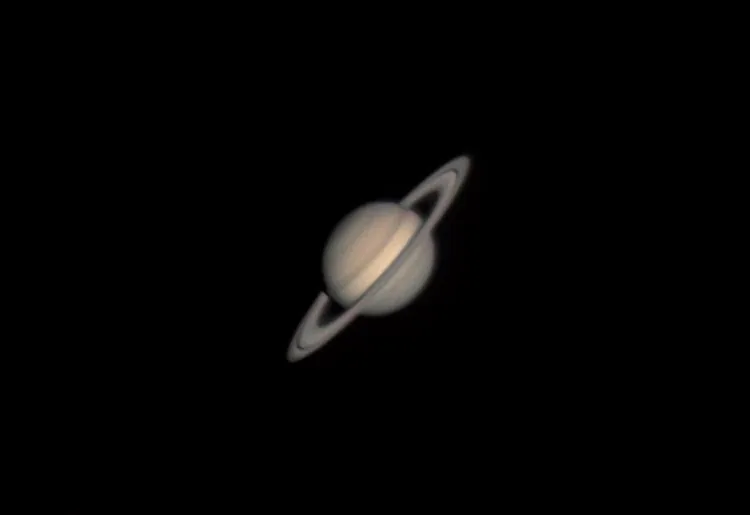
Small telescope: this is where Saturn earns its keep. Even a 4-inch scope cleanly separates the rings from the disk in good seeing — and a bit more aperture keeps paying off, as this shot through a 9.25" SCT shows.
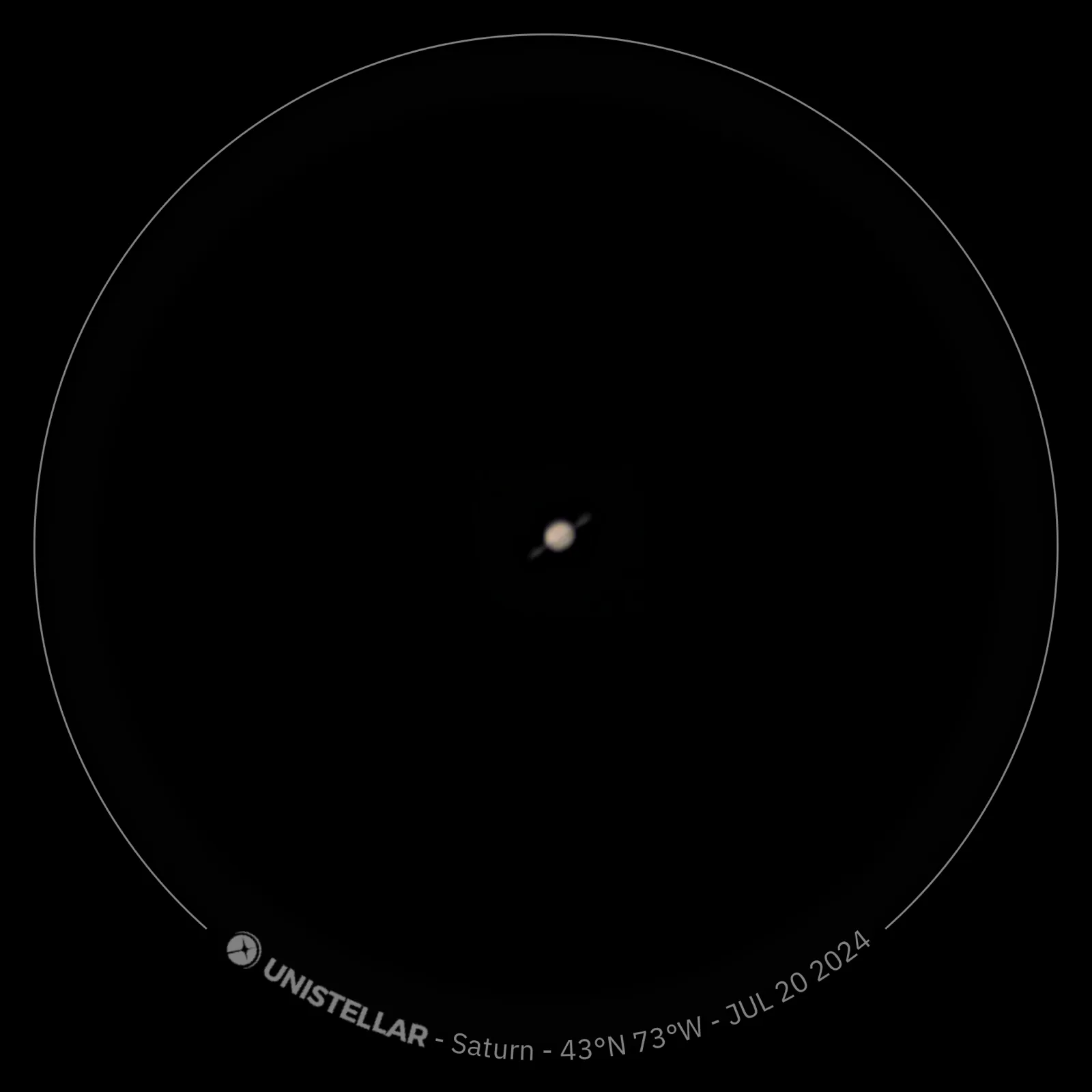
- Smart scope, if you’re curious: short single exposures — not the usual long deep-sky stack — are the trick here, since Saturn’s bright enough that stacking mostly blurs or blows out the disk. We go into that (and the ring geometry, and the moons) in full in our Saturn Returns! article from September.
If you’re observing Saturn, and you want to identify which of the brighter moons you might be picking up at the eyepiece, our Solar System Dashboard has up to date renderings of the Saturnian system with moon positions!
What Do Ice Giants Actually Look Like?
Uranus and Neptune are officially classified as “ice giants” rather than gas giants like Jupiter and Saturn. The name refers to composition, not temperature — though at roughly -200°C, that distinction hardly matters. Instead of Jupiter and Saturn’s deep hydrogen/helium envelopes, Uranus and Neptune are built around a mantle of water, ammonia, and methane “ices” wrapped around a rocky core. That methane is also why both planets read as blue-green: it absorbs red light and reflects the rest.
For most of history since their discovery (Uranus in 1781, Neptune in 1846), that’s about as far as anyone could take it — two featureless colored dots, full stop. That changed, briefly and dramatically, when Voyager 2 flew past each one: Uranus in January 1986, Neptune in August 1989. To this day, those two flybys remain the only close-up visits either planet has ever received.
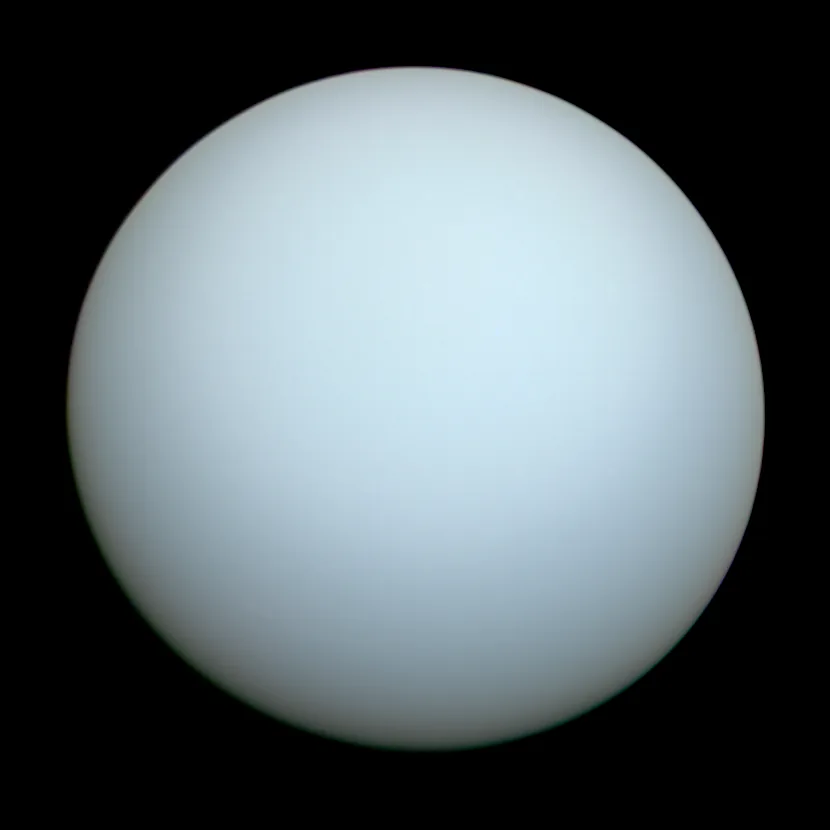
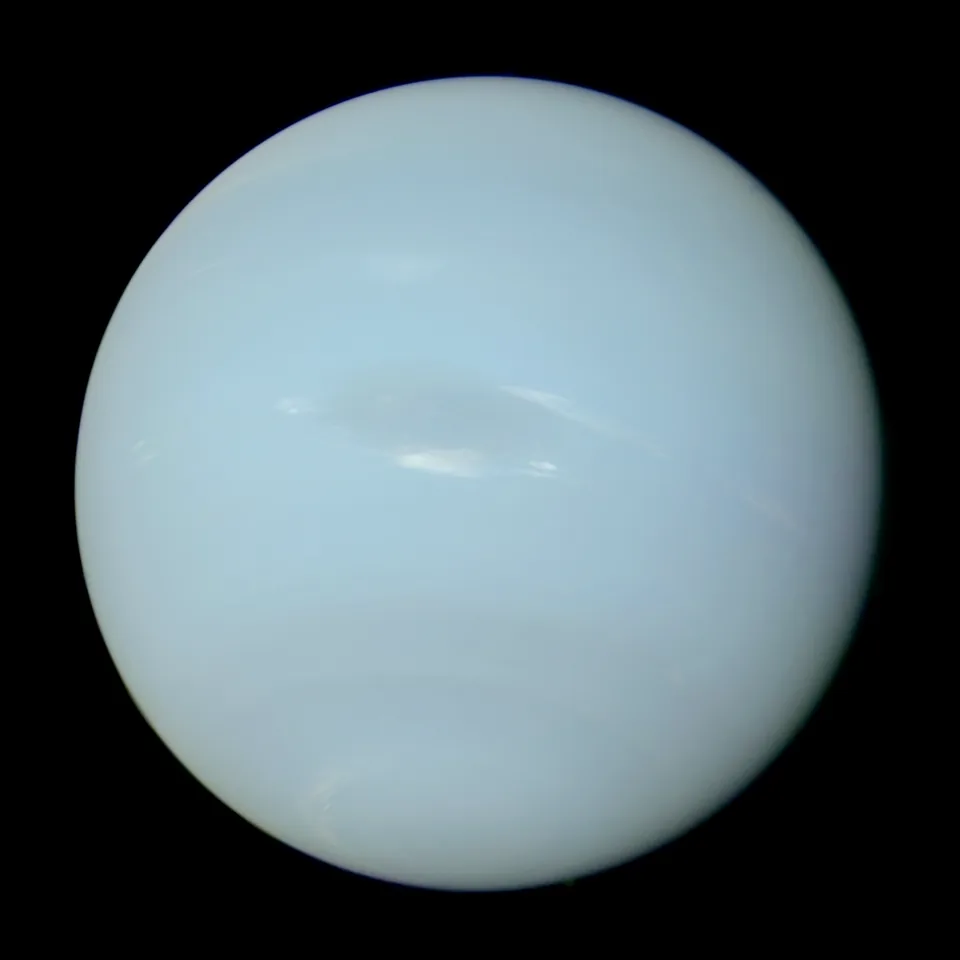
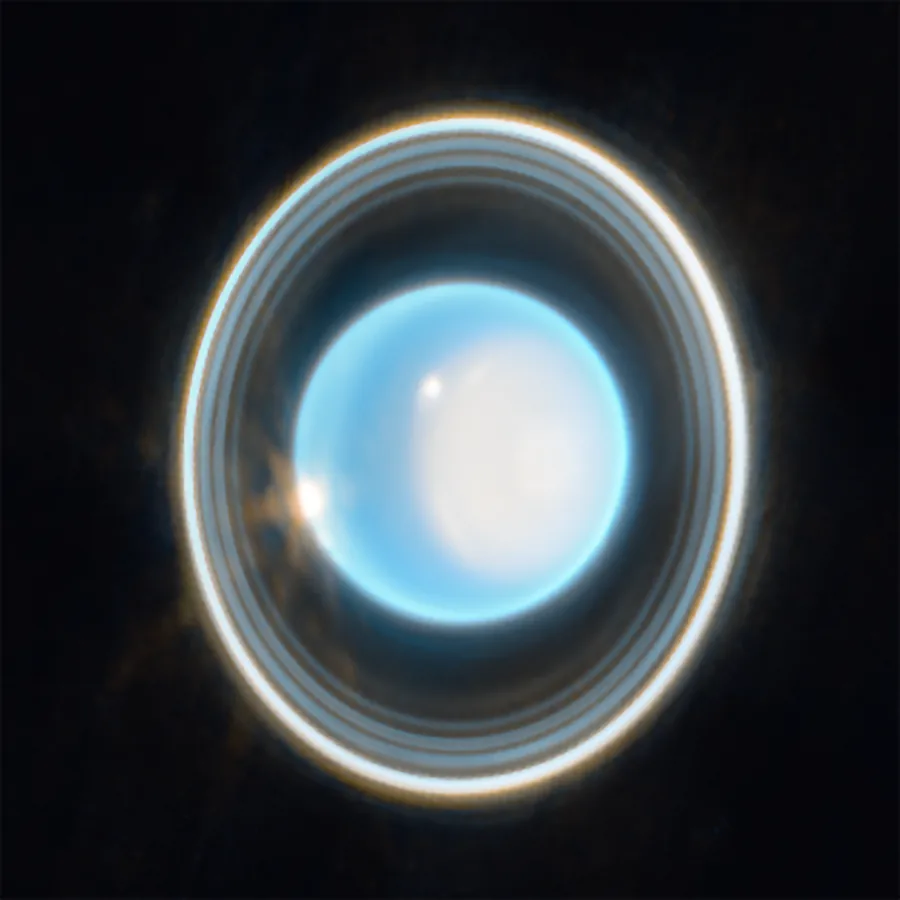
More recently, the James Webb Space Telescope has reimaged both planets in infrared — Neptune in 2022, Uranus in 2023 — revealing detail neither Voyager frame ever showed: banded clouds, faint ring systems around both worlds, and a bright seasonal polar cap on Uranus.
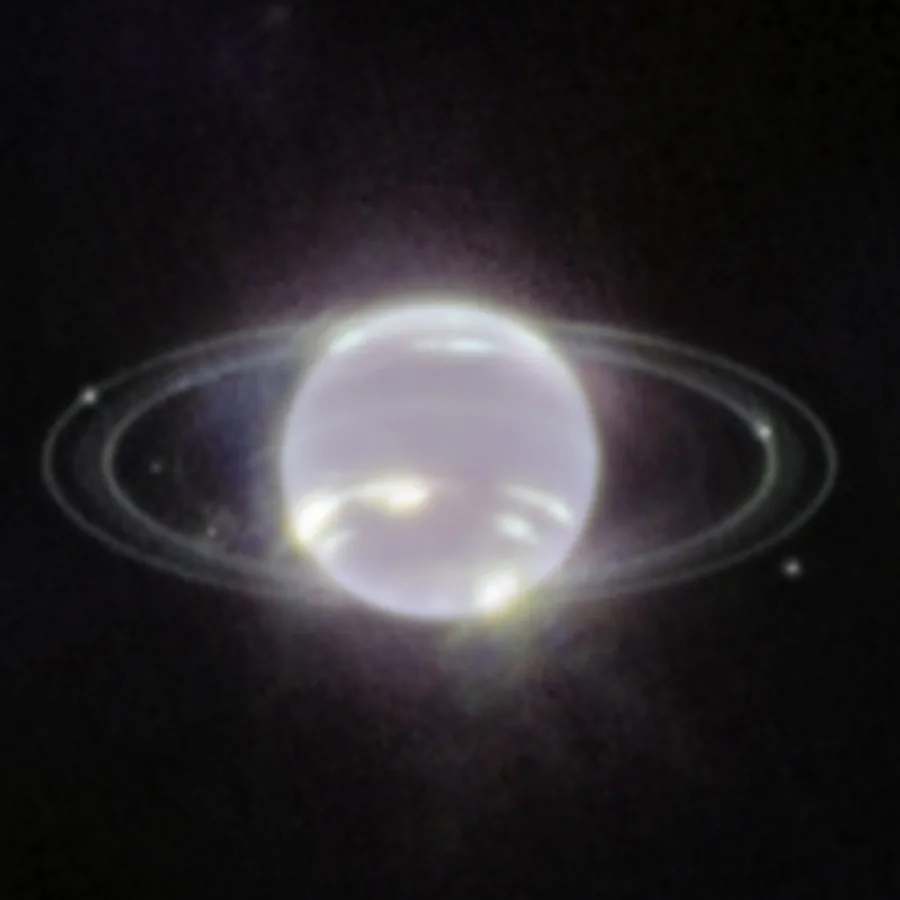
None of that is remotely in reach from a backyard. But a surprisingly close approximation is, using a technique astrophotographers call “lucky imaging” — sometimes nicknamed “poor man’s adaptive optics.” Instead of one long exposure, you capture thousands of very short ones (or a video) and then sort through them for the sharpest individual frames. Earth’s atmosphere is what makes stars twinkle, and that same turbulence is constantly blurring planetary detail too — but it’s rarely equally bad in every single frame. Stack just the clearest handful out of thousands, and you can recover far more disk detail and true color than any single exposure would ever show. It’s the same underlying idea a smart scope automates through computational stacking — just done manually here, with a traditional scope and camera. The Uranus and Neptune images below were captured exactly this way.
Uranus
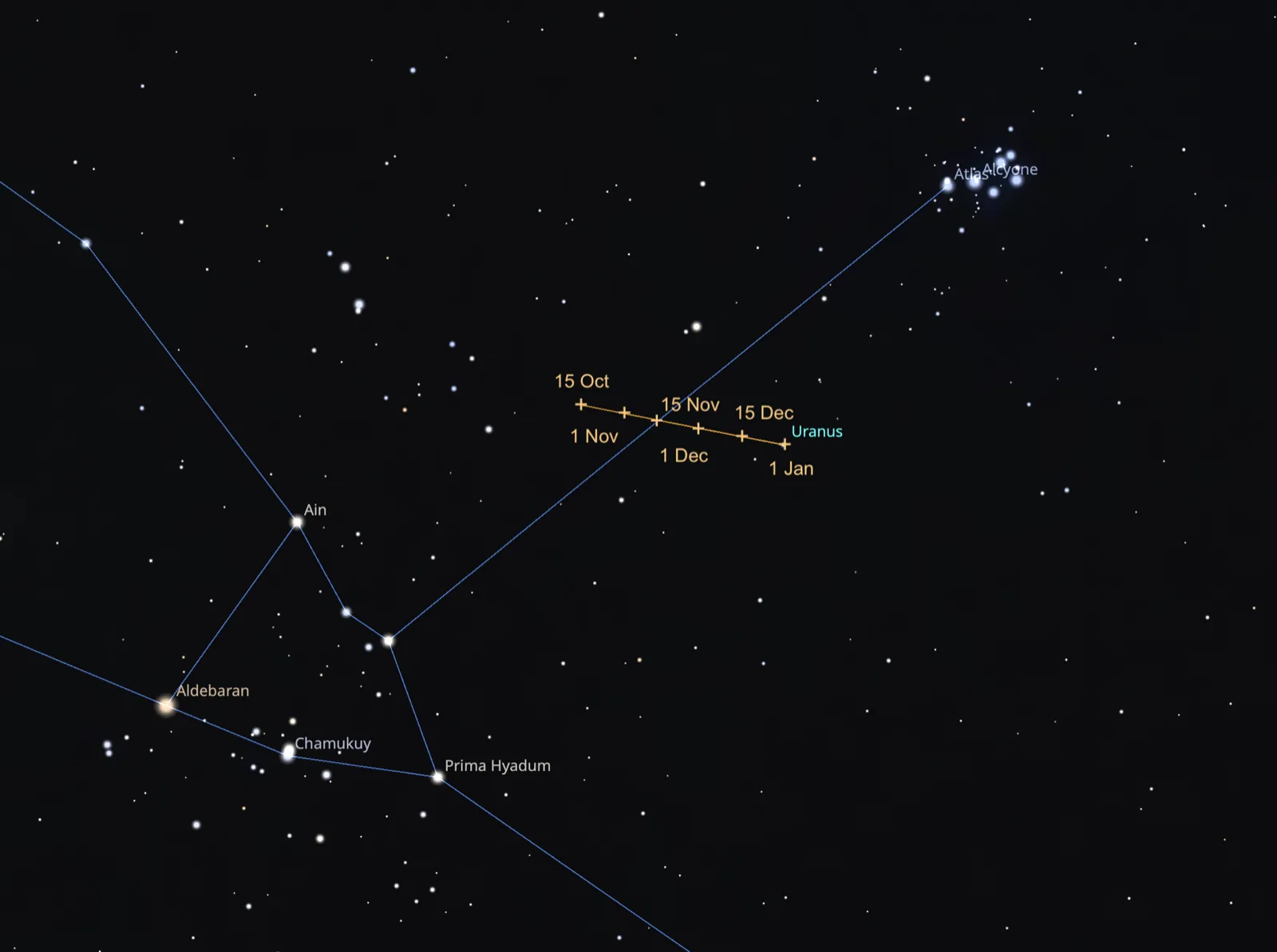
In his 1690 atlas, John Flamsteed recorded the 5th magnitude star “34 Tauri”; he had mistakenly failed to notice that it was actually the planet Uranus! Coincidentally, we’re looking at Uranus this Fall around the same position that Flamsteed saw it: Uranus has made four trips around the Solar System since then!
But this “oops” doesn’t compare to his contemporary, Pierre Charles Le Monnier who logged Uranus at least 12 times as a star, including on four consecutive nights in January 1769! If he had been a little more careful (of course he wasn’t actually looking for a planet) it might’ve been his name in the history books.
Then there’s the intriguing (and completely unverifiable) case of Hipparchos himself - his 128 BCE catalog included a faint star in Virgo that isn’t found now, but - intriguingly - that star’s position roughly coincides with Uranus’s location at that time.
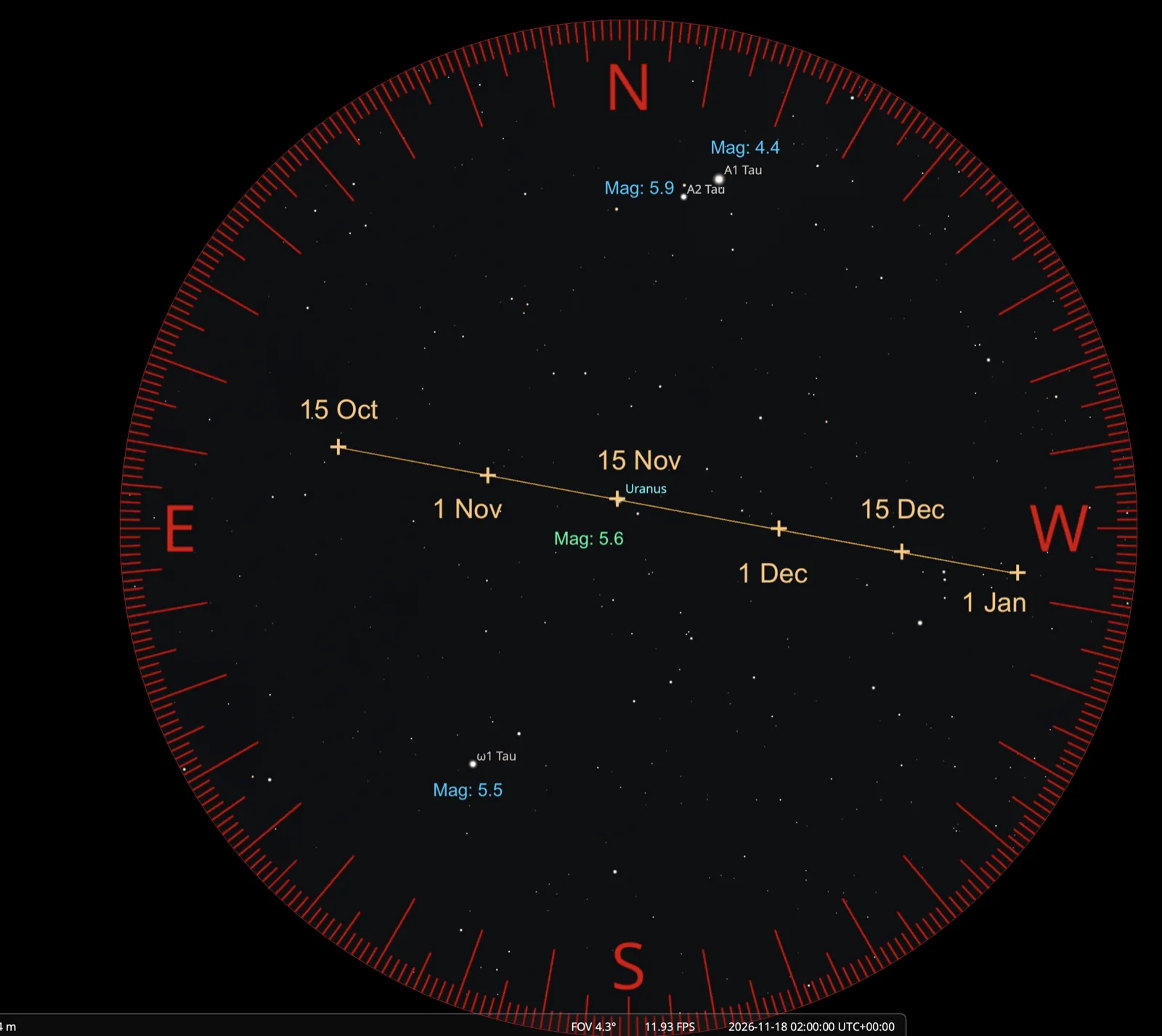
At magnitude 5.6, Uranus is technically right at the edge of naked-eye visibility from a genuinely dark site — but realistically, this is a binocular target, and a satisfying one. Through binoculars it looks exactly like a faint star sitting between the Hyades and Pleiades. The trick isn’t brightness, it’s confirming you’ve actually got the right “star” among a field of similarly-faint ones — which is exactly what the finder chart above is for.
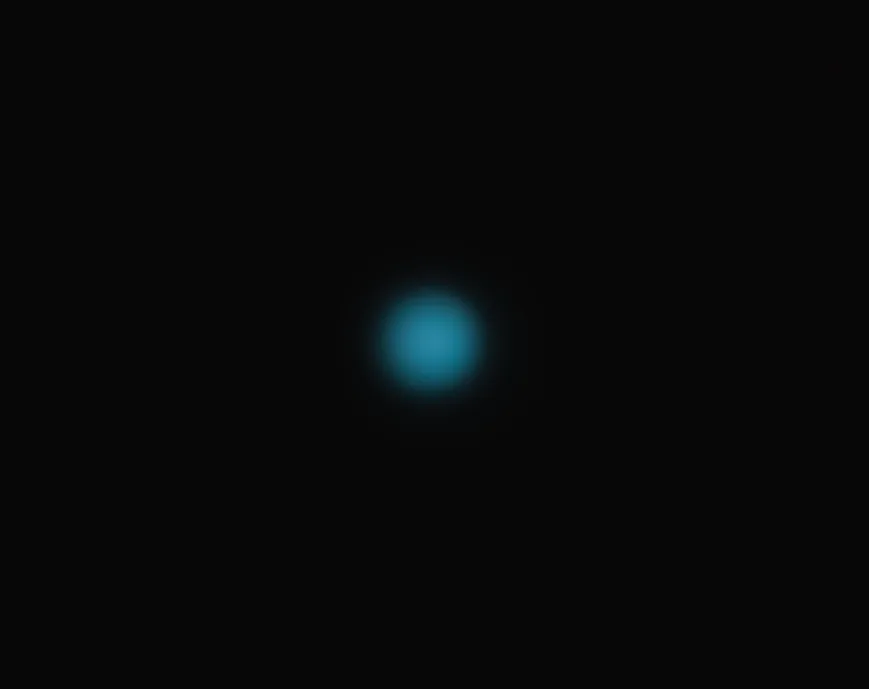
Push up to a small telescope with real magnification (100x or more) and Uranus stops being just “the star that isn’t a star” — it actually resolves into a small disk, with a genuine hint of blue-green color. That’s a real step up from the binocular catch, worth treating as its own milestone rather than a footnote. Push further still — more aperture, a steady night, and the lucky-imaging technique described above — and that hint of color becomes an actual, if small, colored disk, as in this capture.
One thing worth being upfront about: Uranus’s rings are not an amateur target at any level of gear. Even JWST reportedly shows them only as thin slivers — this is space-telescope territory, full stop.
Smart Scope Challenge: the brighter Uranian satellites
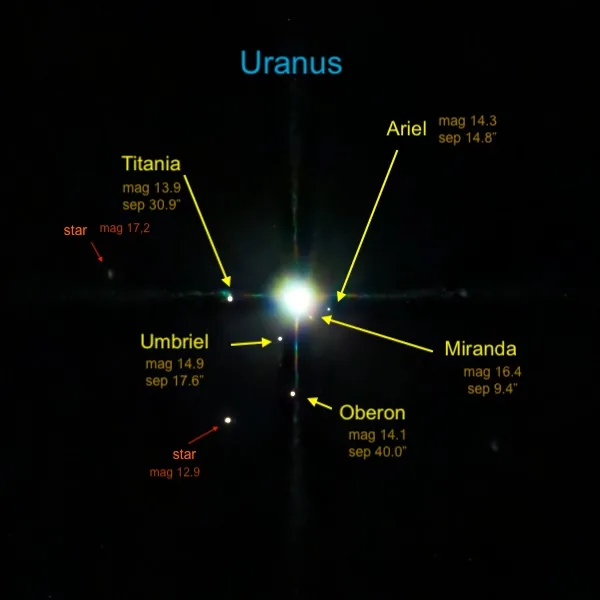
William Herschel — the same person who accidentally discovered Uranus itself in 1781 while surveying stars — spotted its two largest moons (Titania and Oberon) on a single night, January 11, 1787, just six years later. He’d go on to (mistakenly) claim four more moons over the following years, all later shown to be spurious. The other two moons in this section’s target list, Ariel and Umbriel, wouldn’t be found for another 64 years — not until 1851, by William Lassell.
For imaging, the disk itself isn’t really the prize — the real “wait, my backyard rig just did that” moment is catching Uranus’s moons. Titania and Oberon are the easiest of the four, sitting around 14th magnitude; Miranda, the fifth and much more recently-discovered moon (1948), is the real challenge at magnitude 16.4, hugging in close to the planet’s glare. Catching all five in one frame is a legitimate personal-best target.
Neptune
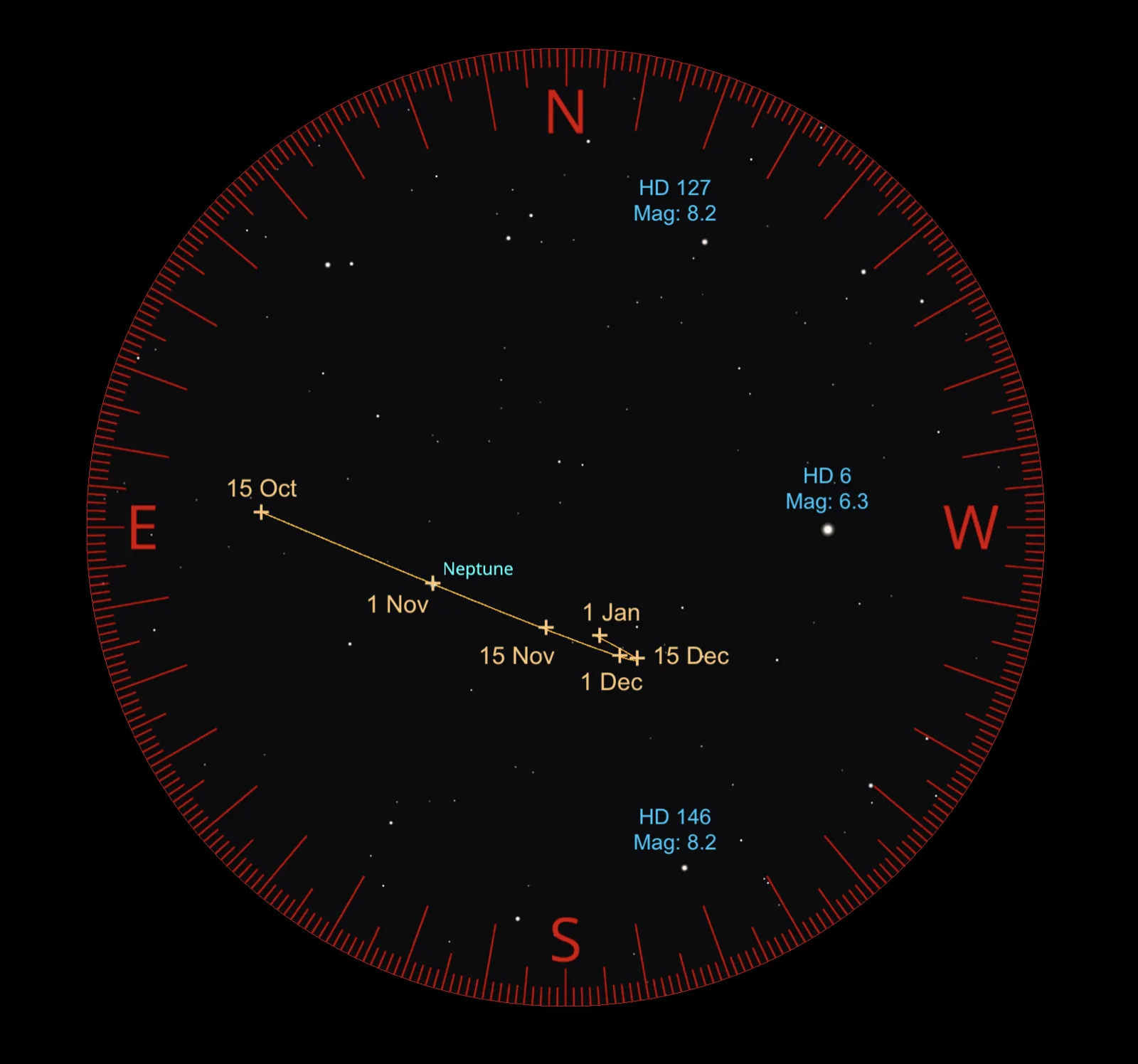
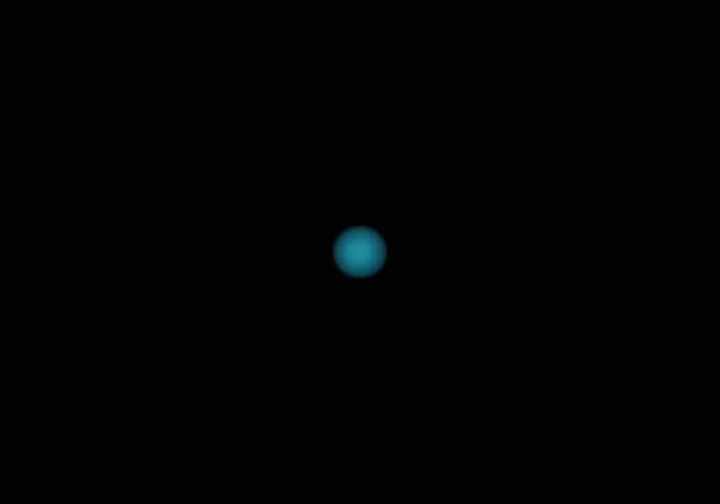
Neptune’s opposition was back in late September, but it’s still well-placed all autumn, sitting in Pisces at magnitude 7.8. Naked eye is out — Neptune is the one planet that never gets bright enough for that — but binoculars are absolutely in play: 10x50s (with a tripod; at this magnitude, steady is what actually matters) will pick it up as a faint, bluish “star,” provided you’re working from a good finder chart, since the surrounding field is faint enough that confusing it with a background star is the real challenge, not the brightness itself. A small telescope at 100x or higher (in very good to exceptional seeing) is what actually gets you the tiny blue-green disk — that’s the point where you stop just “finding a star” and start seeing a planet, as in this shot, taken the same way as the Uranus image above.
While Neptune wasn’t discovered until 1846, like Uranus, there were earlier cases of someone recording the planet, not realizing it was a planet - including Galileo himself! In 1612, Jupiter and Neptune were very close to each other in the sky. Galileo - focused on the motions of the moons of Jupiter he discovered - noted a nearby “star” for reference, and on a later night, recorded that it had shifted position relative to another nearby star. He never followed up on it. (Given how much trouble he got into with the Church over his other observations - trying to add a whole new planet at the time probably wouldn’t have been a wise thing to do, so maybe it’s all for the best.)
Smart Scope Challenge: Find Triton!
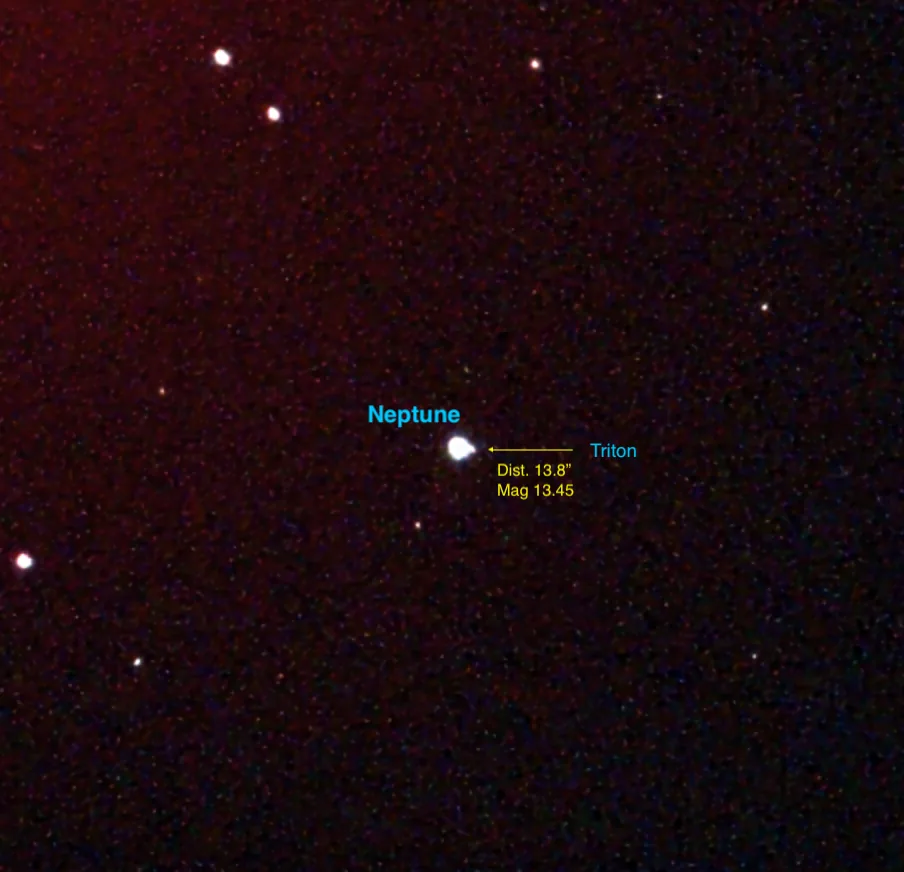
This is where Neptune actually plays to a smart scope’s real strength. Detecting Triton alongside the planet is a sensitivity challenge — exactly the kind of faint-companion detection smart scopes are built for — rather than a resolution challenge the way Uranus’s disk is.
Triton is about the same brightness as Pluto - and we’ve covered Pluto in a previous observing challenge and the similarity doesn’t end there: Voyager images of Triton and New Horizons images of Pluto revealed that the two worlds are very similar, and both are active despite their extreme distance from the Sun.
For smart scopes, Triton might be even easier to “tick off your list” than Pluto is (since it’s easy to find Neptune). The trick here is stacking short exposures (to reduce Neptune’s glare) - post-processing (esp. de-blurring) might help extract Triton.
Worth a mention while we’re here, as a preview of just how far this can go: Neptune’s much smaller moon Nereid sits around magnitude 18.7–19.2 — essentially the same difficulty tier as Eris itself (see below). It’s been done — a Cloudy Nights imager has a documented capture of Nereid over two nights at mag 18.7 overlaying those images to show Nereid and Neptune’s motion against the background stars — but it’s a genuinely different kind of catch than Triton: a moon riding along with a bright planet, rather than a dwarf planet sitting alone in empty sky. Which brings us to the edge of the ladder.
Eris
This is one of the most challenging object for smart-scope imaging. The dwarf planet Eris - presently almost 100 AU away (more than twice the distance to Pluto) is really at the detection limit of a moderately-sized smart scope, at mag 18.6. You’ll need dark skies and substantial exposure time to pick out this faint point of light.
Fittingly, Eris is sitting in Cetus right now too — the same constellation as Saturn. Same patch of sky, opposite ends of what’s possible with a backyard setup.
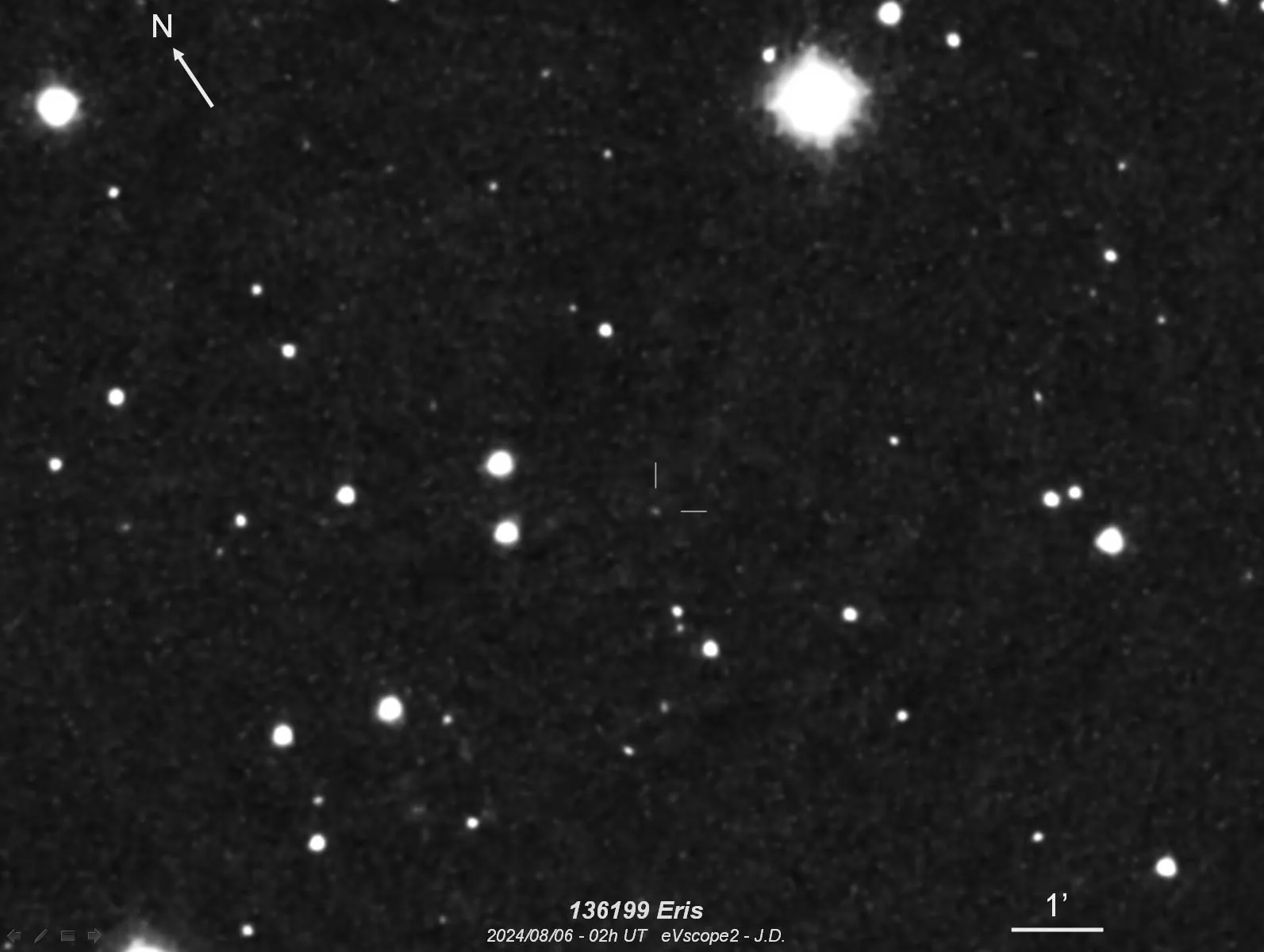
However, it has been done: French Unistellar owner J.D. specializes in these extremely difficult targets: faint SSOs (asteroids, planet outer moons), quasars, and extra-galactic supernovae. Check out his Facebook profile to be truly amazed!
if you want to make the daring attempt: here’s an ephemeris over the next few months. Good luck!
Click to expand: Eris ephemeris, Oct 15 – Jan 1 (every 3 days)
| Date 04:00 UT | RA / Dec | Azi. / Alt. | Air Mass | Mag | Dist (AU) |
|---|---|---|---|---|---|
| 2026-Oct-15 | 01 48 09.81 -00 05 46.9 | 155.87 44.84 | 1.416 | 18.61 | 94.476 |
| 2026-Oct-18 | 01 48 03.05 -00 06 20.2 | 159.95 45.66 | 1.396 | 18.60 | 94.474 |
| 2026-Oct-21 | 01 47 56.26 -00 06 52.4 | 164.14 46.33 | 1.381 | 18.60 | 94.475 |
| 2026-Oct-24 | 01 47 49.46 -00 07 23.6 | 168.42 46.84 | 1.369 | 18.61 | 94.479 |
| 2026-Oct-27 | 01 47 42.67 -00 07 53.6 | 172.76 47.19 | 1.361 | 18.61 | 94.485 |
| 2026-Oct-30 | 01 47 35.91 -00 08 22.3 | 177.16 47.38 | 1.357 | 18.61 | 94.494 |
| 2026-Nov-02 | 01 47 29.20 -00 08 49.5 | 181.57 47.40 | 1.357 | 18.62 | 94.505 |
| 2026-Nov-05 | 01 47 22.55 -00 09 15.3 | 185.96 47.24 | 1.360 | 18.62 | 94.519 |
| 2026-Nov-08 | 01 47 15.99 -00 09 39.5 | 190.32 46.93 | 1.367 | 18.63 | 94.536 |
| 2026-Nov-11 | 01 47 09.54 -00 10 02.0 | 194.62 46.45 | 1.378 | 18.63 | 94.555 |
| 2026-Nov-14 | 01 47 03.21 -00 10 22.6 | 198.82 45.81 | 1.393 | 18.64 | 94.577 |
| 2026-Nov-17 | 01 46 57.04 -00 10 41.4 | 202.92 45.02 | 1.412 | 18.64 | 94.601 |
| 2026-Nov-20 | 01 46 51.02 -00 10 58.3 | 206.90 44.09 | 1.435 | 18.65 | 94.627 |
| 2026-Nov-23 | 01 46 45.19 -00 11 13.1 | 210.74 43.03 | 1.463 | 18.65 | 94.656 |
| 2026-Nov-26 | 01 46 39.56 -00 11 25.8 | 214.45 41.84 | 1.496 | 18.65 | 94.687 |
| 2026-Nov-29 | 01 46 34.14 -00 11 36.4 | 218.01 40.54 | 1.536 | 18.66 | 94.720 |
| 2026-Dec-02 | 01 46 28.96 -00 11 44.9 | 221.43 39.14 | 1.581 | 18.66 | 94.755 |
| 2026-Dec-05 | 01 46 24.01 -00 11 51.1 | 224.72 37.64 | 1.634 | 18.67 | 94.791 |
| 2026-Dec-08 | 01 46 19.33 -00 11 55.0 | 227.86 36.06 | 1.695 | 18.67 | 94.830 |
| 2026-Dec-11 | 01 46 14.93 -00 11 56.6 | 230.88 34.39 | 1.766 | 18.67 | 94.871 |
| 2026-Dec-14 | 01 46 10.82 -00 11 55.8 | 233.78 32.66 | 1.847 | 18.68 | 94.913 |
| 2026-Dec-17 | 01 46 07.01 -00 11 52.6 | 236.57 30.86 | 1.943 | 18.68 | 94.956 |
| 2026-Dec-20 | 01 46 03.52 -00 11 47.1 | 239.25 29.01 | 2.054 | 18.68 | 95.001 |
| 2026-Dec-23 | 01 46 00.34 -00 11 39.2 | 241.84 27.11 | 2.184 | 18.68 | 95.047 |
| 2026-Dec-26 | 01 45 57.50 -00 11 29.0 | 244.33 25.16 | 2.339 | 18.69 | 95.094 |
| 2026-Dec-29 | 01 45 55.00 -00 11 16.4 | 246.75 23.17 | 2.524 | 18.69 | 95.142 |
| 2027-Jan-01 | 01 45 52.85 -00 11 01.5 | 249.10 21.15 | 2.749 | 18.69 | 95.191 |
For other dates, use the JPL/Horizons ephemeris generator.
Wherever You’re Starting From
That’s Saturn, the ice giants, and dwarf planet Eris — bookended by the easiest planet in the night sky and one of the hardest targets in amateur astronomy, with a genuine, satisfying stop at nearly every rung in between. Naked eye, binoculars, a small telescope, a smart scope, or a dedicated imaging rig: this month, there’s a real “yes, I can actually see that” waiting at every level, and more than a few “wait, I actually caught that?” moments too.
If you’ve never gone looking for anything past Saturn before, tonight’s as good a night as any to start. Uranus is sitting right there in binoculars, patiently waiting between two star clusters you may have already looked at a dozen times without knowing a planet was hiding nearby.
Whatever your experience, whatever gear is sitting in your driveway or your closet tonight — you belong under our skies.
Clear skies, and happy hunting.