The Ram
Aries is one of Ptolemy’s original 48, set down in the Almagest as the ram with the golden fleece. In the Greek telling, the ram carried Phrixus and his sister Helle away from a stepmother who wanted them dead; Helle lost her grip over the strait that now carries her name, the Hellespont, while Phrixus completed the flight to Colchis and sacrificed the ram in gratitude, hanging its fleece in a sacred grove. That fleece became the object of Jason’s expedition with the Argonauts – a crew that, in most versions, included Hercules himself. The fleece was never one of Hercules’s own Twelve Labors, though; that’s a separate, later cycle of myths entirely, and the two stories only overlap because Hercules happened to be on board.
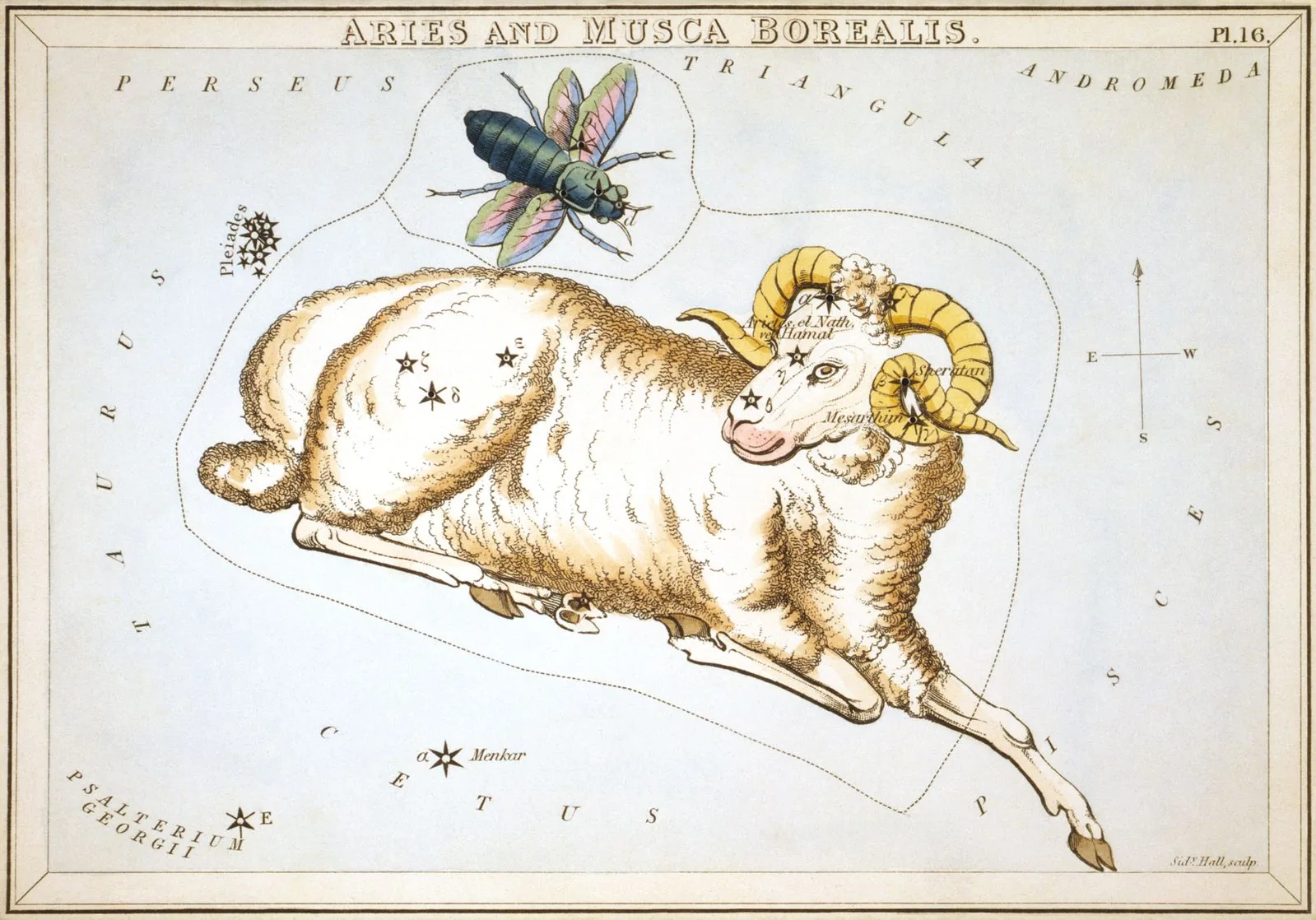
The ram, though, is a comparatively late arrival for this patch of sky. The Babylonians, in the star catalog known as MUL.APIN (compiled around 1000 BCE), called these same stars The Hired Man – an agricultural laborer, not an animal, and the closing station of their version of the ecliptic. That human figure later merged with the shepherd-god Dumuzi’s ram before settling into the purely animal form the Greeks eventually inherited. Ancient Egyptian astronomers took a different path, linking the constellation to Amun-Ra, the ram-headed god of fertility and creation: because the vernal equinox fell within these stars in antiquity, Aries carried the title “Indicator of the Reborn Sun,” and priests processed statues of Amun-Ra through the temples during its season each year.
Arabic astronomers, drawing on an older desert star-lore tradition, grouped Hamal, Sheratan, and Mesarthim together as al-Sharatan – usually translated “the two signs,” though the exact meaning is still debated among modern scholars. Under any name, this small, faint constellation has carried outsized cultural weight for millennia, mostly because of where it used to sit: as the map below explains, this was once the spot marking the start of spring itself.
Map of Aries
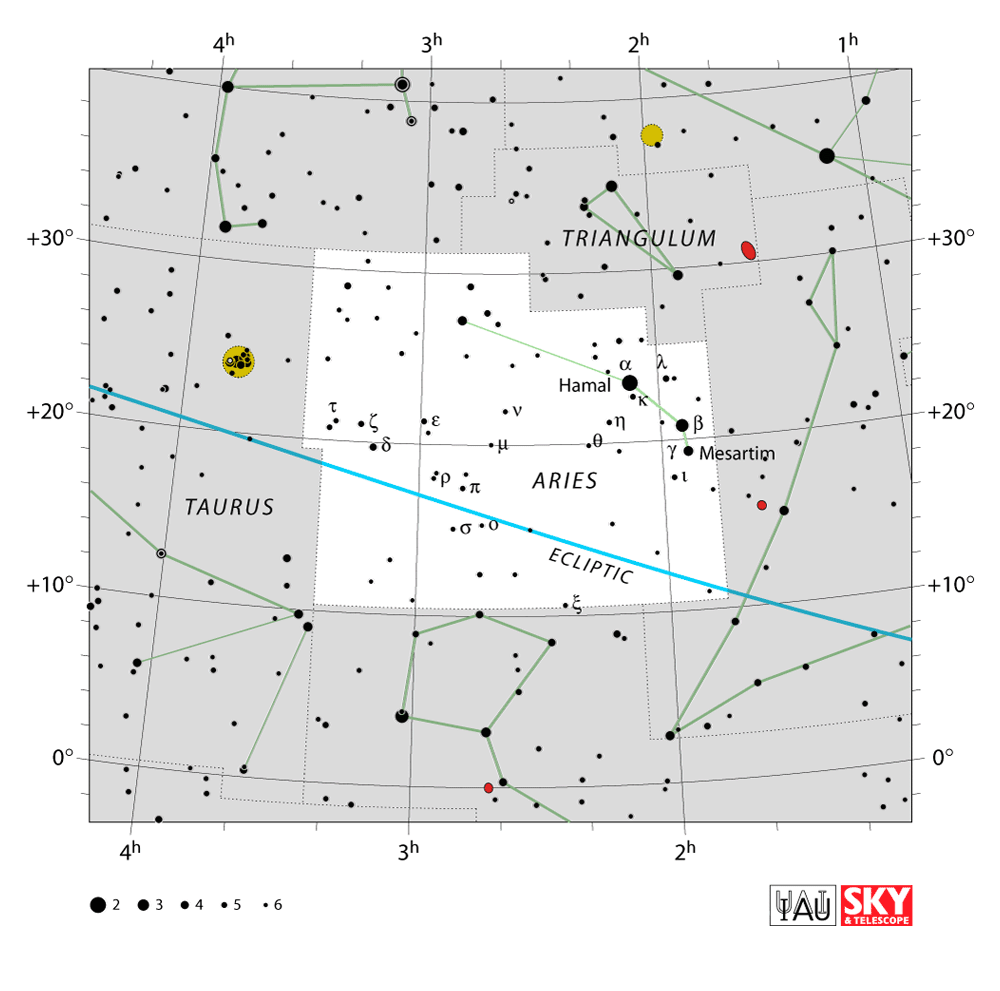
Aries is a modest, faint figure: two second-magnitude stars, Hamal and Sheratan, mark the ram’s head and horns, with the fainter 41 Arietis out along the hindquarters. The whole shape sits just north of the celestial equator, and the ecliptic – the Sun’s apparent yearly path against the stars – runs through the southern part of the constellation, below the main line of stars. The Sun itself passes through Aries from roughly mid-April to mid-May each year.
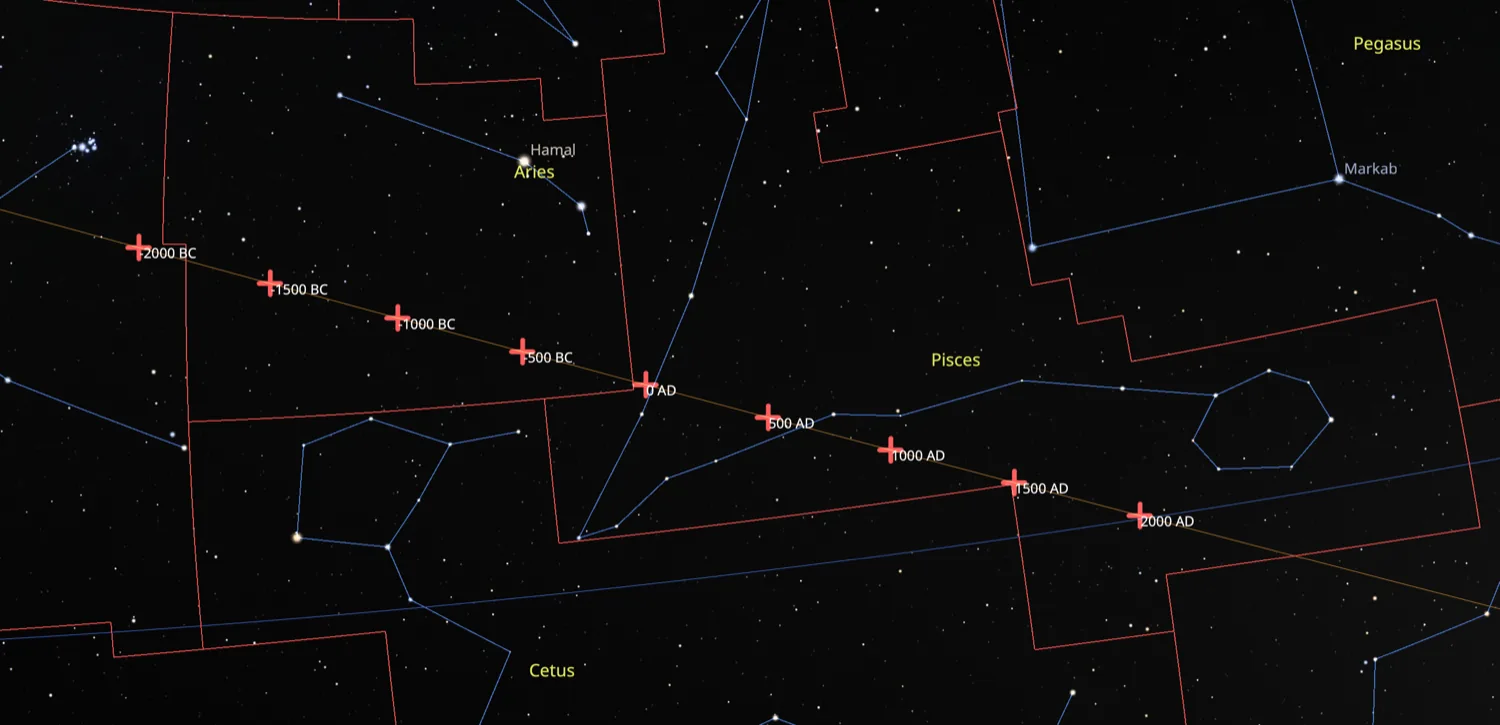
That path through Aries used to matter more than it does now. For centuries, the point where the Sun crosses the celestial equator heading north each spring – the vernal equinox – fell within Aries’ borders (starting in 1866 BCE), and that point is still called the “First Point of Aries” today, even though it no longer is one. Precession of Earth’s axis has slowly dragged the equinox westward over the millennia, and it drifted out of Aries and into neighboring Pisces around 68 BCE – so the point itself no longer lies within Aries at all. In a few more centuries it will drift again, into Aquarius (in 2597 CE). Astronomers still call it the First Point of Aries out of habit, and that drifting point, wherever it currently sits, remains the zero point (RA = 0h) from which right ascension is measured across the entire sky. The name outlasted the geography.
Aries also sits well off the plane of the Milky Way, which is part of why this constellation, unlike a field such as Cassiopeia, has no open or globular clusters and no bright emission nebulae to speak of. What it does have, in abundance, is galaxies: faint, distant, and easy to overlook when there’s no bright nebula around to compete for attention.
The Bee That Became a Fly
musca-borealis.webp
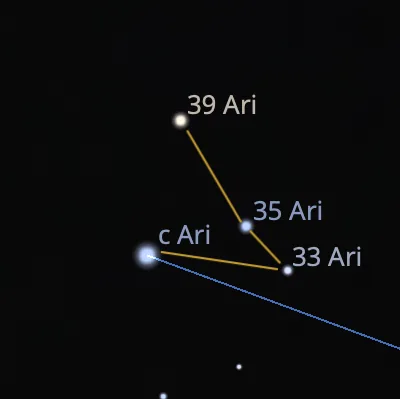
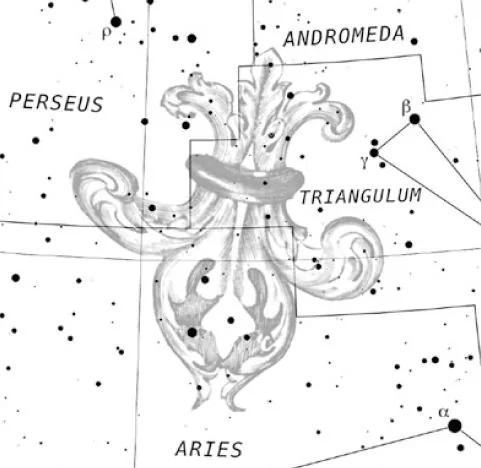
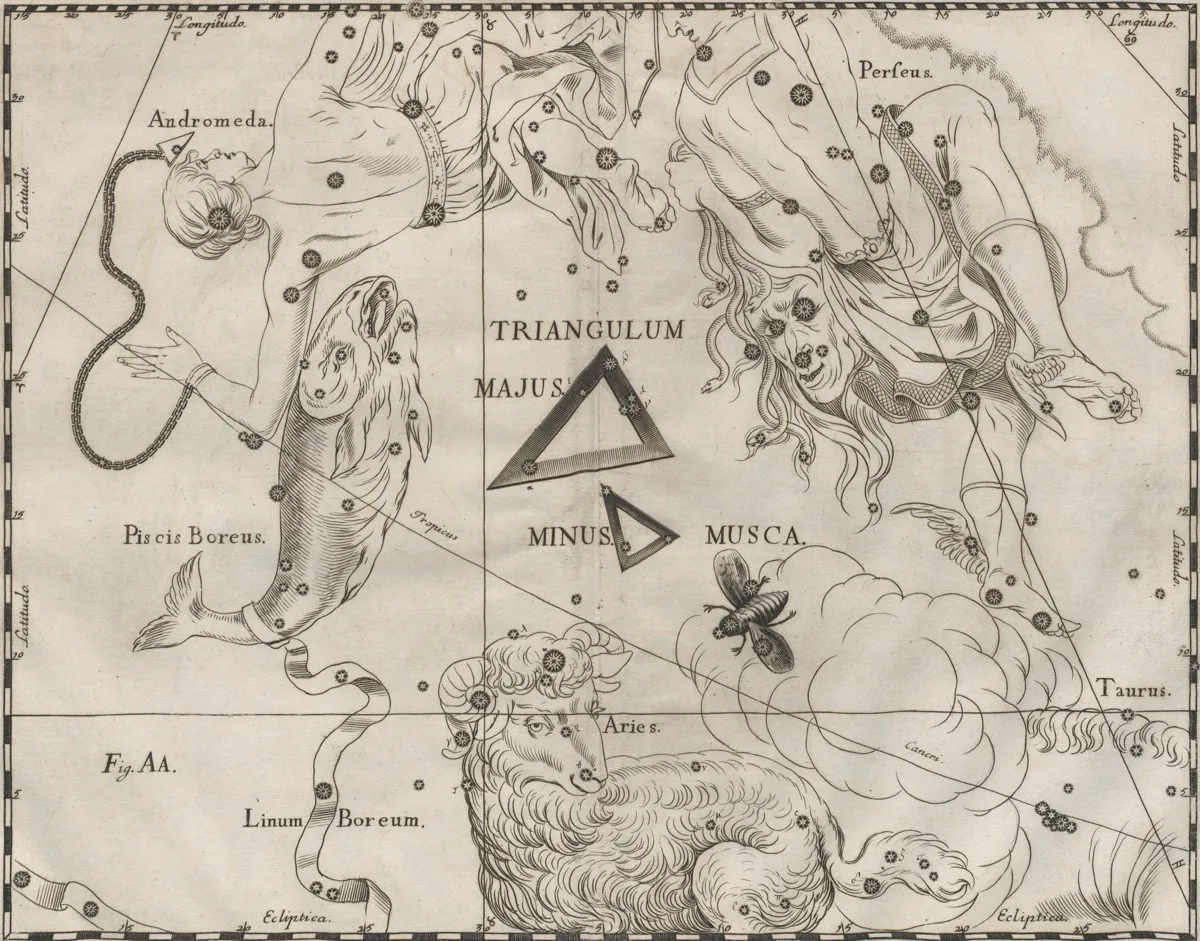
Between Aries and Perseus, four faint stars on the ram’s back – now known simply as 33, 35, 39, and 41 Arietis – spent nearly a century as their own separate constellation, and couldn’t seem to settle on what kind of insect they were. Dutch astronomer Petrus Plancius introduced the group in 1612 as Apes, the Bee. A dozen years later Jakob Bartsch relabeled the same four stars Vespa, the Wasp. In 1679 the French astronomer Augustin Royer tried something entirely different, renaming them Lilium after the fleur-de-lis. None of it stuck until Johannes Hevelius, in his 1690 Firmamentum Sobiescianum atlas, called the group Musca, the Fly – later amended to Musca Borealis, the Northern Fly, to avoid confusion with the unrelated southern constellation Musca near the Southern Cross. None of these names ever gained lasting acceptance, and the four stars were eventually folded back into Aries for good, where they remain today – proof that not every constellation boundary drawn on a star atlas was meant to last.
Three of these four stars – 35, 39, and 41 Arietis – also define the Chinese asterism 胃宿 (Wèi Su), “the Stomach,” one of the 28 lunar mansions of traditional Chinese astronomy.
Nicolas-Louis de Lacaille named 39 and 41 Arietis “Lilii Borea” and “Lilii Austrina” in 1757; the IAU has since adopted “Lilii Borea” for 39 Arietis, but gave 41 Arietis a different name instead – “Bharani,” the second nakshatra of Hindu astronomy.
Quick Reference: Objects of Interest
| Object | Type | Equipment |
|---|---|---|
| NGC 691 | Spiral Galaxy | Medium/Imaging Telescope |
| NGC 697 | Intermediate Galaxy | Imaging Telescope |
| NGC 772 | Spiral Galaxy | Small/Medium Telescope |
| NGC 935 | Interacting Galaxy Pair | Imaging Telescope |
| NGC 1156 | Irregular Galaxy | Small/Medium Telescope |
| Hickson 20 | Compact Galaxy Group | Imaging Telescope |
| Teegarden's Star | Red Dwarf / Nearby Star | Imaging Telescope |
| vdB 16 | Reflection Nebula | Medium/Imaging Telescope |
The Group’s Anchor
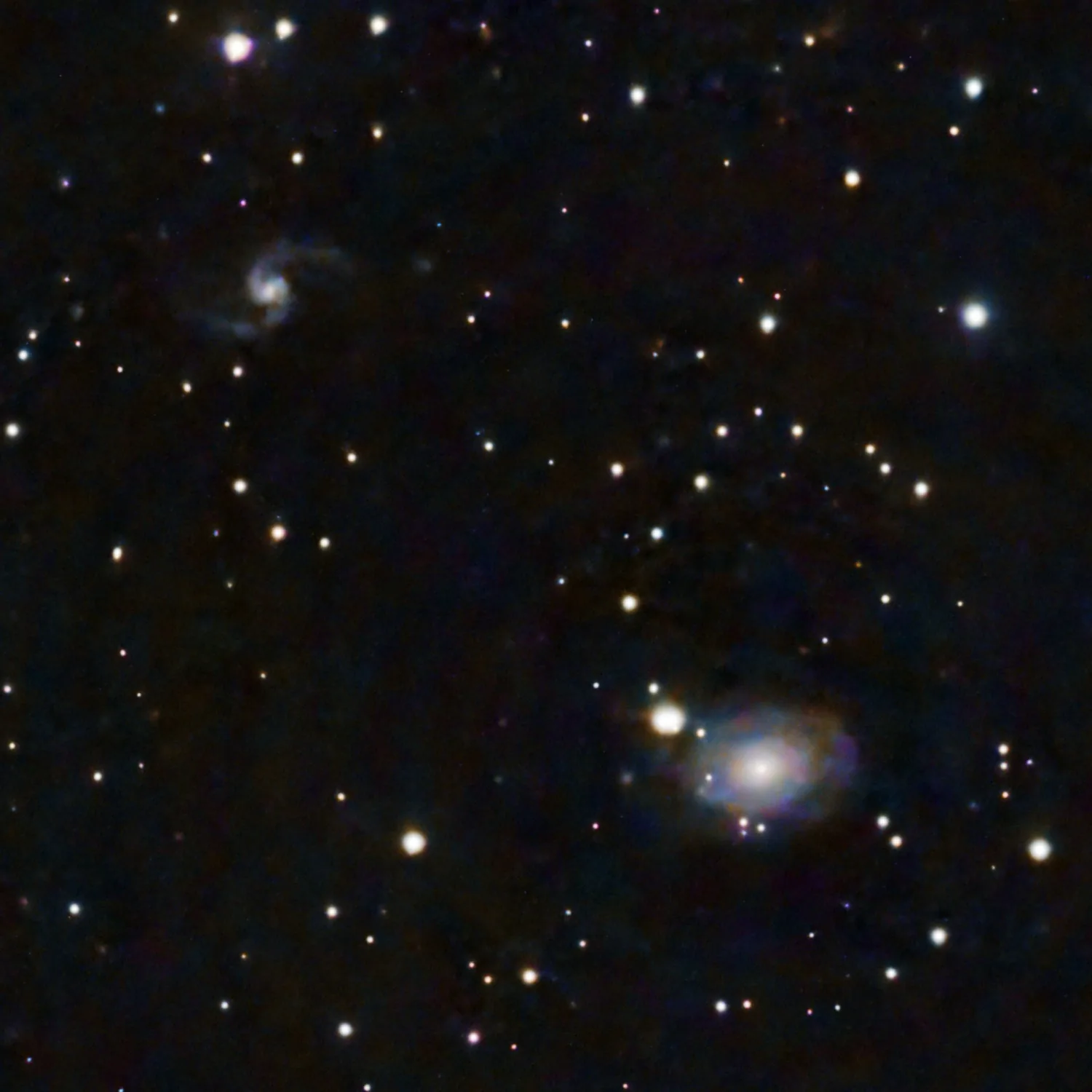
NGC 691 is the anchor of its own small galaxy group in the fall sky – discovered by William Herschel on November 13, 1786, and today recognized as the brightest member of a loose association that also includes NGC 697 (next), NGC 678, NGC 680, NGC 694, and a scattering of fainter IC galaxies nearby. It’s a face-on, unbarred spiral about 120 million light-years away and roughly 130,000 light-years across – slightly larger than our own Milky Way. Infrared surveys have picked out three faint rings threading through its disk, invisible in ordinary visual light. In 2005 it briefly hosted a Type Ia supernova: the same reliable class of stellar explosion used as a “standard candle” to measure distances across the universe, and whose behavior at great distances first revealed that the universe’s expansion is accelerating.
Sharing the Neighborhood
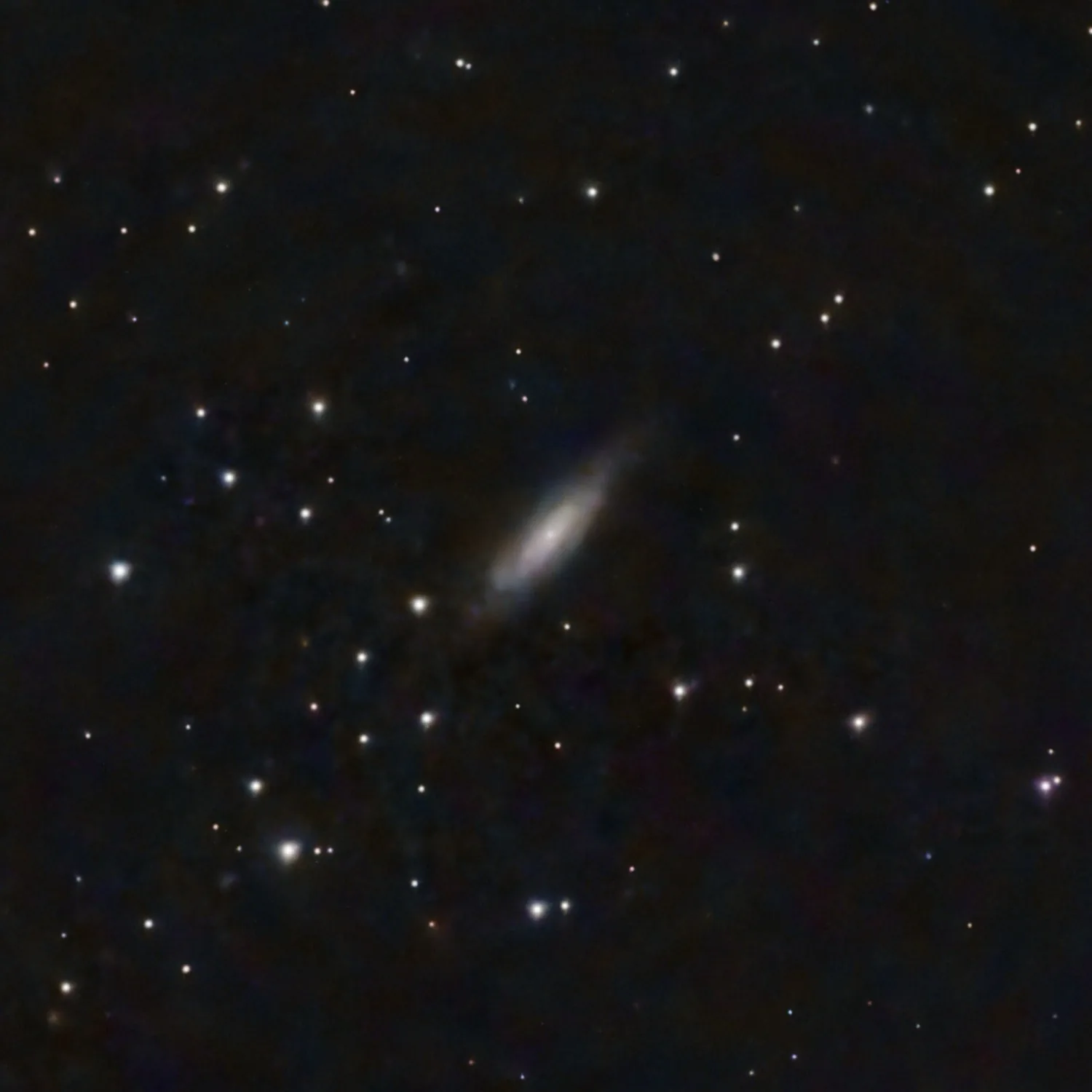
Less than a degree away, NGC 697 belongs to the same group as NGC 691 – discovered two years earlier, on September 15, 1784, also by Herschel. It’s classified SAB(r)c, an “intermediate” spiral showing hints of a bar without being strongly barred, and it’s caught at just enough of an oblique angle that even professional surveys hedge a little on its exact arm structure. For over a century the galaxy carried a redundant second catalog entry, after German astronomer Heinrich d’Arrest reported discovering a nearby object in 1861 that turned out, 77 years later, to be the very same galaxy. Modern catalogs have folded the two entries back together. If you’re hunting one member of the NGC 691 group, the other is essentially free – they share the same eyepiece field.
The Fiddlehead
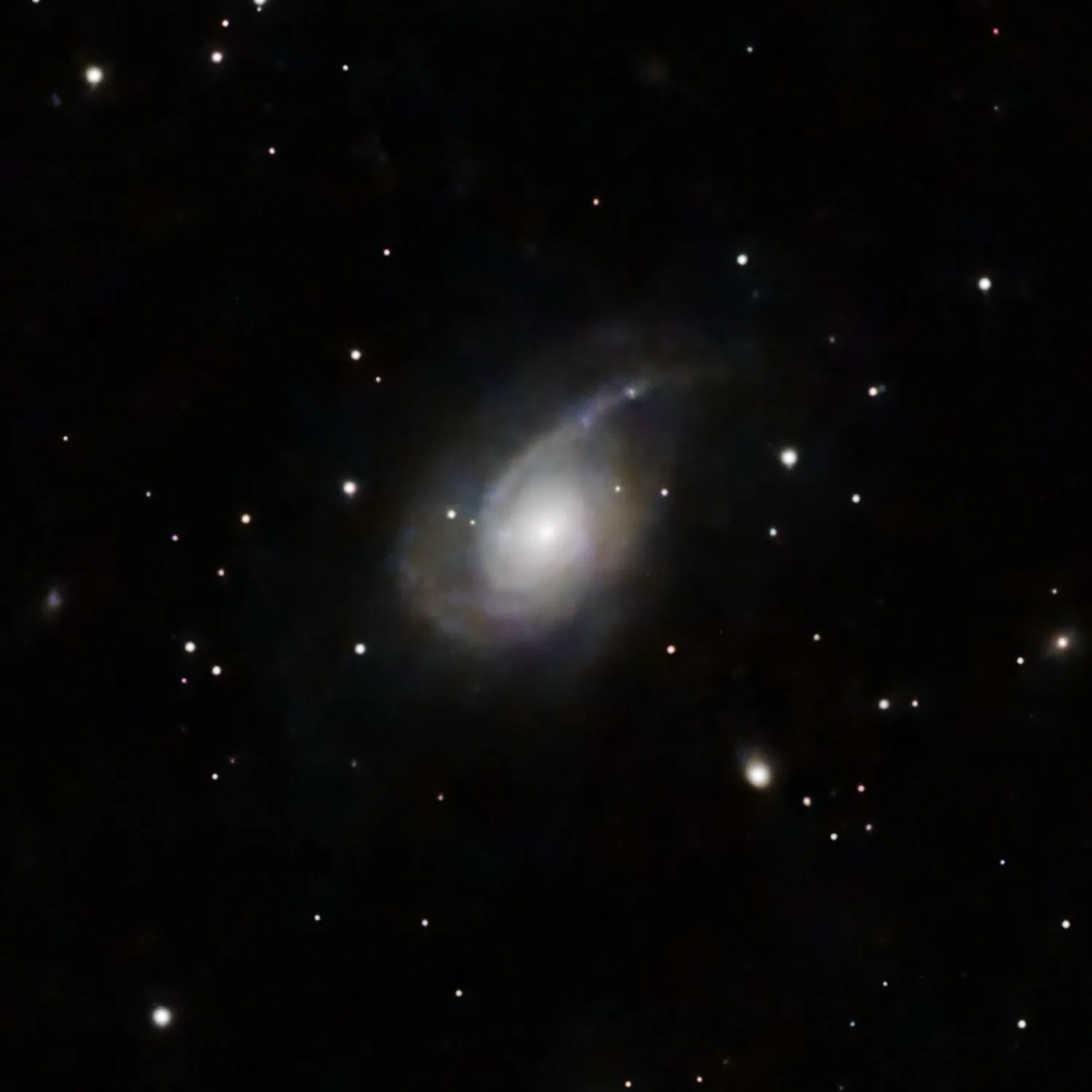
NGC 772 – nicknamed the Fiddlehead Galaxy for the way its single dominant spiral arm curls in on itself – is one of the more dramatic examples of galactic bullying in the fall sky. Discovered by Herschel in 1785, it’s a large unbarred spiral roughly 106 million light-years away and nearly twice the diameter of the Milky Way. Its lopsided, overdeveloped arm isn’t a natural feature: it’s the ongoing result of tidal interaction with its much smaller elliptical companion, NGC 770, discovered seventy years later by an assistant of Lord Rosse using the 72-inch “Leviathan of Parsonstown” – then the largest telescope in the world. Together the pair are catalogued as Arp 78 in Halton Arp’s Atlas of Peculiar Galaxies, and NGC 772 itself has hosted three known supernovae since 2003.
A Slow-Motion Collision
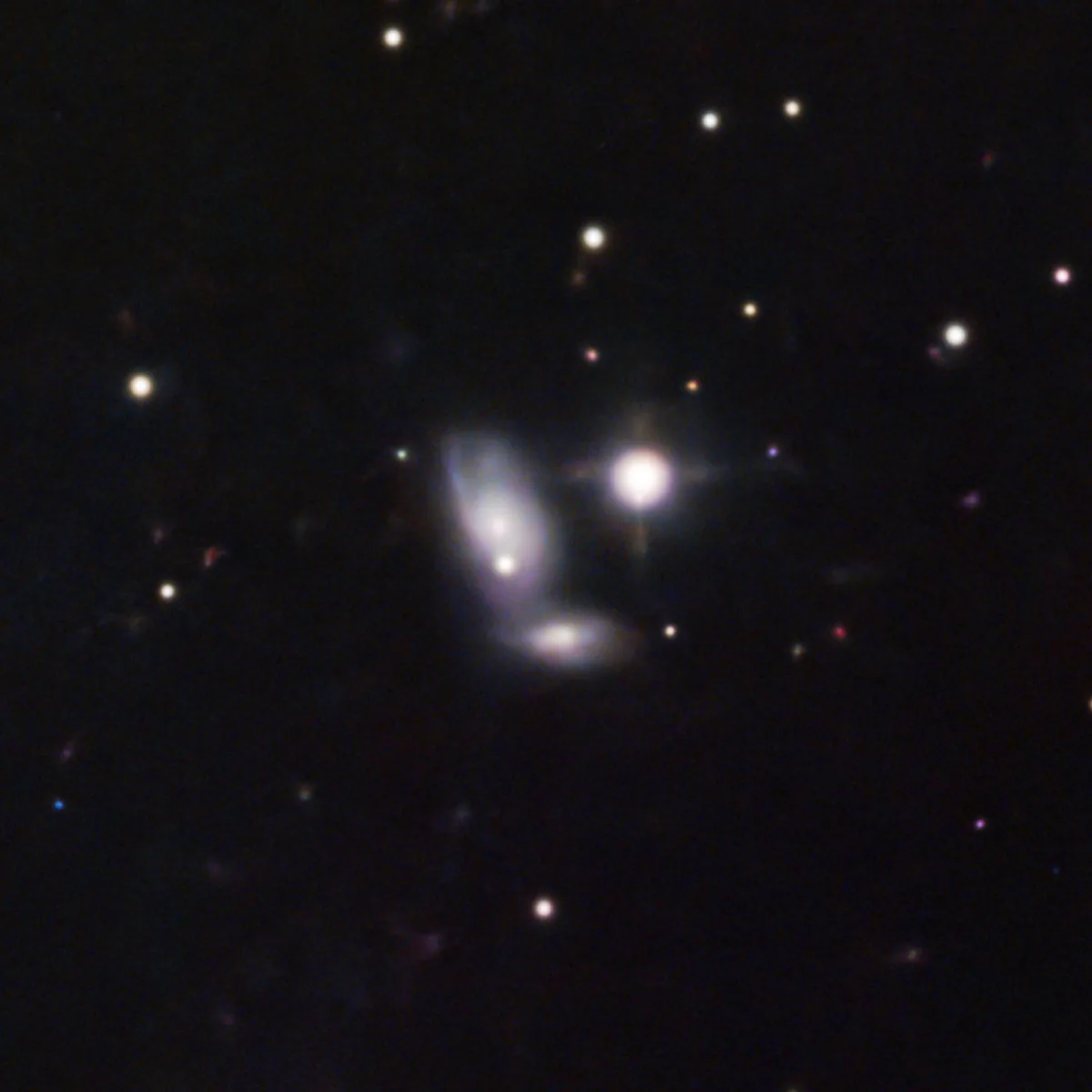
NGC 935 and its close neighbor IC 1801 were discovered together on the same night in 1885 by Lewis Swift, and modern infrared imaging makes clear why they belong together: NASA describes the pair, jointly catalogued as Arp 276, as two spiral galaxies “beginning to crash into each other.” At roughly 190 million light-years away, they’re among the more distant objects in this article – and one of the liveliest. Each galaxy has hosted its own supernova, decades apart: ordinary stellar deaths, still playing out even as the two home galaxies grind toward an eventual merger into one.
The Loner
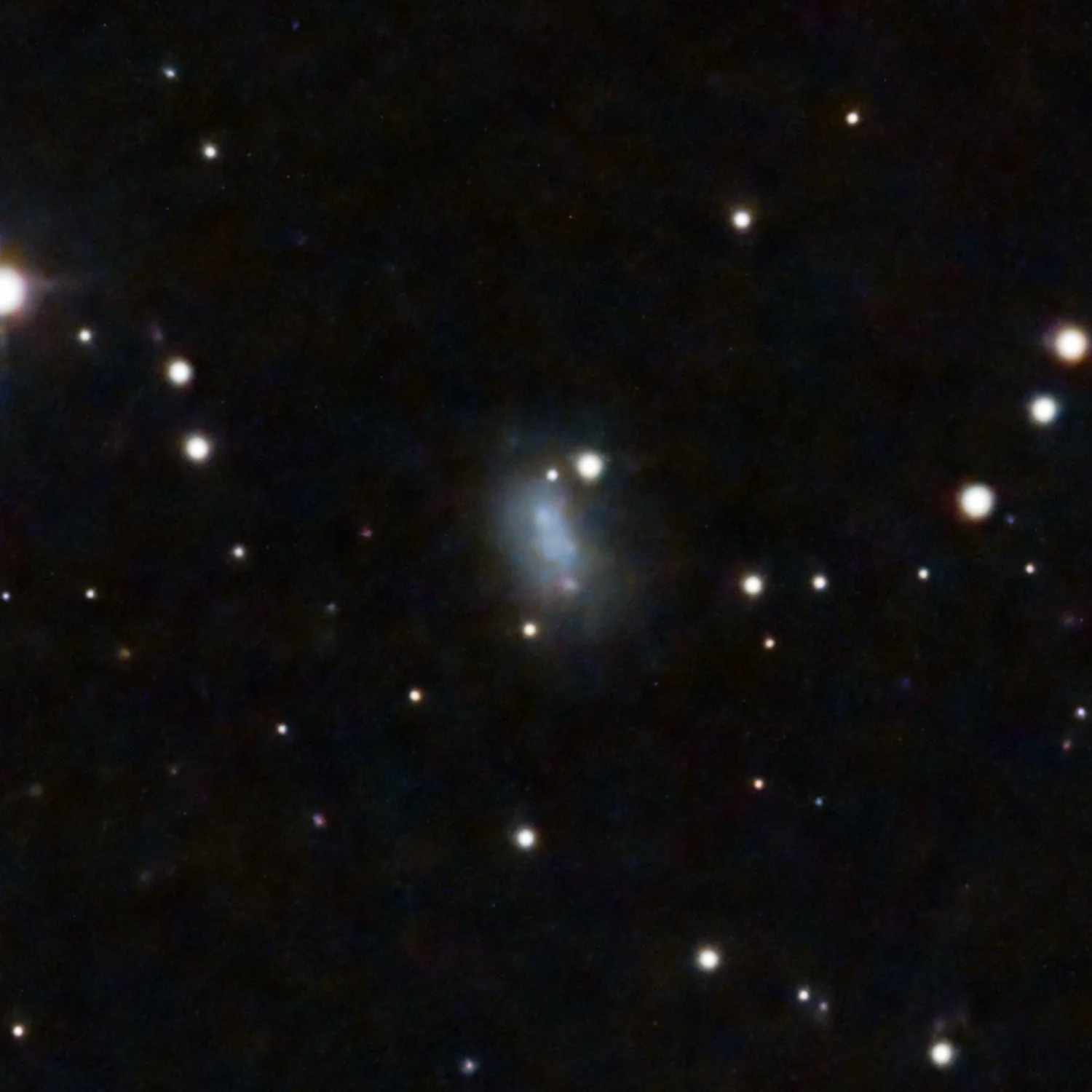
After a run of galaxies caught interacting, colliding, or traveling in groups, NGC 1156 is the odd one out: a dwarf irregular galaxy discovered by Herschel in 1786, and one of the most genuinely isolated galaxies known in the local universe, with its nearest neighbors more than ten degrees away. At only about 25 million light-years distant, it’s also considerably closer than every other galaxy in this piece. Its boxy shape, oversized core, and ongoing bursts of star formation aren’t being triggered by any companion – they’re homegrown. Some pockets of gas within it even rotate backward relative to the rest of the galaxy, a fossil clue that it likely absorbed a smaller galaxy at some point in its distant past, even though nothing else nearby survived to tell the rest of that story. Hubble has returned to image it more than once, most recently in 2022, as part of a program to fill in the gaps in our census of every known nearby galaxy.
A Crowd in a Small Space
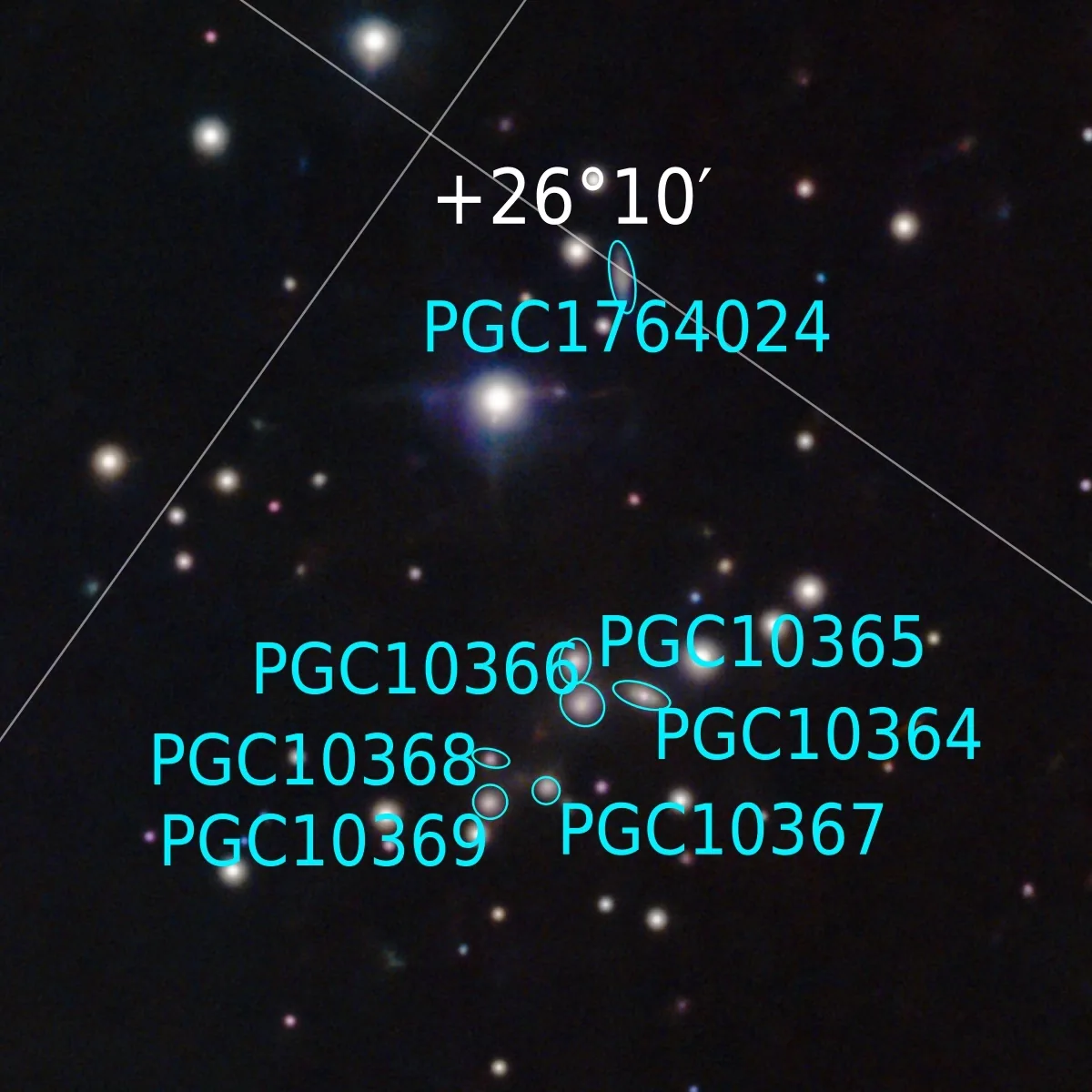
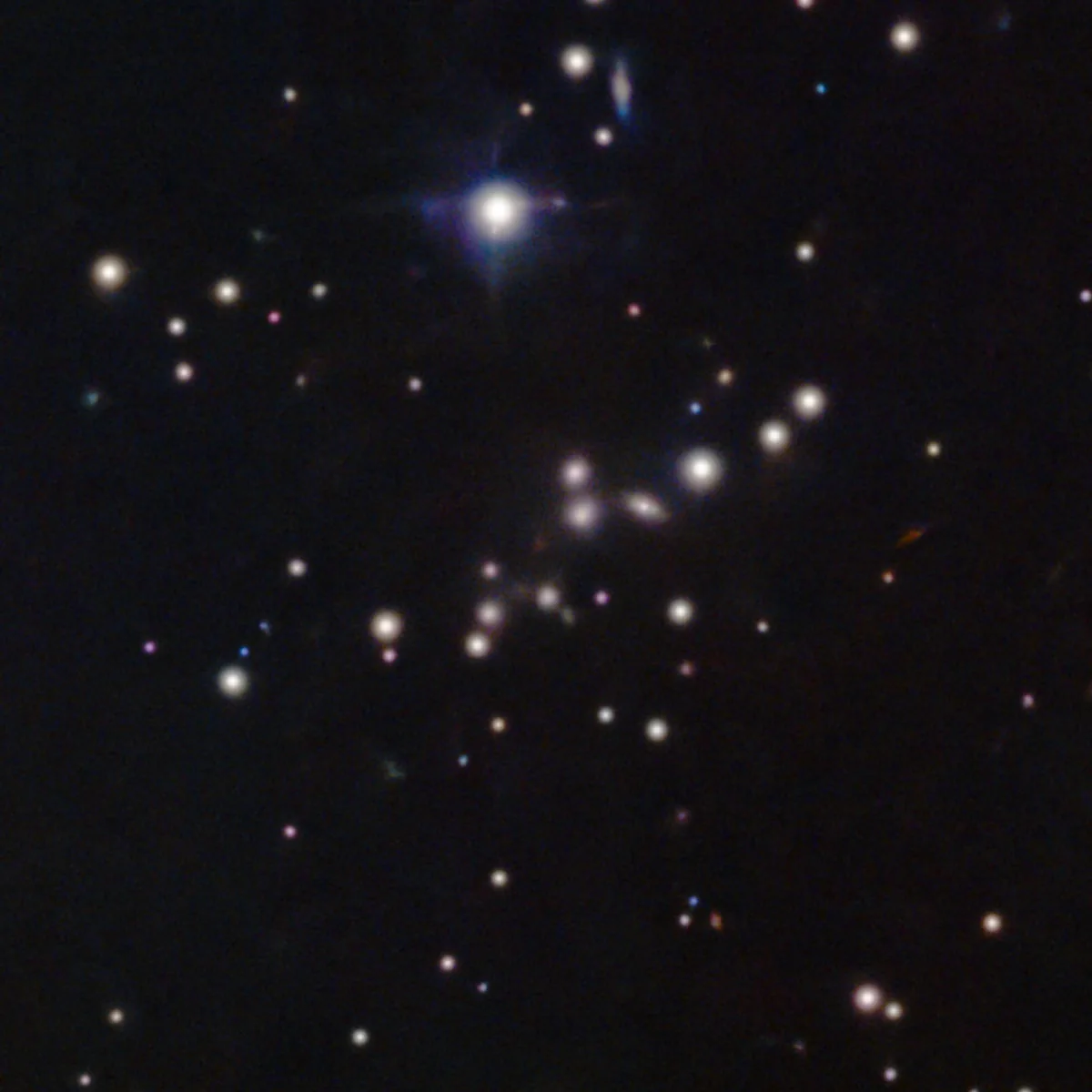
Hickson 20 packs six member galaxies – PGC 10364 through 10369 – into a tight cluster barely visible as separate objects, proof that a group of galaxies doesn’t need to be spread across degrees of sky. It’s one of the hundred such compact groups catalogued by Paul Hickson in 1982 as likely sites of ongoing galaxy mergers and dark-matter-dominated dynamics. Groups this compact tend to run at surprisingly high internal velocities for their size, and Hickson 20 is no exception: its “crossing time” – roughly how long it takes a galaxy to travel from one side of the group to the other – works out to only about a hundredth of the age of the universe. On a cosmic clock, this is a group that won’t stay loosely arranged for very long.
An Invisible Neighbor
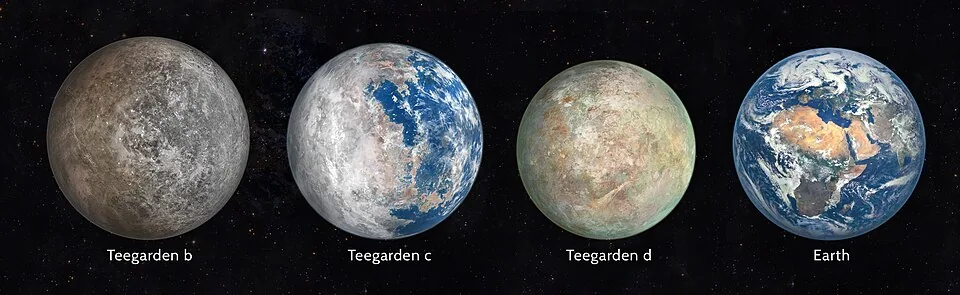
After a run of galaxies, Teegarden’s Star is something else entirely: a faint red dwarf about 12.5 light-years away, one of the nearest stellar systems to the Sun, and yet one that went undiscovered until 2003, when NASA’s Bonnard Teegarden found it while combing through old asteroid-tracking survey data – not even looking for stars. At around magnitude 15, it’s far too dim for the eye or binoculars, but well within reach of a modern imaging telescope or smart scope. What makes the effort worthwhile is what orbits it: at least three planets, two of them roughly Earth-mass and sitting squarely in the habitable zone, discovered in 2019 through years of careful radial-velocity measurements. It’s a system with more confirmed habitable-zone worlds than almost anything else in this fall sky, and it’s invisible without help.
Blue Among the Dust
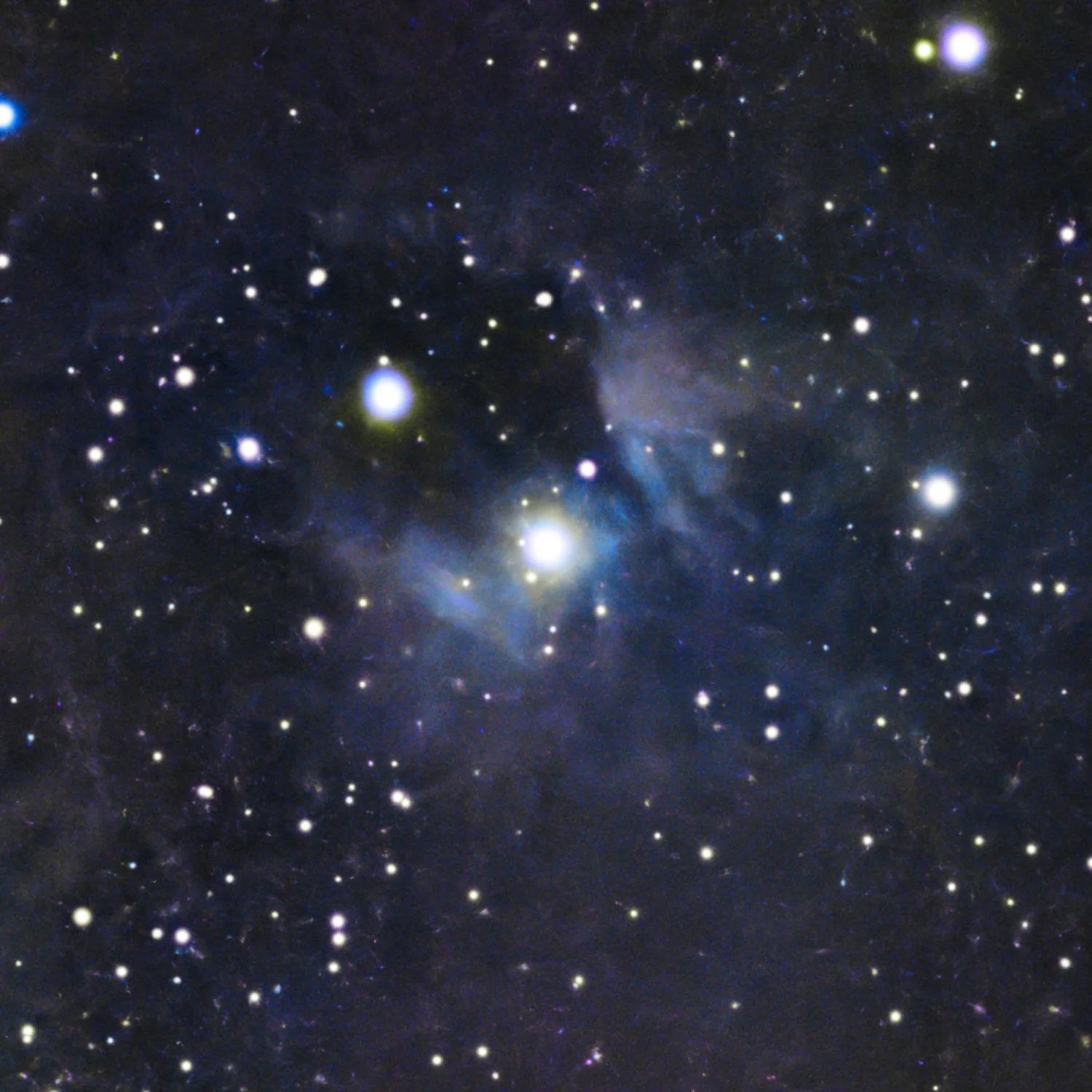
vdB 16 is the odd one out in this otherwise all-galaxy lineup: a small, dusty reflection nebula tucked into the vast Perseus Molecular Cloud, right on the northeastern edge of Aries near the borders of Perseus and Taurus. It’s lit blue by a modest 9th-magnitude star, and sits somewhere between 900 and 1,000 light-years away – the distance estimates genuinely vary by source, unlike the tidy precision of a discovery date. It’s a quieter, more diffuse target than the galaxies elsewhere in this piece, and a sign that Aries, sitting near the plane of the Milky Way at this corner of the sky, has more star-forming material nearby than its reputation as a sparse constellation might suggest.