Introduction

A ruler is only as good as its calibration. So far, we’ve looked at distances in the solar system using light time as a unit of distance: the Sun and the Moon are 8.3 light-minutes, and 1.28 light-seconds from Earth on average, respectively; Voyager 1 is nearly one light day from us. But of course that conversion requires knowing the fundamental quantity: the speed of light.
The Number
The speed of light, c (as in the famous equation E = m c 2) is exactly 299,792,458 meters per second – hardcoded since 1983. We typically round that out to 300,000 km/s or 186,000 miles per second: you can use any velocity units of distance over time – 1.8 trillion furlongs per fortnight, ~1 foot per nanosecond, or going back to our relational measurements, just under 7.5 trips around the Earth per second.
But exact is a strong word – aren’t measured scientific quantities always being continually refined? Yes, but the twist here is that we’ve also defined the meter “exactly” as well – this becomes clear further down.
Too Fast to Catch
Originally, it wasn’t even clear that there was a speed of light. The first question was whether light travels at all, or simply happens. The ancient Greeks argued about it, and tangled up in that argument was another question: does seeing work by light going out from our eyes to an object, or by something coming in from that object to us?
Empedocles (c. 494 – c. 434 BCE) had it both ways: our eyes shine out like lanterns to meet what we look at, and that light takes time to get from one place to another. Aristotle would have none of it. Light, he argued, doesn’t move at all; it’s a state of the transparent air, present everywhere at once. Over a short distance, he allowed, light’s travel might go unnoticed, but from one end of the sky to the other? That strained belief.1
Heron of Alexandria offered a proof. Open your eyes at night, and the stars are there at once. If sight travels out from the eye to the stars, it must get there instantly, so its speed must be infinite. But turn it around: if light comes in, the starlight was already on its way before you opened your eyes – the stars would appear at once no matter how fast light is. Heron’s proof only actually proves something if sight goes out.
It took about a thousand years for someone to turn it around
for good. In his Book of Optics, written between 1011 and 1021 CE, Ibn al-Haytham
(known in Europe as Alhazen, c. 965–c. 1040 CE) argued that seeing is light coming into
the eye, not going out of it. One of his arguments: looking straight at a very bright
light, such as the Sun, can damage your eyes. Another turned Heron’s stars against him:
how could the eye possibly fill the whole sky the instant you open your eyelids?
Once light is something that travels from the object to you, “how fast?” becomes a real question.
He also held that light has a finite speed, and that it slows
down in denser materials. (Hold that thought: someone measures exactly that in 1850.)
Yet even by the 1600s, most of the big names still had light as instantaneous. Johannes Kepler thought empty space offered no obstacle, so why would light take any time at all?
The obvious thing was to test it. In 1629 Isaac Beeckman proposed firing a mortar and watching for its flash in a mirror about a mile away, timing the return.
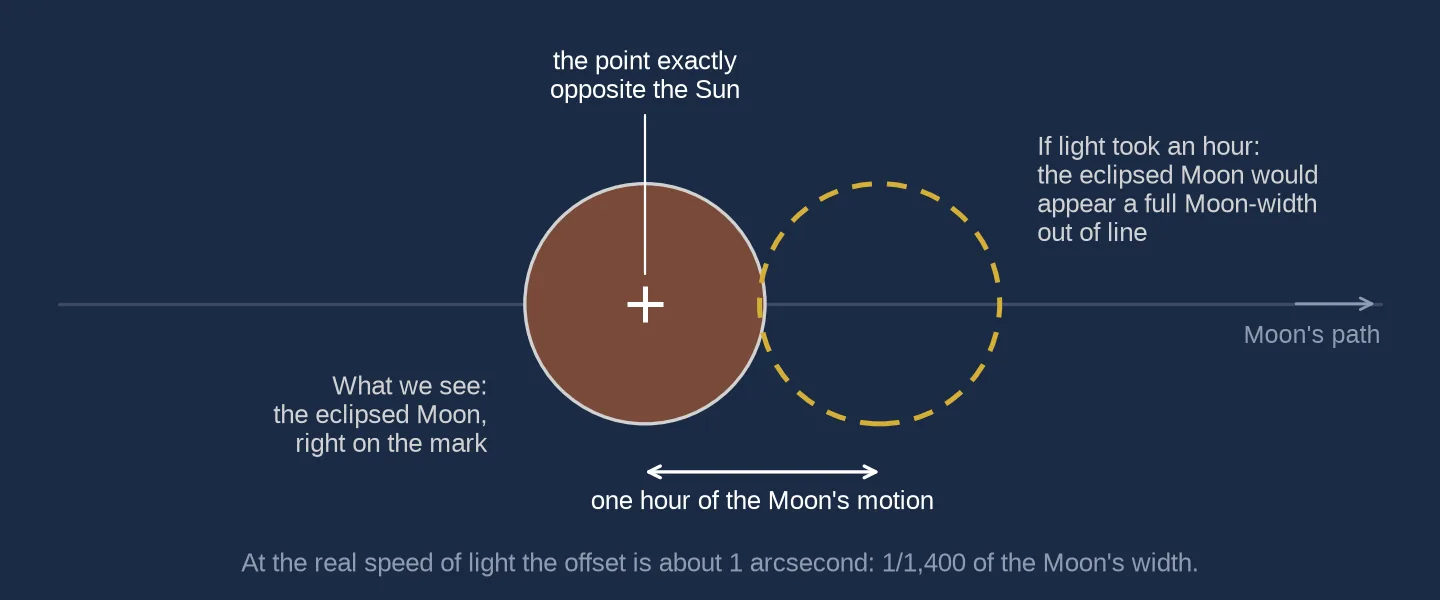
René Descartes, once Beeckman’s protégé, told him not to bother: the sky had already run a far bigger experiment. During a lunar eclipse, the Sun, Earth, and Moon are lined up. If light were slow enough for Beeckman to catch over a mile, then over the distance to the Moon the delay would be about an hour – and in an hour the Moon moves about its own width across the sky. We would see the Moon go dark when it was visibly out of line with the Sun. Nobody had ever seen that, so light must be instant. Descartes staked a great deal on it: if any such delay were ever perceived, he wrote to Beeckman, his whole philosophy would be “completely overturned.”2
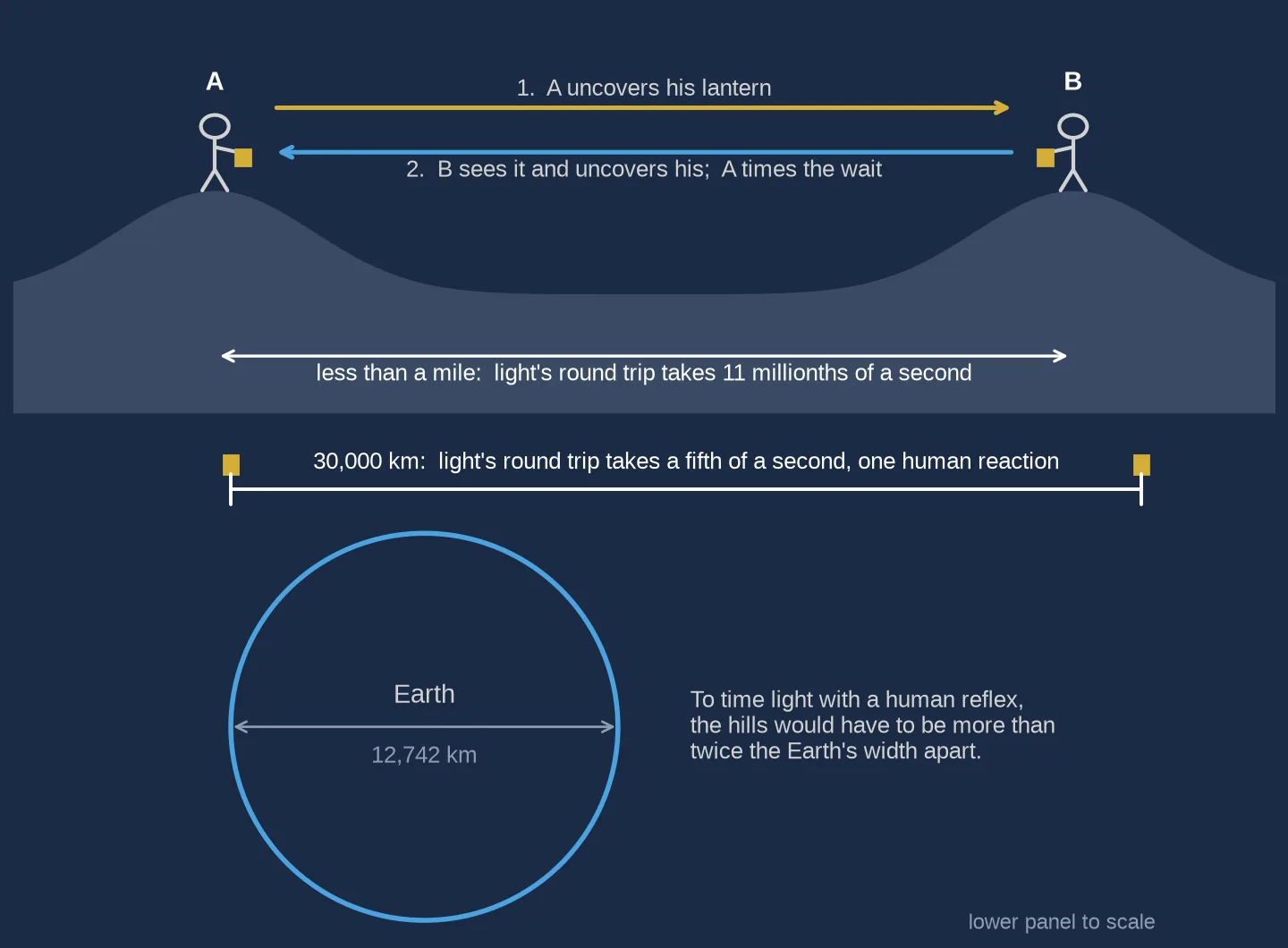
Galileo, in Two New Sciences (1638), described a simpler version of Beeckman’s test: two people with
shuttered lanterns some distance apart. The first uncovers his lantern; the second uncovers his the
moment he sees the first; the first times how long it takes for the answering light to appear.
Galileo said he had tried it only “at a short distance, less than a mile,” and couldn’t tell
whether there was any delay. Light, “if not instantaneous,” was “extraordinarily rapid.”3
In 1667 the Accademia del Cimento in Florence tried Galileo’s experiment anyway, with the lanterns
about a mile apart. Still nothing.
Which means Descartes was right about one thing: the place to look was the sky. His reasoning was fine. His distance still wasn’t big enough. At the real speed of light, the round trip to the Moon takes about 2.6 seconds, and in that time the Moon moves about one arcsecond – far too little for anyone in the 1600s to notice. “No delay observed” only ruled out a slow speed of light. The delay was there, just too small to catch.
A mile was too short. The Moon was too close. Aristotle had it exactly backwards: a short distance is where light’s travel hides, and the huge distances of the sky are where it finally shows. To catch light taking time, you need a distance measured in millions of kilometers – and the only place to find one is farther up.
What You Can Actually Measure
Fundamentally, measuring a speed requires measuring a time over a distance, and the answer comes out in whatever units are used for the distance. This seems obvious, but on astronomical scales (as we’ve seen) it’s not possible to make that distance measurement explicitly: you have to infer it from other observations.
If your distance is “across Earth’s orbit,” you get the speed of light in minutes per AU. That’s a perfectly good number, but in kilometers it’s only as good as your knowledge of the AU. If your distance is a surveyed line between two hills, you get kilometers per second directly.
So instead of asking “how close did each experiment get?”, we’ll ask each one two questions: what did it actually measure, and what else did it need to know? Watch the “What else they needed” column empty out.
| Year | Who | What they measured | What else they needed | Result |
|---|---|---|---|---|
| 1676 | Rømer | How late Io’s eclipses run, per AU of extra distance | The AU, in km | About 11 minutes per AU |
| 1729 | Bradley | Earth’s orbital speed as a fraction of c (a tilt of about 20″) | Earth’s speed in km/s – which means the AU | 8 minutes 12 seconds per AU |
| 1849 | Fizeau | Round-trip time over a baseline of about 8.6 km | Only the baseline | About 315,000 km/s |
| 1855 | Weber & Kohlrausch | One electric charge measured two ways – electrically and magnetically; the ratio is a speed | No light at all | About 310,000 km/s |
| 1862 | Foucault | Round-trip time over a 20-meter path in the lab | Only the path | 298,000 ± 500 km/s |
| 1926 | Michelson | Round-trip time over a 35 km mountain baseline | Nothing else | 299,796 ± 4 km/s |
| 1972 | Evenson et al. | A laser’s frequency times its wavelength | The meter itself | 299,792.4562 ± 0.0011 km/s |
| 1983 | CGPM | – | – | 299,792.458 km/s, exact by definition |
c in the Solar System’s Own Units
The first two real measurements of the speed of light both came from astronomy, and both came out in the solar system’s own units: minutes per AU. They settled the big question – light takes time – but turning them into kilometers per second meant knowing the size of Earth’s orbit in kilometers, and nobody knew that well yet.
Rømer: A Clock Orbiting Jupiter
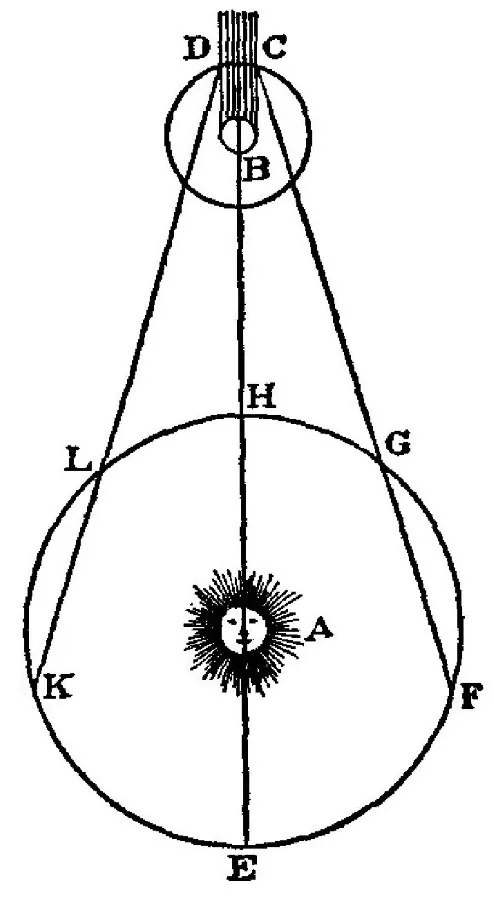
Except the clock didn’t seem to keep time.
Eclipses ran early for months, then late for
months – and the error was spoiling the longitude tables.
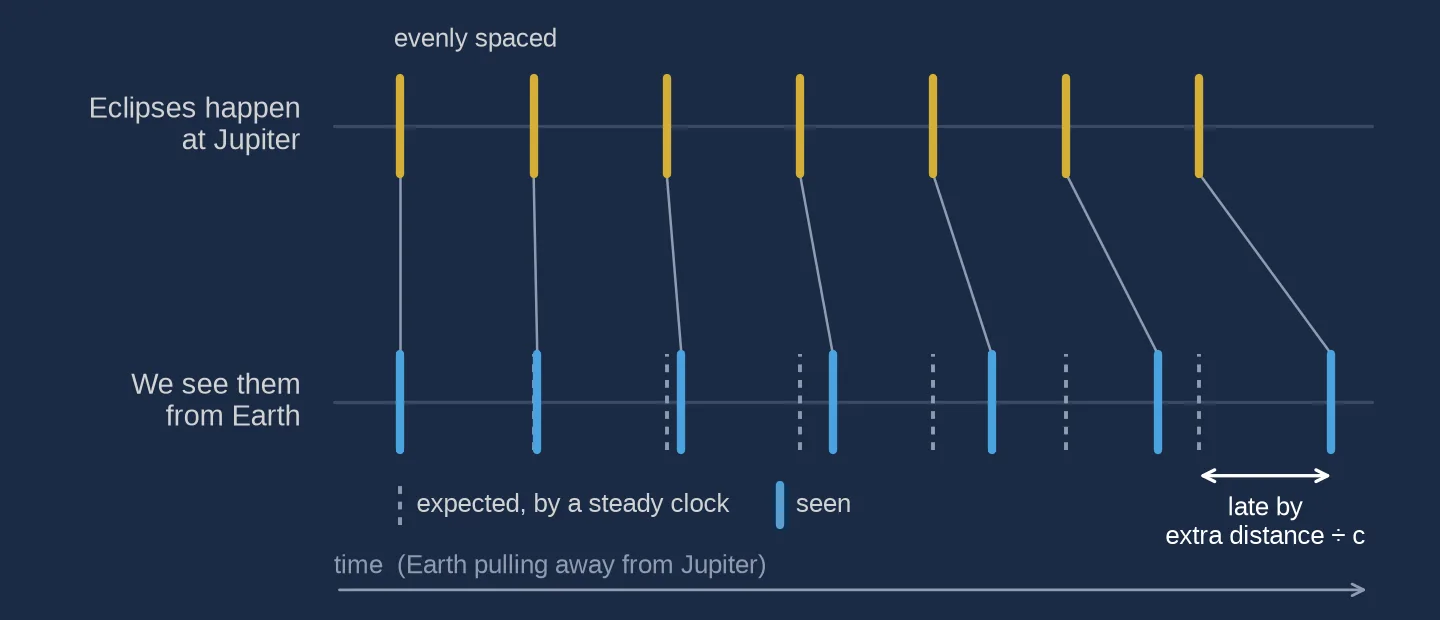
Ole Rømer’s explanation: the clock is fine; the ticks do happen evenly at
Jupiter, but the distance between Jupiter and Earth keeps changing. When Earth is
pulling away, each tick’s light has a little farther to travel than the last, and
the lateness piles up. The whole method fits in one line: the shift in eclipse
times equals the change in the Earth’s distance to Jupiter, divided by the speed of light.
In 1676 the prediction went on the record: an eclipse in November would come about ten minutes late. On November 9, 1676, it did.4 (Check it yourself: by then Jupiter was about 1.12 AU farther away than in late August, and at 8.3 light-minutes per AU that’s about 9.3 minutes.) There’s an irony here: the first written account of the idea is by Giovanni Cassini, the observatory’s director – who then spent the rest of his career rejecting it.5
Rømer’s stated result was that light takes about 11 minutes to cross the distance from the Sun to Earth, or 22 to cross the whole orbit – a speed in minutes per AU. (The modern value is 8.3 minutes per AU.) Turning that into everyday units meant knowing how big Earth’s orbit is, and that step fell to someone else. The Dutch scientist Christiaan Huygens, who was building a theory of light as a wave, worked it through in his Treatise on Light (1690): taking Earth’s orbit to be about 22,000 Earth diameters across, Rømer’s 22 minutes meant light covers 16⅔ Earth diameters every second – about 212,000 km/s. Good measurement, uncertain ruler.
Bradley: The Star That Moved the Wrong Way
Even fifty years later, the question was still open – Rømer’s result had its doubters. James Bradley settled it by accident. In 1725, he and Samuel Molyneux were hunting for something else entirely: stellar parallax, the tiny back-and-forth shift of a nearby star as Earth goes around the Sun. Finding it would prove that Earth moves.
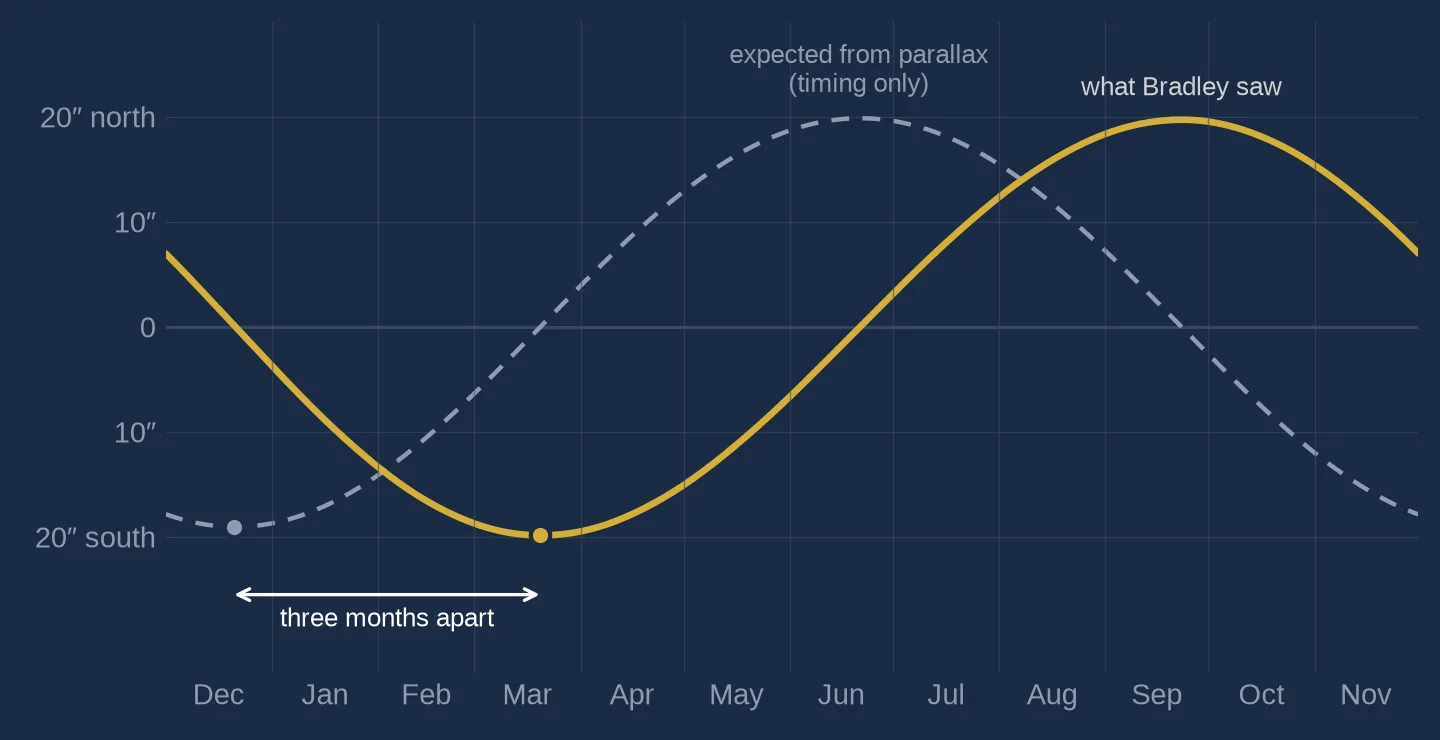
Their star, Gamma (γ) Draconis, did shift, by about 20 arcseconds either way – but at the wrong times of year. It peaked exactly when parallax should have been zero, a quarter of a year out of step. It wasn’t parallax. It was stellar aberration. (The parallax of this star is only 0.021″ – it lies about 154 light-years away – a thousand times smaller than the shift Bradley found, and far too small for him to detect. Stellar parallax would not be measured for another century, and then on much closer stars.)
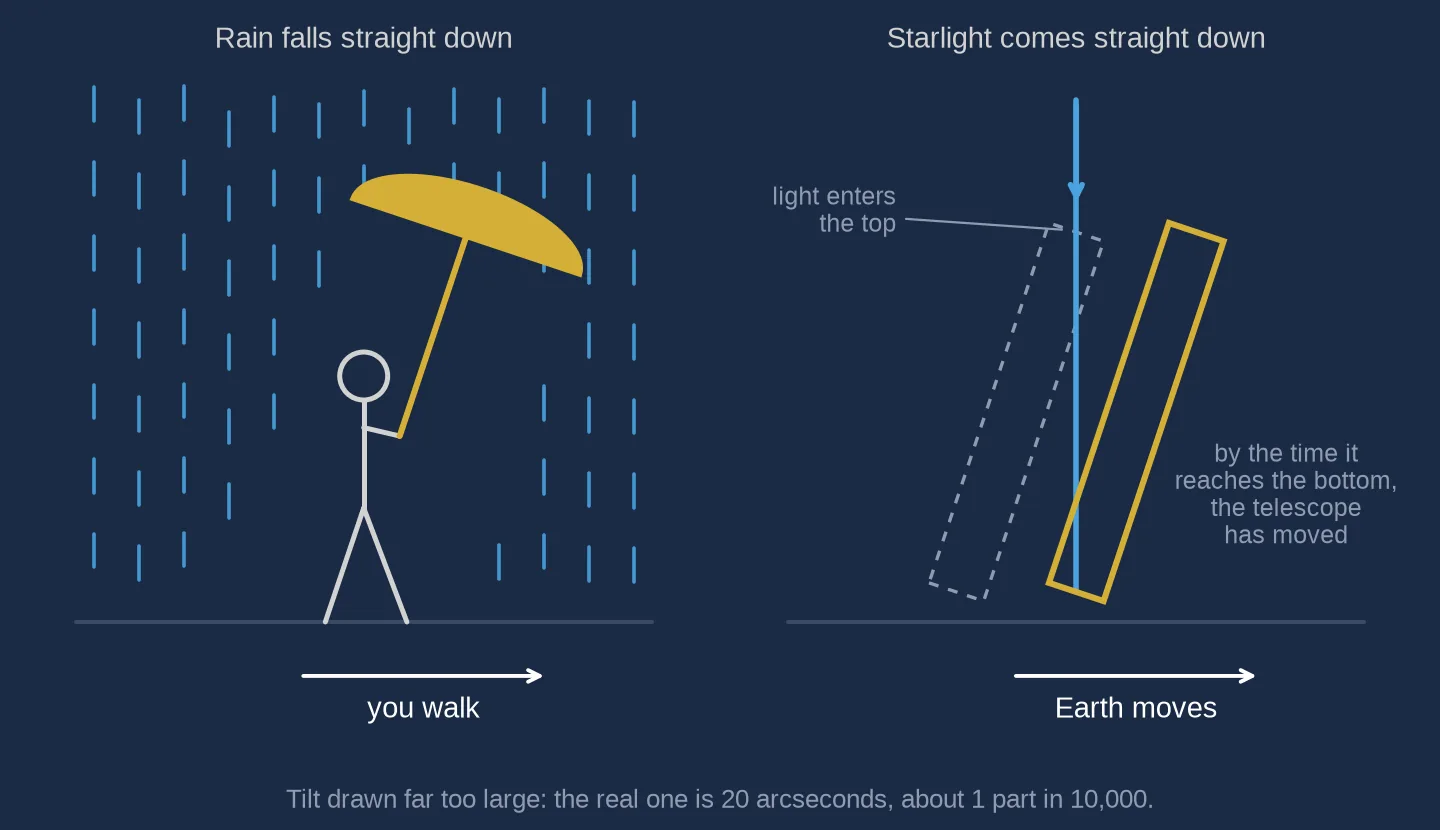
This is the same tilt you get moving through falling rain – only with light. Walking through a vertical downpour, you have to tilt your umbrella forward to deflect the rain; the faster you walk, the more you need to tilt. Earth moves through starlight at about 30 km/s, and starlight arrives at about 300,000 km/s, so the “umbrella” tilts by a ratio of about 1 in 10,000 – which comes out to about 20 arcseconds. Bradley’s result, announced in 1729, did two things at once: it showed that light’s speed is finite, and it was conclusive evidence that Earth really does move around the Sun.
But notice what he measured: a ratio, Earth’s speed compared with light’s. Earth’s speed in km/s comes from the size of its orbit, so – once again – the answer in kilometers depended on the AU. What Bradley could say was that light takes 8 minutes 12 seconds to reach us from the Sun;6 the modern value is 8 minutes 19 seconds.
Cutting the AU Out
To get the speed of light without the AU in it, you need a distance you can survey – which means bringing the measurement back down to the surface of the Earth again. The problem of course is Galileo’s situation all over again: a short distance needs a very fast clock. The answer turned out to be a machine.
Fizeau: A Toothed Wheel
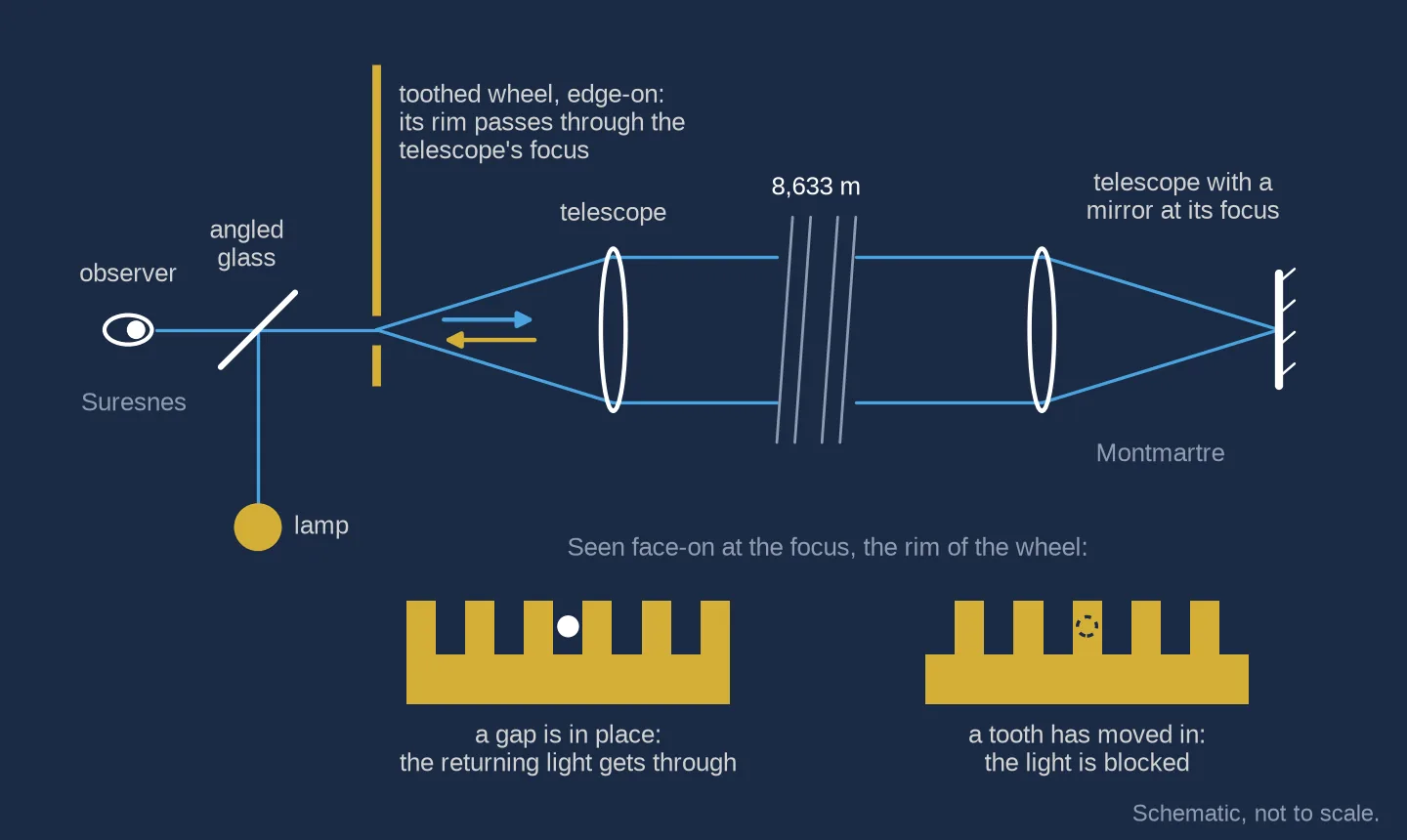
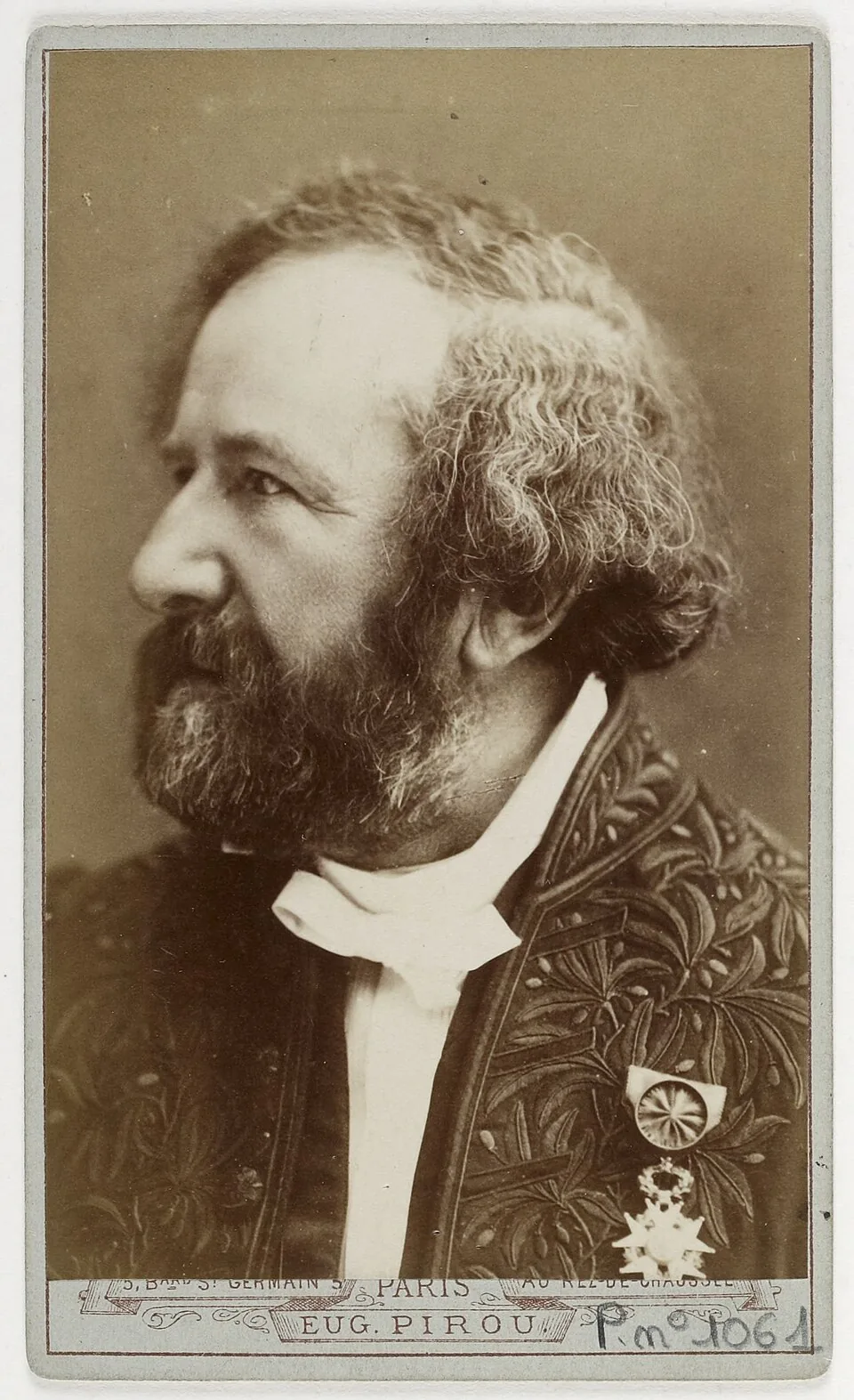
In 1849, Hippolyte Fizeau (1819–1896) set up a telescope in the rooftop belvedere of a house in Suresnes, west of Paris, and put a mirror on the heights of Montmartre, about 8.6 km away. He sent a beam of light through a gap in a spinning wheel with 720 teeth, out to the mirror, and back. If the wheel spins fast enough, then in the time the light takes to make the round trip, the gap moves on and the next tooth arrives to block the returning beam – and the light goes dark. In his setup, the first eclipse came at about 12.6 turns per second.
Then came the check that it really was the light’s travel time: spin the wheel twice as fast, and the light comes back through the next gap and shines again; three times as fast, and it’s blocked again; four times, and it shines. If light were instant, no speed would ever darken it.
Knowing the number of teeth and the rotation speed tells you exactly how long the round trip took. It’s Galileo’s lanterns with the human replaced by a gear: a stopwatch that ticks in millionths of a second. From twenty-eight observations, Fizeau got about 315,000 km/s – 5% high, but finally a value that didn’t depend on the AU at all.7
Foucault: A Spinning Mirror, and Light in Water
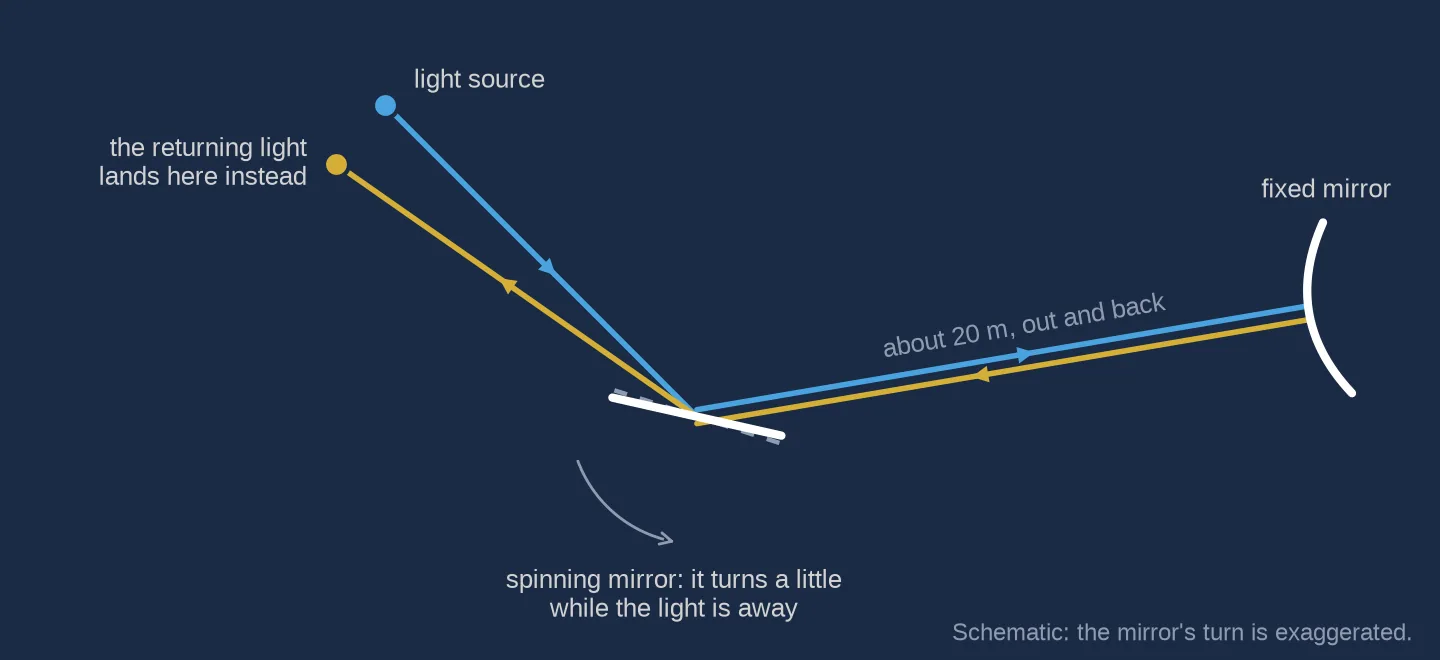
Léon Foucault replaced the wheel with a rapidly spinning mirror. In the time the light took to go out to a fixed mirror and back, the spinning one had turned a tiny bit, so the returning beam came back slightly displaced – and the displacement gave the time. The whole path was about 20 meters; it fit inside a laboratory. By 1862 he had 298,000 km/s, within about 0.6% of the modern value.
The same method settled an older argument. If light were a stream of particles, it should travel faster in water than in air; if it were a wave, slower. In 1850 Foucault found slower – just as Ibn al-Haytham had argued, eight centuries earlier.
And now the dependency could run backward. Foucault made his 1862 measurement because the astronomer Urbain Le Verrier suspected the accepted speed of light was a few percent too high – and wanted a better value in order to pin down the astronomical unit. With c known in kilometers per second, Bradley’s ratio gives Earth’s orbital speed, and so the size of Earth’s orbit.
A Different Road: Electricity
Meanwhile, the same number had been hiding somewhere nobody expected. In 1846, Wilhelm Weber wrote down a law for the forces between electric charges, and buried in the equations was a constant that had the dimensions of a speed. Nobody knew its value, or what it meant.
In the mid-1850s, Weber and Rudolf Kohlrausch measured it, and the experiment had nothing to do with light. They charged a Leyden jar – an early capacitor – and measured the same charge two different ways. First by its electric push: share some of the charge onto a metal ball and measure the force on a delicate torsion balance. Then by its magnetic effect: let the jar discharge through a coil of thousands of turns and watch how far the pulse of current kicks a magnetized needle. The two methods give two different numbers for the same charge, and their ratio comes out as a speed: about 310,000 km/s.8
In today’s notation, that ratio is
c = 1 / √(μ0 ε0)
where ε0 sets how strongly electric charges push on each other, and μ0 sets how strongly electric currents push on each other through magnetism. Weber and Kohlrausch weren’t measuring those two constants – in that form they didn’t exist yet – and they weren’t assuming them. They were measuring the ratio directly, by weighing one charge both ways.
James Clerk Maxwell recognized that the number matched the speed of light, and in 1865 drew the conclusion: light is an electromagnetic wave. The speed of light isn’t just how fast one particular thing happens to travel; it’s built into electricity and magnetism, a property of empty space itself. And it had been sitting in Weber’s equations in 1846 – three years before Fizeau first measured it on the ground – without anyone knowing what it was.
(And this is where the letter c comes from: Weber’s constant, “c” apparently for “constant.” Maxwell called the speed of light V, and it took until the 1890s for c to stick. Einstein himself only switched in 1907.)9
Beating Down the Error
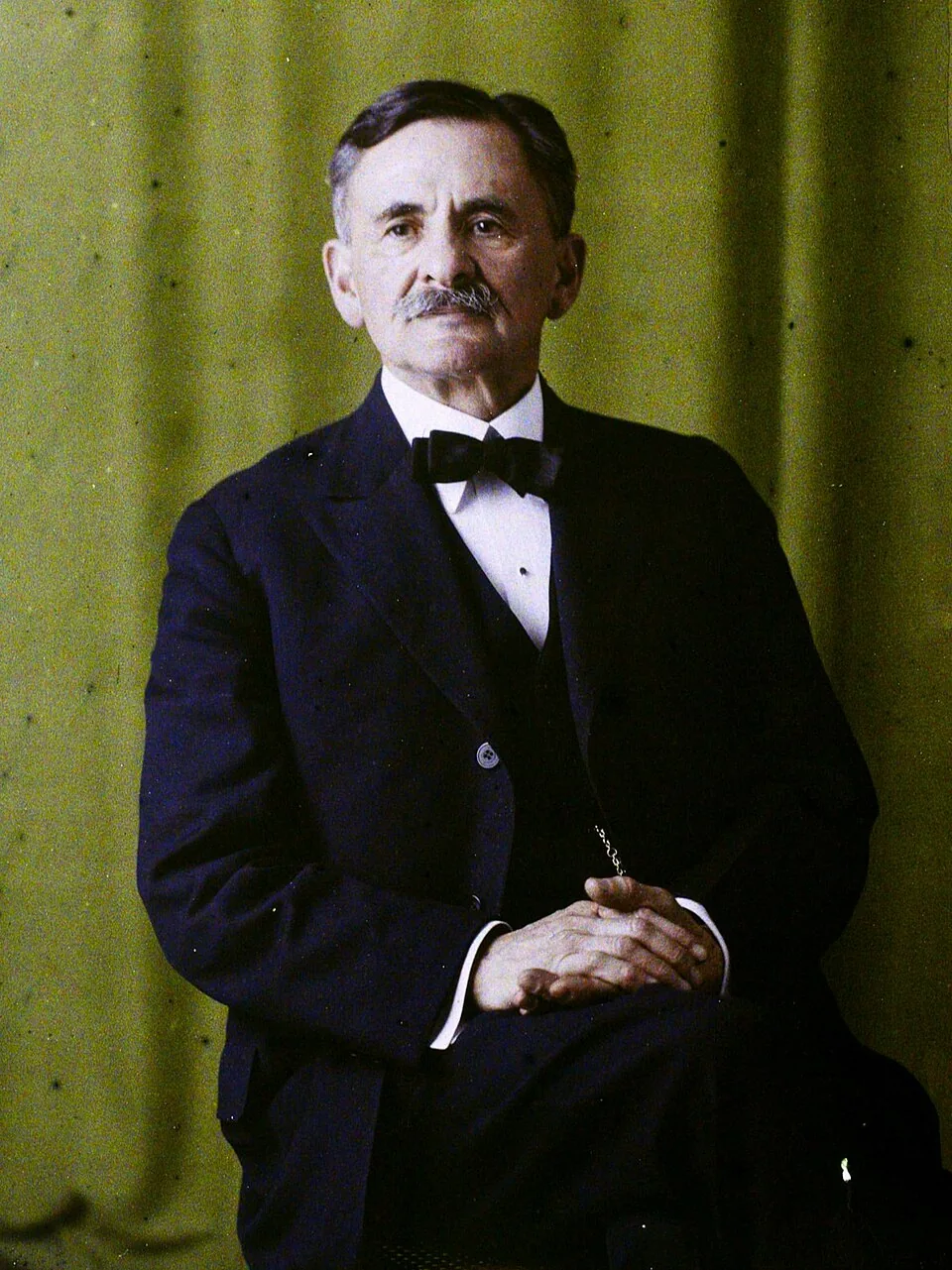
Now our “What else they needed” column above is empty. From here on it becomes “here’s my value of c – now make the error bar smaller.”
Albert Michelson spent about fifty years refining Foucault’s spinning mirror. In the 1920s he timed light over a 35 km path between two California mountains (Mt. Wilson, at the Observatory, and Mt. Baldy), a baseline that took surveyors two years to measure to the needed accuracy, and got 299,796 ± 4 km/s. His last experiment ran light through a mile-long pipe with the air pumped out, because by then even air was slowing the light enough to matter. (He died in 1931 before it finished; the result was published in 1935.)
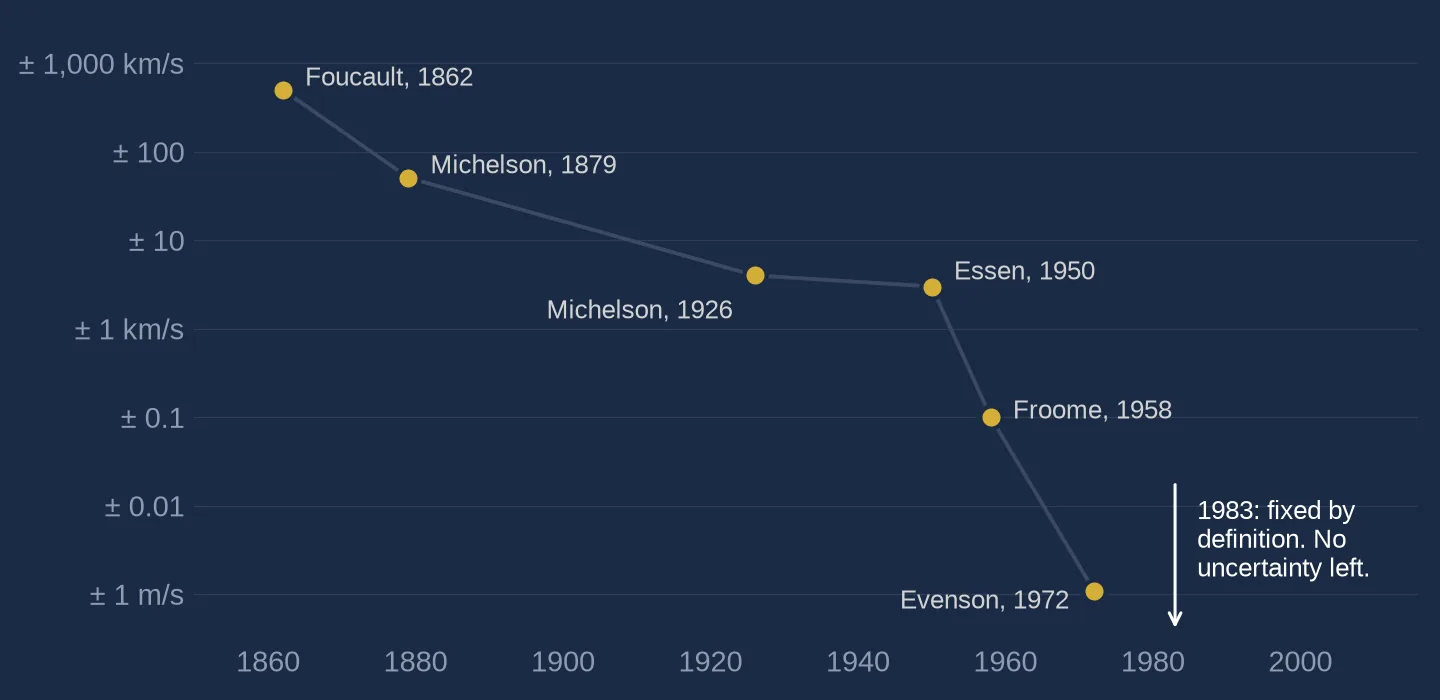
After the Second World War came microwave cavities, radio, and then lasers: measure a laser’s frequency and its wavelength, multiply, and you have its speed.
Measured Better Than the Meter
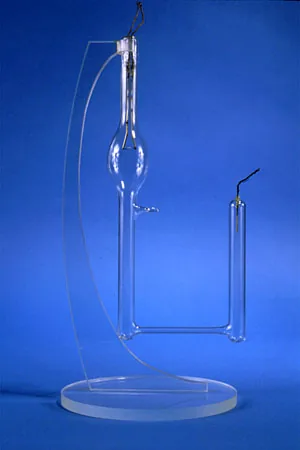
By 1972 a laser measurement gave 299,792,456.2 ± 1.1 m/s – and most of that remaining uncertainty wasn’t in the light. It was in the meter itself: the official definition, based on a particular wavelength of krypton light (605.78021 nm), couldn’t be pinned down any better. The speed of light was now known more precisely than the ruler used to measure it.
So in 1983 the ruler was redefined by the General Conference on Weights and Measures
(the CGPM, from its French name, Conférence générale des poids et mesures).
The speed of light was fixed at exactly 299,792,458 meters per second, and the meter became
“the length of the path travelled by light in vacuum during a time interval of 1/299 792 458 of a second.”10
That’s why c is “exact”: not because nature is tidy, but because we stopped measuring the speed of
light and started measuring distances with it.
What Else Changes the Travel Time
Using light as a ruler means assuming travel time is just distance divided by c. Almost – but not quite, and the corrections matter for anyone timing light across the solar system.
Stuff slows it down. c is the speed in a vacuum. In air, light is slower by about 0.03%; in water, about 25%; in glass, about a third. That’s why Michelson pumped the air out of his pipe – and it’s also why the internet, running through glass fiber, moves at only about two-thirds of c.
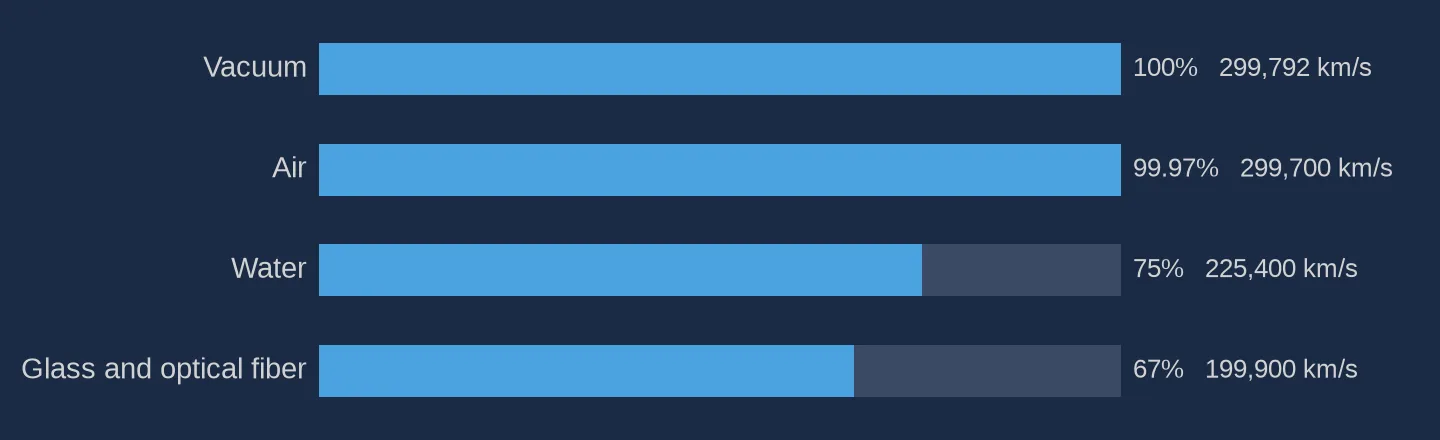
Your motion doesn’t change it. Everyone who measures the speed of light in a vacuum gets the same answer, however fast they or the source are moving. That’s what makes it usable as a universal ruler.
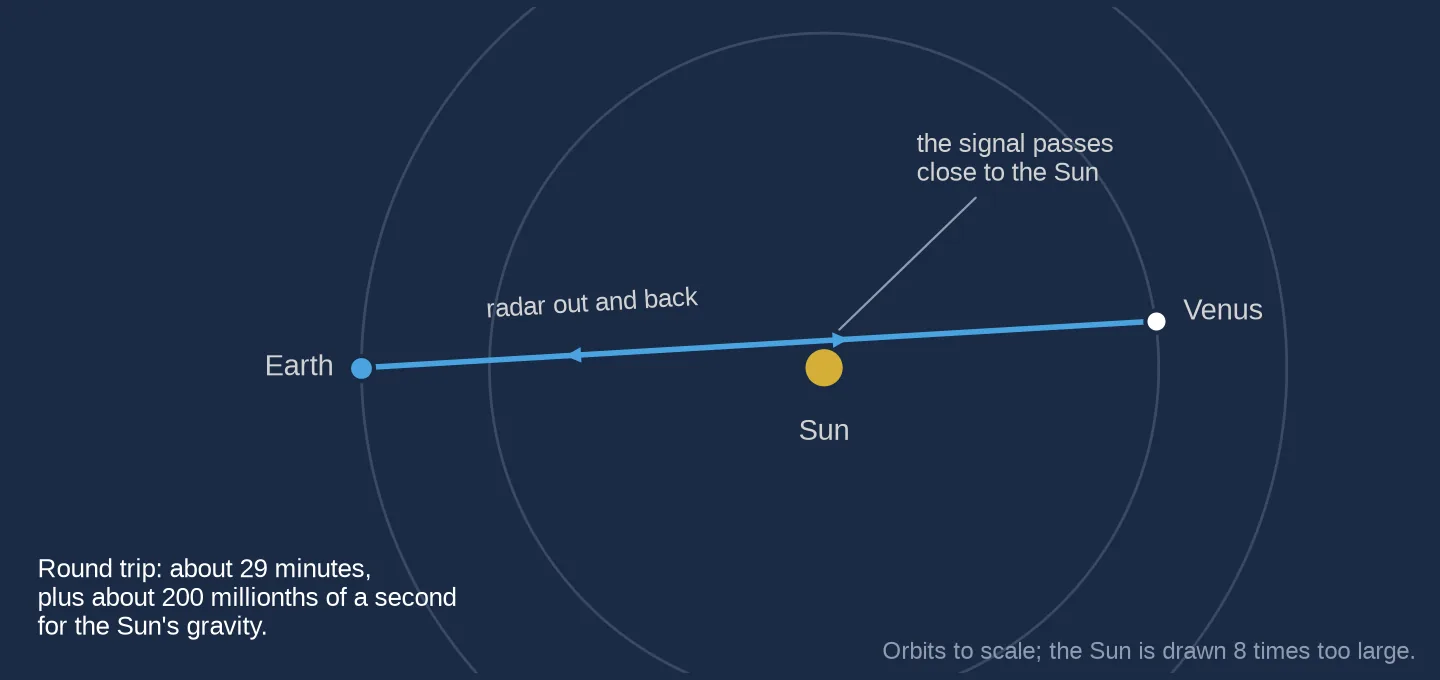
Gravity adds delay. Light passing close to the Sun takes measurably longer to make the trip. In the 1960s, radar signals bounced off Mercury and Venus when they were on the far side of the Sun came back about 200 millionths of a second late – just as had been predicted from general relativity. Measured right where the light is, its speed never changes; but near the Sun, space is stretched and clocks run slow, so seen from far away the trip takes longer than the distance alone would suggest. Anyone using radar to measure the solar system has to correct for it.
Wrapup
In the last article we used light as a ruler on credit: light-minutes to the Sun, a light-day to Voyager. This was the calibration certificate. The first measurements came out in the solar system’s own units – minutes per AU. Bringing the distance down to Earth gave kilometers per second with no AU in it. Electricity gave the same number from a completely different direction. And the measurements got so good that the speed of light became the definition of the meter.
Now run it backward. With c in hand, bounce a radar signal off a planet, time the echo, and you have the distance – and from that, the size of the AU itself. That’s the next article.
Footnotes
Aristotle, De Anima II.7, trans. J. A. Smith. ↩︎
Descartes to Beeckman, 1634; quoted in R. J. Mackay and R. W. Oldford, “Scientific Method, Statistical Method, and the Speed of Light” (2000). ↩︎
Galileo, Two New Sciences (1638), First Day, trans. H. Crew and A. de Salvio. ↩︎
O. Rømer, “Démonstration touchant le mouvement de la lumière,” Journal des Sçavans, 7 December 1676. ↩︎
L. Bobis and J. Lequeux, “Cassini, Rømer and the Velocity of Light,” Journal of Astronomical History and Heritage 11 (2008), 97–105. ↩︎
J. Bradley, “Account of a new discovered Motion of the Fix’d Stars,” Philosophical Transactions 35 (1729), 637–660. ↩︎
H. Fizeau, “Sur une expérience relative à la vitesse de propagation de la lumière,” Comptes rendus 29 (1849), 90–92. ↩︎
A. K. T. Assis, “On the First Electromagnetic Measurement of the Velocity of Light by Wilhelm Weber and Rudolf Kohlrausch” (2003). ↩︎
P. Gibbs, “Why is c the symbol for the speed of light?” (2004). ↩︎
17th CGPM (1983), Resolution 1, BIPM. ↩︎