
Before we get into the different types of telescopes, it helps to understand a handful of fundamental concepts. These terms come up constantly in telescope descriptions and reviews — and once you understand them, everything else falls into place.
Aperture
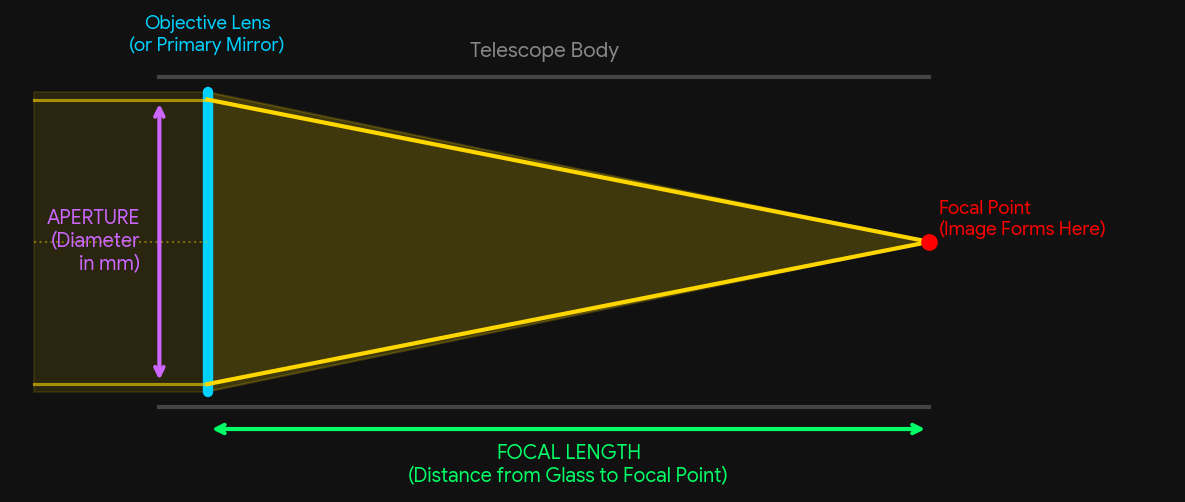
Aperture is the diameter of a telescope’s main optical element — the objective lens in a refractor, or the primary mirror in a reflector. It’s measured in millimeters (or sometimes inches).
When comparing telescopes, always look at aperture first.
Focal Length
Focal length is the distance — measured in millimeters — from the main optical element to the point where light comes to a focus. It’s usually printed right on the telescope tube.
Focal length determines two things:
- The magnification you get with a given eyepiece (more on that below)
- The field of view — longer focal lengths give a narrower, more zoomed-in view
A telescope with a focal length of 1000mm will give you a more “zoomed in” view than one with a 500mm focal length, using the same eyepiece.
Focal Ratio
Focal ratio — written as f/number, like f/6 or f/10 — is simply the focal length divided by the aperture.
$ \text{Focal\ Ratio\ (}f\text{-number)}=\frac{\text{Telescope\ Focal\ Length}}{\text{Aperture}} $
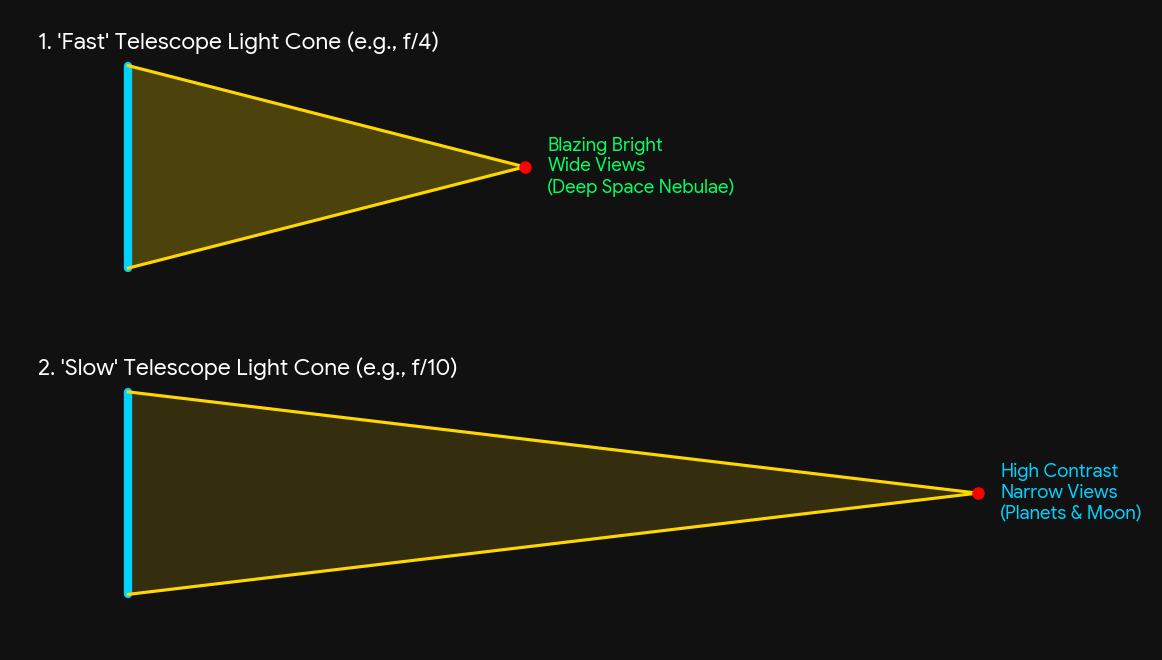
Fast scopes (f/6 and lower) have shorter tubes, wider fields of view, and are better for viewing large objects like nebulae and star clusters. They’re more compact and easier to transport.
Slow scopes (f/8 and up) have longer tubes, narrower fields of view, and are better suited for high-magnification views of planets and the Moon.
Neither is better — it depends what you want to observe.
Magnification
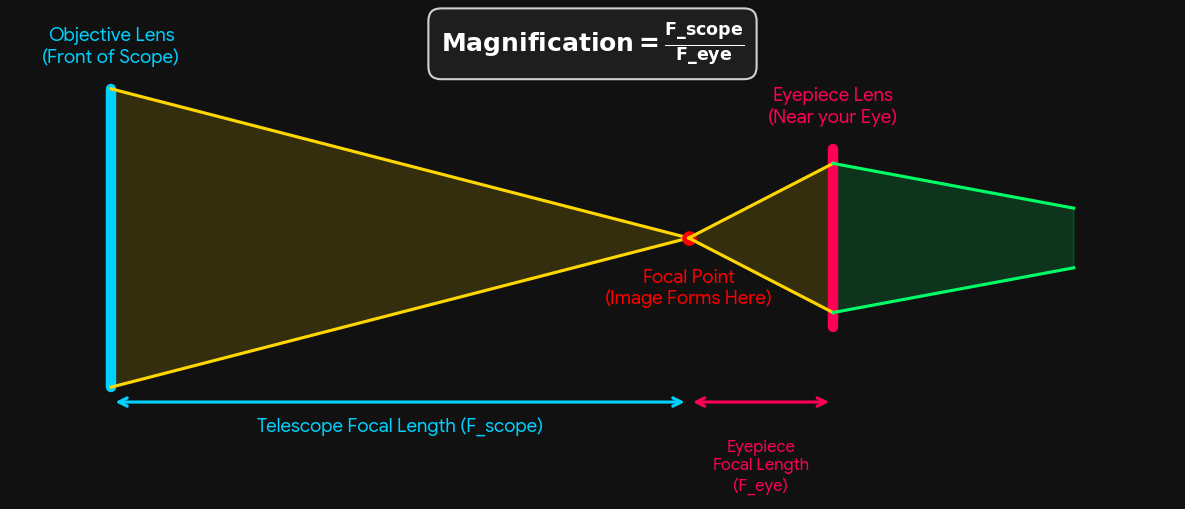
Magnification is not a fixed property of a telescope — it depends on the eyepiece you use. The formula is simple:
Magnification = Telescope focal length ÷ Eyepiece focal length
(Yes, eyepieces have a focal length too! That’s the number you’ll see printed on them.)
Higher magnification isn’t always better. More magnification means a dimmer, narrower image — and any atmospheric turbulence gets amplified too. Most experienced observers use lower magnification more often than beginners expect.
A useful rule of thumb: a telescope’s maximum useful magnification is roughly 50× per inch of aperture (or 2× per millimeter). Beyond that, images become blurry and washed out regardless of eyepiece quality.
Field of View
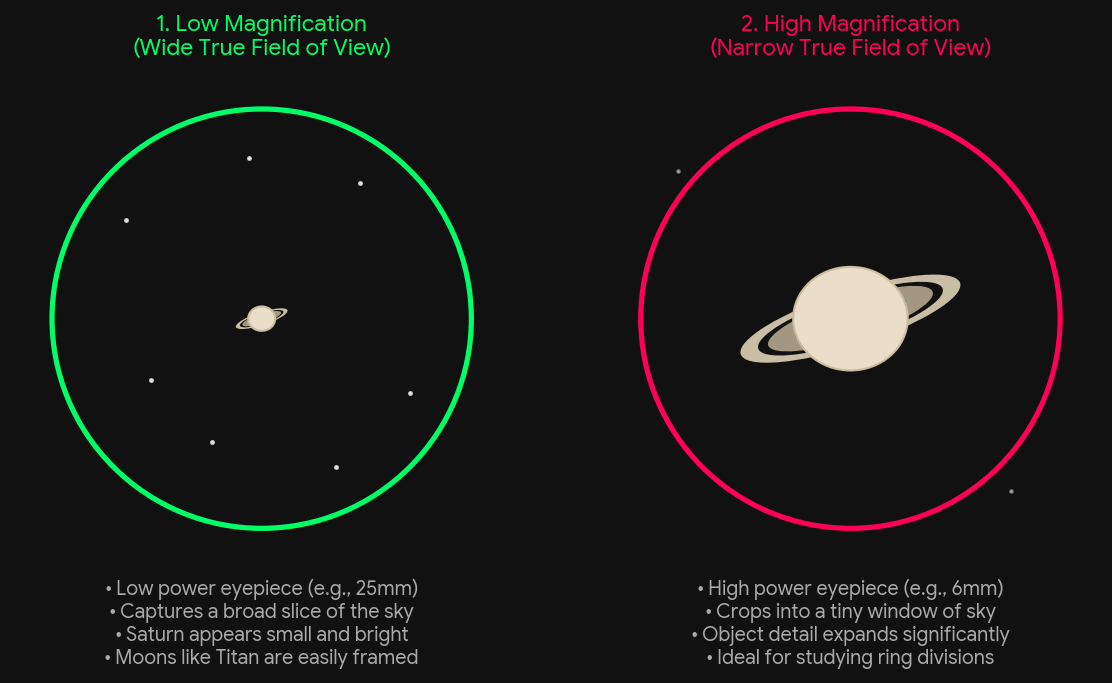
Lower magnification = wider field of view. This makes it easier to find objects and better for viewing large targets like the Andromeda Galaxy or the Pleiades. Higher magnification = narrower field, better for the Moon, planets, and tight double stars.
Exit Pupil
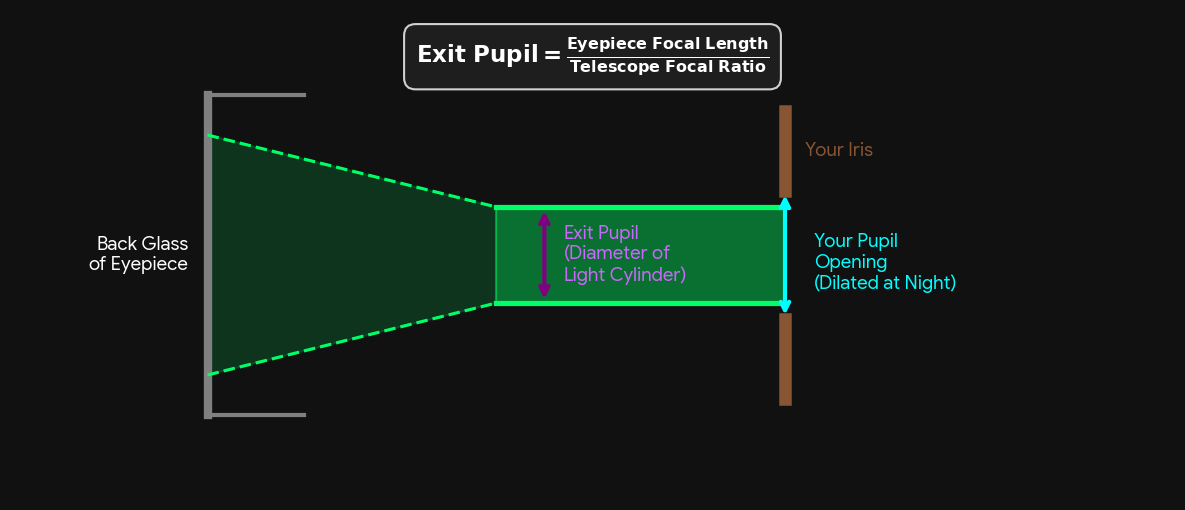
Exit pupil is the diameter of the beam of light that reaches your eye. It’s calculated as:
Exit pupil = Aperture ÷ Magnification
That’s the core vocabulary. You don’t need to memorize all of this before moving on — just keep it in mind as you read about telescope types, and refer back here whenever a term comes up.